
TL;DR
- The ads that kept running sell one of nine angles: the hours back, the customer with a number, the busywork, the AI teammate, the prompt, the free seat, the no-setup promise, the brand line, the series. Atlassian and Figma carry most of the long runners, with 27 and 35 ads past 45 days.
- Six angles are almost empty here: a named competitor, trust as the headline, a price, a download, the switch spelled out, and a date.
- Social ads almost never land on the homepage. 9 of the 355 Meta ads that link to the brand's own site, against 83 of 347 on Google.
- Two accounts give an outsider little to read. Miro had no Meta ad live on the sweep date, and 43 of its 60 are creator videos with no landing link; Trello had no brand-verified Meta ad and shows up on Google only.
8 companies swept in the US, 420 Meta ads and 347 Google ads on file, 2 and 3 September 2026. How we did it is at the end.
The sample: 8 productivity companies, their ads, and where the ads land
Everything below was pulled on 2 and 3 September 2026 in the US market. Day counts are the ad's age on that date, not today.
| Company | Meta ads on file | Ran 45 days or more | Still live | Oldest live ad | Where the ads land |
|---|---|---|---|---|---|
| Canva | 60 | 47 | 9 | 89 days | the Dutch AI video page, the Polish video editor, 24 pages in all |
| Figma | 60 | 35 | 46 | 154 days | Figma Make, the agents page |
| Atlassian | 60 | 27 | 16 | 162 days | Jira, Confluence, Jira Service Management |
| Dropbox | 60 | 20 | 18 | 21 days | share-more, the teams version, the Replay version |
| Slack | 60 | 9 | 31 | 8 days | small business, Google Drive, Slackbot |
| Zoom | 60 | 8 | 7 | 54 days | the buy page, AI Companion |
| Miro | 60 | 0 | 0 | none | 43 of 60 carry no link; the rest go to the canvas page |
| Trello | 0 | 0 | 0 | none | Google only |
Figma and Atlassian hold the oldest ads: Figma had 35 past 45 days and 46 still live, Atlassian had 27 past 45 days and its oldest live creative at 162 days. Slack is at the other end, with 31 ads live and an oldest live ad of 8 days, because it relaunched its whole paid set in the last week of August.
Ad analysis: the nine angles productivity ads use
Every message we could read on Meta fits one of nine angles. For each one: the ads that ran longest, one creative to look at, and our reading of why it stayed up. The library shows run length, not results, so read each angle as something worth testing. The number in brackets is how many days the ad had been running when we pulled the data.
1. The hours back
Time saved, always as a count of hours rather than a feeling.
- Atlassian: "Udemy got 2,400+ hours a year in meeting time back" (147 days), and the same figure on a Jira card, "Udemy saves 2,400 hours a year with Jira" (162 days).
- Atlassian: four more cards carrying the link headline "Get time back from meetings with Jira" (145, 145, 144 and 140 days).
- Slack: "Get time back with Slack. 2 hours a day x 5 days a week x 52 weeks a year = Your most productive year ever." (8 days).
- Zoom: "Cut the clutter. Keep the hours. Save time with work that flows." (17 days).
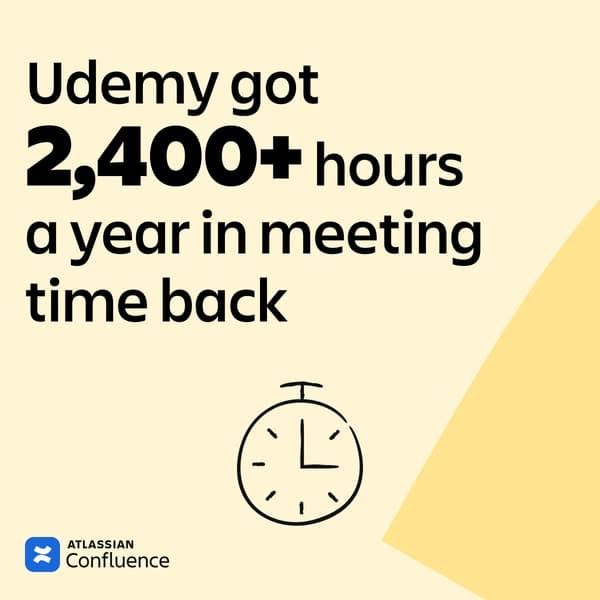
Why it runs: a manager who sits in six meetings a week can divide 2,400 by the size of their team and check the answer against their own calendar. Atlassian has kept that sum up for 147 days.
2. The customer with a number
A named company, a figure, and the switch that produced it.
- Atlassian: "Reddit scaled, standardized, and saved $300k+ per year by switching to Jira" (162 days), "Udemy unified their people and processes by switching to Jira" (162 days, and again at 162 days as a second buy).
- Atlassian: "Reddit saved $300k a year by switching to Confluence", on a dynamic card with the link headline "Turn ideas into action with Confluence" (147 days).
- Atlassian: "Since starting with Jira Service Management AI agents, Thumbtack has saved both time and money on IT tooling" (151 days).
- Slack: "Innovation, unblocked. Swap chaos for clarity and keep teams aligned. That's how Anthropic scales with Slack." (8 days), and "Wolf & Badger keeps clothing flying off the shelves with a little help from Slack" (8 days).
- Zoom: "Sonos Customer Testimonial. Sonos Engineers Deepen Collaboration on Video" (167 days).
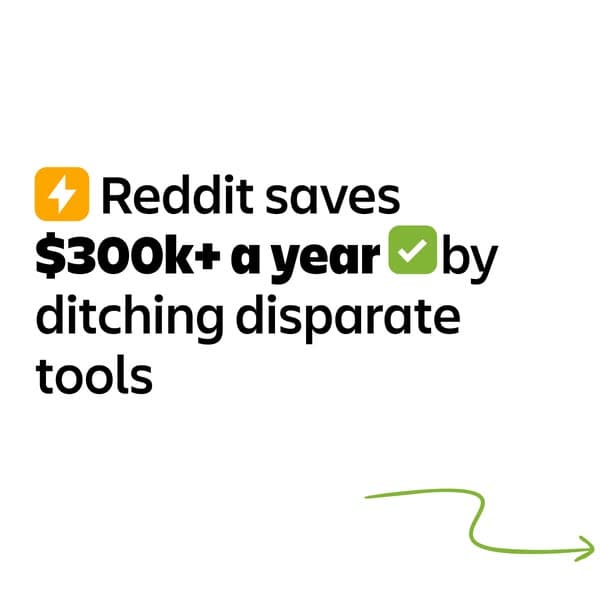
Why it runs: Atlassian has five customer cards past 145 days, more than any other message in its account. The two it keeps buying both name a company the reader has heard of and a figure that reader could repeat to a finance team.
3. The busywork
The chore the buyer already hates, named out loud.
- Zoom: "Let AI handle your busywork. Less manual tasks, more big wins." (17 days).
- Slack: "Automate tasks in Slack. Why do your own busywork when automations in Slack can do your busywork for you?" (18 days), and "Let automations tackle your busywork, while you tackle the important stuff." (8 days, run twice).
- Miro: "Engineering chaos? Still drowning in messy workflows, endless meetings, and scattered diagrams?" (21 days).
- Atlassian: "Reddit saves $300k+ a year by ditching disparate tools" (162 days).
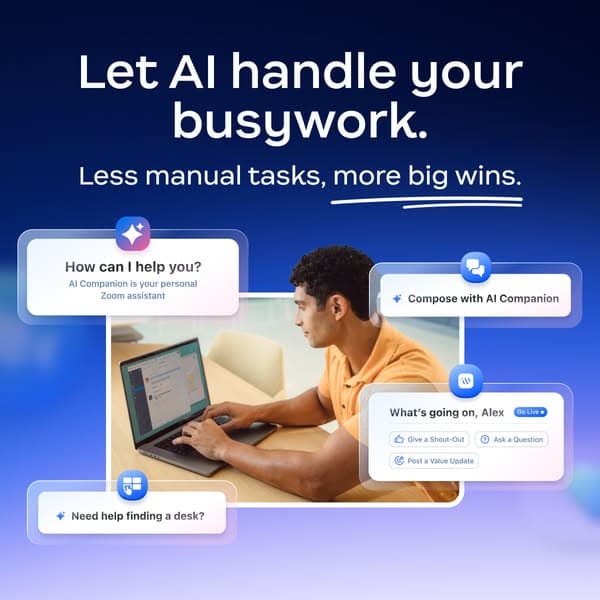
Why it runs: the word busywork appears in five of the ads whose copy we can read, two at Miro and three at Slack, and a sixth time on the Zoom card. Slack puts it twice in the same sentence.
4. The AI teammate
AI sold as a colleague who already knows the work, rather than as a feature.
- Slack: "Slackbot already knows your work. Your conversations, projects, and tools. No setup needed. AI that's been there all along." (28 days).
- Zoom: "AI that actually works the way you do. ZoomMate connects the dots across meetings, chats, and docs to give meaningful insights without adding complexity." (54 days, still live).
- Figma: "Speed up workflows with Figma's agent. Designers, meet Figma's AI agent. Explore ideas, make bulk edits, and finish repetitive tasks in record time.", bought seven times between 18 and 20 days, and "The agent tailor-made for design. Introducing an agent that lives on the Figma canvas." twice at 19 and 18 days.
- Atlassian: "Meet Rovo. AI-powered Search, Chat, and Agents that connect every app, every team, and every workflow. With over 3 million active users." (9 days).
Why it runs: 79 of the 301 readable ads mention AI, so the word on its own tells a reader very little. These four give the AI a name and a job, and three of them are names the reader would have to learn: Slackbot, ZoomMate, Rovo, and Figma's agent.
5. The prompt
The card shows a typed sentence turning into a finished thing.
- Figma: a card reading "Make me an app for remixing audio tracks" above three phone screens and a "Make it" button (154 days, still live), under the post text "More show. Less tell. Prompt your ideas to life with Figma AI."
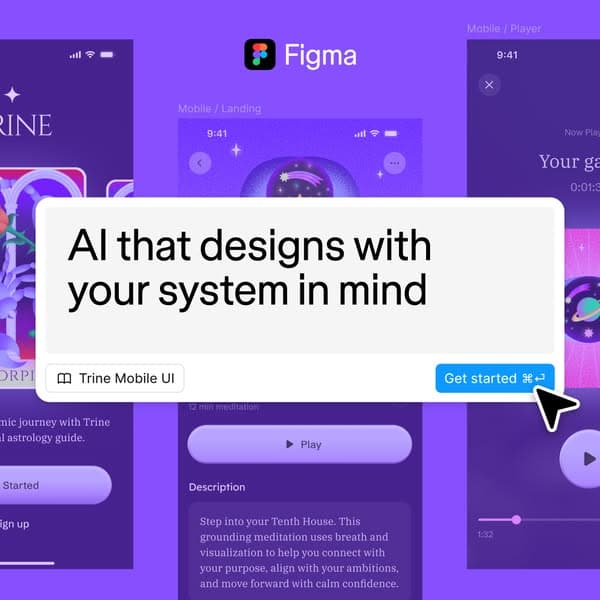
- Figma: a second version, "AI that designs with your system in mind", with a Get started button and a cursor on it (106 days, still live).
- Miro: "I used to dread planning everything on my own after client calls... Now I use Miro AI to do it for me. Here are some prompts that..." (20 days).
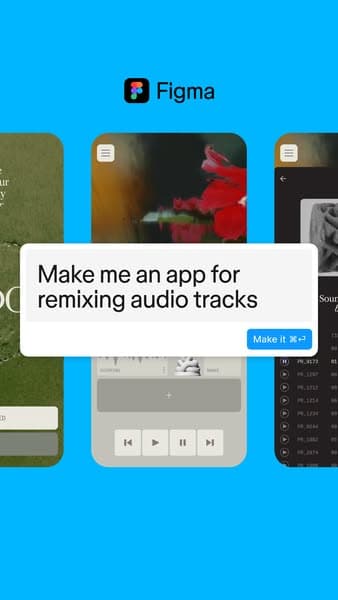
Why it runs: the card shows the input and the output in one frame, so the reader sees the size of the sentence they would have to write. The first card is Figma's oldest live creative, at 154 days, and the second had been live 106.
6. The free seat
Free, with a number of seats attached to it.
- Atlassian: "Jira is free for 10 users. Your all-in-one project management tool powered by AI" (162 days, still live).
- Atlassian: "Get started with 10 free seats", the last frame of the Confluence carousel (147 days), and "Try Confluence for free" as a static card (146 and 141 days, both live).
- Canva: "Sign up for free. Here are 3 FREE Canva features that can help you plan lessons faster this back-to-school season." (49 days) and "Plan your year with Learn Grid. Teachers, sign up for Canva Education, it's free." (48 days).
- Figma: "Design at the speed of thought. Try Figma AI for free." (77 days, run twice).
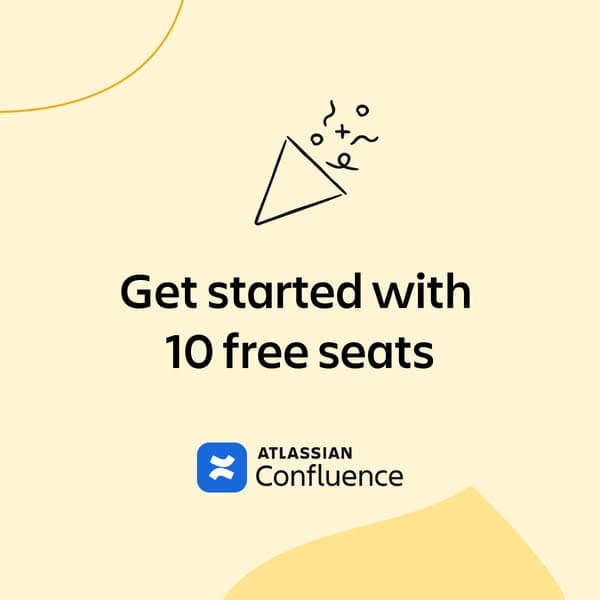
Why it runs: twelve ads in the sample use the word free, and the longest of them, at 162 days, is the one that puts a number on it: Jira is free for 10 users. A reader with a team of eight knows immediately whether the offer covers them.
7. The no-setup promise
Nothing to install, nothing to migrate, nothing to learn.
- Zoom: "Up and running before your coffee cools. No IT saga required." (17 days).
- Slack: "Slackbot already knows your work... No setup needed." (28 days).
- Figma: "Built into how you already work. Keep your workflow connected in one continuous flow with Figma." (133, 130 and 68 days, all live).

Why it runs: the buyer of a productivity tool is usually the person who would have to roll it out. Figma bought its version three times at 133, 130 and 68 days, and the copy names no feature at all.
8. The brand line
A line with no product claim in it, carried by a film or by big type.
- Dropbox: "Share more with Dropbox. Sometimes what feels like an ending is actually a beginning." (20 days), "If you're going in circles, you're sure not going forward." (18 days), "There's only one way to know if the studio riff is your next hit single." (13 days). Forty ads sit behind this one campaign.
- Zoom: "Designed for how you actually work" and "Teamwork, minus the friction. Everything you need to work better, together." (17 days).
- Canva: "Canva AI can keep you on brand." (58 days) and "Let's talk about brand guidelines..." (20 days).
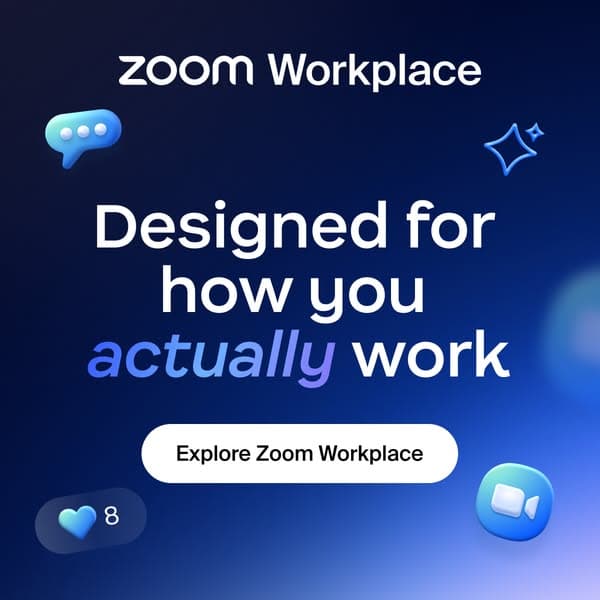
Why it runs: Dropbox put 40 of its 60 ads behind sentences that never say what the software does and sent all of them to one page, where the headline is the same two words as the ads. Zoom and Canva use the same kind of line to open a carousel and then name a product on the next frame.
9. The series
One template, one version per market or per feature, so an account can run a lot of ads that still look like one campaign.
- Canva: the same pages in Spanish, Dutch and Polish. The Spanish homepage ran 212 days, the Spanish whiteboard page 137, the Dutch AI video editor 128, the Polish video editor 113. Eighteen of Canva's 24 paid pages carry a market in the path.
- Slack: the small-business page and the Google Drive page, each served again under /intl/en-gb/ and /intl/de-de/ with its own ads (25, 22, 19 and 17 days).
- Atlassian: the Reddit story and the Udemy story, each in two formats, a three-frame Jira carousel and a dynamic single image, all four at 162 days.
- Zoom: one January carousel whose six frames each run a different angle, from the busywork to the brand line to the buy button.
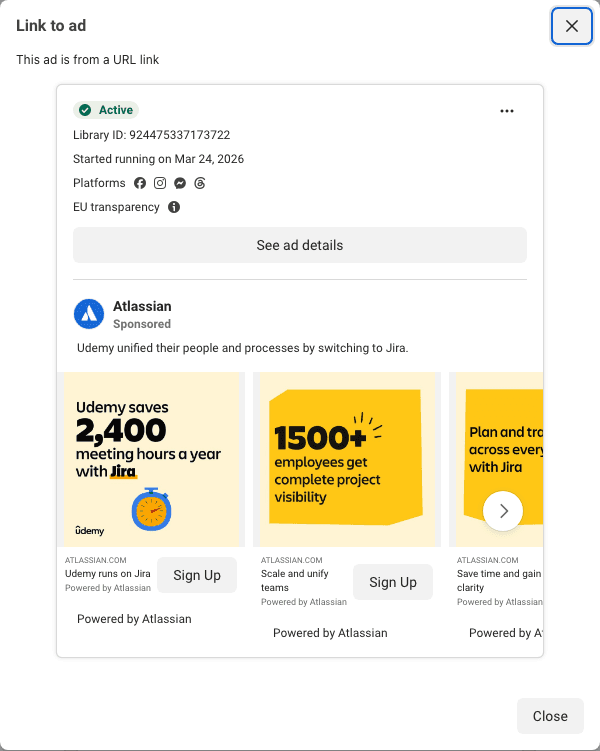
Why it runs: Canva's per-market series produced its four longest-running ads in the sample, between 113 and 212 days. None of the four was still live in September, and Canva's oldest live ad in the sweep was 89 days old.
Ad analysis: six angles almost nobody in productivity uses
Read against all 301 readable ads, these six appear once or not at all. The ads that do exist are listed and linked in the sources, so you can start from them.
- A named competitor. Not one ad in the set names another product. Atlassian comes closest and stops short: "saved $300k+ per year by switching to Jira" (162 days) and "by ditching disparate tools" never say which tools, and the Reddit quote on Atlassian's own page says "getting out of multiple other tools" in the same careful way.
- Trust as the headline. One ad. Slack's card quotes Alasdair Bradley, a customer support supervisor at Wolf & Badger: "Slack stores our data in the UK, so it's GDPR compliant." The link headline is "Slack means secure" and the description is "Keep private info private". It ran 83 days and had stopped by the sweep.
- A price. Not one ad in the sample says what the product costs per user per month. The closest is Slack's "Get 50% off Slack." (8 days), which names a discount and not a figure. Slack's own landing page carries the numbers the ads leave out.
- A download. Six ads matched our document pattern and five of them are creator videos. The one real download ad is Zoom's "Free eBook: Removing the Barriers to Productivity" (180 and 179 days, two buys, both stopped). In the B2B categories we have swept, the document angle usually carries the longest runners. Here it has one advertiser.
- The switch, spelled out. Four Atlassian ads say "by switching to" and then describe the result. Not one ad in the set describes the move itself: no import, no migration, no "bring your data across".
- A date. Not one creative we could read carries a deadline or a calendar date. Canva's two back-to-school ads at 49 and 48 days are the closest, and they name the season rather than a day.

Landing page analysis: what happens after the click
Here is where the ads send people, and the two channels do it differently:
- On Meta, 9 ads of 355 point at the homepage. Seven are Canva's, one is Dropbox's and one is Zoom's. Every other ad that links out goes to a page deeper than the front door, and Slack's 60 ads include no homepage link at all.
- On Google, 83 of 347 do. Miro sends 34 of its 60 search ads to the homepage and Atlassian 20 of 60. On search the visitor has already typed what they want, so the front door answers them.
- So the pages worth studying are the social ones. We sorted the pages behind the ads into four types by the shape of their address, then read the pages themselves. Every page below is linked, so open them.
| Tier | The ad points at | In the sweep |
|---|---|---|
| 0 | The homepage | 9 of 355 ads |
| 1 | A product page that already existed | Jira, Figma Make |
| 2 | A path that exists because the ads do | Dropbox share-more, Slack small business |
| 3 | A market or a campaign segment in the path | Canva in Dutch, Slack small business in German |
Tier 1: the ad points at a product page that already existed
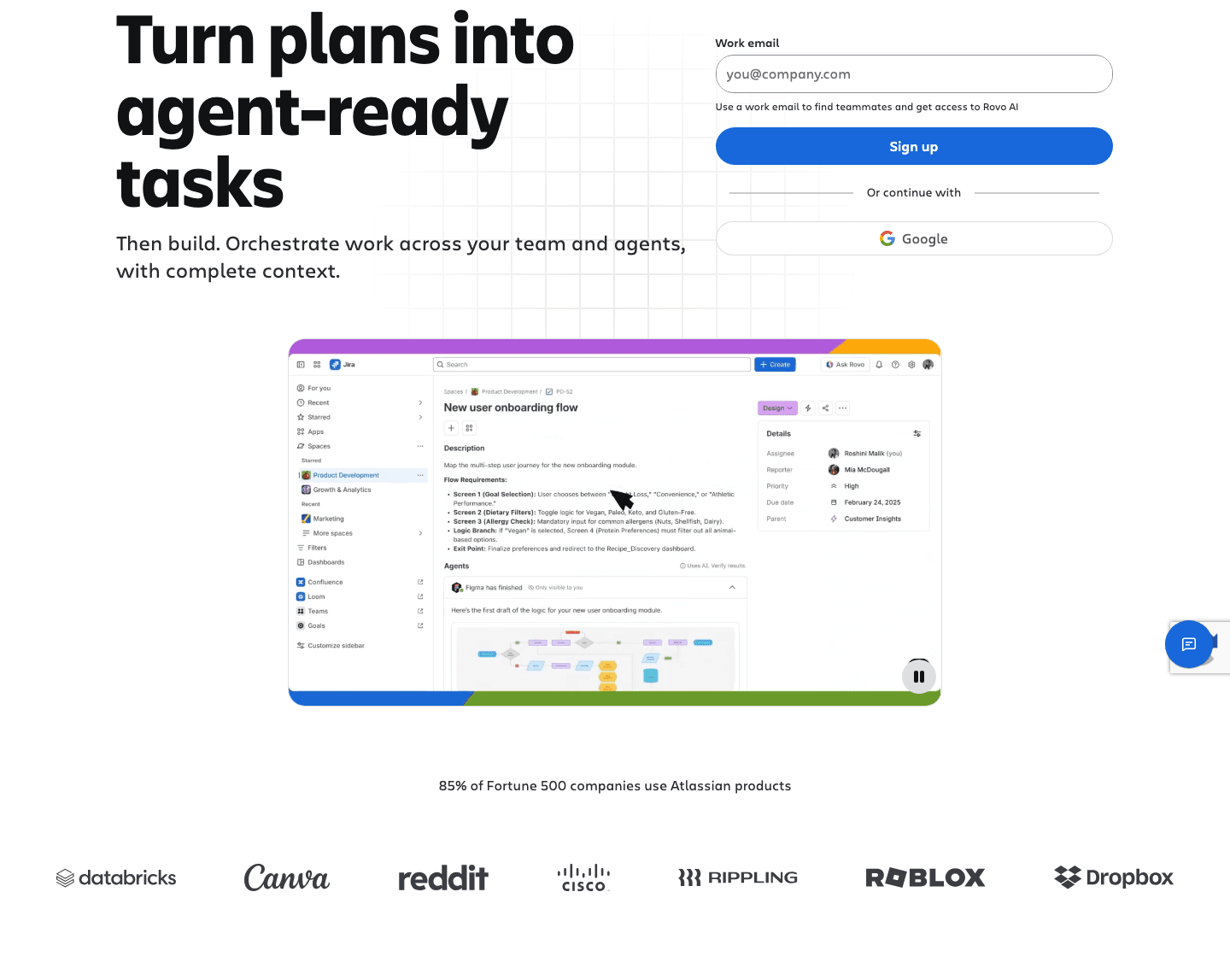
- Twenty-three Atlassian ads land on atlassian.com/software/jira, the page an organic visitor reaches from the product menu. Thirty-seven Figma ads land on figma.com/make the same way.
- Neither page carries a campaign path, and 201 of the ads in this sample land on a product address of this shape.
- The Jira hero sells agent-ready tasks while the Atlassian cards that ran longest sell Reddit's and Udemy's figures.
Tier 2: the ad points at a path built for the ads
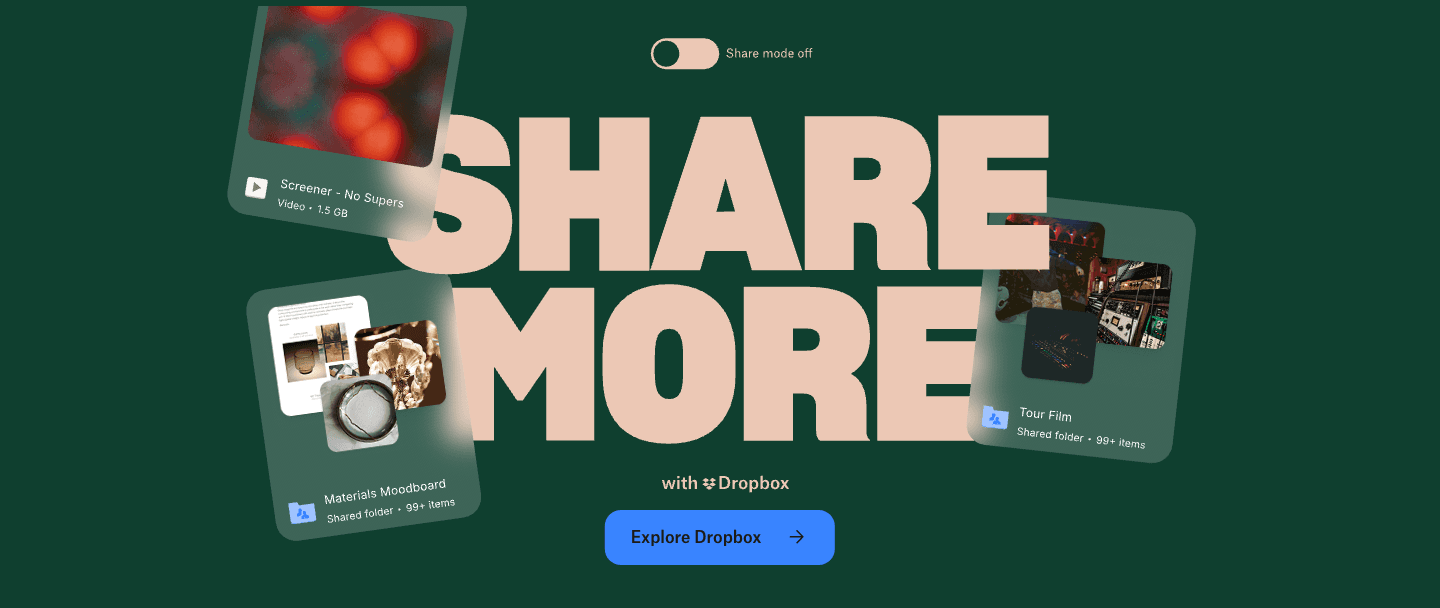
- Dropbox keeps its whole paid programme under one folder: 40 ads on share-more, 8 on the teams branch and 7 on the Replay branch. One Dropbox ad in 60 goes to the homepage.
- Slack does the same thing with a shorter name: /lp/small-business, /lp/google-drive and /lp/slackbot, one page per thing the ads talk about.
- Both had pointed new ads at those paths just before the sweep: Dropbox's newest share-more ads were 6 days old and Slack's whole /lp/ set was 8.
Tier 3: the ad points at a per-market or per-segment page
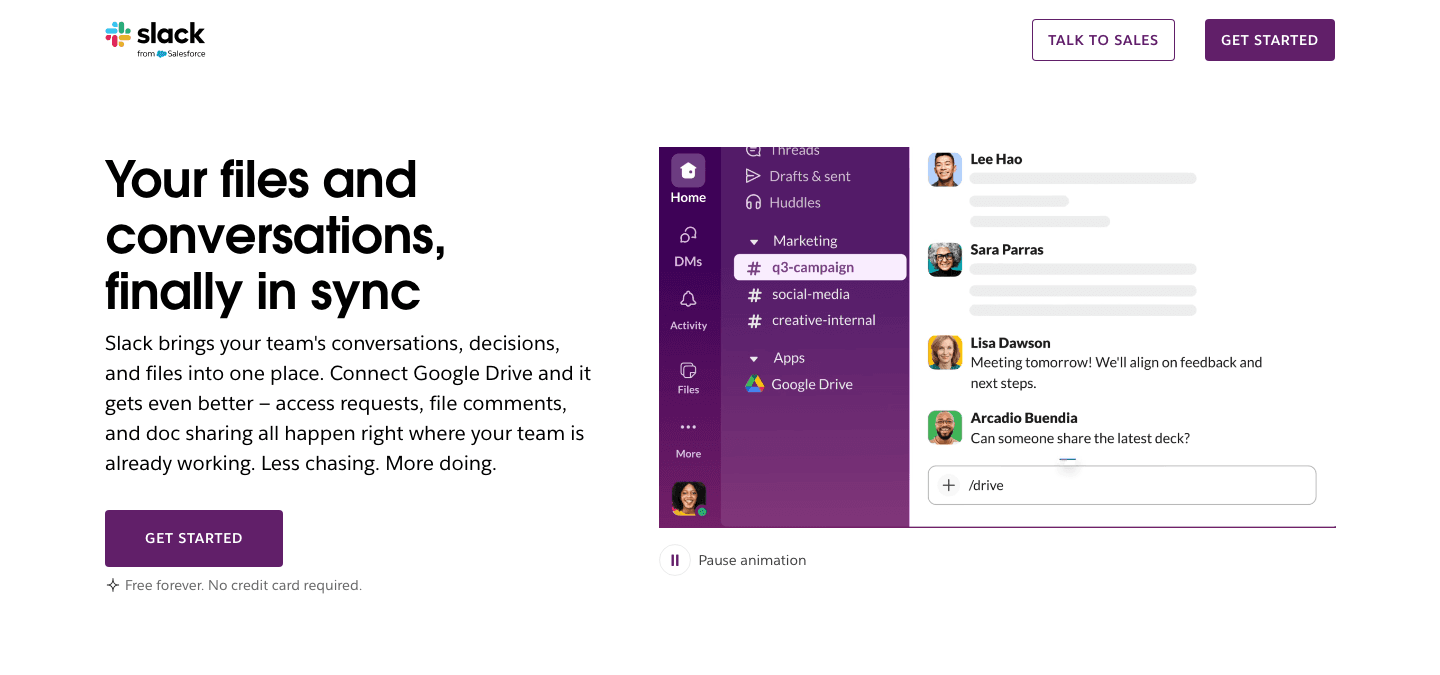
- Slack serves the same two pages three times: /lp/google-drive, /intl/en-gb/lp/google-drive and the German twin of the small-business page, each with its own ads behind it.
- Canva goes further. Eighteen of its 24 paid pages carry a market in the path, including a Dutch AI video editor, a Polish launches page and a Spanish whiteboard page.
- Those per-market pages produced Canva's longest runs in the sample, 212 days on the Spanish homepage and 137 on the Spanish whiteboard page, and none of them was live in September.
How many paid pages each company runs
| Company | Brand-site Meta ads, homepage excluded | Distinct pages | Of which per-market |
|---|---|---|---|
| Canva | 53 | 24 | 18 |
| Atlassian | 55 | 22 | 0 |
| Slack | 60 | 11 | 3 |
| Dropbox | 55 | 4 | 0 |
| Figma | 56 | 3 | 1 |
| Zoom | 50 | 3 | 0 |
| Miro | 17 | 1 | 0 |
- The first column leaves out the 9 homepage ads, so it adds up to 346 and the brand-site total is 355. Six of the seven advertisers sit at 60 ads on file, because the library stops there. The page counts run from Miro's one to Canva's 24, and that is where the companies differ.
- Canva and Slack are the two companies selling in several languages, and they carry 21 of the 22 per-market paths. Figma has the other one.
- Miro is in the table for one page because 43 of its 60 ads carry no landing link at all. They are creator videos with a comment-for-the-link ask in the caption, so Meta records no destination.
Do it on your own account. Open your Ad Library entry, click one ad and read the address bar on the page it opens. A bare domain is tier 0. A product path you also link from the nav is tier 1, which is where most of this sample sits. A folder like /campaigns/ or /lp/ is tier 2, and a market code in front of it is tier 3.
Teardown 1: Slack
Two campaigns read the way we read a page in a client audit: the ads first, then the page they open, crop by crop, then what is missing. Slack because it had rebuilt its entire paid set in the week before we swept, so nothing on it is left over from an older plan. Atlassian because its Confluence campaign had been buying the same two figures for 147 days.
The campaign. All 60 of Slack's Meta ads on file point at slack.com and none at the homepage. Forty-five of them are designed creatives. On 2 September 2026, 17 pointed at slack.com/lp/small-business and 14 at slack.com/lp/google-drive, and the oldest ad still running anywhere in the account was 8 days old. Nine ads had passed 45 days, and the oldest of those, at 83 days, had already stopped. Slack switched its whole paid programme over in the last week of August.
The ad
The one Slack card on file is the 83-day one from the spring, and it is worth reading because the customer on it comes back in September. A purple quote mark, then the sentence in the customer's own words: "Slack stores our data in the UK, so it's GDPR compliant." Under it the attribution a procurement reader needs, Alasdair Bradley, Customer Support Supervisor, Wolf & Badger, with his photograph and the Wolf & Badger wordmark. Bottom left, the Slack lockup with "from Salesforce" under it. The link headline is "Slack means secure" and the line below it is "Keep private info private". There is no product screenshot on the card and no feature in the copy.
The September set does not carry a card we can open, so what follows is the copy the library publishes. Six messages point at the small-business page, all 8 days old: the discount, "Get 50% off Slack."; the AI summary, "Get the TL;DR on any conversation instantly with AI summaries in Slack."; the automation, "Let automations tackle your busywork, while you tackle the important stuff."; the clock, "Get time back with Slack. 2 hours a day x 5 days a week x 52 weeks a year = Your most productive year ever."; and two customer lines, "Innovation, unblocked... That's how Anthropic scales with Slack" and "Wolf & Badger keeps clothing flying off the shelves with a little help from Slack."
The landing page
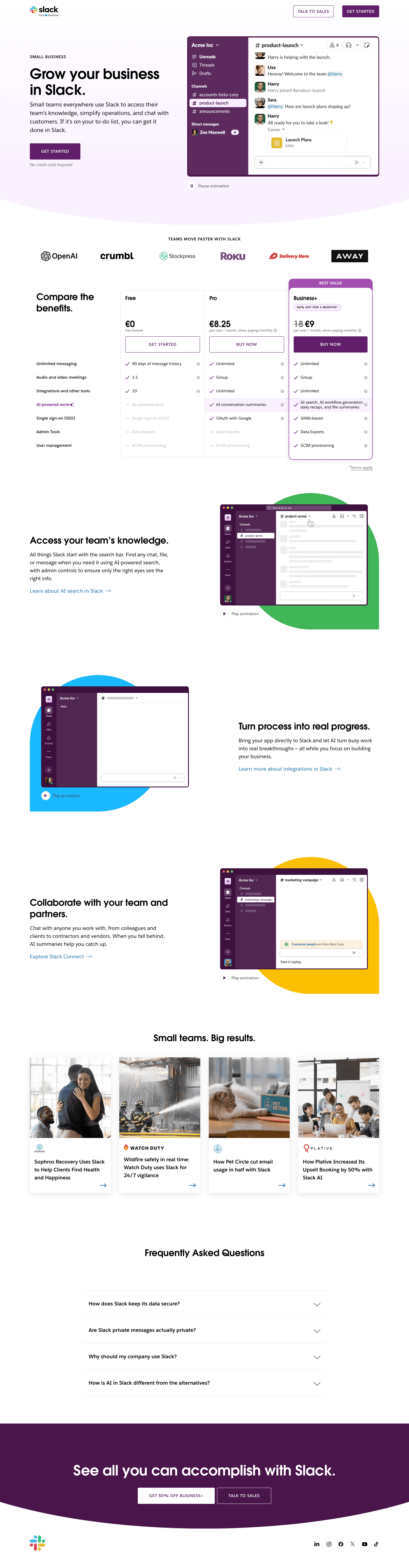

The hero. An eyebrow that names the audience, SMALL BUSINESS, then "Grow your business in Slack." The subhead writes the job in the reader's language rather than the product's: small teams use Slack to access their team's knowledge, simplify operations and chat with customers, and "if it's on your to-do list, you can get it done in Slack". One button, GET STARTED, and under it the only reassurance on the first screen, "No credit card required". Beside it a live product window with a #product-launch channel, four named people and a Launch Plans card.
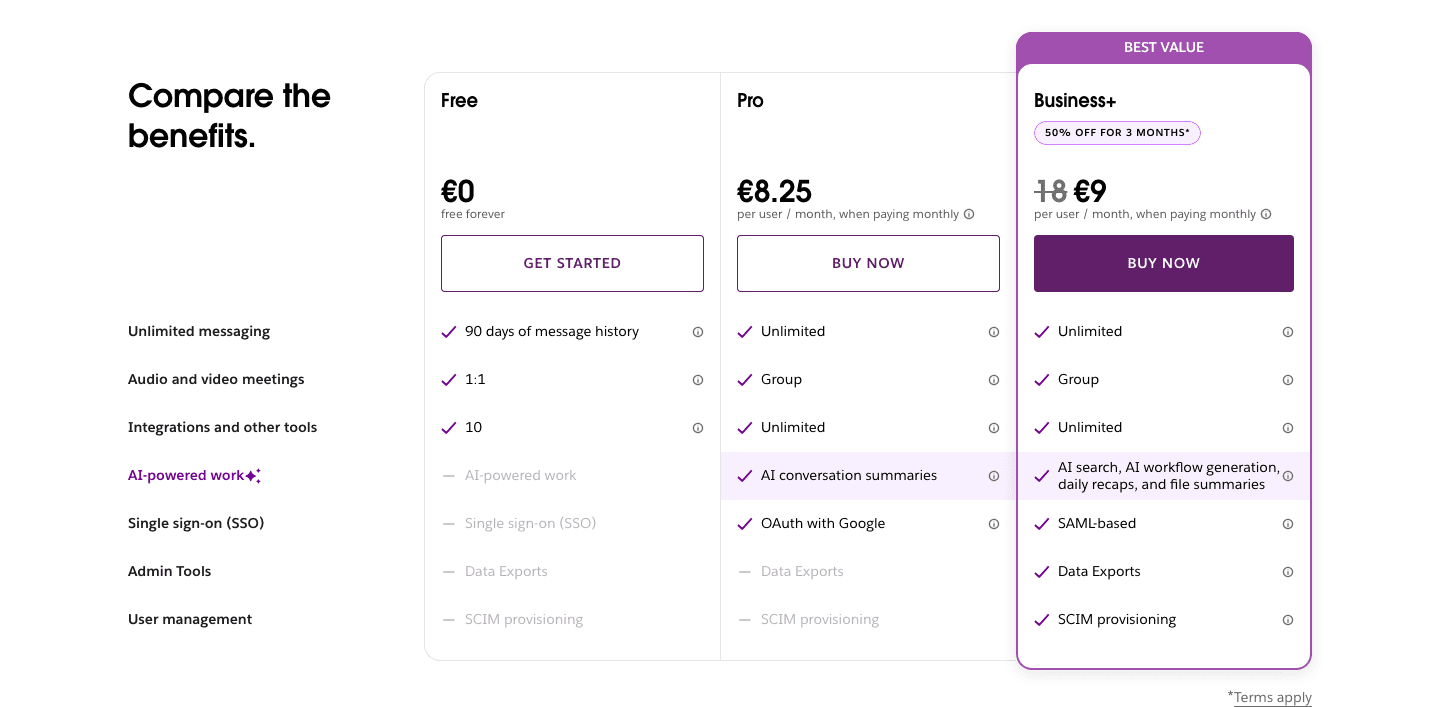
The price table. Three columns under the heading "Compare the benefits": Free at 0 forever, Pro at 8.25 a user a month, and Business+ marked BEST VALUE with 18 struck through and 9 beside it, carrying a "50% OFF FOR 3 MONTHS" badge and a terms link. Our capture rendered these prices in euros, although the sweep ran in the US, so read the table for its layout rather than as the US price. Seven rows run across the columns, and the AI row is the one the ads sell: nothing on Free, "AI conversation summaries" on Pro, "AI search, AI workflow generation, daily recaps, and file summaries" on Business+. The ads name a discount; this table is where the figures are.
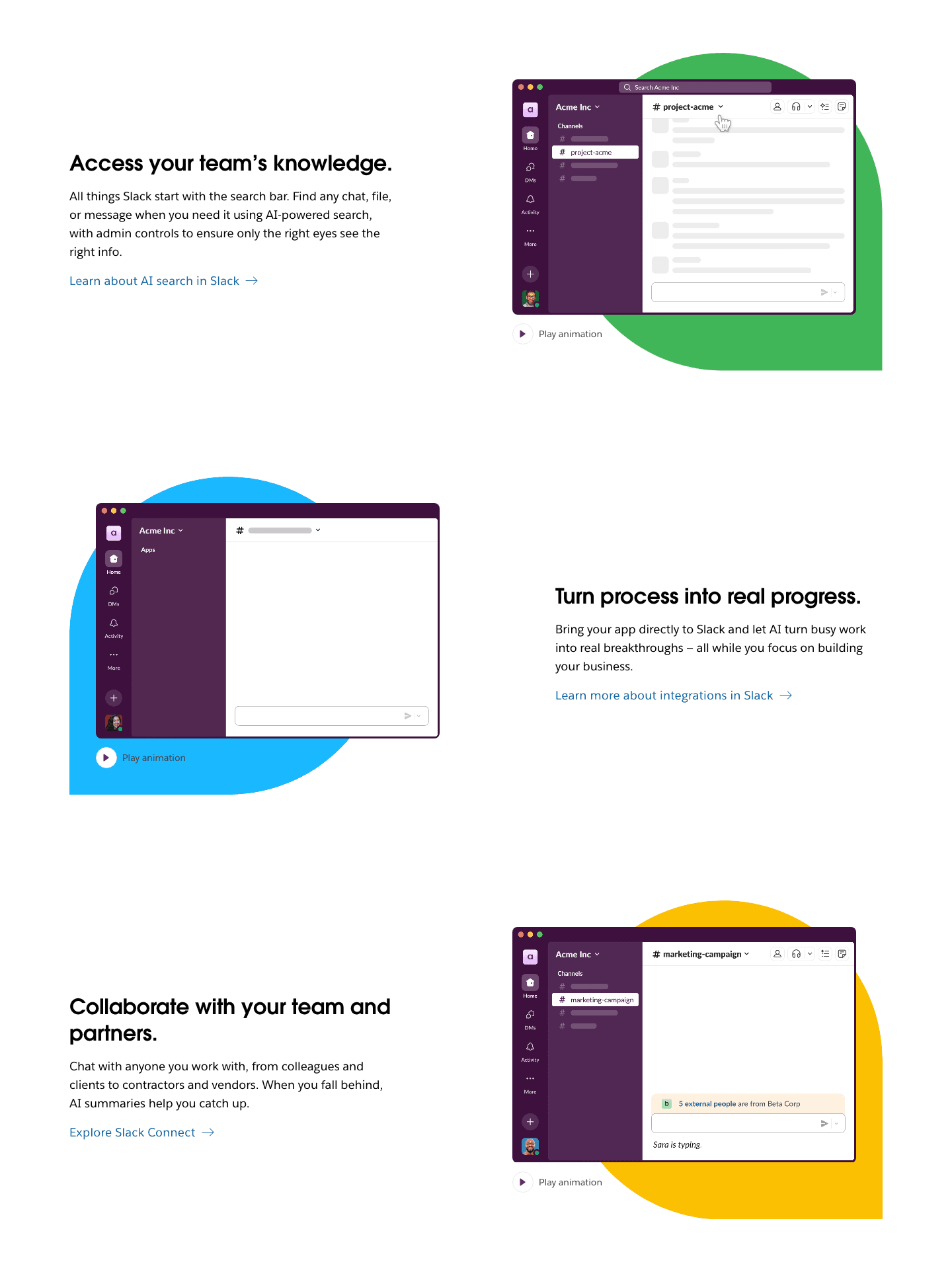
The three jobs. Three alternating blocks, each one a sentence and a link: "Access your team's knowledge" with AI-powered search and admin controls over who sees what; "Turn process into real progress", which promises AI will turn busy work into real breakthroughs while the reader builds their business; and "Collaborate with your team and partners", which covers contractors, clients and vendors and offers AI summaries for catching up.
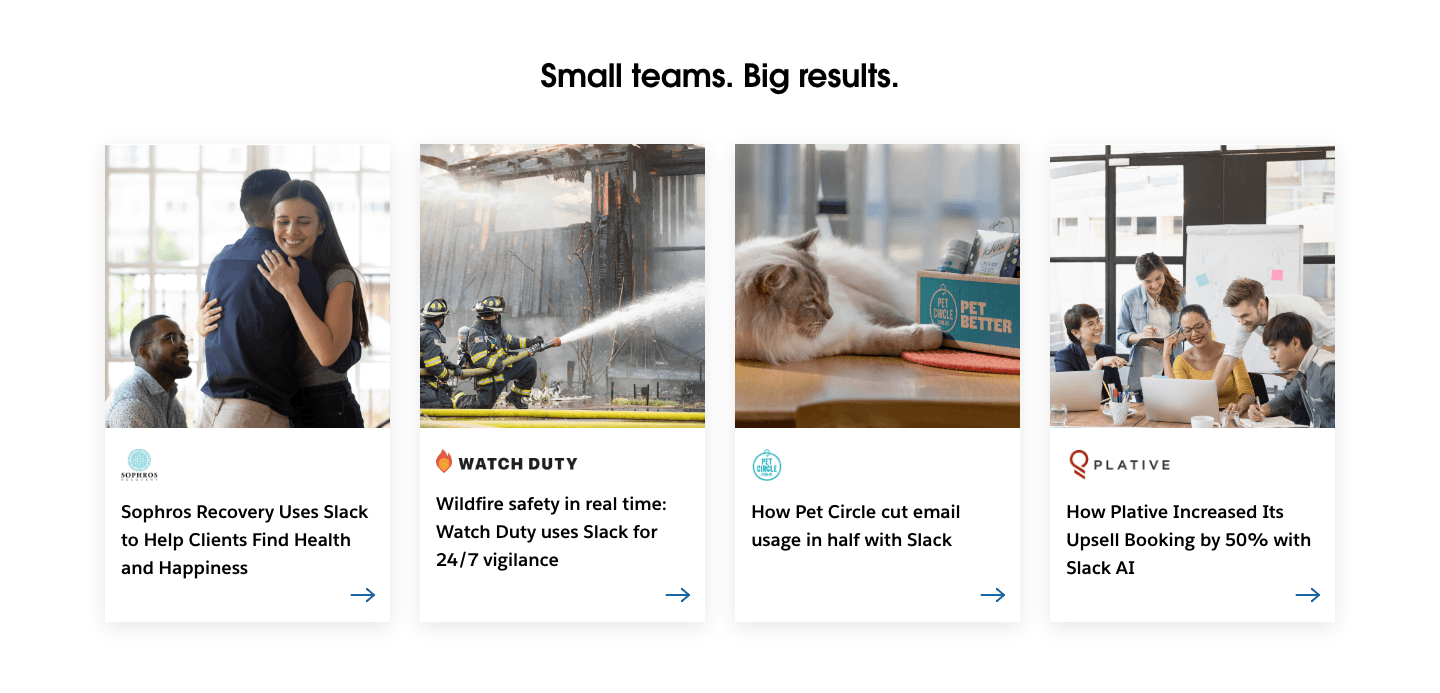
The proof row. "Small teams. Big results." over four customer cards, each with a photograph and a logo: Sophros Recovery, Watch Duty on wildfire safety in real time, Pet Circle cutting email usage in half, and Plative increasing its upsell booking by 50% with Slack AI. Two of the four carry a figure.
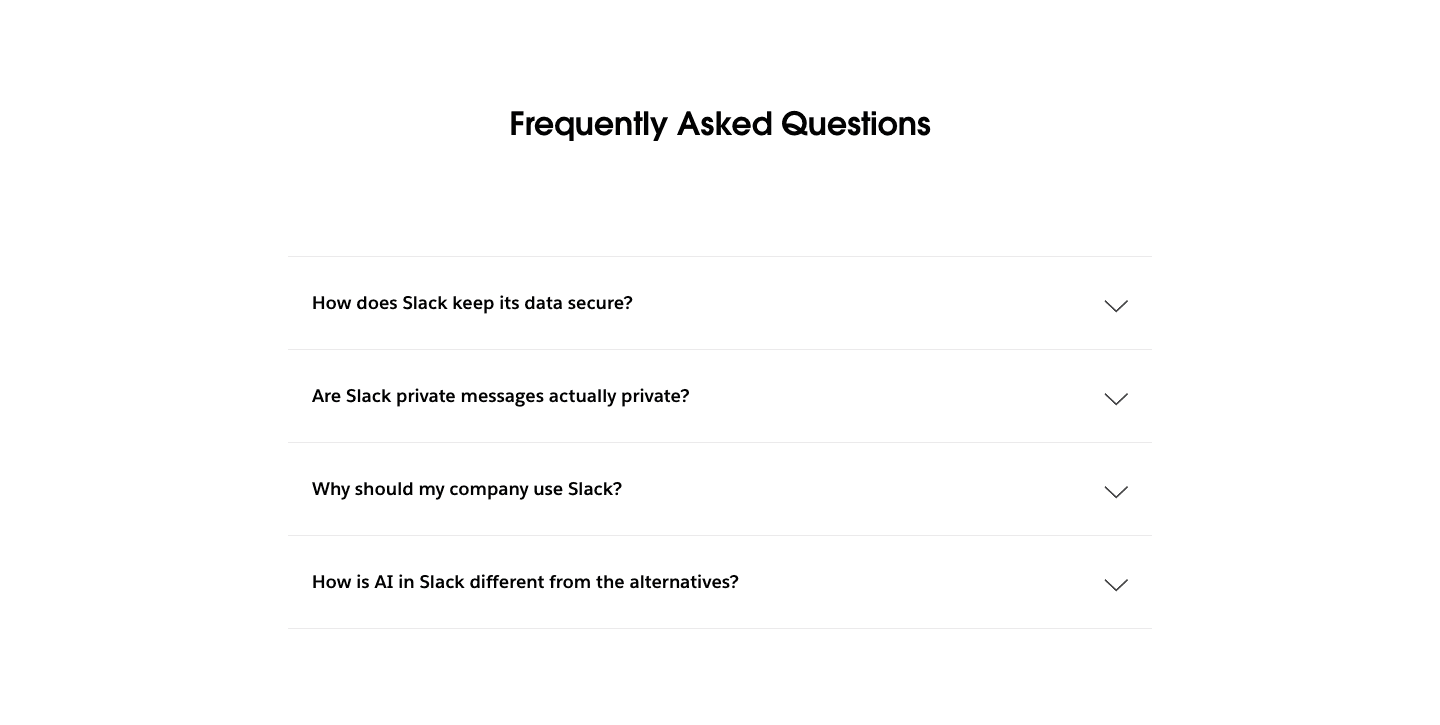
The FAQ. Four questions, and the first two are about data: how does Slack keep its data secure, are Slack private messages actually private. Then why should my company use Slack, and how is AI in Slack different from the alternatives. The spring card sold security as the headline; on this page it sits in an accordion at the bottom.
Message match
| The ad says | The page proves it with |
|---|---|
| Get 50% off Slack. | The Business+ column: 18 struck through, 9 a user a month (in euros on our capture), a 50% off for 3 months badge |
| Get the TL;DR on any conversation instantly with AI summaries | The AI row of the table, and the catch-up line in the collaborate block |
| Let automations tackle your busywork | "Turn process into real progress", which promises AI will turn busy work into real breakthroughs |
| Wolf & Badger keeps clothing flying off the shelves with a little help from Slack | Four other customers: Sophros Recovery, Watch Duty, Pet Circle, Plative |
The gaps
Two things to fix, neither of them expensive. One of the six messages pointing here is the Wolf & Badger story, and the four cards in the proof row are Sophros Recovery, Watch Duty, Pet Circle and Plative. Slack already owns a Wolf & Badger quote with a photograph and a job title, and it is sitting in an old ad rather than on the page the new ads point at.
The second is the discount. "Get 50% off Slack." is the only offer in the set that names money, and on the page the 50% badge sits in the third column of a comparison table, one scroll down. The hero's only reassurance is "No credit card required", which answers the free plan, not the offer. A reader who clicked the discount reads about free first and has to keep going to find what they came for. We run the same read on a client's own pages in the competitive audit.
Teardown 2: Atlassian
The campaign. Four Meta ads pointed at atlassian.com/software/confluence, all four live when we swept Atlassian on 2 September 2026. The oldest started on 8 April 2026 and was 147 days old. They run in three formats from one idea: a four-frame carousel, a dynamic single image, and two static cards that repeat the same offer at 146 and 141 days. Atlassian runs 22 paid pages in all, and this is the second-biggest after Jira.
The ads
The carousel spends four frames on one customer and shows no product at any point. Frame one carries the figure, "Udemy got 2,400+ hours a year in meeting time back", over a drawn stopwatch. Frame two supplies the method, "...when they unified all 1500+ employees on Confluence", with three smiley faces where a screenshot would normally go. Frame three hands the claim to the reader, "Win your time back with seamless collaboration". Frame four carries the ask.
The last frame drops the customer and names the offer: "Get started with 10 free seats", a party popper, the Confluence lockup. Each frame carries its own link headline under the image, "Udemy unlocks collaboration", "Teams create and collaborate", "Get time back from meetings", and each one has the same Sign Up button.
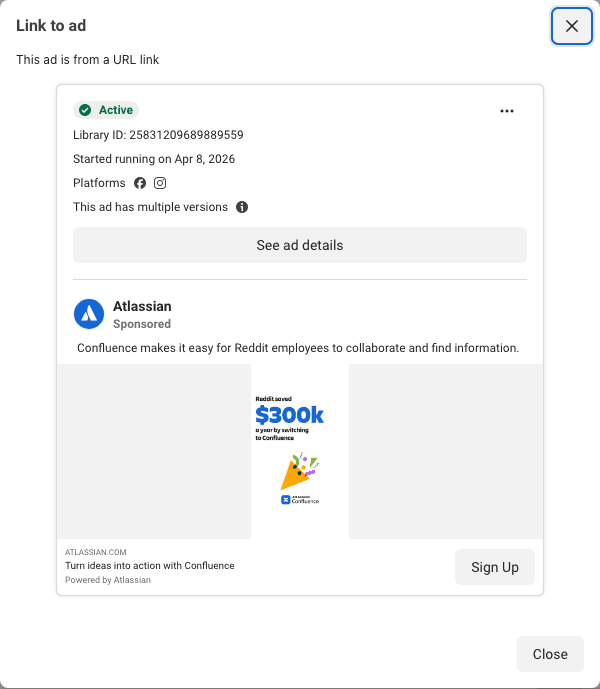
The dynamic card runs the second customer at the same age, 147 days. The post text is flat and specific, "Confluence makes it easy for Reddit employees to collaborate and find information", the creative inside reads "Reddit saved $300k a year by switching to Confluence", and the link headline is the campaign's shortest description of the job: "Turn ideas into action with Confluence". The two static cards beside it lead with "Try Confluence for free" and explain it in one line about keeping information up to date, findable and shareable.
The landing page

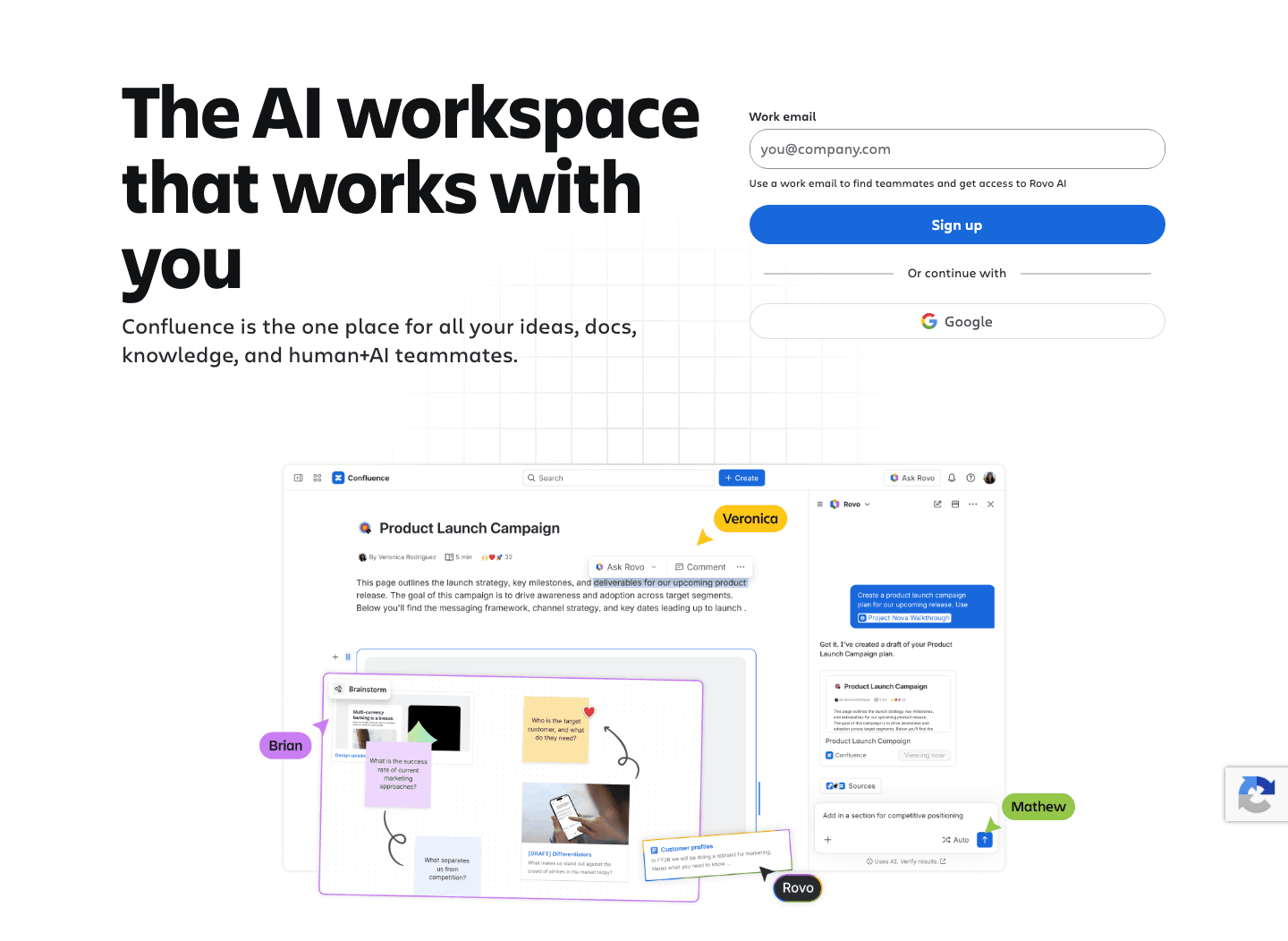
The hero. "The AI workspace that works with you", then "Confluence is the one place for all your ideas, docs, knowledge, and human+AI teammates." One work-email field, a Sign up button and a Google option, with a line that earns the work address: "use a work email to find teammates and get access to Rovo AI". The product shot shows a Product Launch Campaign page with three named collaborators and Rovo drafting in a side panel. The four ads pointing here sell meeting hours and a dollar figure; the first screen of the page sells an AI workspace.

The logo row. Six customers scroll past under the hero: Sprout Social, Datasite, Reddit, Dropbox, Roblox, trivago. Reddit appears as a wordmark with no sentence attached to it, and Udemy, whose 2,400 hours carry the carousel, is absent from the page.
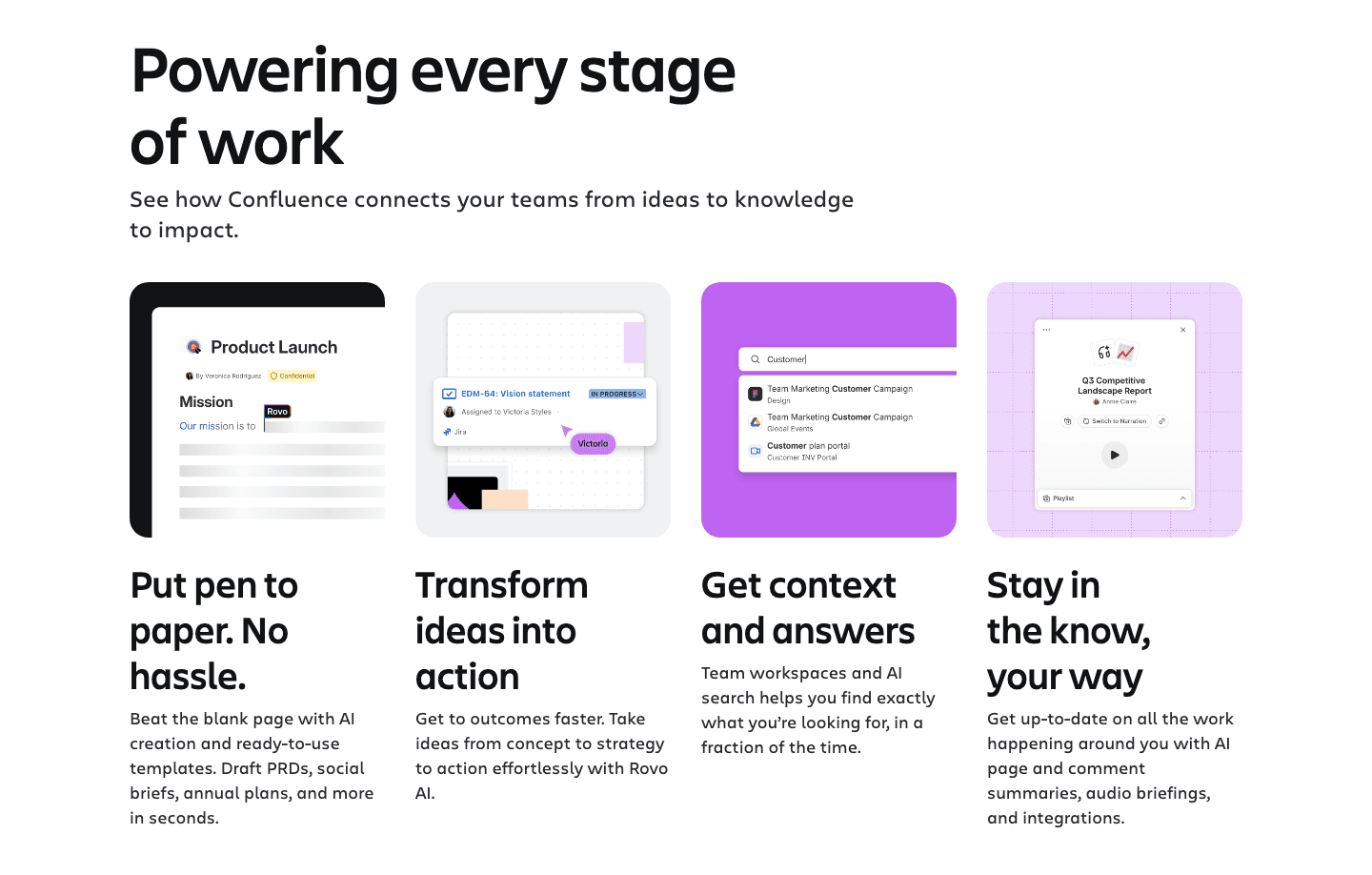
The four stages. "Powering every stage of work" over four cards that follow a document from blank to shared: "Put pen to paper. No hassle." with AI drafting and templates, "Transform ideas into action" with Rovo, "Get context and answers" with team workspaces and AI search, and "Stay in the know, your way" with page summaries, audio briefings and integrations. The third and fourth cards are the meeting-hours promise written out, one screen below the point where most readers stop.
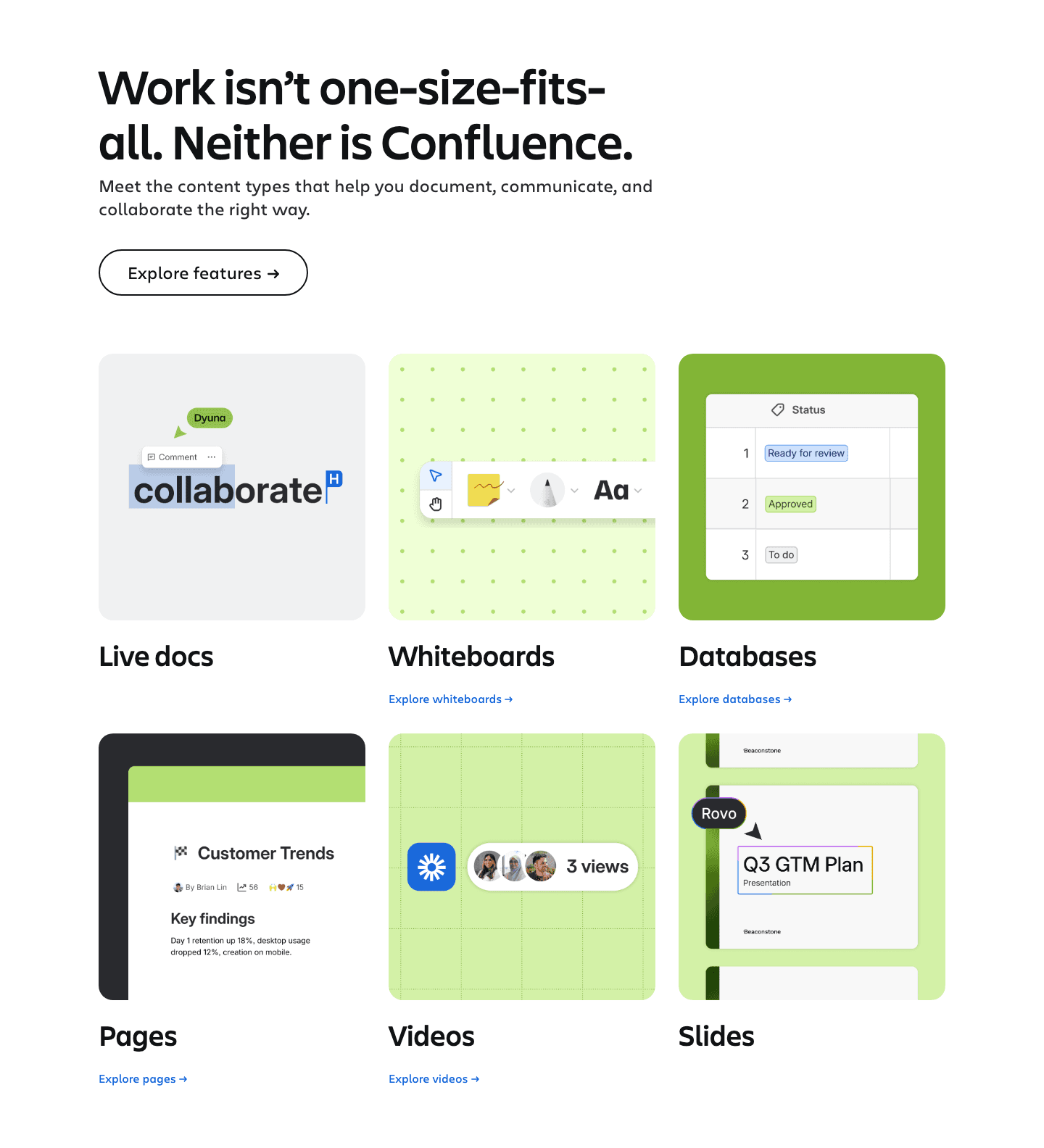
The content types. "Work isn't one-size-fits-all. Neither is Confluence." Six tiles with their own screenshots: live docs, whiteboards, databases, pages, videos and slides, each with an Explore link. A reader who arrived from the meeting-hours ad has six formats to pick between before anything mentions meetings.
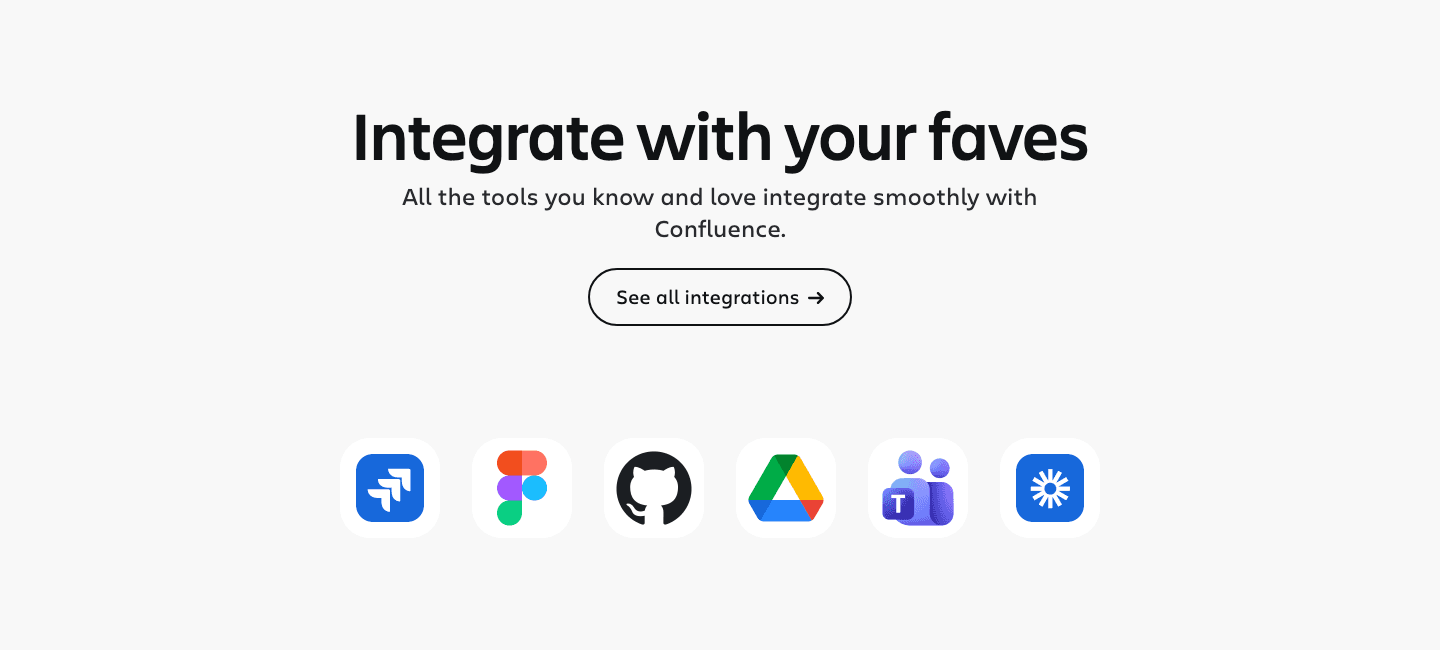
The integrations row. "Integrate with your faves" over six icons, Jira, Figma, GitHub, Google Drive, Microsoft Teams and Slack, with one button, See all integrations. It is the shortest band on the page, and the only one that names the tools the reader already pays for.
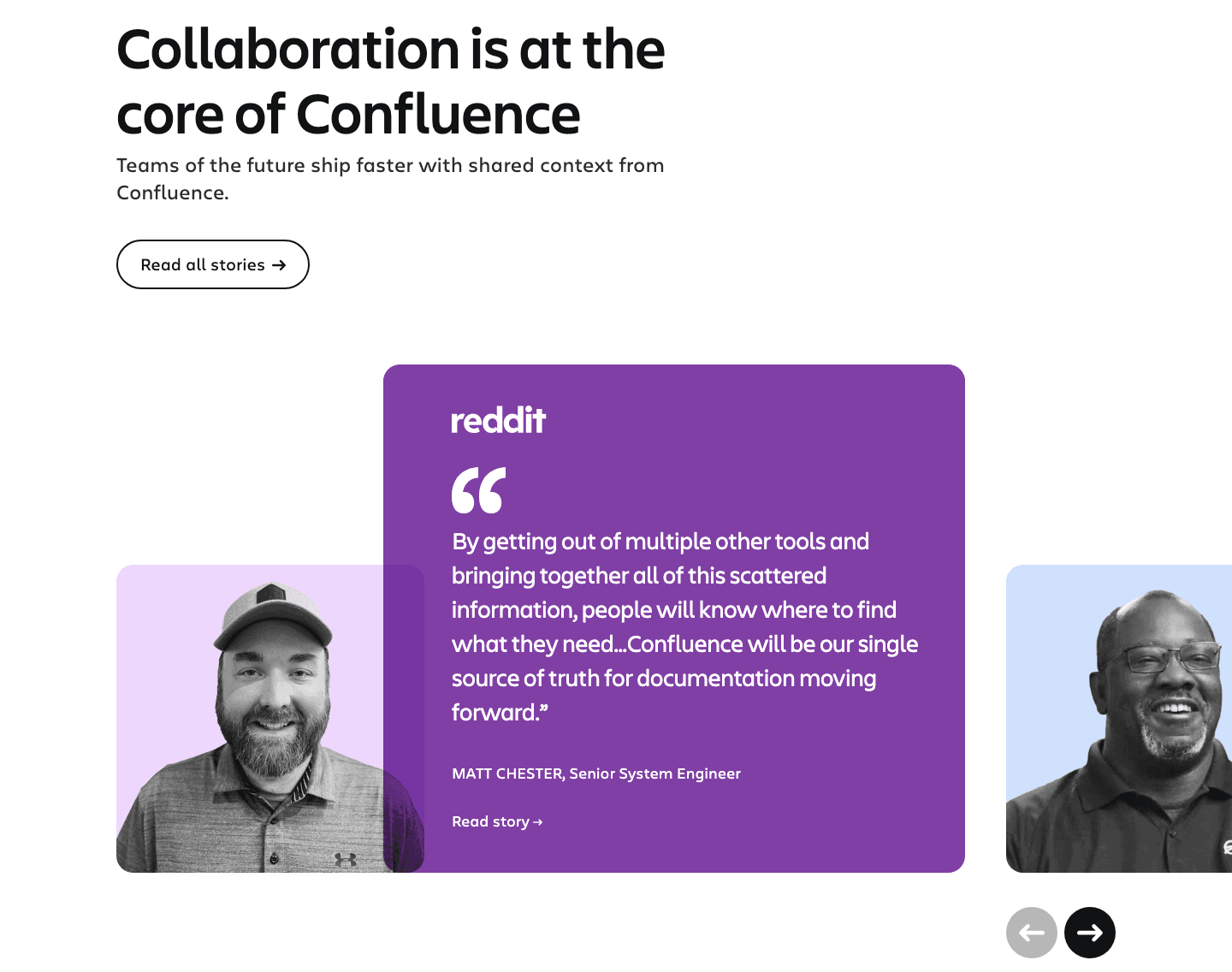
The proof. "Collaboration is at the core of Confluence" over a carousel of customer portraits, open on Reddit. Matt Chester, Senior System Engineer: "By getting out of multiple other tools and bringing together all of this scattered information, people will know where to find what they need... Confluence will be our single source of truth for documentation moving forward." It is the same customer as the dynamic card, quoted at four lines, and the $300,000 figure from the card is not in the quote.
The closer. A black band, "Get your team on Confluence", a line about a connected workspace built to last, and one button, Get Confluence free. It sits 9,000 pixels down, and it is the only place below the hero where we found the word free.
Message match
| The ad says | The page proves it with |
|---|---|
| Udemy got 2,400+ hours a year in meeting time back | Nothing. Udemy is not named anywhere on the page |
| Reddit saved $300k a year by switching to Confluence | Reddit's logo in the row, and a Reddit quote with no figure in it |
| Get started with 10 free seats | "Get Confluence free" in the closing band, with no seat count |
| Win your time back with seamless collaboration | The third and fourth stage cards: AI search, page summaries, audio briefings |
The gaps
Two things to fix. The campaign had been running two figures for 147 days, 2,400 hours and $300,000, and the page, as we captured it in September, prints neither. Reddit is already quoted here at four lines by a named engineer, so the expensive part is done; the quote simply stops before the number. Adding it is a one-line edit.
The second is the offer. Three of the four ads carry it, 10 free seats on the carousel and a free trial on the two static cards; the page's only free line is a button at the very bottom, with no seat count and no plan beside it. The hero asks for a work email and says nothing about what the reader gets for it. Both show up in a single read of the page, which is what a page audit does.
Key takeaways: five things to do with this
- Put a number on the time. Atlassian's cards that name a customer and a figure, 2,400 hours or $300,000, ran 147 to 162 days. The Zoom and Dropbox lines about working better together ran 13 to 20 days.
- Name the AI and give it a job. 79 of the 301 readable ads mention AI. The ones that kept running call it Slackbot, ZoomMate, Rovo or Figma's agent and say which task it takes off the reader.
- Put the ad's offer on the page. Atlassian offers 10 free seats on its carousel and a free trial on two more cards, and the page says "Get Confluence free" 9,000 pixels down. Slack sells 50% off and the badge sits in a table below the fold.
- Build the path before you need it. Dropbox put 55 of its 60 ads under one campaign folder and Slack pointed a whole new set of ads at three /lp/ pages in one week. A page under a campaign path can be rewritten the day the campaign changes.
- Take one of the six open angles. A price, a named competitor, a download, a date. In 301 readable ads, a price appears once as a discount and a date never.
How to run this analysis on your own competitors
The Meta Ad Library and the Google Ads Transparency Center are public and free. Search the brand's page rather than a keyword, set the country, include the ads that have stopped as well as the active ones, and sort by start date. Then:
- Group the ads by angle. Use the nine above.
- Keep the ones that have run 45 days or more. An ad that stays up that long has been through at least one look at the spend. Click through and read the page each one lands on.
- Write down the angles they are not running. Start your next campaign from that list.
Or send us the URL and we do it for you.
How we did the analysis
- Sample: the productivity companies on the benchmark leaderboard, picked by traffic rather than by advertiser status. Fifteen were selected and eight were swept: Atlassian, Canva, Dropbox, Figma, Miro, Slack, Trello and Zoom. Trello was swept and had no brand-verified Meta ad, so seven companies carry the Meta numbers. Calendly, Notion, Monday.com, Airtable, Prezi, Asana and Evernote were selected and never swept; they are set aside, not counted as non-advertisers.
- Sources: the Meta Ad Library, searched by brand page, and the Google Ads Transparency Center, both through Apify. The sweeps ran on 2 and 3 September 2026 in the US market, and nothing here was re-checked since. Every day count is the ad's age on the sweep date.
- Filter: brand-verified ads only. An ad counts when the page name and the landing host are the brand's own. That dropped 347 Google ads on page name, 245 on landing host and 96 whose dynamic template returned no copy and no creative.
- Ranking: days active. The floor of interest is 45 days, long enough for the advertiser to have looked at the spend at least once. 146 of the 420 Meta ads on file cleared it.
- Reading: every distinct message was read by hand and put in one angle. Dynamic ads return a template instead of copy, so those were read from the creative image where we had one. We could open 17 of the ads as pictures: 10 Atlassian, 4 Figma, 2 Zoom and 1 Slack. Everything else is quoted from the library's own headline and body fields, and the post says so where it matters.
- Limits: the library returns about 60 ads per brand per market, so a company's count is a floor and the shares inside the sample are what to read. This is a US sweep, so Canva's and Slack's per-market pages show up through their US-served ads only. Meta publishes reach in the EU and never publishes spend.
Every ad named above has its Library ID in the sources list, so each claim can be opened and checked.
Sources
All public. Any Meta ad below opens at facebook.com/ads/library/?id= followed by its Library ID.
- Atlassian's Jira Reddit carousel, Library ID 934612762599064, running since 24 March 2026: facebook.com/ads/library/?id=934612762599064
- Atlassian's Confluence carousel, Library ID 1886919976008034, running since 8 April 2026: facebook.com/ads/library/?id=1886919976008034
- Atlassian's dynamic Confluence card, Library ID 25831209689889559: facebook.com/ads/library/?id=25831209689889559
- Slack's Wolf & Badger card, Library ID 1250004700592890, 2 March to 24 May 2026: facebook.com/ads/library/?id=1250004700592890
- The other creatives shown above: Zoom 2090082488423074, Figma 1012270771310979, 1268881618002516 and 1665850477751550, Atlassian 924475337173722 and 1291153286204947.
- The ads quoted by angle: Atlassian 2478919085860804, 1236321585151991, 926646490148969, 917447611187910, 797031066809250, 3453579718138223, 1249905600591716, 752522221160404, 1710389509916898, 2679328722441992, 848750261574883, 1965946484263334, 2060470165344649; Slack 1505170794783593, 1398423765755932, 1992863734736866, 1524635875165526, 2712959912431436, 1591851851771091, 1727064368342778, 916713914352808, 884347927886135, 867779882939772, 3714577482032911; Zoom 4057222311077324, 1170489784557801, 292130955007365, 2779746702378467; Figma 935163386293746, 1014459034919075, 2038082363806736, 835643772672561, 26647122958305506, 1347854217153661, 1890163895014834; Canva 3483571901795615, 1708516613787638, 1470248711611611, 1075650781457097; Miro 1191991119656661, 853029123931372.
- The per-market and campaign-path ads: Canva 1451908565936361 (Spanish homepage, 212 days), 1341810264268181 (Spanish whiteboard), 1128763019241889 and 1838156000155095 (Dutch AI video), 1600760101055792 (Polish video editor), 4196183577316557 (Polish launches); Slack 1470271258184212 (German small business) and 2567690477020917 (British Google Drive); Dropbox 839398012472093, 2301677370605595, 1708736933505081, 2312782792823327, 1543568057073802, 4390918294507489, 1070595669168355.
- The landing pages, as captured on 2 and 3 September 2026 (they may have changed since): slack.com/lp/small-business, slack.com/lp/google-drive, atlassian.com/software/confluence, atlassian.com/software/jira, figma.com/make, dropbox.com/campaigns/share-more
- The sample: the productivity leaderboard of the Web Anatomy benchmark, selected by traffic. The sibling posts on the same method: software, developer tools and fintech.
- The Google Ads Transparency Center for the search ads: adstransparency.google.com
- Ad sweeps and landing-page captures made 2 and 3 September 2026, US market, Meta by brand page and Google by advertiser.
Data collected September 2026. Ad statuses and run lengths change; the library links above always show the current state.

Written by
Gabriel Amzallag , Founder, Web Anatomy
5 years CRO + SEO at Qonto (2021–2025). After advising 15+ SaaS on their websites (Payfit, Pigment…), the same patterns kept breaking, so I decided to build the source of truth on what works on the web: the intelligence layer every tool, builder, and team uses to ship sites that perform.
More from the blog
Playbooks
We analyzed the ads the top EdTech companies run. Here is what works.
Which EdTech ads kept running through the summer of 2026, the eight angles they use, and the pages behind them. The takeaways, with the ads to look at.
 Gabriel Amzallag24 min read
Guides
AI SEO content workflow: how to publish one page a day without publishing slop
The four parts of the AI content machine behind Web Anatomy's SEO pages: a roadmap CSV, a page template, a skill file per page type and a daily routine. The agent makes zero strategic decisions.
Gabriel Amzallag10 min readGuides
How to improve your website conversion rate (instead of chasing traffic)
You don't need more traffic. A simple method to improve your website conversion rate: know if it is worth it, generate ideas at three levels, rank them with RICE and measure each change.
Gabriel Amzallag7 min read