Skip to content

Best SaaS Websites: 300 Examples (And Why They Convert)

We scored 300 SaaS homepages on 60+ conversion criteria. See which sections separate the top performers, and what your page is probably missing.

Updated April 2026300 pages analyzed
#CompanyScore

Scored by AI across 60+ conversion criteria

ProductLed landing page
#1
79/100
Scroll to explore
Analyze your SaaS pageFree. Takes 2 minutes.

What the best SaaS websites get right

SaaS buyers are comparison-ready, demo-fatigued, and quick to bounce if the page does not answer "what does this do and why should I care?" in the first viewport. The strongest SaaS landing page examples in this benchmark do four things consistently:

51.7/100

Avg. page score

  • Nail visual hierarchy first. The top-performing pages use layout, contrast, and whitespace to guide the eye to one promise and one action before anything else competes for attention.
  • Keep a single focus per section. Pages that try to say everything above the fold lose to pages that say one thing clearly and back it with proof.
  • Show the product early. The strongest pages pair a specific claim with a real interface or workflow screenshot so the promise feels operational, not abstract.
  • Invest in navigation. Strong SaaS pages use navigation to route intent, not just list pages. Clear pathways help different buyers find their entry point fast.

6 best SaaS homepages analyzed in detail

Each company below is paired with its strongest section and scored across 60+ conversion criteria. See what they get right, and what you can borrow for your own SaaS landing page design.

01

ProductLed, A PLG community that teaches product-led growth through free tools and structured learning paths.

Editor's pick79/100
Gabriel AmzallagGabriel AmzallagFounder, Web Anatomy

ProductLed turns navigation into a conversion tool. The navbar (scored 100, top-scoring) uses a Free Tools mega menu with six tools and descriptions, groups them under a TOOLS header, and maps nav labels to the buyer journey (About PLG, Learn PLG, Implement PLG). The bold yellow APPLY NOW CTA creates unmistakable visual priority. This is the strongest navigation pattern in the SaaS dataset.

What makes this page stand out

  • Wes Bush as the instructor brings strong personal brand authority as bestselling author of "Product-Led Growth" and "The Product-Led Playbook" — the definitive books in the PLG space
  • The 9-week structured program with live sessions and certification creates commitment and completion incentives that typical self-paced courses lack
  • The $549 price point positions the program as accessible for individual contributors while being easy to expense for team purchases — smart pricing strategy
  • The PLG Scorecard diagnostic tool gives participants an immediate, personalized assessment — driving engagement before the program even begins

Section we love

·Navbar
ProductLed Navbar section
  1. 1The yellow Apply Now button stands out as the single high-contrast conversion action in the bar
  2. 2The open Free Tools mega-menu lays out six utilities like Audit Your PLG Flow and Website Analyzer
  3. 3Each tool entry carries a one-line description so visitors grasp the value before clicking
  4. 4A topic-based nav (About PLG, Learn PLG, Implement PLG) maps the buyer journey across the bar
  5. 5Free lead magnets (Product Led Assessment, Templates, AI Onboarding Examples) pull visitors deeper into the funnel
02

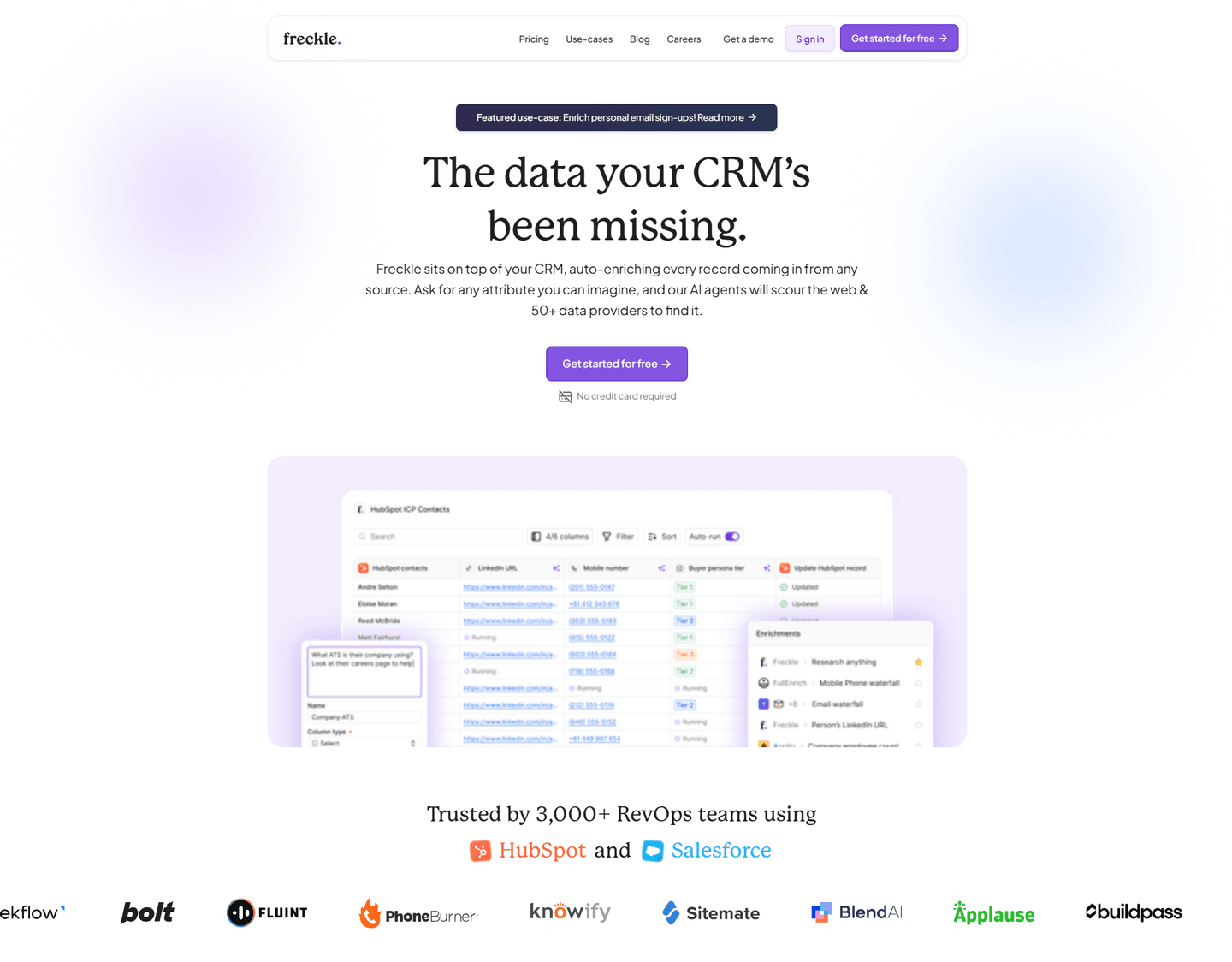
Freckle, A data enrichment tool that turns messy contact data into clean, synced profiles in three steps.

78/100
Gabriel AmzallagGabriel AmzallagFounder, Web Anatomy

Freckle makes an invisible data workflow tangible. The how-it-works section (scored 100, top-scoring) uses bold action verbs (Import, Clean and enrich, Sync), a data flow diagram showing email to enriched profile, and multiple import options (CRM, webhooks, CSV). The "3 simple steps" headline sets expectations before the visitor even reads the details.

What makes this page stand out

  • The clear product explanation — sits on top of your CRM, auto-enriches every record from any source — makes the integration model instantly understandable for RevOps buyers
  • "Ask for any attribute you can imagine" positions the AI enrichment as limitless and flexible, differentiating from rigid enrichment tools that only provide pre-defined data fields
  • 50+ data providers aggregated into a single enrichment layer creates a genuine data breadth advantage over tools that rely on a single proprietary database
  • Product screenshot showing real HubSpot integration with enrichment in action makes the value tangible — buyers can immediately see how Freckle fits into their existing workflow

Section we love

·How It Works
Freckle How It Works section
  1. 1The header promises enriching and scoring sign-ups in 3 simple steps, anchoring the whole flow
  2. 2Numbered cards 01 02 03 walk through import, clean and enrich, then sync back to your stack
  3. 3The header line sets a low-effort expectation while each step names the exact integrations (CRM, webhooks, CSV)
  4. 4The diagram visualizes raw inputs flowing into one enriched record then fanning out to Slack, CRM, Data Warehouse and more
  5. 5The sample record (LinkedIn, name, role, ICP and Buyer Persona fit scoring) previews exactly what you get back
03

Happeo, An intranet platform that unifies channels, pages, and people search for Google Workspace teams.

76/100
Gabriel AmzallagGabriel AmzallagFounder, Web Anatomy

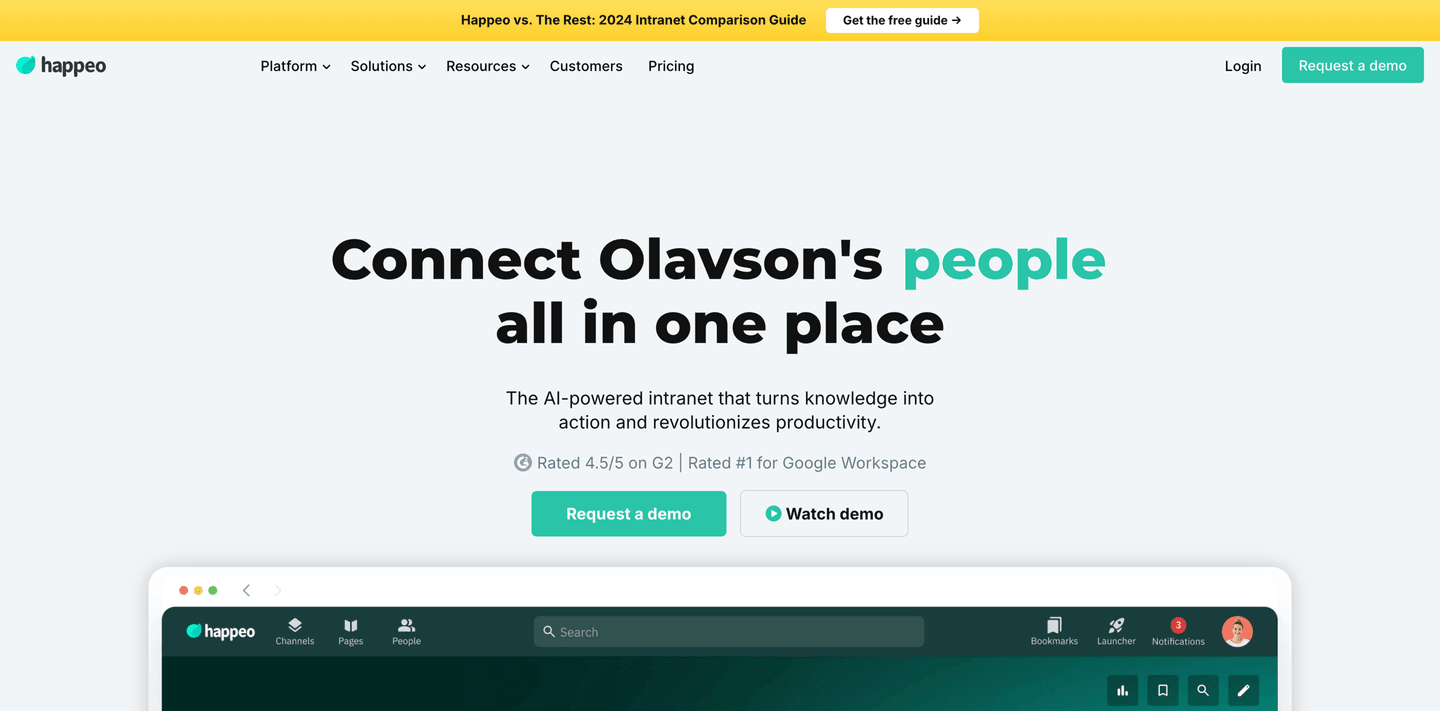
Happeo stacks social proof before the ask. The hero section (scored 78) layers G2 4.5/5 alongside a Rated number one Google Workspace badge, shows a real intranet UI with Channels, Pages, and People visible, and offers dual CTAs (Request demo plus Watch demo). The headline personalizes with the visitor's company name to increase relevance.

What makes this page stand out

  • "The intranet for companies that have outgrown drive, email and chat and need one official place without turning it into a 6-month project" — exceptionally specific pain point identification.
  • 4.5/5 G2 rating badge provides immediate credibility.
  • Dual CTAs "Request a demo" and "See pricing" give visitors both evaluation and pricing transparency paths.
  • Clean, modern design with teal accents signals a fresh alternative to legacy intranets.

Section we love

·Hero
Happeo Hero section
  1. 1Double social proof (4.5/5 on G2 and Rated number 1 for Google Workspace) builds strong credibility
  2. 2Real intranet UI showing Channels, Pages, People tabs proves the product is a working tool
  3. 3Dual CTAs (Request a demo) and (Watch demo) serve both active and passive buyer intent
  4. 4Headline personalizes with company name (Olavsons people) making it feel tailored to each visitor
  5. 5Clear product category (AI-powered intranet) with outcome promise (turns knowledge into action)
04

Perspective, A mobile funnel builder with structured education paths that teach users to convert faster.

75/100
Gabriel AmzallagGabriel AmzallagFounder, Web Anatomy

Perspective turns resources into a retention and conversion layer. The resources section (scored 60) offers three distinct paths (community, crash course, academy), names a real team member for credibility, and uses a wider bottom card to create visual priority. This pattern works well for SaaS companies with an educational content moat.

What makes this page stand out

  • "Easily create mobile-first, interactive, and personalized lead gen and sales funnels with market-leading conversion rates in just 30 minutes" packs multiple differentiators into one sentence: mobile-first, interactive, personalized, fast time-to-value.
  • "No design or coding skills required" removes the primary adoption barrier for the target audience (SMBs and agencies).
  • "Create free funnel in 30 min" CTA is brilliantly specific — the time commitment sets concrete expectations and makes the action feel achievable.
  • Dual review scores (G2 4.9, OMG 4.8) provide exceptionally high ratings that build immediate trust, complemented by "1k+ growth community" showing ecosystem engagement.

Section we love

·Resources
Perspective Resources section
  1. 1Heading Not sure where to start meets beginner anxiety and routes new users to the right resource
  2. 2All three resources (Community, Funnel Crash Course, Marketing Academy) center on funnel marketing, Perspective's core use case
  3. 3Original formats like a 60-minute live crash course and an Academy led by Head of Content Leni build real authority
  4. 4Each card carries a Learn more CTA that links into the deeper resource
05

Synapsa, A GTM intelligence platform that anchors its CTA around pipeline revenue generated for existing customers.

75/100
Gabriel AmzallagGabriel AmzallagFounder, Web Anatomy

Synapsa leads with outcomes, not features. The CTA section (scored 71) anchors with "$100M+ in pipeline generated" as a proof point, adds "Join hundreds of GTM teams" as social proof, and provides dual-path CTAs (Book Demo plus See Pricing) so both self-serve and sales-assisted buyers find their next step instantly.

What makes this page stand out

  • The "AI Sales Agent" category is simple and immediately understood: this isn't a copilot or assistant, it's an autonomous agent that handles outreach end-to-end
  • Differentiation against traditional SDR tools is clear: while competitors help humans sell faster, Synapsa replaces the manual outreach workflow entirely with AI-driven execution
  • The value proposition for lean sales teams (startups, SMBs) is compelling: enterprise-grade outbound capability without hiring a team of SDRs
  • Personalization at scale — the core promise — addresses the fundamental tension in outbound sales: you can send volume OR you can personalize, but doing both requires AI

Section we love

·Cta
Synapsa Cta section
  1. 1One dominant orange button (Book A Demo) clearly outranks the outlined See Pricing, so the main action stays obvious
  2. 2Outlined See Pricing gives a lower-commitment path for visitors who want numbers before a call
  3. 3Question headline (Ready To Convert More Pipeline?) plus $100M+ pipeline proof in the subhead frame a strong reason to act
06

Comet Rocks, A social commerce platform that turns social channels into measurable revenue drivers.

74/100
Gabriel AmzallagGabriel AmzallagFounder, Web Anatomy

Comet Rocks makes abstract use cases concrete. The use cases section (scored 100, top-scoring) pairs visual phone mockups with real social media interfaces, uses a dark background for premium feel, and connects each card to a business outcome (CVR, AOV). The micro-stores framing ties every feature to commerce metrics buyers already track.

What makes this page stand out

  • "Micro-storefronts" concept creates a new product category — not landing pages, not full stores, but personalized shopping funnels
  • Price anchoring ($49/mo starting) in the hero removes a major objection early and signals accessibility
  • Brand logos (NARS, Supercilium, Qure) provide social proof from recognizable beauty/lifestyle brands
  • "From ad click to checkout" clearly maps the user journey, making the value proposition immediately tangible

Section we love

·Use Cases
Comet Rocks Use Cases section
  1. 1Three micro-store use cases (Paid Social, Influencer storefronts, Whitelisted Influencer Content) split the offer by channel
  2. 2The Paid Social card names a concrete optimization goal (tailored micro-stores for CVR and AOV)
  3. 3The Influencer storefronts card targets co-branded activation of influencer communities
  4. 4Each card pairs a real mock (TikTok ad, IG story, For You feed) with its specific use case

See how your page compares to the 51.7 SaaS average

Run a section-by-section diagnostic on your SaaS page and get prioritized fixes, then see how you stack up against these SaaS website examples.

Design patterns across these SaaS pages

Across 300 SaaS homepage examples, the pages that convert share a consistent trait: the first screen does one job well, state a clear promise, show the product, and make the next step obvious.

The strongest SaaS landing page design patterns pair visual clarity with single focus, then back the claim with proof that feels easy to verify. Restraint beats density for SaaS buyers scanning quickly. Pages that guide the eye to one promise and one action consistently outperform those that try to say everything at once. Explore our best landing page examples to compare how other industries resolve similar clarity problems.

Trust Alchemy

0/100

How Alchemy builds credibility early

Alchemy trust section
  1. 1The padlock-with-fingerprint visual signals security but stays decorative, with no real badge or certification.
  2. 2(Secure assets) reads as a product feature (custodial and non-custodial wallets) rather than verifiable trust proof.
  3. 3No logos, numbers, or compliance seals appear, so there is no concrete evidence a buyer can check.
  4. 4The custodial vs non-custodial breakdown educates more than it reassures, leaving the trust angle thin.

Reviewed design-pattern pick from Alchemy’s trust section.

What I love about this section

  • The padlock-with-fingerprint visual signals security but stays decorative, with no real badge or certification.
  • (Secure assets) reads as a product feature (custodial and non-custodial wallets) rather than verifiable trust proof.
  • No logos, numbers, or compliance seals appear, so there is no concrete evidence a buyer can check.
  • The custodial vs non-custodial breakdown educates more than it reassures, leaving the trust angle thin.

Cta ActiveCampaign

80/100

How ActiveCampaign drives action without pressure

ActiveCampaign cta section
  1. 1Risk-reversal headline (See results in 30 days or get your money back) removes the fear of wasting money
  2. 2Primary button (Start your free trial) stays dominant with See details as a low-key text link
  3. 3Refund guarantee microcopy (full refund if you are not satisfied after 30 days) kills last-minute hesitation
  4. 4See details link gives unsure visitors a path to learn more without leaving the trial offer

Reviewed design-pattern pick from ActiveCampaign’s cta section.

What I love about this section

  • Risk-reversal headline (See results in 30 days or get your money back) removes the fear of wasting money
  • Primary button (Start your free trial) stays dominant with See details as a low-key text link
  • Refund guarantee microcopy (full refund if you are not satisfied after 30 days) kills last-minute hesitation
  • See details link gives unsure visitors a path to learn more without leaving the trial offer

Value Proposition Attribuly

100/100

How Attribuly presents their value

Attribuly value proposition section
  1. 1Four growth levers as separate cards, each headline carrying a number: retarget 2x, attribute 99%, grow email list 10x, richer analytics
  2. 2Every card has a custom data visual (50 to 90% donuts, channel journey graph, bar charts, funnel) that shows the lift, not decoration
  3. 3Mechanism is named, not vague: unifies Shopify, Meta, Google, Klaviyo and pushes server-side data into GA4, Looker Studio, BigQuery
  4. 4A Learn More link sits under every card so high-intent merchants can dig into a single lever

Reviewed design-pattern pick from Attribuly’s value proposition section.

What I love about this section

  • Four growth levers as separate cards, each headline carrying a number: retarget 2x, attribute 99%, grow email list 10x, richer analytics
  • Every card has a custom data visual (50 to 90% donuts, channel journey graph, bar charts, funnel) that shows the lift, not decoration
  • Mechanism is named, not vague: unifies Shopify, Meta, Google, Klaviyo and pushes server-side data into GA4, Looker Studio, BigQuery
  • A Learn More link sits under every card so high-intent merchants can dig into a single lever

Sections SaaS teams underuse (but visitors still look for)

Even with a strong hero, secondary sections often decide whether someone keeps scrolling, especially in competitive SaaS categories where buyers are comparing three or four tools simultaneously.

In this dataset, Navbar sections tend to outperform at 90.4 while Comparison sections are the most fragile at 33.6, suggesting many SaaS pages invest in messaging but leave gaps in wayfinding and competitive positioning that slow decisions. See how best fintech websites handle similar trust gaps in adjacent B2B categories.

Navbar Altura

71/100

Why this navbar works

Altura navbar section
  1. 1The open Platform menu splits into three columns (Workflows, Bid Management Platform, Platform overview) each with descriptions
  2. 2A product screenshot card previews the bid-management workspace inside the dropdown
  3. 3The dark Boek een demo CTA repeats inside the menu next to a full-platform link
  4. 4The Prijzen pricing tab stays visible beside Customers and Resources
  5. 5A language switcher and Login link round out the utility navigation

Reviewed overlooked-section pick from Altura’s navbar section.

What I love about this section

  • The open Platform menu splits into three columns (Workflows, Bid Management Platform, Platform overview) each with descriptions
  • A product screenshot card previews the bid-management workspace inside the dropdown
  • The dark Boek een demo CTA repeats inside the menu next to a full-platform link
  • The Prijzen pricing tab stays visible beside Customers and Resources

How It Works Banxware

33/100

How Banxware simplifies the process

Banxware how it works section
  1. 1The diagram maps the full flow from Lender through the Banxware Orchestration Layer out to funded SMEs
  2. 2The center panel names the concrete capabilities in the path (Always-on Pipeline, One API, Modern UX, Digital KYC AML, Pre-qualification)
  3. 3The right side shows the end outcome (Credit Brokers, SME Aggregators and Banxware direct reaching many SMEs)
  4. 4The labeled connectors (Financing product, Second look capability) make the orchestration role visually legible

Reviewed overlooked-section pick from Banxware’s how it works section.

What I love about this section

  • The diagram maps the full flow from Lender through the Banxware Orchestration Layer out to funded SMEs
  • The center panel names the concrete capabilities in the path (Always-on Pipeline, One API, Modern UX, Digital KYC AML, Pre-qualification)
  • The right side shows the end outcome (Credit Brokers, SME Aggregators and Banxware direct reaching many SMEs)
  • The labeled connectors (Financing product, Second look capability) make the orchestration role visually legible

Use Cases Agorapulse

25/100

How Agorapulse makes the product feel relevant

Agorapulse use cases section
  1. 1The three cards name concrete jobs (Streamline content management, Enhance team collaboration, Empower team with insights)
  2. 2The collaboration card targets a real pain (removing the friction of email approval chains)
  3. 3The insights card promises measurable results (metrics that matter, data to craft posts)
  4. 4The testimonial is role-specific (Joanne Watt, Marketing Lead at StreamYard)
  5. 5The quote backs the cross-team angle (everyone from marketing to product management on one platform)

Reviewed overlooked-section pick from Agorapulse’s use cases section.

What I love about this section

  • The three cards name concrete jobs (Streamline content management, Enhance team collaboration, Empower team with insights)
  • The collaboration card targets a real pain (removing the friction of email approval chains)
  • The insights card promises measurable results (metrics that matter, data to craft posts)
  • The testimonial is role-specific (Joanne Watt, Marketing Lead at StreamYard)

If you are refreshing a SaaS landing page design, treat navigation and comparison blocks as conversion infrastructure, not afterthoughts.

How does your SaaS homepage compare?

Five quick questions to see where your page stands against this SaaS benchmark. For a full section-by-section audit, try our landing page analysis.

Interactive quiz

What would your SaaS homepage score?

Question 1 of 5
0%

Can a visitor understand what your SaaS product does in under 5 seconds?

"Import, clean, and sync your contact data" beats "the all-in-one data platform for modern teams."

Gabriel Amzallag

Reviewed by

Gabriel Amzallag , Founder, Web Anatomy

5 years CRO + SEO at Qonto (2021–2025). After advising 15+ SaaS on their websites (Payfit, Pigment…), the same patterns kept breaking, so I decided to build the source of truth on what works on the web: the intelligence layer every tool, builder, and team uses to ship sites that perform.

See how your page compares to the 51.7 SaaS average

Run a section-by-section diagnostic on your SaaS page and get prioritized fixes, then see how you stack up against these SaaS website examples.

Analyze your SaaS pageFree. Takes 2 minutes.

Explore other industries

See how conversion patterns differ across verticals. Each page scores real homepages on the same framework.

See all industries
Benchmark-backed answers for SaaS website design

FAQ: Best SaaS Websites (Benchmarks)

Quick answers to common questions about what makes the best SaaS websites convert, based on section-level benchmark data from this review.

What makes the best SaaS websites different from average ones?

[01]

The best SaaS websites resolve "what does this do?" faster and with less cognitive load. The gap between strong and weak usually comes down to visual clarity, focus, and proof placement, not visual polish. Pages that guide the eye to one promise and one action consistently outperform those that try to say everything at once.

What sections should a SaaS homepage include?

[02]

A strong SaaS homepage typically includes a clear hero with one primary action, early social proof (logos, ratings, or a quantified outcome), a product visual or walkthrough, a focused features or use-cases section tied to outcomes, and a CTA that matches the buyer's readiness level. In this dataset, Cta, Features, and Hero are the three most common section types among top performers.

What is the biggest design mistake on SaaS landing pages?

[03]

Trying to say everything above the fold instead of saying one thing clearly. With an average page score of 51.7 across this dataset, many SaaS pages dilute their hero with competing messages, multiple CTAs, and no visible product proof, forcing the visitor to work harder than they should to understand the offer.

How important is navigation design for SaaS homepages?

[04]

More important than most teams realize. In this benchmark, Navbar sections averaged 90.4. The highest score of any section type. The strongest SaaS pages use navigation to route buyer intent (by use case, role, or journey stage) rather than mirroring internal product categories. ProductLed is a standout example, mapping nav labels to About PLG, Learn PLG, and Implement PLG.

What signals mean your SaaS homepage needs a rewrite, not just a tweak?

[05]

Three signals point to a rewrite rather than a tweak. First, new users keep asking sales what the product actually does. The hero isn't landing. Second, demo calls spend the opening minutes explaining the category instead of qualifying the buyer. The product proof isn't visible above the fold. Third, paid traffic bounces before scrolling past the hero. The offer isn't filtering intent. When two of three show up, the fix is positioning, not polish.

Where can I find great SaaS landing page inspiration?

[06]

Study SaaS pages section by section instead of saving full-page screenshots. Browse best landing page examples for the full gallery, then drill into hero section examples, trust section examples, and pricing section examples to see what the strongest SaaS homepages do differently at each stage of the funnel.

How do I audit my SaaS homepage before a redesign?

[07]

Use a structured rubric that checks clarity, proof, and friction instead of relying on subjective feedback. Run your page through the landing page analyzer for a section-by-section score.