
TL;DR
- The ads that keep running sell one of nine angles: the customer with a number, the clock, the AI, the document, the price, the founder, the craft, the joke, the compliance. Nine of the twelve advertisers run two or more. Slack runs five, Atlassian and DocuSign four each.
- AI is the most crowded message in the set. 101 of the 428 readable ads mention it, across nine companies, and Zendesk spent all 21 ads of its 45-day club on one sentence about self-improving AI.
- 11% of the social ads land on the homepage, against 33% of the search ads. The two pages that absorb the most traffic are built for one offer each: 40 Dropbox ads point at one campaign page, 37 Figma ads at one product page.
- Software puts the price on the card, and fintech does not. Twenty ads say free, Squarespace sells domains at $10 and Slack offers 50% off. Not one of the 428 says how long a free trial lasts.
13 companies swept, 689 Meta ads and 360 Google ads on file, Great Britain and the United States, September 2026. How we did it is at the end.
The sample: 13 software companies, their ads, and where the ads land
| Company | Meta ads on file | Ran 45 days or more | Still live | Oldest live ad | Where the ads land |
|---|---|---|---|---|---|
| Spotify | 60 | 51 | 54 | 403 days | the app stores (49 ads), Premium |
| Shopify | 60 | 50 | 2 | 91 days | start, free trial, Sweden |
| Canva | 60 | 47 | 9 | 89 days | Spain, Poland, the Netherlands |
| Squarespace | 60 | 38 | 30 | 192 days | create a website, services, the homepage |
| Figma | 60 | 35 | 46 | 154 days | Figma Make, Figma agents |
| Trainline | 60 | 30 | 1 | 183 days | the way to train, split tickets |
| Atlassian | 60 | 27 | 16 | 162 days | Jira, Confluence |
| Zendesk | 60 | 21 | 1 | 41 days | a tracking redirect (38 ads), retail |
| Dropbox | 60 | 20 | 18 | 21 days | one campaign page and its team version |
| DocuSign | 60 | 17 | 29 | 154 days | the IAM page, a webinar, a Deloitte study |
| Slack | 60 | 9 | 31 | 8 days | small business, Google Drive |
| GitHub | 29 | 0 | 29 | 5 days | a tracking redirect, all 29 ads |
| Linktree | 0 | 0 | 0 | none | nothing matched the brand |
Spotify, Shopify and Canva have found their ads: 51, 50 and 47 of their 60 have passed 45 days. Slack and GitHub are still looking, and both are mid-relaunch, with 31 and 29 ads live and the oldest of them 8 and 5 days old.
Ad analysis: the nine angles software ads use
Every message we could read on Meta fits one of nine angles. For each one: the ads that ran longest, one creative to look at where we captured it, and why it keeps running. The number in brackets is how many days the ad had been running when we looked.
1. The customer with a number
The strongest angle in the set, and the one carrying the oldest live creatives. The ad names a company, gives a figure, and says what changed.
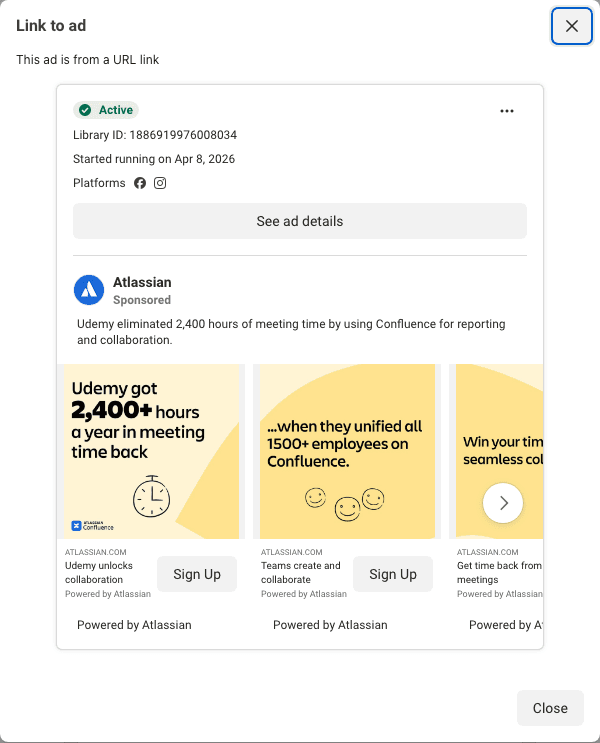
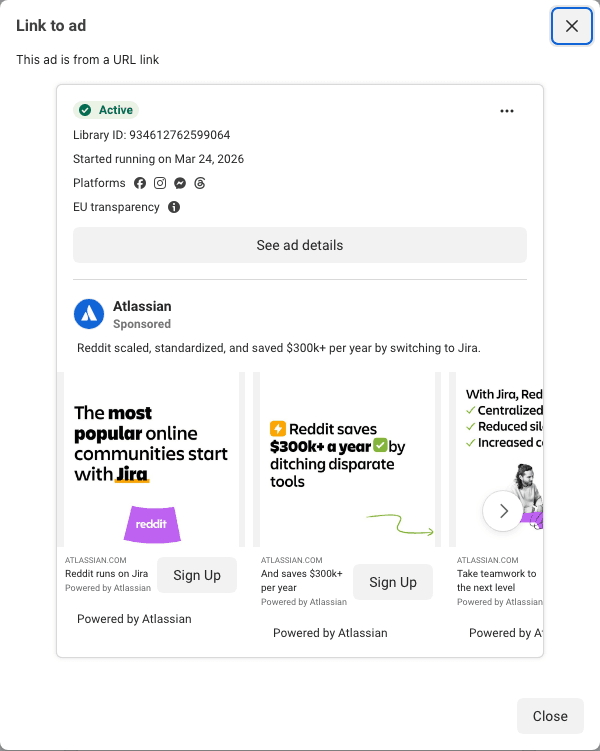
- Atlassian: "Reddit scaled, standardized, and saved $300k+ per year by switching to Jira" (162 days, live), "Udemy unified their people and processes by switching to Jira" (162 days, live), "Udemy eliminated 2,400 hours of meeting time by using Confluence" (147 days, live).
- Atlassian again: the Jira Service Management card, whose creative reads the Thumbtack IT team is on track to save 350 hours every year (151 days).
- Slack: "Wolf & Badger keeps clothing flying off the shelves with a little help from Slack" (8 days), "Swap chaos for clarity and keep teams aligned. That's how Anthropic scales with Slack" (8 days).
- DocuSign: "Double agreement capacity. Remove process friction and scale growth", on a Catchafire customer story (13 days).
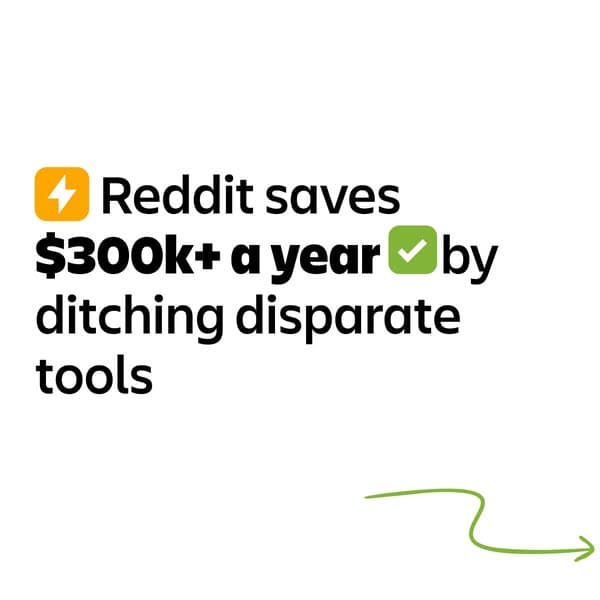
Why it runs: a finance or IT buyer can take "$300k+ a year" into a meeting. The three Atlassian carousels built this way are the oldest live creatives in the sweep, at 162, 162 and 147 days.
2. The clock
Time, counted. Every ad in this group puts a figure on what the buyer gets back.
- Atlassian: "Get time back from meetings with Jira" (145 days, live, and four more versions to 140 days), behind a creative that reads Udemy saves 2,400 hours a year with Jira.
- Slack: "Get time back with Slack. 2 hours a day x 5 days a week x 52 weeks a year = Your most productive year ever" (8 days).
- DocuSign: "Finding data across thousands of agreements took days. Not anymore" (96 days, live), and "the AI-powered platform turning hours of work into seconds" (96 days, live).
- Slack again, without the arithmetic: "Why do your own busywork when automations in Slack can do your busywork for you?" (18 days).

Why it runs: 2,400 hours is a number a team lead can divide by their own headcount before they click.
3. The AI
101 of the 428 readable ads mention AI, across nine of the twelve advertisers. No other word in the set is repeated by that many brands.
- Zendesk: one sentence, "Zendesk is defining the future of service with self-improving AI", under three executive quotes, run as 21 separate ads between 69 and 53 days.
- DocuSign: "One AI platform for all your agreements" (96 days, live), "Docusign AI digitizes and organizes" (123 days, live).
- Figma: "Try Figma Make today. Imagine an AI-powered design tool that can pull from your design system so everything looks just right" (105 days, live), "Designers, meet Figma's AI agent" (20 days, live).
- Canva: "Canva AI can keep you on brand" (58 days, live). Slack: "Catch up quicker with AI" (7 days). Atlassian: "Atlassian's Rovo is everywhere, for everyone" (9 days). GitHub: a whole Copilot CLI launch, every ad 5 days old or less.
Why it runs: the ones that last pin AI to a job. Figma's card names the design system it reads; Zendesk's names the three people who signed off on the claim. The GitHub and Atlassian AI ads are days old, so there is nothing yet to say about whether they stay.
4. The document
Nothing for sale on the card. A report, a guide or a webinar seat in exchange for an email, and DocuSign runs more of these than anyone.
- DocuSign: "Download the Free Report", on a Deloitte study of agreement technology, twice at 105 days and once at 103, all live. One of the two carries the only percentage in the set that comes from research: organizations see a 29% higher ROI from time savings, cost avoidance, cost savings, and revenue uplift.
- DocuSign again: "Sessions Offered Every Other Tuesday" (127 days as an image, 114 as a video, both live) and "Learn more during our 30-minute webinar!" (96 days, live), all three pointing at one registration page.
- Figma: the annual State of the Designer 2026 report, run in Japanese to a Japanese page (113 days, two ads, live).
Why it runs: the product is on the page the ad opens and never on the card, so the ad does not go out of date when the product does. DocuSign's three oldest live creatives are all documents.
5. The price
This is where software parts company with fintech, where almost no ad names a figure. Twenty of the readable ads say free and several put a number on the picture.
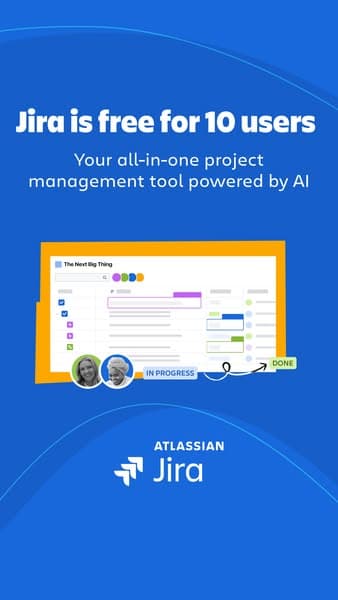
- Atlassian: "Jira is free for 10 users" on the creative (162 days, live), "Try Confluence for free" (146 and 141 days, live).
- Squarespace: "Domains starting at $10" (144 days, live), "Domains starting under $15" (62 days, live), "Save 20% on your website today. 20% off with code SQSP20" (49, 48 and 47 days, live).
- Slack: "Get 50% off Slack" (8 days, twice).
- Canva: "Sign up for free" (49 and 48 days, live). Spotify: "Get Spotify for free" (227 days, live).
Why it runs: a seat count or a dollar figure is something the reader can check on the pricing page in one click. The two oldest price lines here, Atlassian's 10 free users and Squarespace's $10 domain, have run 162 and 144 days.
6. The founder
Shopify is the only company in the set that makes its customers the subject of a whole line of ads, faces and names included. Slack has one card built that way; Shopify has been running them for more than a year.
- Shopify: "East Fork started in a barn. Now they sell across the planet", with Alex Matisse holding one of his plates and the line Shopify opened us up to the world (105 days).
- Shopify: "Eastside Golf is changing the game on courses everywhere", with Olajuwon Ajanaku and the line if you're doing it the right way, you're on Shopify (153 days).
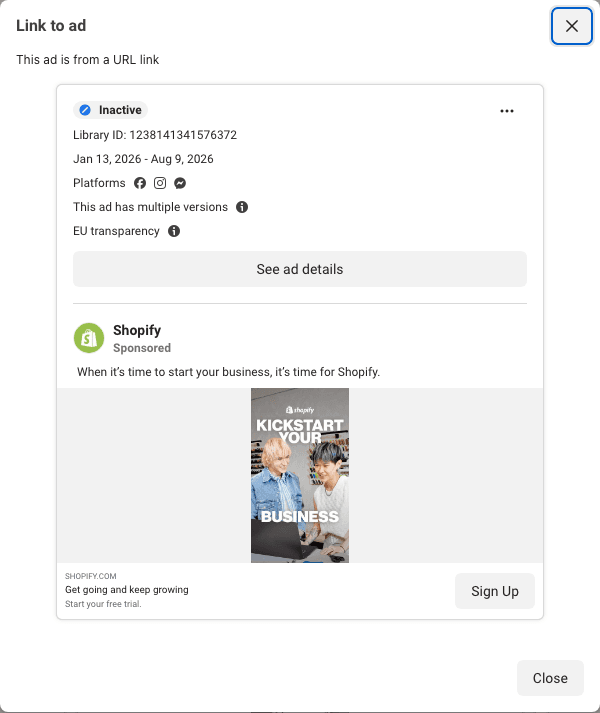
- Shopify: "Spin your passion into a business" over a record-shop owner, and "Kickstart your business" over two people at a laptop in a haberdashery (153 and 208 days).
- The nearest thing anyone else runs is Dropbox's artist films, where the producer Fred again.. shares the process behind a record built across 10 weeks, 10 songs and 10 cities (6 days).

Why it runs: Shopify is selling a shop, and the picture shows a named person who has one. The four cards above ran 208, 153, 153 and 105 days.
7. The craft
The website builders show the buyer's finished work on screen and leave the editor in the background.
- Squarespace: "Build your website your way", with your set in an italic serif and a cursor parked on an editing toolbar (139 days, and a 99-day rerun).
- Squarespace: "Sell what you do directly from your site", with an order summary reading Wellness Retreat, total $525 (143 days).
- Squarespace: "Easily express yourself online. Use Squarespace's intuitive design tools to create a site that reflects your personal brand" (56 days, live).
- Canva: "Here are 3 FREE Canva features that can help you plan lessons faster this back-to-school season. Which one will you try first?" (49 days, live), and "Plan your year with Learn Grid" for teachers (48 days, live).
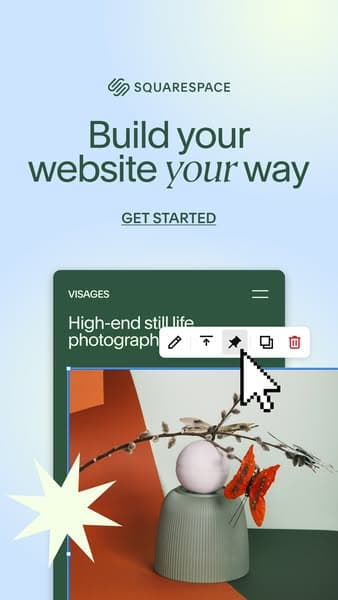
Why it runs: every one of these creatives shows a finished site or a paid order rather than a Squarespace screen, and the four Squarespace cards ran 143, 139, 99 and 56 days.
8. The joke
Three of the twelve sell a feeling and leave the product out: Trainline, Spotify and Dropbox.
- Trainline: "When the type B friend uses Travel Assistant and they become the type A friend" (105 days), "Split to save the smart way. Meet SplitSave, our very own super genius way to save you money on train tickets" (231 days), "Sometimes we're The Direct Devotee, but we're always a SplitSave Justifier" (69 days).
- Spotify: "Give every step a soundtrack" (299 and 287 days, live), "Spotify, It Gets You. Search 'Daylist' to get your day in a playlist" (109 days, live).
- Dropbox: "Sometimes what feels like an ending is actually a beginning" (20 days, live), "If you're going in circles, you're sure not going forward" (18 days, live).
Why it runs: Spotify has run "Give every step a soundtrack" for 299 days and Trainline's SplitSave film ran 231, longer than any B2B creative in this set. We did not capture cards for these, so they are quoted from the copy fields the library publishes and not from the picture.
9. The compliance
Rare, and worth noticing because fintech almost never runs it either.
- Slack: "Slack stores our data in the UK, so it's GDPR compliant", a customer quote attributed to Alasdair Bradley, Customer Support Supervisor at Wolf & Badger, under the link line Slack means secure (83 days).
- Zendesk: "We're moving beyond features to establish the most trusted foundation for agentic service the industry has ever seen" (57 days), and "Speed and compliance, no tradeoff. Your customers want speed. Regulators want proof" (6 days).

Why it runs: it puts the compliance question in a customer's mouth instead of the vendor's, and names the country.
One pattern sits outside the nine because it is a shape rather than a message: the series. Zendesk ran 21 ads off three sentences. Atlassian keeps one layout and swaps the customer. Squarespace rotates three headlines against one page. Slack launched seven ads at one page in eight days.
Ad analysis: five angles almost nobody in software uses
Read against all 428 readable ads, these five appear twice or not at all. The closest existing ad is named each time, and linked in the sources, so you can start from it.
- A named competitor. Not one ad in the set names a rival. The closest is Atlassian's "by switching to Jira" and "by ditching disparate tools" (162 days), which names the destination and never the thing being left. DocuSign's "Manage your contracts with the leader" (7 days) claims the position without a comparison.
- A trial you can time. Twenty ads say free. None says for how long. The closest is Atlassian's "Jira is free for 10 users" (162 days), which bounds the free tier by seats instead, and Shopify's "Start your free trial" in the link line under a 208-day card.
- A number the reader works out. No calculator, no slider, no "see your figure" on any card. The closest is Slack's "2 hours a day x 5 days a week x 52 weeks a year" (8 days), which does the arithmetic for the reader, and DocuSign's "29% higher ROI" (105 days), which is research about other companies.
- A guarantee. One brand, and it is the train company: Trainline's Best Price Guarantee (75 days, and again at 39). No software advertiser here promises anything back if the product does not work.
- A date on the card. Two ads carry one: Trainline's Christmas film (38 days) and GitHub's Universe ad, which names October 28 and 29 (5 days). Squarespace's SQSP20 code runs on "a limited time" and never names the day it ends.
Landing page analysis: what happens after the click
The two channels behave differently, and the gap is wide enough to plan around:
- On Google, 33% of the ads point at the homepage. 118 of the 360 on file. Squarespace sends 31 of 60 there, Shopify 29 of 60. A search ad answers a question the visitor typed, so the homepage can carry it.
- On Meta, 11% do. 61 of the 547 ads that link to the brand's own site. A social ad has to create the intent, so the page has to finish what the ad started.
- The pages worth studying are the social ones. The kind of page sorts these advertisers into four tiers. Every page below is linked.
| Tier | The ad points at | In the sweep |
|---|---|---|
| 0 | The homepage | 61 of 547 ads |
| 1 | A product page that already existed | Figma Make (37 ads), Atlassian's Jira page (23 ads), Trainline's railcards page |
| 2 | A page that exists because the ad does | Dropbox's share-more page (40 ads), DocuSign's webinar page, Shopify's free-trial page |
| 3 | A campaign path or a market in the address | Squarespace's create-a-website page (29 ads), Slack's small-business page, Canva in Polish, Shopify in Swedish |
Tier 1: the ad points at a product page that already existed
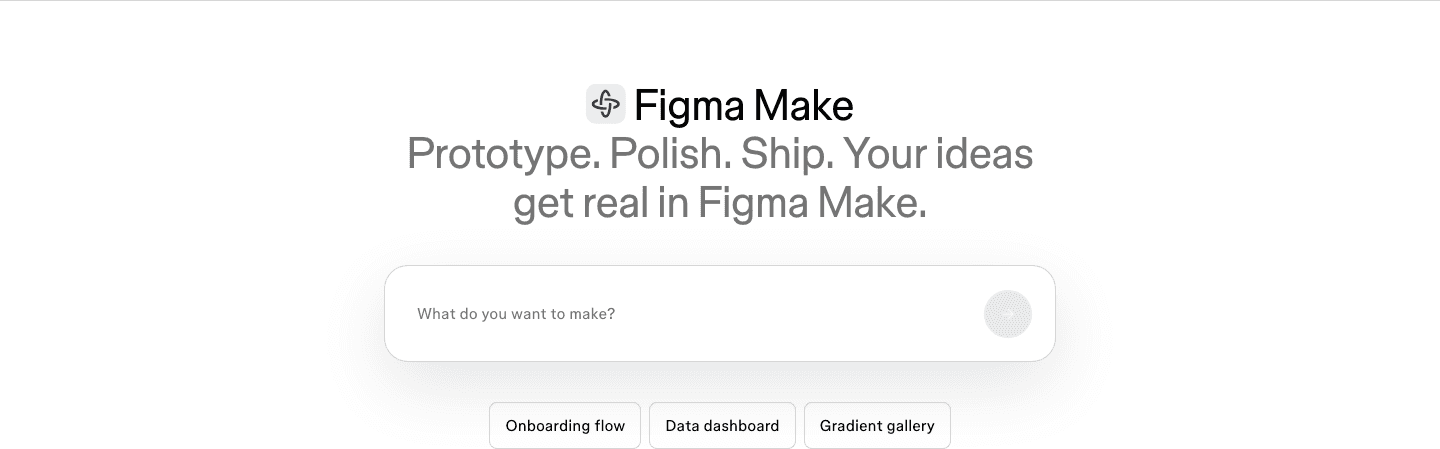
- 37 Figma ads land on figma.com/make, a page anyone can reach from the product menu.
- Nothing was built for the campaign, and the page carries the full site footer with every other product in it.
- It is the cheapest tier, and 261 of the 547 brand-site ads in this sweep sit on it.
Tier 2: the ad points at a page built for that ad
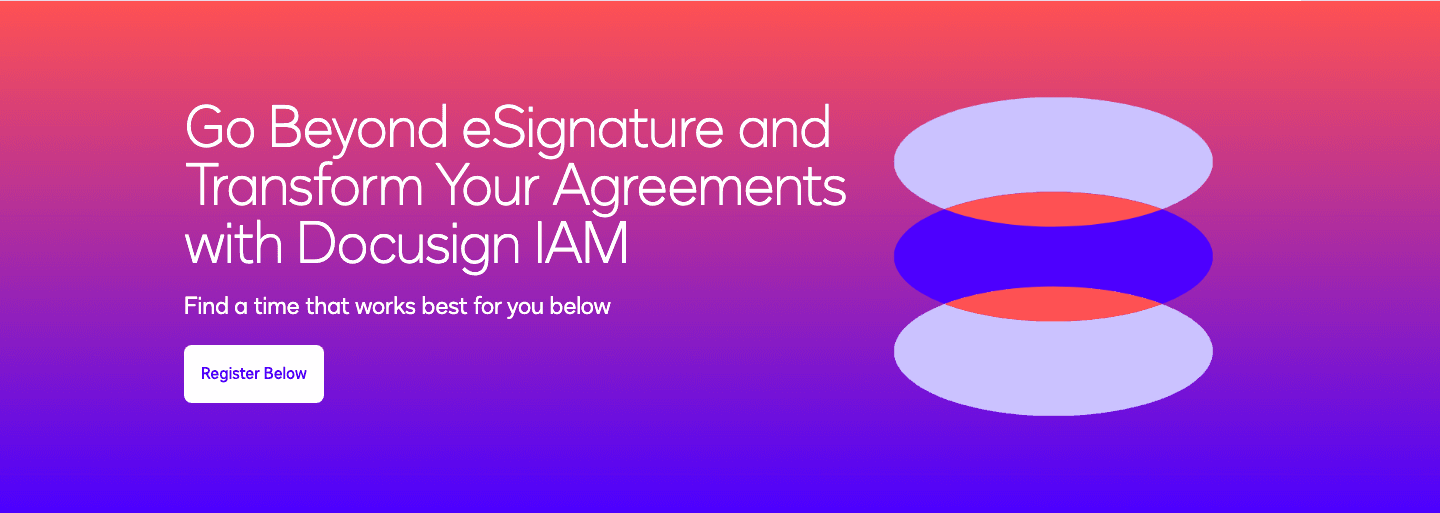
- DocuSign's webinar ads land on a page at a different address, events.docusign.com, with one heading, one line and one Register Below button on 1,391 pixels.
- Dropbox's campaign page does the same job for 40 ads at once. Neither page is reachable from the site navigation; both exist because an ad does.
Tier 3: the ad points at a campaign path or a per-market page
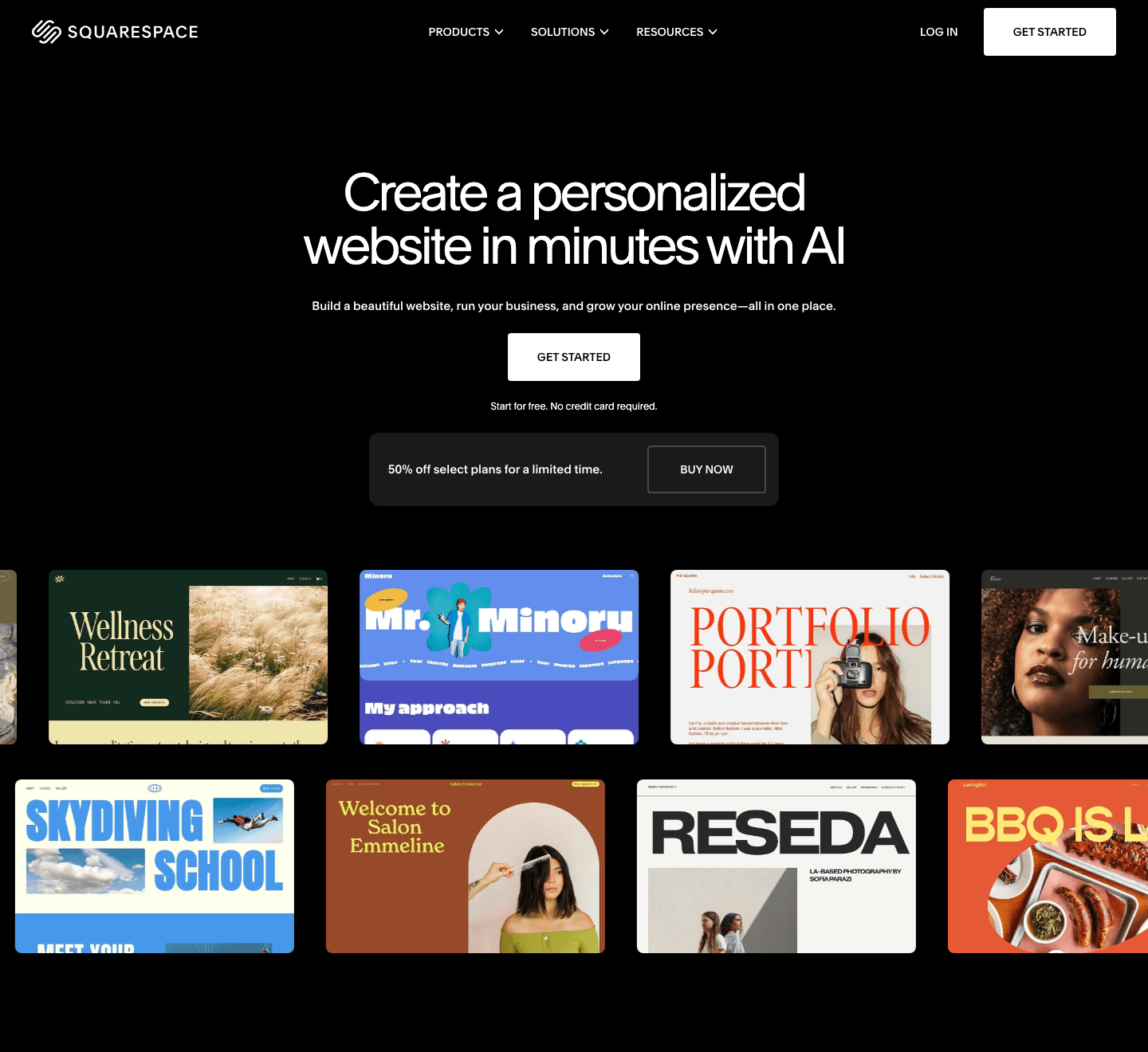
- 29 Squarespace ads land on /go/create-a-website. The
/go/prefix is a campaign family, which means Squarespace builds enough of these to need a place to put them. - Read the offer: the ads say 20% off with code SQSP20, the page says 50% off select plans. Both are true, and the visitor has to reconcile them.
- Canva runs 18 of its 24 pages per market, Shopify 11 of 17. Those two sell in the most languages and have the most pages to show for it.
How many paid pages each company runs
| Company | Brand-site Meta ads | Distinct pages | Of which per-market |
|---|---|---|---|
| Canva | 53 | 24 | 18 |
| Atlassian | 55 | 22 | 0 |
| DocuSign | 51 | 22 | 0 |
| Shopify | 41 | 17 | 11 |
| Trainline | 42 | 13 | 0 |
| Slack | 60 | 11 | 3 |
| Squarespace | 47 | 5 | 1 |
| Zendesk | 15 | 5 | 0 |
| Dropbox | 55 | 4 | 0 |
| Figma | 56 | 3 | 1 |
| Spotify | 11 | 1 | 0 |
- Ad counts barely separate these companies, because the library stops at about 60 per brand. Page counts do, from Spotify's 1 to Canva's 24.
- Figma and Dropbox sit at the other end from Canva. Figma puts 37 of its 56 brand-site ads on one page; Dropbox puts 40 of its 55 on one, plus 15 more on that page's two branches.
- GitHub is left out: all 29 of its Meta ads point at a tracking redirect, so its pages cannot be read from the library. 38 of Zendesk's 60 do the same, which is why its page count is built on only 15 ads.
Try it on yourself. Open your own Ad Library entry, click an ad, look at where it lands. The homepage puts you on tier 0. A campaign path or a market code in the address puts you on tier 3. Most teams are on tier 1, pointing paid traffic at a page that was written for somebody else.
Teardown 1: Figma
Two campaigns taken apart the way we take apart a page in a client audit: the ads, then the page they land on, then the gaps. Figma because 37 ads point at one page and the oldest has run 154 days. Dropbox because 40 ads point at one page that was built for them.
The campaign. 37 brand-verified ads pointing at figma.com/make, the two oldest running since April 1, 2026, which was 154 days when we swept on September 2. Twenty-seven of the 37 were still live that day. Figma runs three paid pages in total: Make, the agents page launched on August 13 with 17 ads behind it, and a Japanese report page. 56 of its 60 ads go to its own site, and not one goes to the homepage.
The ads
We captured no card for Figma, so what follows is the copy the library publishes, not a reading of the picture. Four messages carry the campaign, and seven dynamic units at 154 and 135 days return a template instead of copy.
The momentum message, "Supercharge your team's work. Move from concept to execution without breaking momentum", runs as five video ads between 134 and 95 days, all live. It names no feature. The promise is that work does not stall between the idea and the finished screen.
The fit message, "Built into how you already work. Keep your workflow connected in one continuous flow with Figma", runs three times between 133 and 68 days. This is the one aimed at a designer who already has a tool and does not want a second.
The product message is the only one that describes what Make does: "Try Figma Make today. Imagine an AI-powered design tool that can pull from your design system so everything looks just right. Yep, it's here." It runs four times between 105 and 57 days, all live, as a static image.
The price message, "Design at the speed of thought. Try Figma AI for free", runs twice at 77 days. It is the only Figma message in the set that mentions money.
The landing page

The hero. The product name, then one line of three verbs, Prototype. Polish. Ship. Your ideas get real in Figma Make. Under it, where most pages put an email field, there is a prompt box reading What do you want to make? and three starter prompts: Onboarding flow, Data dashboard, Gradient gallery. No price, no sign-up button, no form. The first thing the page asks a paid visitor for is an idea.
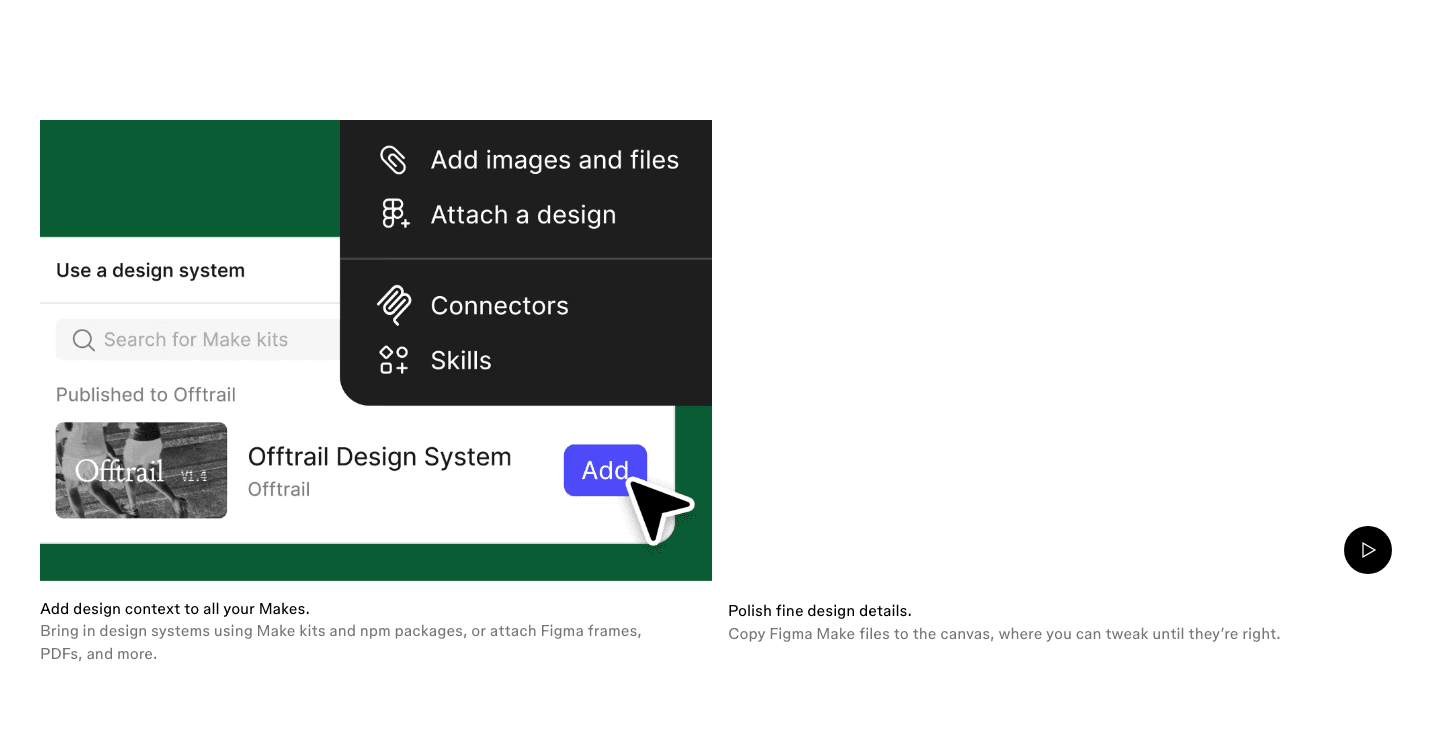
The design-context band. Add design context to all your Makes. Bring in design systems using Make kits and npm packages, or attach Figma frames, PDFs, and more. Beside it, polish fine design details. Copy Figma Make files to the canvas, where you can tweak until they're right. The screen shows a kit called Offtrail Design System being added.
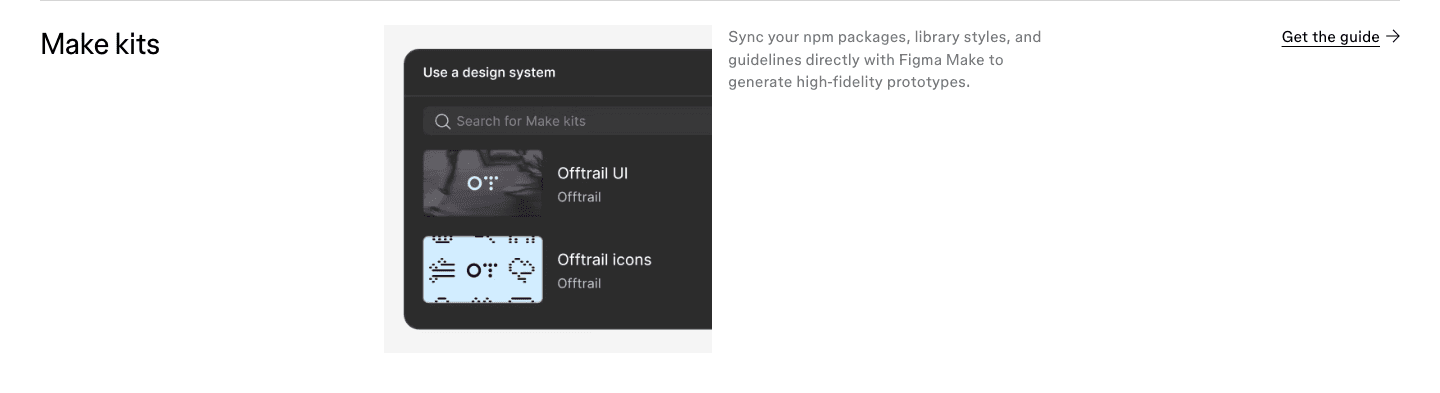
The kits row. Make kits. Sync your npm packages, library styles, and guidelines directly with Figma Make to generate high-fidelity prototypes. One link, Get the guide. The ad promised the tool would pull from your design system; this row says which three things it pulls.
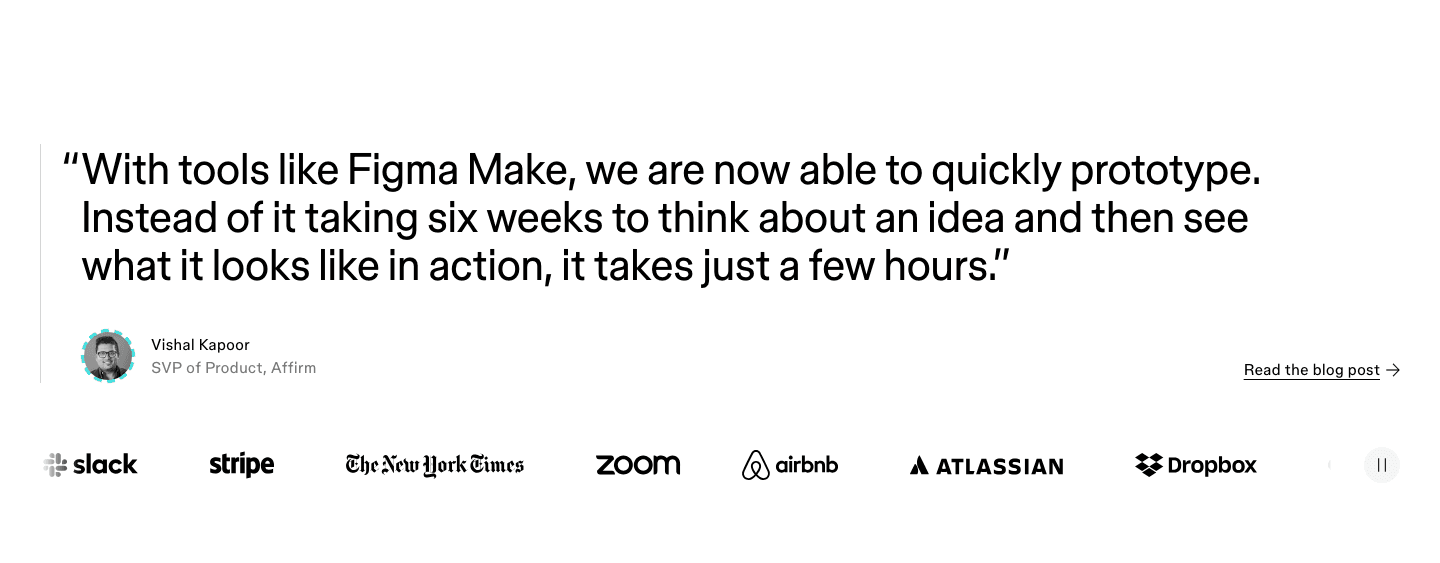
The proof. Vishal Kapoor, SVP of Product at Affirm: instead of it taking six weeks to think about an idea and then see what it looks like in action, it takes just a few hours. A second quote further up the page is from a product manager at Ticketmaster. Under them, a logo row: Slack, Stripe, The New York Times, Zoom, Airbnb, Atlassian, Dropbox. Six weeks against a few hours is the only before-and-after figure anywhere in this campaign, and it is on the page, not on a card.
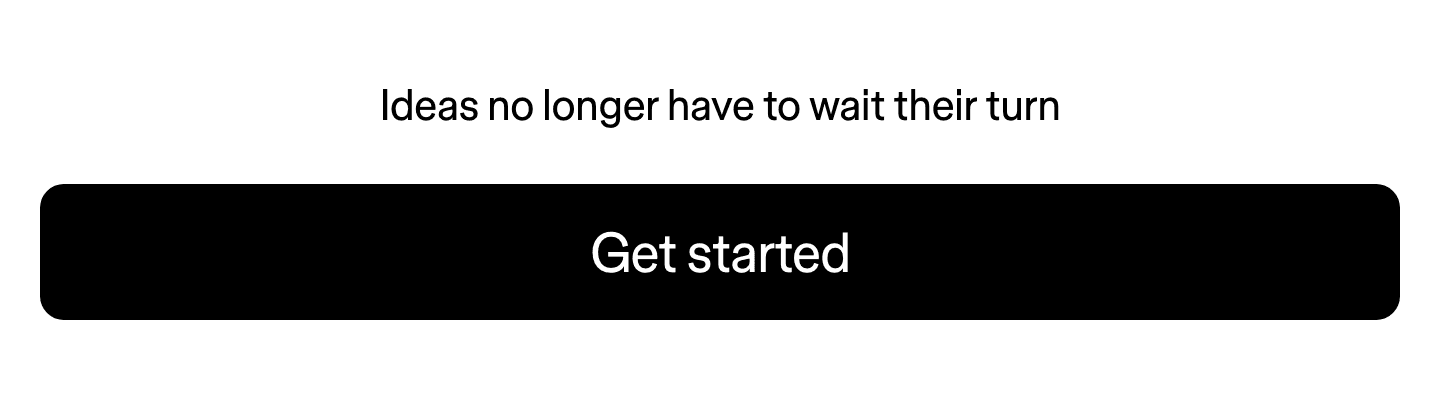
The closer. One line, ideas no longer have to wait their turn, and a Get started button the full width of the column. Then the site footer, with nine other Figma products and sixteen use cases in it.
Message match
| The ad says | The page proves it with |
|---|---|
| Pull from your design system so everything looks just right | The kits row: npm packages, library styles and guidelines, by name |
| Move from concept to execution without breaking momentum | A prompt box in the hero, with three prompts already written |
| Built into how you already work | The design-context band: attach Figma frames, PDFs and your codebase |
| Try Figma AI for free | Nothing. The word free does not appear on the page |
The gaps
Two gaps, both cheap to close. The 77-day ad sells a free trial and the page has no price, no plan and no free line anywhere on 10,037 pixels; the only route to one is the Pricing link in the footer, under a column listing nine other Figma products. One line under the prompt box would carry it. The second: two of the page's bands end in "coming soon", including the local-codebase row and the line under the product film. On a page that 37 paid ads point at, two of the things being shown cannot be used yet.
The competitive audit looks for gaps like these on your own pages, the same way.
Teardown 2: Dropbox
The campaign. 40 ads point at dropbox.com/campaigns/share-more, the three oldest running from April 22, 2026 to August 5, which was 105 days. Eight more point at the team version and seven at the Replay version, so 55 of Dropbox's 60 ads land on one campaign and its two branches. One ad in 60 points at the homepage.
The ads
The eleven oldest, at 105 and 104 days, are dynamic units whose copy the library returns as a template, so they cannot be read from outside. The ads that do carry copy are newer, and all of them are the campaign's two words plus one sentence that never mentions software.
"Share more with Dropbox. Sometimes what feels like an ending is actually a beginning" (20 days, live). "Share more with Dropbox. If you're going in circles, you're sure not going forward" (18 days, live). "Share more with Dropbox. There's only one way to know if the studio riff is your next hit single" (13 days). The only Dropbox ad we can read that names the product's job points at the team branch: "Try Dropbox today. Share every file, comment, and version in Dropbox" (16 days, live).
Around them run films about working artists, including one in which the producer Fred again.. shares the process and the assets behind a record built across 10 weeks, 10 songs and 10 cities (6 days). A reader who sees four of these learns the brand's idea and nothing about the product.
The landing page
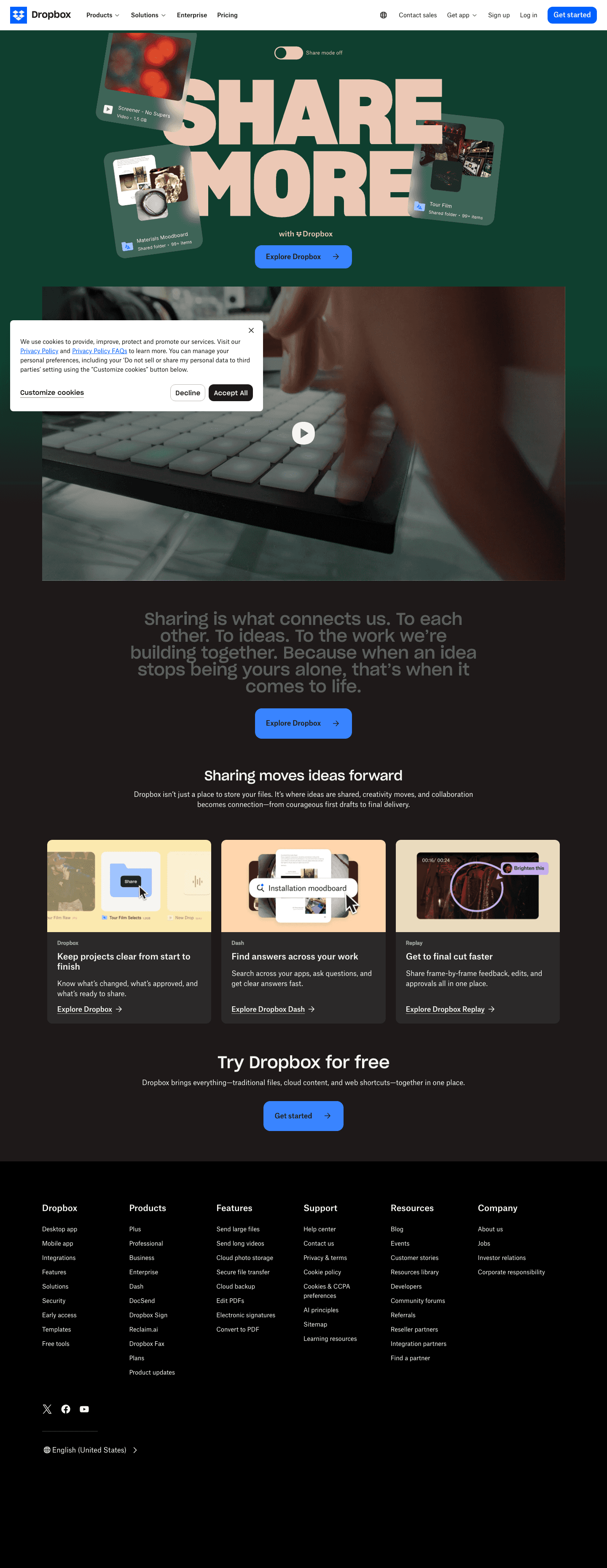
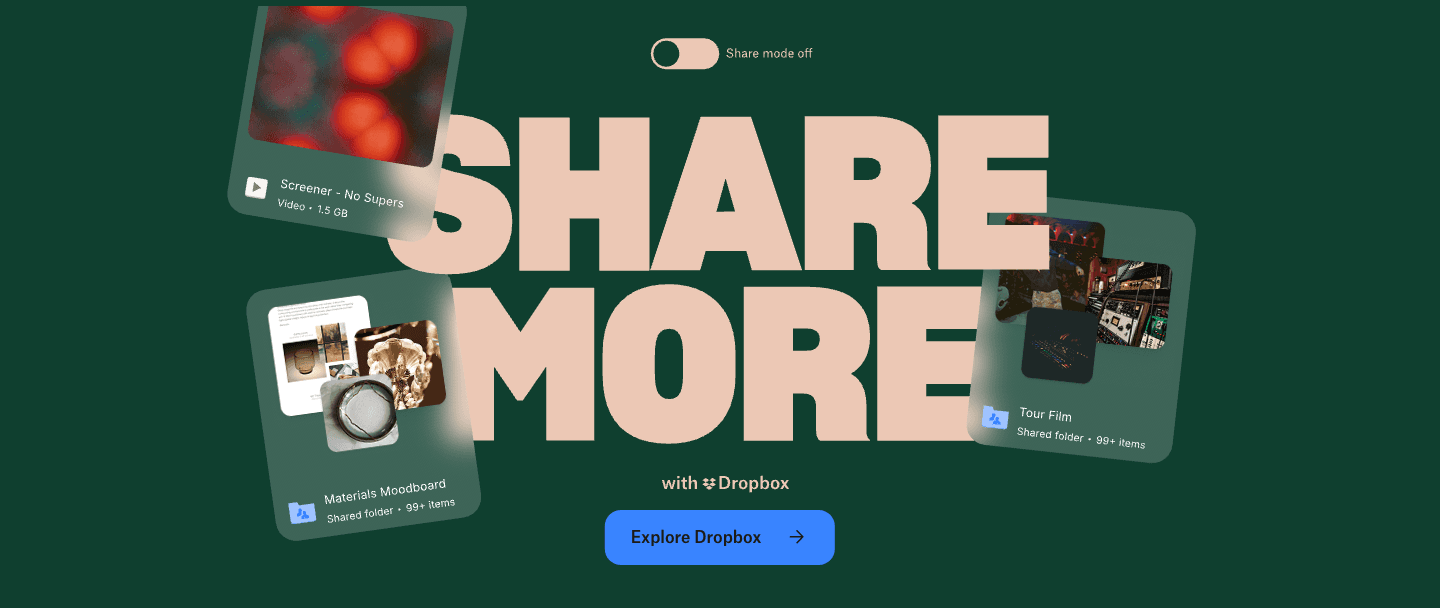
The hero. SHARE MORE in a display face the width of the screen, with Dropbox in small type under it, and one blue button, Explore Dropbox. Four tilted cards float around the words and each one is a real file: a 1.5 GB video called Screener, a Materials Moodboard with 99+ items, a Tour Film folder with 99+ items. A toggle at the top reads share mode off. The ad's two words are the page's only headline.

The manifesto. Sharing is what connects us. To each other. To ideas. To the work we're building together. Because when an idea stops being yours alone, that's when it comes to life. Then Explore Dropbox again. The ad running at 14 days uses the same clause with one word changed, track in place of idea.
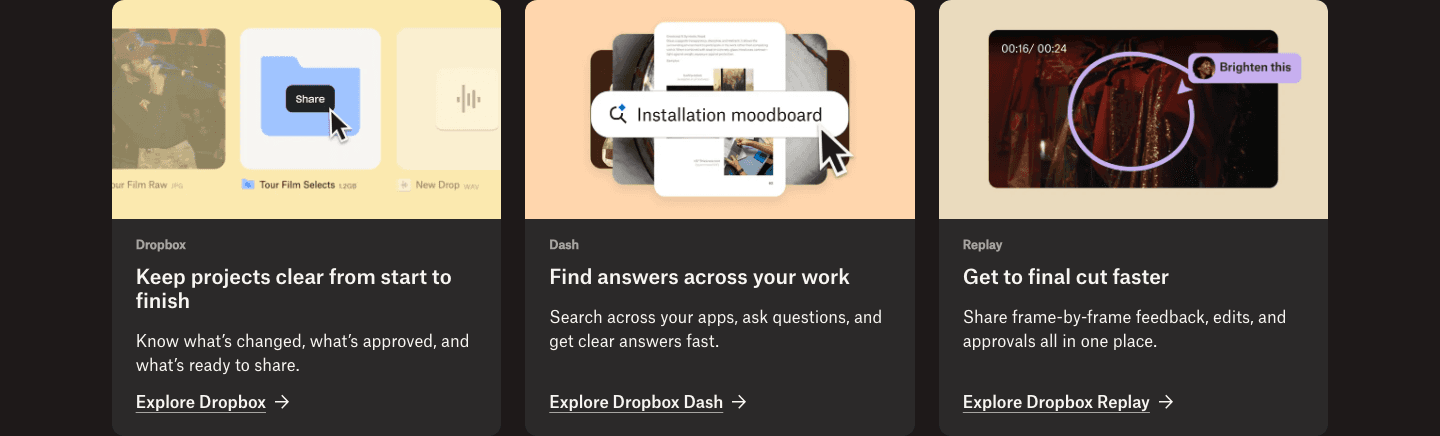
The product row. Three cards and three products. Dropbox, keep projects clear from start to finish. Dash, find answers across your work. Replay, get to final cut faster. Each card has its own Explore link, so one campaign splits into three destinations here.

The closer. Try Dropbox for free, over a line saying Dropbox brings traditional files, cloud content and web shortcuts together in one place, and a Get started button. This is the first and last time the page asks for anything, near the foot of 3,721 pixels.
Message match
| The ad says | The page proves it with |
|---|---|
| Share more with Dropbox | SHARE MORE as the only headline, in letters the width of the screen |
| When the track stops being yours alone, that's when it comes to life | The manifesto band, nearly word for word |
| Share every file, comment, and version in Dropbox | Three product cards: Dropbox for projects, Dash for search, Replay for video |
| Try Dropbox today | One Get started button, at the foot of the page |
The gaps
Two gaps. The page offers five ways out before it offers one way in: Explore Dropbox twice, then Explore Dash, Explore Replay and the full site footer, all of them ahead of the single Get started at the bottom. A visitor who clicked one ad about sharing files is handed three products to choose between first. The second gap is that nobody is named. The ads are built on working artists and the page shows folders called Tour Film and Materials Moodboard without saying whose they are. One named customer on the page would carry the campaign's own argument.
We read pages this way for a living. The competitive audit does it on yours, against the competitors you name.
Key takeaways: five things to do with this
- Put a customer and a number on the card. The three oldest B2B creatives here carry Reddit's $300k+ a year, Udemy's 2,400 meeting hours and Thumbtack's 350 hours, at 162, 162 and 151 days. All three name the company.
- Build the page for the offer. 486 of the 547 brand-site ads land somewhere other than the homepage. The two pages taking the most ads are Figma's product page with 37 and Dropbox's campaign page with 40.
- Put the ad's sentence on the page. Figma's "pull from your design system" is a row on its page. Figma's "for free" is not, and that ad ran 77 days.
- Say what free means. Twenty ads here say free and none says for how long. Atlassian's "free for 10 users" is the only bounded version in 428 ads.
- Try one of the five open angles. A named competitor, a trial you can time, a number the reader works out, a guarantee, a date. Three of the five appear in no ad at all.
How to run this analysis on your own competitors
The Meta Ad Library and the Google Ads Transparency Center are public and free. Search the brand's page rather than a keyword, set the country, filter to active ads, sort by start date. Then:
- Group the ads by angle. Use the nine above.
- Keep the ones that have run 45 days or more. The advertiser keeps paying for those. Click through and read the page each one lands on.
- Write down the angles they are not running. Start your next campaign from that list.
Or send us the URL and we do it for you.
How we did the analysis
- Sample: the software companies on the benchmark leaderboard, picked by traffic, not by advertiser status. Fifteen were selected. Weebly and Mozilla were not captured and are set aside. Linktree was swept and nothing on file matched the brand, 60 ads failing the page-name check and 36 the format check, so it stays in the table with zeros. That leaves 13 swept and 12 with a readable Meta ad: Atlassian, Canva, DocuSign, Dropbox, Figma, GitHub, Shopify, Slack, Spotify, Squarespace, Trainline and Zendesk.
- Sources: the Meta Ad Library, searched by brand page, and the Google Ads Transparency Center, both through Apify, swept on 1 and 2 September 2026 in Great Britain and the United States.
- Filter: brand-verified ads only. An ad counts when the advertising page name matches the brand and the landing host is the brand's own domain or an app store. Everything else is dropped, and the tally of what we dropped is in the dataset.
- Ranking: days active. The floor of interest is 45 days, the point at which an ad has survived at least one budget review. 154 of the 428 readable ads cleared it.
- Reading: every distinct message was read by hand and put in one angle. Dynamic ads return a template instead of copy, so those were read from the creative image where we captured one, and counted but not quoted where we did not.
- Limits: the library returns about 60 ads per brand per market, so the per-company counts are a floor and the shares inside the sample are what to read. Meta publishes reach only in the EU and never publishes spend. Shopify's UK page came back in French when we captured it, so that capture is not shown here.
Every ad above links to its primary source in the sources list, so you can check the whole analysis yourself.
Sources
Primary sources, all public and checkable today. Open any Meta ad with its Library ID at facebook.com/ads/library/?id=ID.
- Atlassian's Reddit carousel, Library ID 934612762599064, running since March 24, 2026: facebook.com/ads/library/?id=934612762599064
- Atlassian's Udemy carousels, 924475337173722 (Jira) and 1886919976008034 (Confluence), and the dynamic versions 2478919085860804, 1236321585151991, 926646490148969 and 917447611187910.
- Atlassian's other ads quoted: 2679328722441992 and 848750261574883 (Confluence free), 1710389509916898, 797031066809250, 3453579718138223, 1249905600591716 and 752522221160404 (time back), 1965946484263334 (Thumbtack), 25831209689889559 (Confluence, Reddit), 2060470165344649 (Rovo).
- Figma's Make campaign: 1665850477751550 and 1268881618002516 (the 154-day pair), 1347854217153661, 954430683895808, 1303530625074031, 1950767619139316 and 2489462454808924 (momentum), 26647122958305506, 991200336773135 and 1326493579024046 (fit), 1890163895014834, 2399798117198588, 4026916084106165 and 1045304697851674 (Make today), 1157288153272174 and 835643772672561 (free). The agents page: 935163386293746 and 1014459034919075. The Japanese report: 1657587242149502.
- Dropbox's share-more campaign: 816933427668603 (105 days), 2312782792823327, 1543568057073802, 4390918294507489, 1413403810645574, 1449421390572936 (teams) and 3409869315842488 (the artist film).
- The creatives shown above: Shopify 1238141341576372 and 1448592443101900, Squarespace 1508504967085204, Slack 1250004700592890. Other ads quoted: Shopify 949336410447476 and 660375433571716, Squarespace 830814856326431, 1244725967720955, 1031798856046995, 2121801748732154 and 4115747708721557, Slack 1408864811144269, 1505170794783593, 1367781625421147, 2712959912431436, 1524635875165526 and 916713914352808, Canva 1470248711611611, 3483571901795615 and 1708516613787638, Spotify 1515236379800680, 2164596904067807 and 1541539984158177, Trainline 24838040572513733, 1244500430406985 and 1437872627835601.
- The AI and document ads: Zendesk 1545058484178958, 981897014471337, 2004729106804316 and 1021470643948234, DocuSign 4315649682084891, 3103243073195240, 1028317762860886, 2043382819878950, 986284410651192, 1977445479567988, 1691010445577603, 957507100396463, 804140852757730 and 1776563730202016, GitHub 1051010471042837 and 1288725756558612.
- The open-angle ads: Trainline 1678767816450733 and 2684084528676163 (the guarantee), Trainline 849428361327568 and GitHub 1577990037113397 (the date).
- The landing pages, live: figma.com/make, dropbox.com/campaigns/share-more, squarespace.com/go/create-a-website, the DocuSign webinar page, atlassian.com/software/jira
- The sample: the software leaderboard of the Web Anatomy benchmark, selected by traffic. The sibling post for financial brands is the fintech ads playbook.
- The Google Ads Transparency Center for the search ads: adstransparency.google.com
- Ad sweeps made 1 and 2 September 2026 (Meta by brand page, Google by advertiser), in Great Britain and the United States; the landing pages captured the same days.
Data collected September 2026. Ad statuses and run lengths change; the library links above always show the current state.

Written by
Gabriel Amzallag , Founder, Web Anatomy
5 years CRO + SEO at Qonto (2021–2025). After advising 15+ SaaS on their websites (Payfit, Pigment…), the same patterns kept breaking, so I decided to build the source of truth on what works on the web: the intelligence layer every tool, builder, and team uses to ship sites that perform.
More from the blog
Guides
Programmatic SEO: a practical guide from 10 city pages to 300
How Staycation went from 10 hand-made city pages to 300 with programmatic SEO, and grew purchases from search by 90%: how to find your topics, four rules, the template, and how to produce and measure the pages.
 Gabriel Amzallag12 min read
Playbooks
We analyzed the ads the top B2C companies run. Here is what works.
Which consumer ads keep running in 2026, the eight angles they use, and the pages behind the click. Eleven brands, 969 ads, every claim beside its ad.
Gabriel Amzallag26 min readGuides
Headless CMS vs traditional CMS: do you still need one with AI?
How CMSs evolved from FTP to WordPress to headless, what AI changed for Webflow and WordPress, and four questions to pick the stack your team can actually edit.
Gabriel Amzallag7 min read