
TL;DR
- The EdTech ads that keep running sell one of eight angles: the report, the number, the busywork, the free seat, the practice, the event, the job at the end, the price cut. Panopto runs four of the eight, Dataquest four, Administrate one.
- Three angles carry most of the long runners: of the 90 readable ads past 45 days, 38 point at a document, 21 at a page about manual work, 14 at an event.
- Five angles are almost empty: a named competitor, student and staff data as the headline, a price on a card aimed at an institution, interactive proof in the ad, and the academic calendar.
- 36 of the 388 Meta ads that lead to the brand's own site land on a homepage, and 22 of those belong to ClassDojo. Panopto points 24 of its 60 ads at the same two pages, an ebook and a webinar.
11 companies, every brand-verified ad in the public Meta library, swept August 31 to September 3, 2026. How we did it is at the end.
The sample: 11 EdTech companies, their ads, and where the ads land
Every count, every run length and every "still live" below is from the sweep, made August 31 to September 3, 2026, about nine weeks before this was published. There was no second sweep, so read "still live" as "live in early September 2026", not as today.
| Company | Meta ads on file | Ran 45 days or more | Still live | Oldest live ad | Where the ads land |
|---|---|---|---|---|---|
| 360Learning | 60 | 37 | 16 | 301 days | the German L&D academy, blog guides, the French site |
| Pluralsight | 60 | 26 | 6 | 54 days | the pricing page, the AI skills report |
| Panopto | 60 | 24 | 26 | 104 days | an ebook, a webinar |
| Whatfix | 60 | 20 | 0 | none | a Gartner reprint, life sciences, a Guidewire page |
| Administrate | 54 | 15 | 0 | none | one live-training page, for 42 of the 54 |
| Instruqt | 60 | 0 | 0 | none | a lab ROI page, a self-guided tour |
| ClassDojo | 29 | 0 | 28 | 26 days | the homepage, a tutoring page |
| Dataquest | 28 | 0 | 0 | none | the AI Engineer path, lifetime access |
| Guild | 19 | 2 | 0 | none | employer subdomains and a Fortune brand-studio piece |
| ProductLed | 4 | 1 | 1 | 44 days | the book page, the homepage |
| Magoosh | 0 | 0 | 0 | none | nothing passed the brand filter |
Panopto and 360Learning have found their ads: 24 and 37 past 45 days, and the two oldest live creatives in the set, at 104 and 301 days. Instruqt and Dataquest are still looking. Between them they had 88 ads on file and not one past 45 days, in bursts that ran one to four weeks each.
Ad analysis: the eight angles EdTech ads use
125 of the 434 ads on file had run 45 days or more. 90 of those 125 are readable, which is to say they carry copy or a creative we could open rather than a dynamic template with nothing on file. Every message in the set fits one of eight angles. For each one: the ads that ran longest, one creative to look at, and why it keeps running. The number in brackets is how many days the ad had been running when we looked.
1. The report
A survey, a research report or an analyst reprint, given away for an email address.
- Panopto: "Higher Ed Video Learning", a survey of students at 1,500 institutions run with College Pulse (104 days, live).
- Whatfix: "Prioritize High-Impact GenAI Use Cases", a Gartner reprint for life sciences (69 days); "The Insurance Talent Crisis is Here", a second Gartner reprint (70 days); "Gartner Maps 13 GenAI Likely Wins" (42 days).
- Pluralsight: the 2025 AI skills report, sold on a five-card carousel (88 days).
- 360Learning: three blog guides, bought on retargeting, "Tip #8 might be the most overlooked..." (279 days) and "Employee Training Program: Successful Start" (277 days).
- Panopto: "L&D Leaders: Download This", the Findability Gap report with Training Magazine (35 days).
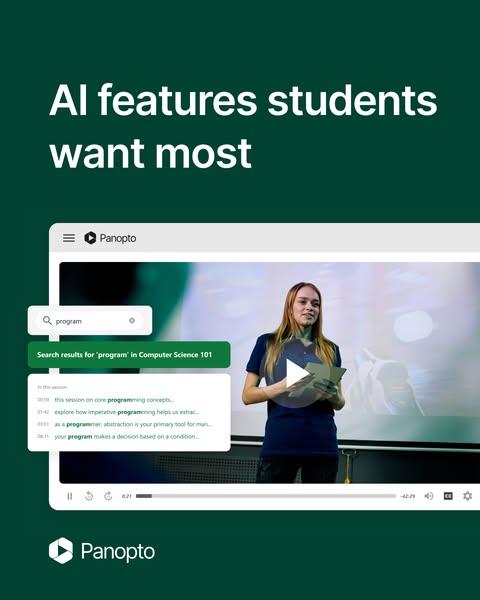
Why it runs: 38 of the 90 readable long runners point at a document. Panopto has run the same two, an ebook and a webinar, since May 19, 2026, and Whatfix buys 20 ads for one Gartner reprint it did not write itself.
2. The number
A statistic as the headline.
- Panopto: "96% of college students want searchable videos" (104 days, live).
- Whatfix: "Insurance giants poured $2.1B into AI. But sophisticated tech is useless if frontline staff can't adopt it." (93 days).
- Pluralsight: "2/3 of orgs have had projects fail due to lack of AI skills", the opening card of a carousel (88 days).
- Instruqt: "300 registrants. Then 600. 90 lab participants. Then 200." (26 days).
- Whatfix: "Only 5% of insurers are confident in proving the ROI of their technology investments, according to Gartner." (17 days).
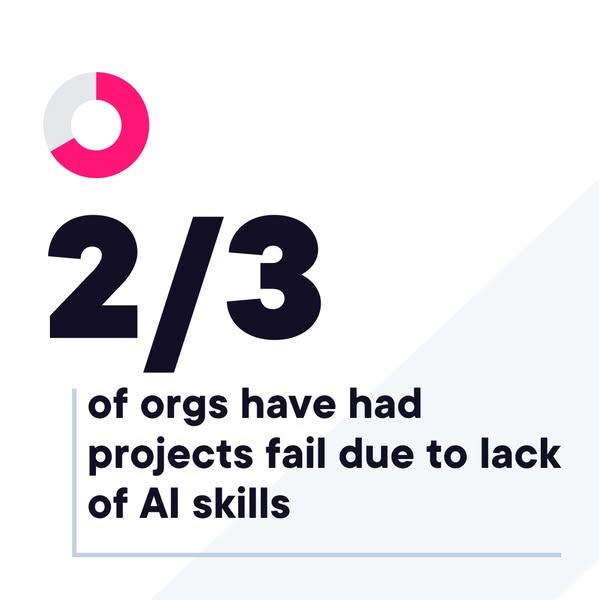
Why it runs: the buyer here signs off a training budget and has to defend it to someone else. Four of the five ads above name where the figure came from on the card: College Pulse, Gartner twice, and BMC.
3. The busywork
Scheduling, spreadsheets, rooms, instructors, the work around the learning rather than the learning.
- Administrate: "Automate your entire training program. There's a better way to manage instructor-led training." (66 days); "Planning a training program across hundreds of classes and months of sessions shouldn't require spreadsheet gymnastics." (64 days); "When one schedule change creates ten more problems, manual planning stops being sustainable." (63 days).
- Whatfix: "Beyond Adoption, Lies Transformation" (83 days), against AI tools nobody in the building uses.
- Panopto: "Accessibility gaps accumulate faster than most institutions can address them manually." (34 days).
- Administrate: "Still juggling instructors, classrooms, spreadsheets, and learner data around your LMS?" (2 days).
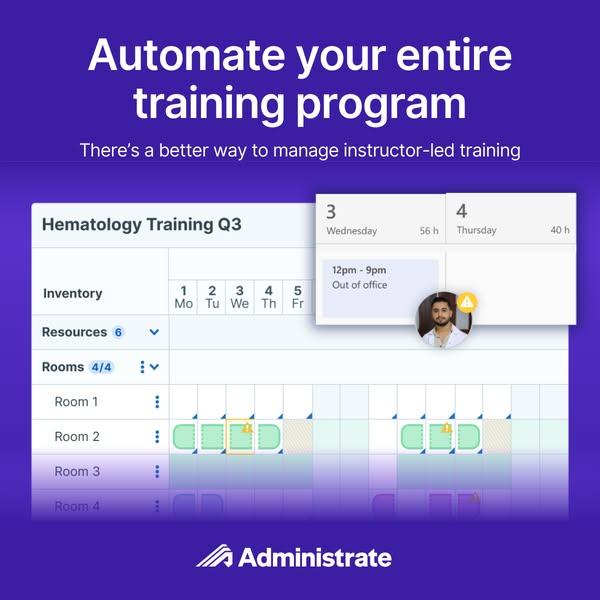
Why it runs: Administrate points 42 of its 54 ads at one page, and 15 of them passed 45 days on this one idea. The person who sees the ad is the person who rebuilds the timetable when an instructor cancels.
4. The free seat
A course, a trial, an academy or a conference ticket, given away whole.
- 360Learning: "Jetzt kostenlos einschreiben", a free nine-part certification programme for L&D managers (301 days, live, the oldest live ad in the set).
- Pluralsight: a dynamic ad pointing at the free-trial page (83 days).
- Dataquest: "Try It Free, No Commitment" on the button, "No credit card required" under it (26 days).
- Instruqt: "Free. Virtual. One day. HANDS-ON 2026, Sept 29" (6 days).
- Dataquest: "Learn Data & AI. We'll Cover the Cost." (3 days).
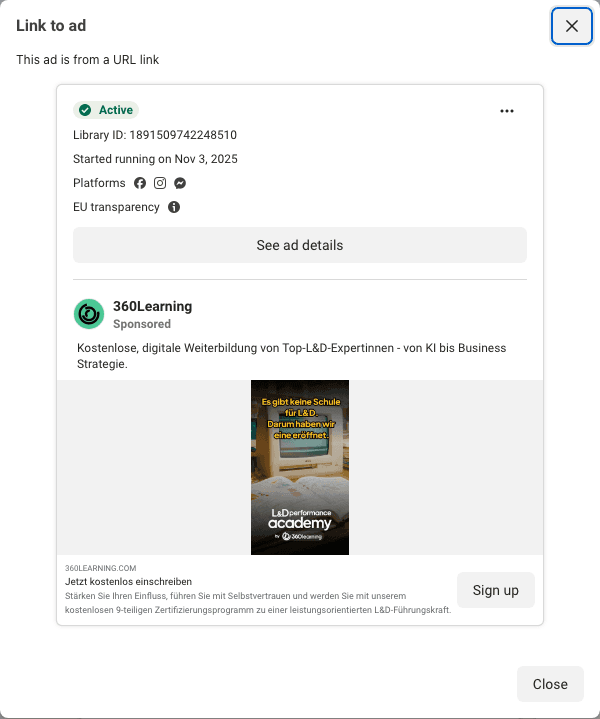
Why it runs: 360Learning's card says there is no school for L&D, so it opened one, and the academy it opened runs on 360Learning. The card has not been rewritten since November 3, 2025.
5. The practice
Doing instead of watching. Three of the ten advertisers put it on a card.
- Instruqt: "Stop training with slides. Start training that sticks." (16 days); "Hands-On Beats Read-About. Every Time." (16 days); "Your Prospects Remember What They Do, Not What They See" (33 days).
- Dataquest: "Build a production RAG app, deploy AI services with FastAPI, and earn a certificate." (27 days); "No video lectures." (15 days).
- ProductLed: "The best products are meant to be experienced, not explained." (44 days, live).
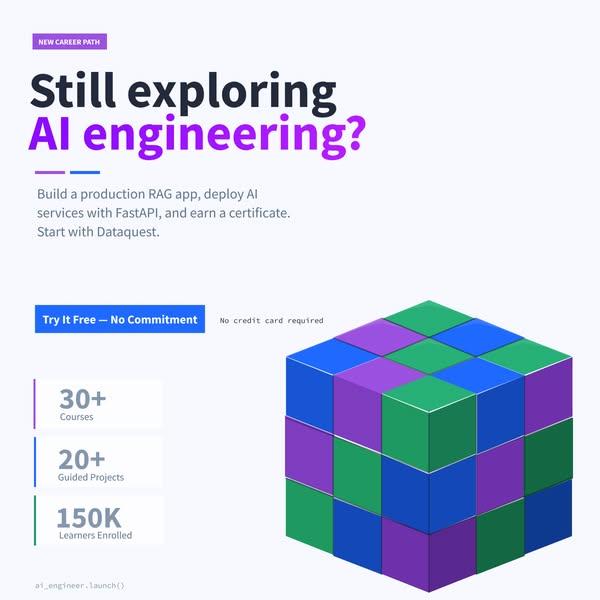
Why it runs: Dataquest names the thing that gets built, a RAG app deployed with FastAPI, so the reader can tell whether it is above or below their level before clicking. Instruqt names what it replaces, the slide deck.
6. The event
A date, a time zone and a seat.
- Panopto: "Higher Ed Video Strategies", an on-demand webinar on moving from bulk lecture uploads to purpose-designed video (104 days, live).
- 360Learning: "Register for L&D Next 2026", a week of sessions in March (43 days).
- Instruqt: "The future of hands-on: Live preview of Instruqt 2.0", with the date and two named speakers on the card (20 days).
- Pluralsight: a recording from the Cyber-Resilient CISO Virtual Summit (88 days).
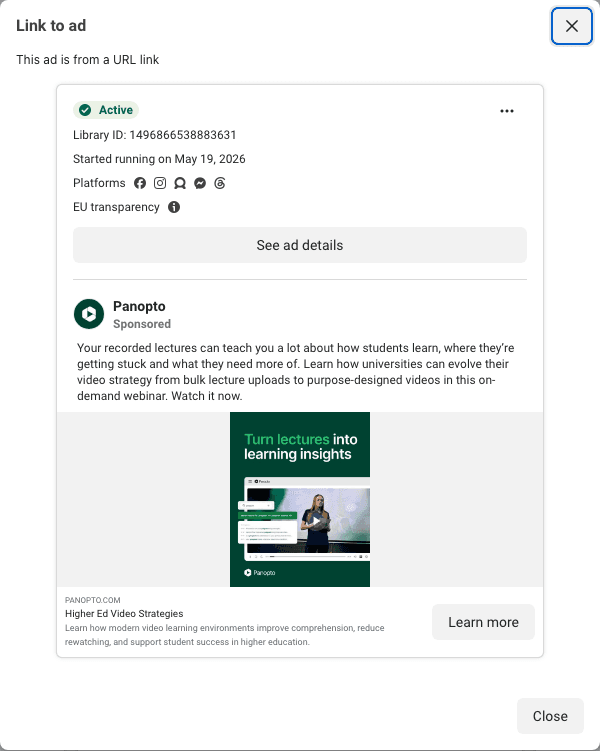
Why it runs: 14 of the 90 readable long runners point at an event, and 12 of those 14 are Panopto's, which are recordings. A webinar that already happened keeps the registration form and loses the deadline.
7. The job at the end
The outcome the learner is buying, named.
- Dataquest: "Go From Beginner to Job-Ready", with "30+ courses and 20 projects that prove you can ship AI systems employers want" on the link line (26 days).
- Dataquest: "From Python to Production AI Engineer" (15 days).
- Pluralsight: "Invest in your career", with a promo code (69 days); "Your breakthrough moment is closer than you think." (89 days).
- Guild: "The company helping upskill America's workforce" (49 days), the longest-running ad of the two Guild got past 45 days.
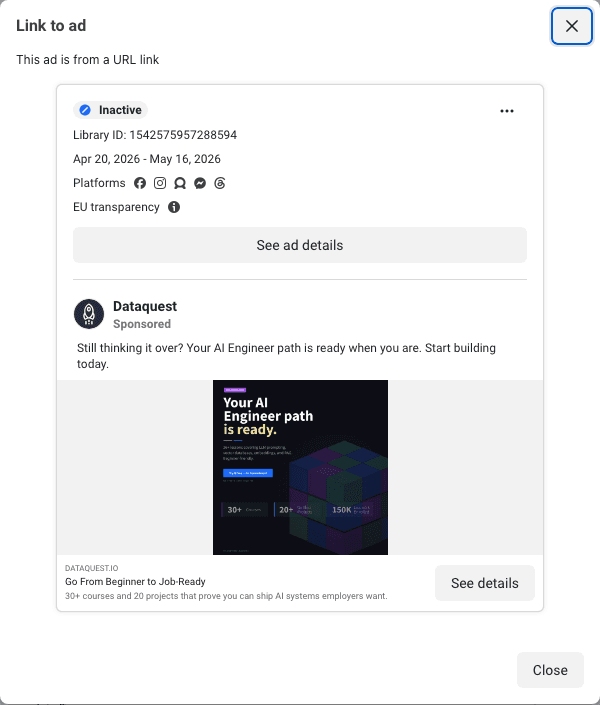
Why it runs: the page behind Dataquest's card puts the same promise in the first line, "from zero to job-ready in 10 months", so the reader who clicked for a job finds the job sentence before the curriculum.
8. The price cut
A percentage off, a code, or a first class that costs almost nothing.
- Pluralsight: "Reclaim your momentum. Save 60%." (46 days, live); "Don't miss out on 50% off tech skills" (45 days, live).
- Dataquest: "VIP Early Bird: 57% off Lifetime Premium" (13 days); "Grab $670.32 in Savings" (6 days).
- ClassDojo: "Try a class for just $5" (25 days, live).
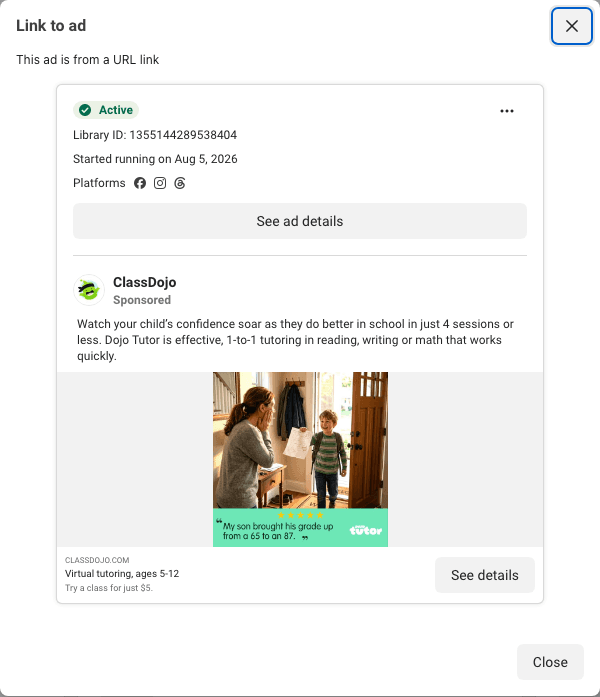
Why it runs: 13 ads in the set mention money. Six name a price the reader would pay, ClassDojo's $5 first class and Dataquest's $670 saving, and the other seven quote somebody else's budget: $2.1B poured into AI by insurers, $900 per employee a year on training.
One angle sits outside the eight because a single company runs it: the parent. ClassDojo is the only advertiser here talking to a mother or a father rather than a buyer at work. "You don't have to wait for a bad report card to get extra help. An experienced 1-to-1 tutor can spot tricky areas early" (19 days). "Watch your child's confidence soar as they do better in school in just 4 sessions or less" (26 days). Its 29 ads were all under a month old at the sweep, and 28 of them were live.
Ad analysis: five angles almost nobody in EdTech uses
Read against all 434 ads, these five appear in three ads or fewer. Where something close exists, it is listed and linked in the sources, so you can start from it.
- A named competitor. Not one ad in the set names another product. The closest is 360Learning, which buys ads for its own LMS comparison articles: "Comparatif des meilleurs LMS de 2026" (70 days) and "15 LMS-Anbieter im Vergleich" (48 days). Neither card names a single rival. Administrate gets nearest in English with "Using your LMS for ILT? Meet Administrate" (2 days), which names a category.
- Student and staff data as the headline. Three ads in the set lead with trust, all of them Whatfix's "Fortune 500 companies trust Whatfix DAP!" (20 days), which carries no number and no mention of data. Panopto runs the only compliance ads, on ADA and Section 508 captions (34 and 33 days), and the compliance sits in the body under the headline "ATTN Higher Ed Leaders".
- A price on a card aimed at an institution. Six ads name a price the reader would pay, and all six are ClassDojo's or Dataquest's, sold to a person paying with their own card. Among 360Learning, Panopto, Whatfix, Administrate, Instruqt and Guild, which sell to a school or an employer, not one ad says what the product costs.
- Interactive proof in the ad. No calculator, no quiz, no playable card in 434 ads. The closest is 360Learning's French self-assessment ad, "J'évalue mon département" (154 days), which sends the reader to an assessment rather than running one on the card. Instruqt sells hands-on labs for a living and never puts one in a creative.
- The academic calendar. Not one headline names a term, a semester, an intake or an enrolment window. The closest are Dataquest's "Get full access until April 21st" (15 days) and ClassDojo's "this school year", which sits in the body of a 26-day ad.

Landing page analysis: what happens after the click
- The Google half of this sweep came back empty. The Transparency Center returned no ads for any of the eleven companies, so every number below is Meta.
- 388 of the 434 ads lead to the brand's own site, and 36 of those land on a homepage. 22 of the 36 are ClassDojo's, which sends most of its tutoring ads to classdojo.com and to a tutor subdomain. Take ClassDojo out and the homepage share of the other nine advertisers is 14 ads in 364.
- So the pages worth studying are the other 352. The kind of page sorts EdTech advertisers into four tiers, from the homepage to a page with a version or a market code in the path. Every page below is linked, so open them.
| Tier | The ad points at | In the sweep |
|---|---|---|
| 0 | The homepage | 36 of 388 ads |
| 1 | A page that already existed | 235 ads: Panopto's ebook, Pluralsight's pricing page |
| 2 | A page that exists because the ad does | 8 ads: Pluralsight's free-trial page, 360Learning's L&D Next 2026 page, ClassDojo's tutoring/lp2 |
| 3 | A version number or a market in the path | 109 ads: Administrate's lp/live-training, 360Learning's German academy, Whatfix's 2025 reprint |
Tier 1: the ad points at a page that already existed

- 19 of Pluralsight's 60 ads land on the individuals pricing page, the page anyone reaches from the nav, and the oldest of them had run 149 days.
- The discount ads and the dynamic ads land on the same page. Each of the five plan cards carries a Try 10 days free link, and a band repeating the offer sits below the comparison table. The ads promise 50% and 60% off; the only saving printed on the page in our capture is the 30% on the yearly toggle.
- It is the cheapest tier and 235 of the 388 ads use it, Panopto's 60 included.
Tier 2: the ad points at a page built for that ad
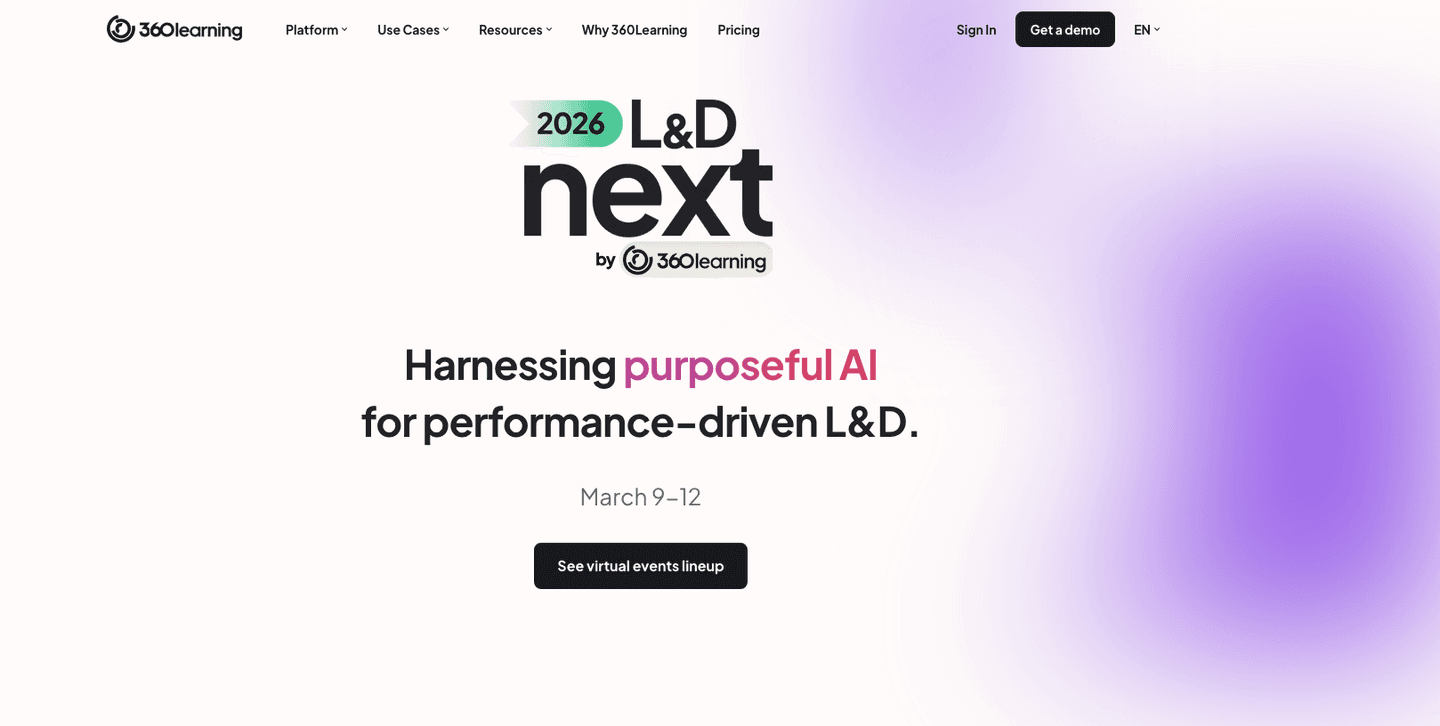
- Four 360Learning ads land on the L&D Next 2026 page, which is a dated event page with one button and no product pitch above the fold.
- Only 8 of the 388 ads in the set sit in this tier, against 235 in tier 1.
- ClassDojo's tutoring/lp2 is the other example, and the
lp2in that path is a numbered variant.
Tier 3: the ad points at a versioned or per-market page
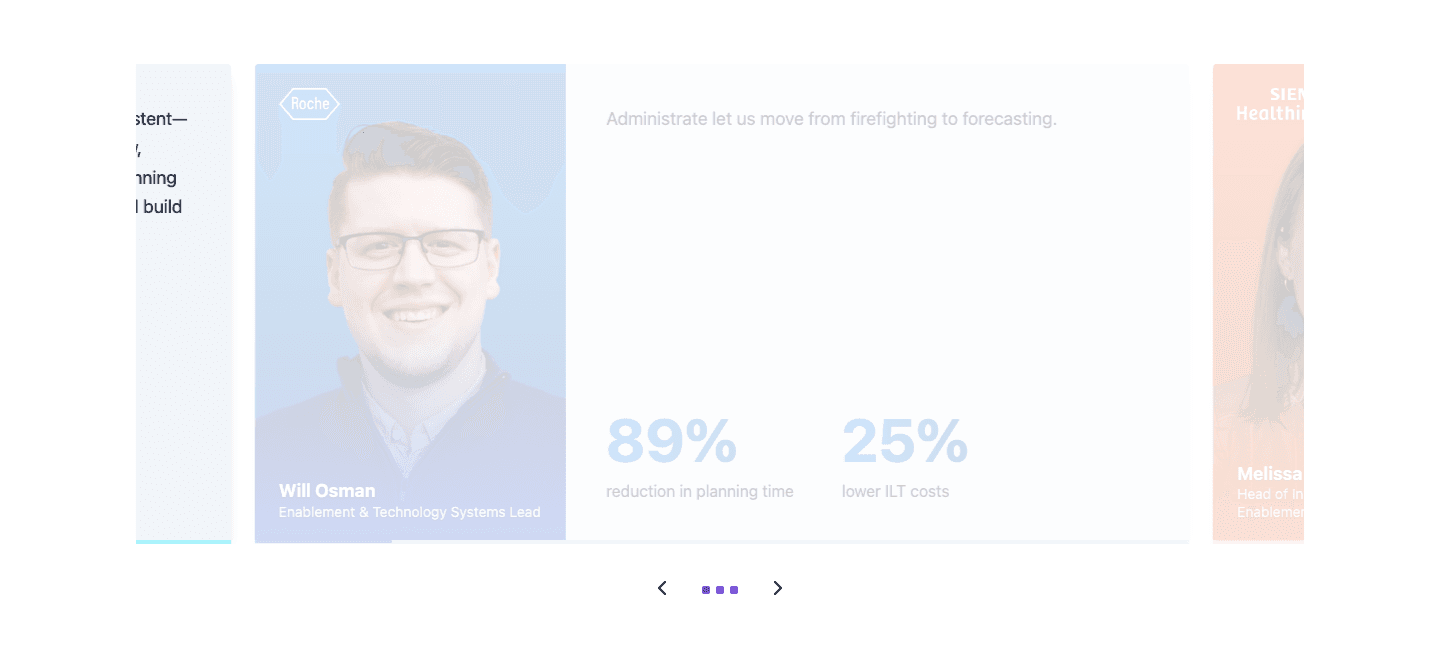
- 42 of Administrate's 54 ads land on one page under /lp/. It has no navigation, a headline promising hundreds of sessions scheduled in minutes, and a form that asks what kind of instructor-led training you run and how many learners you train a year.
- 360Learning carries 15 per-market pages of its 22, under
/fr/and/de/, and the German academy page is where the 301-day ad lands. - Whatfix runs its life-sciences Gartner reprint at two addresses, one of them ending
-2025, with 20 ads on the first and 6 on the second.
How many paid pages each company runs
| Company | Brand-site Meta ads | Distinct pages | Of which per-market |
|---|---|---|---|
| 360Learning | 59 | 22 | 15 |
| Pluralsight | 59 | 22 | 1 |
| Panopto | 60 | 7 | 0 |
| Whatfix | 60 | 7 | 0 |
| Instruqt | 45 | 6 | 0 |
| Dataquest | 26 | 4 | 0 |
| Administrate | 51 | 3 | 2 |
| ProductLed | 4 | 3 | 0 |
| ClassDojo | 24 | 2 | 0 |
- Ad counts barely separate these companies, because the library stops at about 60 per brand. Page counts run from ClassDojo's 2 to 22 for both 360Learning and Pluralsight.
- 360Learning is the only company here with a paid page per market, and it is the only one selling in French, German and English at once.
- Guild is left out: all 19 of its ads land on subdomains of its own site, one per employer (lowes, hilton, fidelity), which the sweep records as another host, so its page count cannot be read from the library the same way.
Try it on yourself. Open your own Ad Library entry, click the ad, look at where it lands. A homepage puts you on tier 0. A /lp/ or a market code puts you on tier 3. Most EdTech teams are on tier 1, pointing paid traffic at a page that already existed. Whatfix shows what that costs: 20 ads promising a Gartner report land on a page whose first screen says "Drive 67% Higher ROI From Digital Transformation" and asks for an email in exchange for a demo rather than for the report.
Teardown 1: Panopto
Two campaigns taken apart the way we take apart a page in a client audit: the ads, then the page they land on, then the gaps. We picked Panopto because it has the longest-running live campaign in the set, and Dataquest because its ad and its page say the same sentence more closely than any other pair here.
The campaign. Five ads launched on May 19, 2026, all still live at the sweep on August 31 at 102 to 104 days. Ten more launched on June 5 at the same two destinations. Across the account, 60 ads on file, 24 past 45 days, 26 still live, and 24 of the 60 pointing at one of two pages: an ebook and an on-demand webinar. Each of the five May 19 creatives leads with the research rather than with the product.
The ads
The first creative is dark green with the headline at the top and nothing else above the picture. The picture is the product doing the one thing the report is about: a lecture video playing, a search box open on the word "program", and four timestamped results from inside that lecture. The body under the card names the sample, students from 1,500 higher ed institutions, and the partner, College Pulse. The link line says "Higher Ed Video Learning" and the button says Learn more, so the card never asks for the sale.
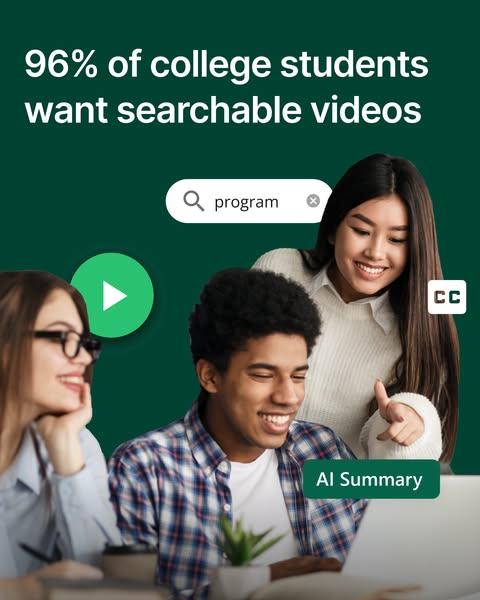
The second creative, from the same launch day and the same destination, replaces the product shot with a statistic and three students. The interface elements are reduced to three chips floating over the photo: a search field, a closed-caption badge and an AI Summary label. It is the same report, sold on the finding rather than on the feature.
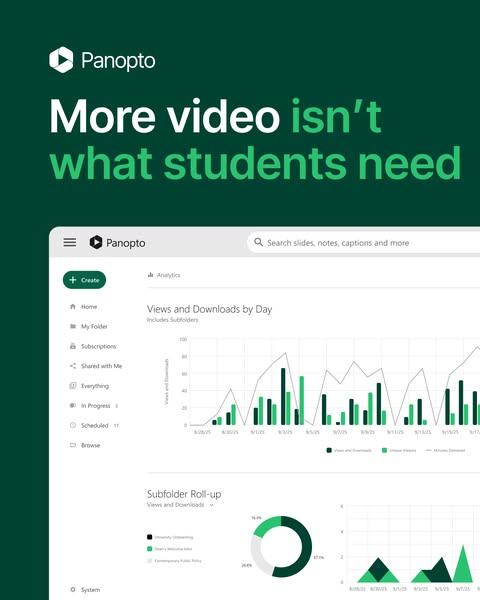
The third is the webinar's card and it argues with its own buyer. "More video isn't what students need" sits over a dashboard of views and downloads by day, which is the measurement the webinar is about. The company selling the recorder is telling a university that has recorded everything for four years that recording more will not help.
The landing page
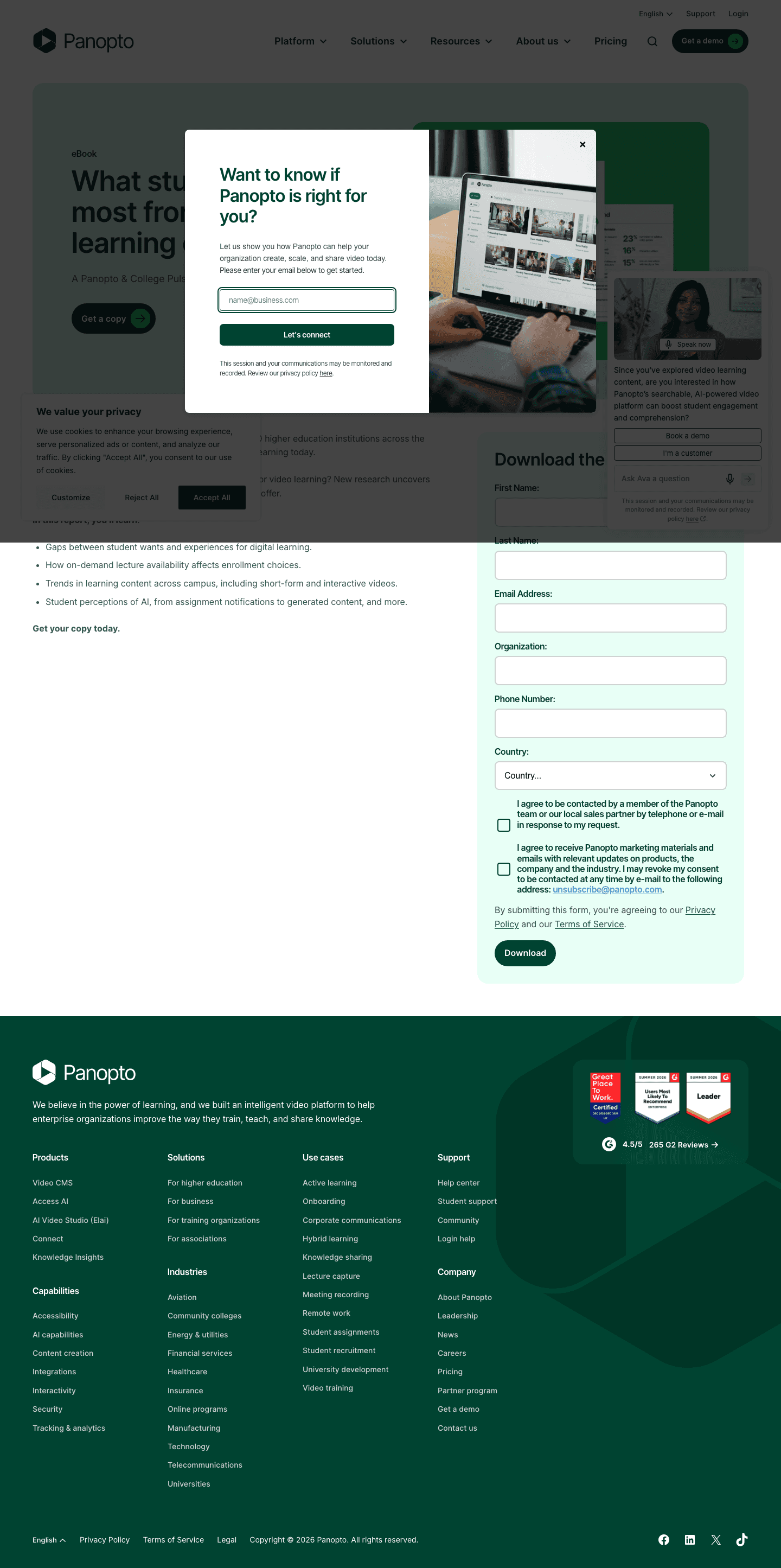
The hero. Two columns. On the left, the eyebrow "eBook", the title of the report, the line "A Panopto & College Pulse" study and a Get a copy button. On the right, the form. In our capture both are partly covered: a cookie banner sits over the left column and a chat panel asking "Want to know if Panopto is right for you?" sits over the middle of the screen with an email field of its own. A visitor arriving from the ad meets that second email field before the one the campaign paid for.
The bullet list. Four lines, each a question the report answers: gaps between what students want and what they get, how on-demand lecture availability affects enrolment choices, trends in learning content including short-form and interactive video, and student perceptions of AI. Then one line, "Get your copy today." Four bullets and a call to action are the whole left column.
The form. First name, last name, email, organization, phone number, country, and two separate consent checkboxes, one for sales contact and one for marketing email. Seven fields for a PDF. Nothing on the page explains why a phone number is needed to download a survey.
The assistant panel. A video assistant in the bottom right opens with a line written for this exact visitor: "Since you've explored video learning content, are you interested in how Panopto's searchable, AI-powered video platform can boost student engagement and comprehension?" It offers Book a demo, I'm a customer, and a question box. On the webinar page it reads the other document instead, so the panel knows which of the two pages you came in on.
The footer. The standard site footer, with the G2 badges and 4.5 out of 5 from 265 reviews in a card on the right. It is the only proof in the capture.
Message match
| The ad says | The page proves it with |
|---|---|
| We surveyed students from 1,500 higher ed institutions | The eyebrow, the title and "A Panopto & College Pulse" study in the hero |
| 96% of college students want searchable videos | Nothing on the page repeats the figure |
| From accessibility features to AI tools to search functionality | Four bullets, one of them on student perceptions of AI |
| Download the free report | A seven-field form with a Download button |
The gaps
Two gaps, both fixable in a week. The statistic that carries the longest-running creative, 96% of students wanting searchable video, appears nowhere on the page the creative opens, so the one number a reader remembers from the ad is not there to confirm. And the page fires a chat panel with its own email field over its own hero, on a destination the company is paying for, which gives the visitor a cheaper thing to do than the download.
The competitive audit looks for gaps like these on your own pages, the same way.
Teardown 2: Dataquest
The campaign. Six ads to one page, the AI Engineer in Python path. Two started on April 20, 2026 and ran 26 and 27 days; two more started April 14 and ran 14 and 15 days; two more ran under ten days in the same window. Dataquest's whole account works this way: 28 ads on file between September 2025 and June 2026, none past 45 days, every burst tied to a launch or a sale. The AI Engineer burst is the one whose page we captured whole.
The ads
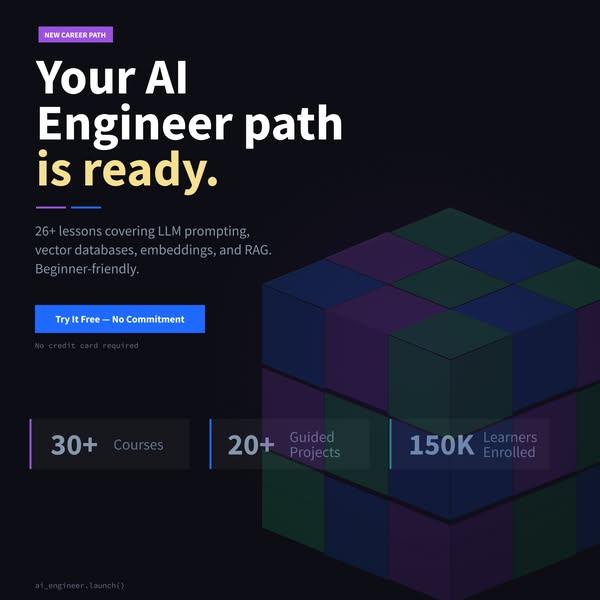
Read the card from the top. A purple chip says NEW CAREER PATH. The headline is three lines, the last one in yellow: "Your AI Engineer path is ready." Under it, one sentence of syllabus, "26+ lessons covering LLM prompting, vector databases, embeddings, and RAG. Beginner-friendly." Then a blue button, "Try It Free, No Commitment", with "No credit card required" in small type beneath it. Across the bottom, three numbers in boxes: 30+ Courses, 20+ Guided Projects, 150K Learners Enrolled. The body text on the card is one line, "Still thinking it over? Your AI Engineer path is ready when you are."
The second creative is the same layout inverted, dark to light, with the headline turned into a question and the syllabus line swapped for the outcome: "Build a production RAG app, deploy AI services with FastAPI, and earn a certificate. Start with Dataquest." Same button, same three numbers, moved to a column. Two cards on one template, one dark and one light.
The landing page

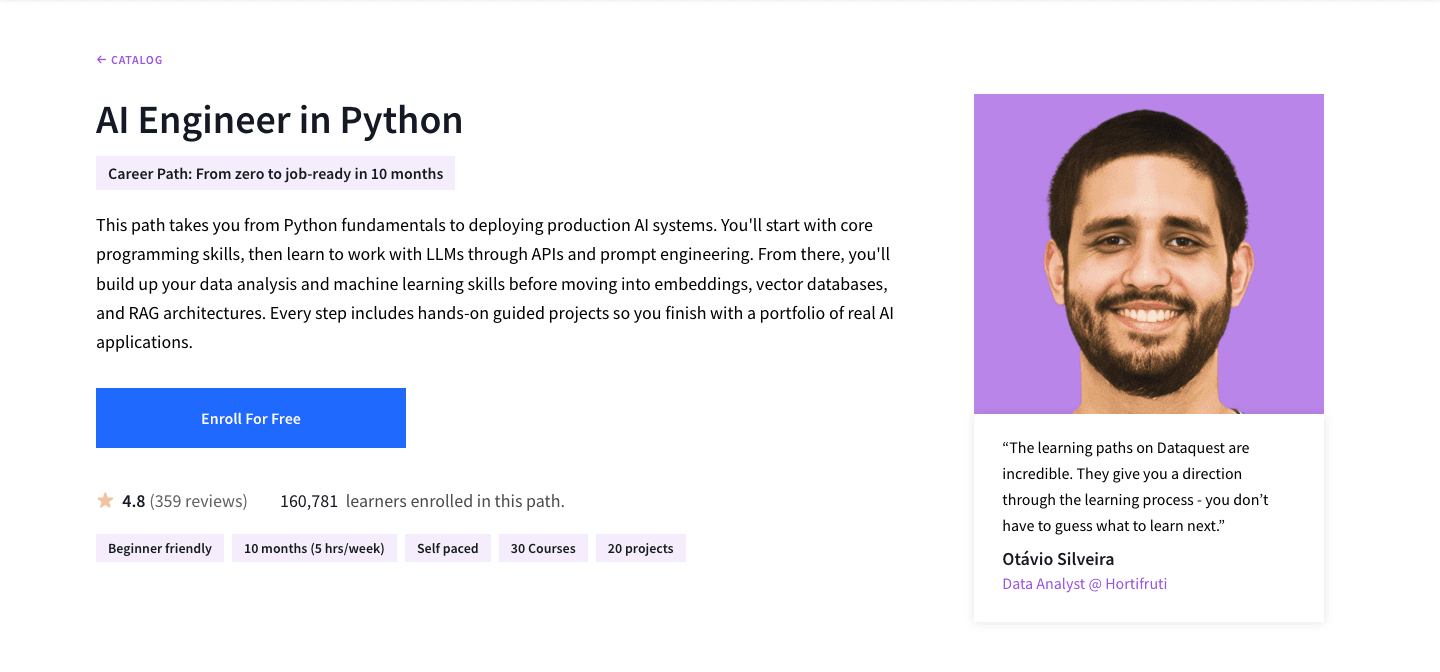
The hero. The title, then a chip carrying the two things a career-changer needs, a starting point and a duration: "Career Path: From zero to job-ready in 10 months." A four-line paragraph names the whole route, Python fundamentals to LLM APIs to embeddings, vector databases and RAG. One button, Enroll For Free. Under it, 4.8 from 359 reviews and 160,781 learners enrolled in this path, which is the ad's 150K figure, updated. Five chips repeat the shape of the commitment: Beginner friendly, 10 months at 5 hours a week, Self paced, 30 Courses, 20 projects. A testimonial card on the right carries a photo and a quote from Otavio Silveira, a data analyst at Hortifruti.
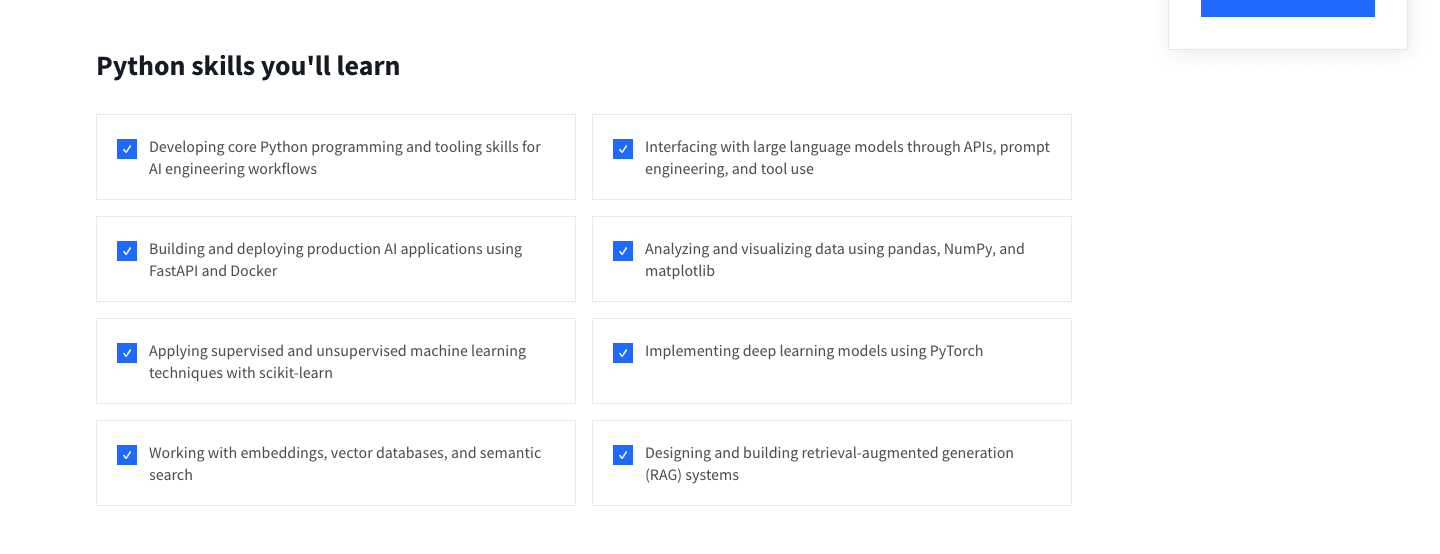
The skills grid. Eight ticked boxes in two columns, each one a thing the learner will be able to do: interface with large language models through APIs, build and deploy with FastAPI and Docker, apply machine learning with scikit-learn, implement deep learning with PyTorch, design retrieval-augmented generation systems. These are the same words as the ad's syllabus line, expanded one for one.
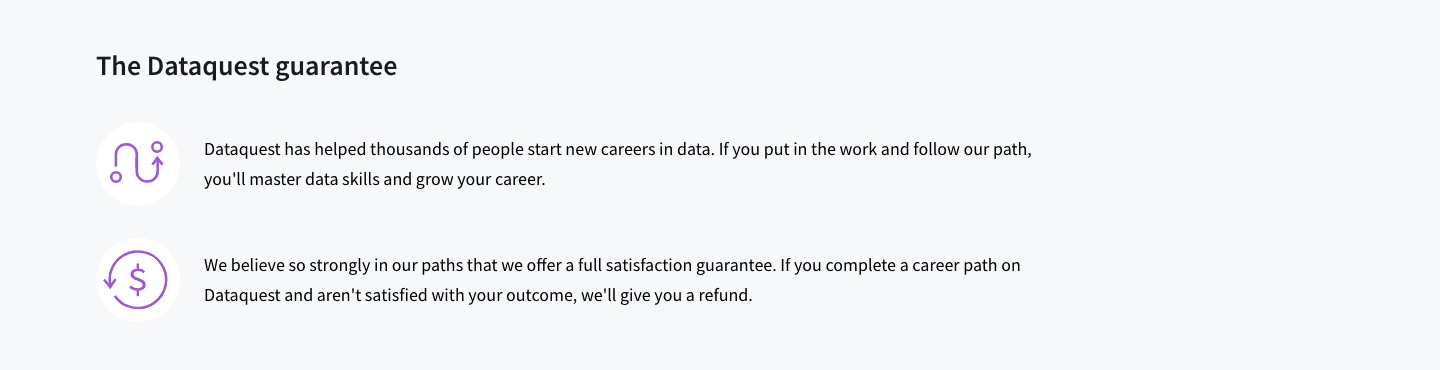
The guarantee. Two paragraphs with icons. The second one is the offer: complete a career path, and if you are not satisfied with your outcome, you get a refund. None of the six ads mentions it.
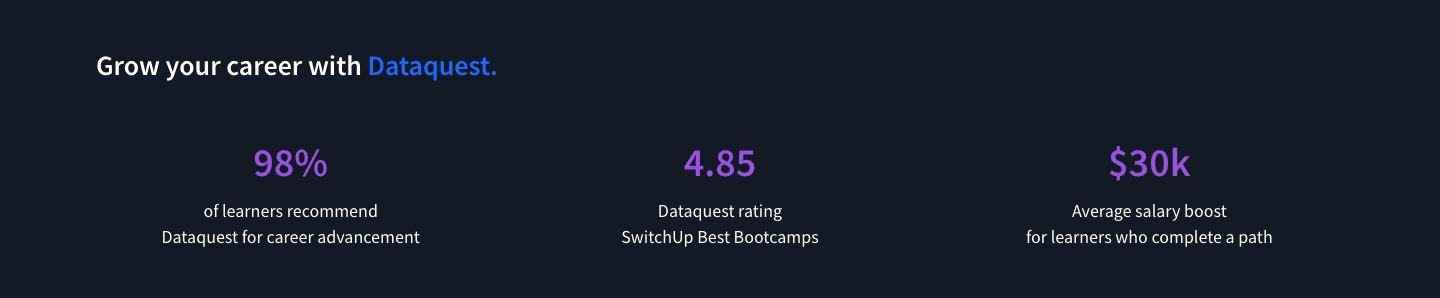
The proof band. Three figures on dark blue: 98% of learners recommend Dataquest for career advancement, 4.85 on SwitchUp Best Bootcamps, and a $30k average salary boost for learners who complete a path. The $30k figure sits about two thirds of the way down a page 12,765 pixels tall.
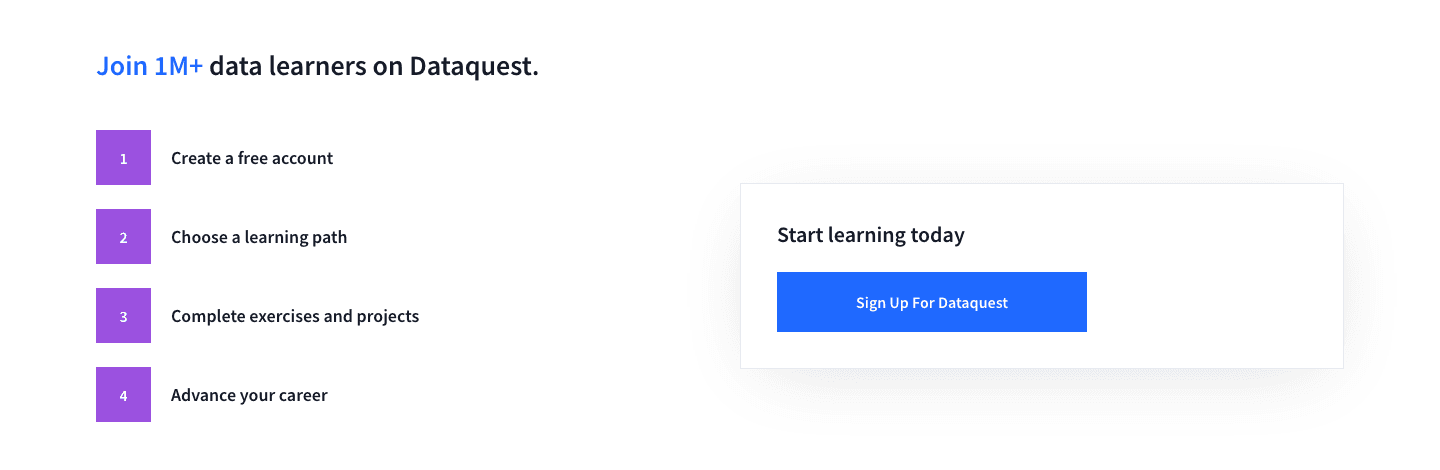
The closer. "Join 1M+ data learners on Dataquest", then four numbered steps, then one button. The last step is "Advance your career", which closes the page on the same promise the chip opened it with.
Message match
| The ad says | The page proves it with |
|---|---|
| Go From Beginner to Job-Ready | "Career Path: From zero to job-ready in 10 months" in the hero chip |
| 30+ courses and 20 projects | Five chips in the hero: 30 Courses, 20 projects, 10 months at 5 hrs/week |
| 150K Learners Enrolled | 160,781 learners enrolled in this path, under the button |
| Build a production RAG app, deploy with FastAPI | Eight ticked skills, two of them naming FastAPI, Docker and RAG |
| Try It Free, No Commitment | Enroll For Free, plus a refund guarantee two thirds down |
The gaps
Two gaps. The refund guarantee appears in none of the six ads, which spend their one line of body copy on "Still thinking it over?" instead, and a refund is the answer to the doubt that line names. And the $30k salary figure is the nineteenth of twenty-one blocks on the page, so a visitor who clicked for a job reads the whole curriculum before reaching the outcome.
The same reading, on your pages and your competitors': the UX competitor analysis.
Key takeaways: five things to do with this
- Pick the document before you pick the creative. 38 of the 90 readable long runners point at a report, an ebook or an analyst reprint. Panopto has run the same two since May 19, 2026.
- Put the ad's number on the page. Panopto's 104-day creative promises 96% of students want searchable video, and the page it opens never says it again.
- Build the page, do not borrow it. 235 of the 388 brand-site ads land on a page that already existed. Only 8 land on one built for the ad.
- Name what the learner will do. Dataquest's card names a RAG app and FastAPI; Instruqt's names the slide deck it replaces. Three of the ten advertisers here say anything about the work.
- Take one of the five open angles. Nobody names a competitor, nobody puts a price on an ad aimed at a school, nobody runs the academic calendar.
How to run this analysis on your own competitors
The Meta Ad Library and the Google Ads Transparency Center are public and free. Search the brand's page, not a keyword, set the country, filter to active ads, sort by start date. Then:
- Group the ads by angle. Use the eight above.
- Keep the ones that have run 45 days or more. The advertiser is still paying for them. Click through and read the page each one lands on.
- Write down the angles they are not running. Start your next campaign from that list.
Or send us the URL and we do it for you.
How we did the analysis
- Sample: the EdTech companies on the benchmark leaderboard, picked by traffic, not by advertiser status. Thirteen were selected. Podia and Tigerhall were not captured. Magoosh was swept and nothing it returned passed the brand filter, so it is listed with zero ads rather than dropped. That leaves ten advertisers: 360Learning, Administrate, ClassDojo, Dataquest, Guild, Instruqt, Panopto, Pluralsight, ProductLed and Whatfix.
- Sources: the Meta Ad Library, searched by brand page, and the Google Ads Transparency Center, both through Apify. The Google side returned nothing for any of these advertisers, so this analysis is Meta only and says so wherever a number would otherwise imply both.
- Filter: brand-verified ads only. An ad counts when the page name and the landing host both belong to the brand. 107 results were dropped because the page running the ad was not the brand's own.
- Ranking: days active, counted to the sweep date. The floor of interest is 45 days, the point at which an ad has survived at least one budget review.
- Reading: every distinct message was read by hand and put in one angle. Dynamic ads return a template instead of copy, so those were read from the creative image and the landing path; 35 had neither and are counted but never quoted. Non-English copy from 360Learning's French and German accounts is counted in its totals and quoted only where the card was read.
- Limits: the library returns about 60 ads per brand per market, so a count of 60 is a floor and the shares inside the sample are what to read. The sweep covers the United States only. Meta publishes reach in the EU and never publishes spend. Nothing here was re-checked after September 3, 2026.
Every ad above links to its primary source in the sources list, so you can check the whole analysis yourself.
Sources
Primary sources, all public and checkable today. Open any Meta ad with its Library ID at facebook.com/ads/library/?id=ID.
- Panopto's ebook ads, active since May 19, 2026: 2038147070428466, 1671580354159879 and 1379538047317962. Its webinar ads: 1496866538883631 and 26606453905643484.
- Dataquest's AI Engineer ads: 1542575957288594 (April 20 to May 16, 2026), 967962859317001 and 1459710875945416.
- The other creatives shown above: 360Learning 1891509742248510, Pluralsight 1684258895622190 and 1539466833679910, Administrate 2748479275487534, ClassDojo 1355144289538404.
- The angle ads quoted: Panopto 1363322628498973 and 1734894241184373; Whatfix 1277841337074585, 1803892210566350, 763490013173392, 1037377891398317, 1698287451057177 and 771147248731173; 360Learning 2069902557079416, 1167868385544524 and 1957832805119224; Administrate 2017645865554398, 633034323238484 and 1458177946046924; Instruqt 956270040523611, 1674771317273988, 2190280918042543, 2173710990043015, 1671000194275436 and 1114201901071166; Pluralsight 1258609015670062, 1502380067602908, 4592850521036749, 903982615374903 and 1804567356847086; Dataquest 759650880539007, 1369253604597093 and 670512506082216; ClassDojo 1884106195883672 and 2277347816417048; ProductLed 1054189843693526; Guild 933879550719563.
- The open-angle ads: 360Learning 801308465589991, 1379727704067930 and 669398965702569; Whatfix 1858734478038793; Administrate 965608992509476.
- The landing pages, live: panopto.com ebook, panopto.com webinar, dataquest.io/path/ai-engineering, pluralsight.com/individuals/pricing, getadministrate.com/lp/live-training, 360learning.com/l-and-d-next/2026, go.whatfix.com/gartner-life-sciences-reprint.
- The sample: the EdTech leaderboard of the Web Anatomy benchmark, selected by traffic.
- The Google Ads Transparency Center, searched and empty for these advertisers: adstransparency.google.com.
- The sibling post on the same method, in another market: the fintech ads playbook.
- Ad sweeps made August 31 to September 3, 2026 (Meta by brand page); the landing-page captures made in the same window.
Data collected August and September 2026. Ad statuses and run lengths change; the library links above always show the current state.

Written by
Gabriel Amzallag , Founder, Web Anatomy
5 years CRO + SEO at Qonto (2021–2025). After advising 15+ SaaS on their websites (Payfit, Pigment…), the same patterns kept breaking, so I decided to build the source of truth on what works on the web: the intelligence layer every tool, builder, and team uses to ship sites that perform.
More from the blog
Guides
AI SEO content workflow: how to publish one page a day without publishing slop
The four parts of the AI content machine behind Web Anatomy's SEO pages: a roadmap CSV, a page template, a skill file per page type and a daily routine. The agent makes zero strategic decisions.
 Gabriel Amzallag10 min read
Guides
How to improve your website conversion rate (instead of chasing traffic)
You don't need more traffic. A simple method to improve your website conversion rate: know if it is worth it, generate ideas at three levels, rank them with RICE and measure each change.
Gabriel Amzallag7 min readPlaybooks
We analyzed the ads the top design tool companies run. Here is what works.
Nine angles the design tool ads that keep running use, the five nobody runs, and the pages behind the clicks. Eight advertisers, 229 Meta ads, one sweep.
Gabriel Amzallag25 min read