
TL;DR
- The ads that kept running sell one of nine angles: the stack, the chore, the file size, the tool at work, the money, the no-skill promise, the AI tool, the series, the number. Kittl ran eight of the nine, Jitter and Alai 2.0 one each.
- Five angles are almost empty in design tools: what the product costs, licensing and rights, the switch itself, interactive proof on the card, a named competitor.
- Social ads almost never land on the homepage (13 of 209). There is no search half here at all: not one of the twelve companies had a Google ad on file.
- The page says what the ad cannot. Kittl's 95-day card asks about $200 of stock subscriptions; the page it opens names Envato, Creative Market and Adobe Stock in the second line.
Twelve companies swept between 1 and 3 September 2026, eight of them advertising on Meta. Every day count and every "still live" below is as of that window, not today. How we did it is at the end.
The sample: 9 design tool companies, their ads, and where the ads land
| Company | Meta ads on file | Ran 45 days or more | Still live | Oldest live ad | Where the ads land |
|---|---|---|---|---|---|
| Elementor | 60 | 37 | 0 | none | Elementor One, the popup builder, a WordPress variant page |
| Cloudinary | 60 | 33 | 2 | 23 days | image optimization, the image API, four video pages |
| Kittl | 60 | 16 | 0 | none | the assets page, one subscription, merchandise-design3 |
| Submagic | 12 | 7 | 4 | 37 days | the homepage, the caption page |
| Rayon | 21 | 3 | 1 | 6 days | one US campaign page |
| Getshogun | 11 | 0 | 0 | none | Shopify price testing, Shopify A/B testing |
| Venngage | 2 | 0 | 0 | none | one Spanish blog post |
| Jitter | 2 | 0 | 0 | none | the homepage |
| Alai 2.0 | 1 | 0 | 0 | none | the homepage |
Elementor and Cloudinary had found their ads: 70 of their 120 ads on file had passed 45 days. Elementor's Pro-upgrade card is the oldest in the sweep at 349 days, and Cloudinary holds the next six, from 328 days down to 288. Kittl sat in the middle with 16 past the floor and 44 under it, a steady run of short video ads, the newest of them five days old at the sweep. Getshogun, Jitter and Alai 2.0 were starting: 14 ads between the three of them, none older than 36 days.
One thing separates this market from the fintech and developer tools sets: nobody was buying search. Across all twelve swept companies the Google Ads Transparency Center returned zero ads.
Ad analysis: the 9 angles design tool ads use
Every readable message on Meta fits one of nine angles. For each: the ads that ran longest, one creative to look at, and why it kept running. The number in brackets is days running on the day of the sweep.
1. The stack
One tool in place of the four or five the reader already pays for.
- Kittl: "Tired of paying $200+ for all the stock platform subscriptions? Kittl has everything you need to create in one place" (95 days), under the link headline Too many subscriptions?
- Kittl: "Everything in one place. Stop wasting hours searching for assets. Kittl gives you fonts, templates, and mockups, all in one place" (173 days, and again at 78 days).
- Rayon: "Meet the effortless CAD! Stop wasting hours on learning too many different software! Use this one tool instead" (70 days).
- Elementor: "Create stunning websites NO CODING NEEDED with Elementor's complete website solution: builder, hosting, AI, and so much more" (121 days).
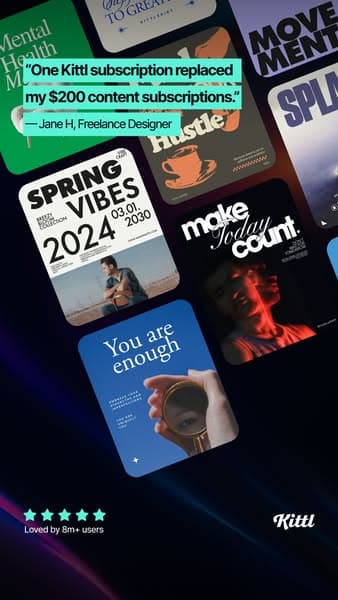
Why it runs: the reader can add up their own subscriptions while they read the card. Kittl's 95-day creative does the sum for them with a figure, $200, and a job title, freelance designer.
2. The chore
Hours lost to one task, named the way the person who does it would name it.
- Kittl: "Stop wasting hours searching for assets" (173 days, 78 days).
- Rayon: "Stop wasting hours on learning too many different software" (70 days, in three of the 21 Rayon ads on file).
- Submagic: "POV: you've spent more time fixing captions than editing the actual video" (37 days, and still live at the sweep).
- Cloudinary: "Still waiting on your team to cut social versions of that new listing video? Cloudinary does it instantly. No waiting. No backlogs. No excuses" (20 days).
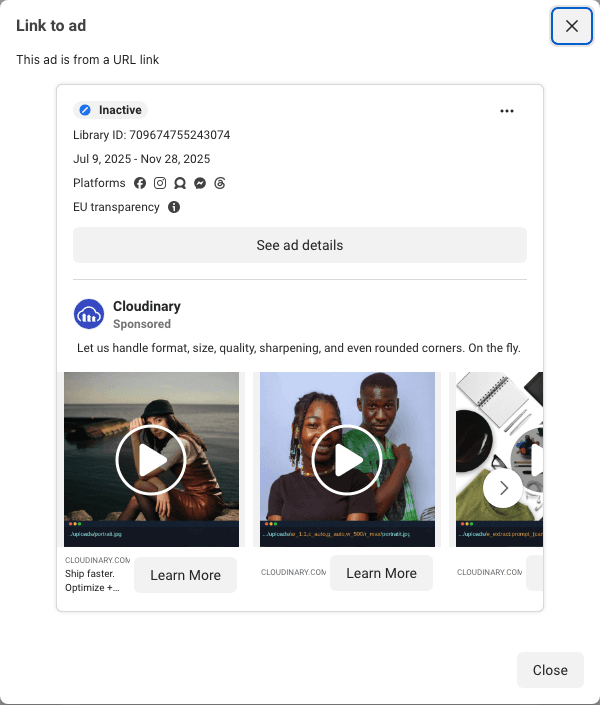
Why it runs: four of the eight advertisers run this angle, and each one names a different chore. Submagic names fixing captions, Rayon names learning a second piece of software, Kittl names searching for assets, Cloudinary names waiting on a teammate.
3. The file size
A number about the asset itself: megabytes, a percentage of the payload, a gigabyte ceiling.
- Cloudinary: "Cut 90% Off Your Image Payload" (288 days), with 5.2 MB and 55 KB printed on two copies of the same photograph.
- Cloudinary: "Say goodbye to image compression woes! Cloudinary optimizes images from AVIF to WebP" (328 days, the oldest Cloudinary ad on file), under the link headline Nap Time for You. Go Time for Your Images.
- Cloudinary: "Tired of performance hits from heavy images? Let our responsive tech deliver the best format in real time" (274 days).
- Cloudinary: "Upload files up to 100GB and stream instantly without buffering" (132 days).

Cloudinary is alone on this angle. No other advertiser in the set puts a measurement on the card, and the 328-day and 288-day cards sit among the seven oldest ads in the whole sweep.
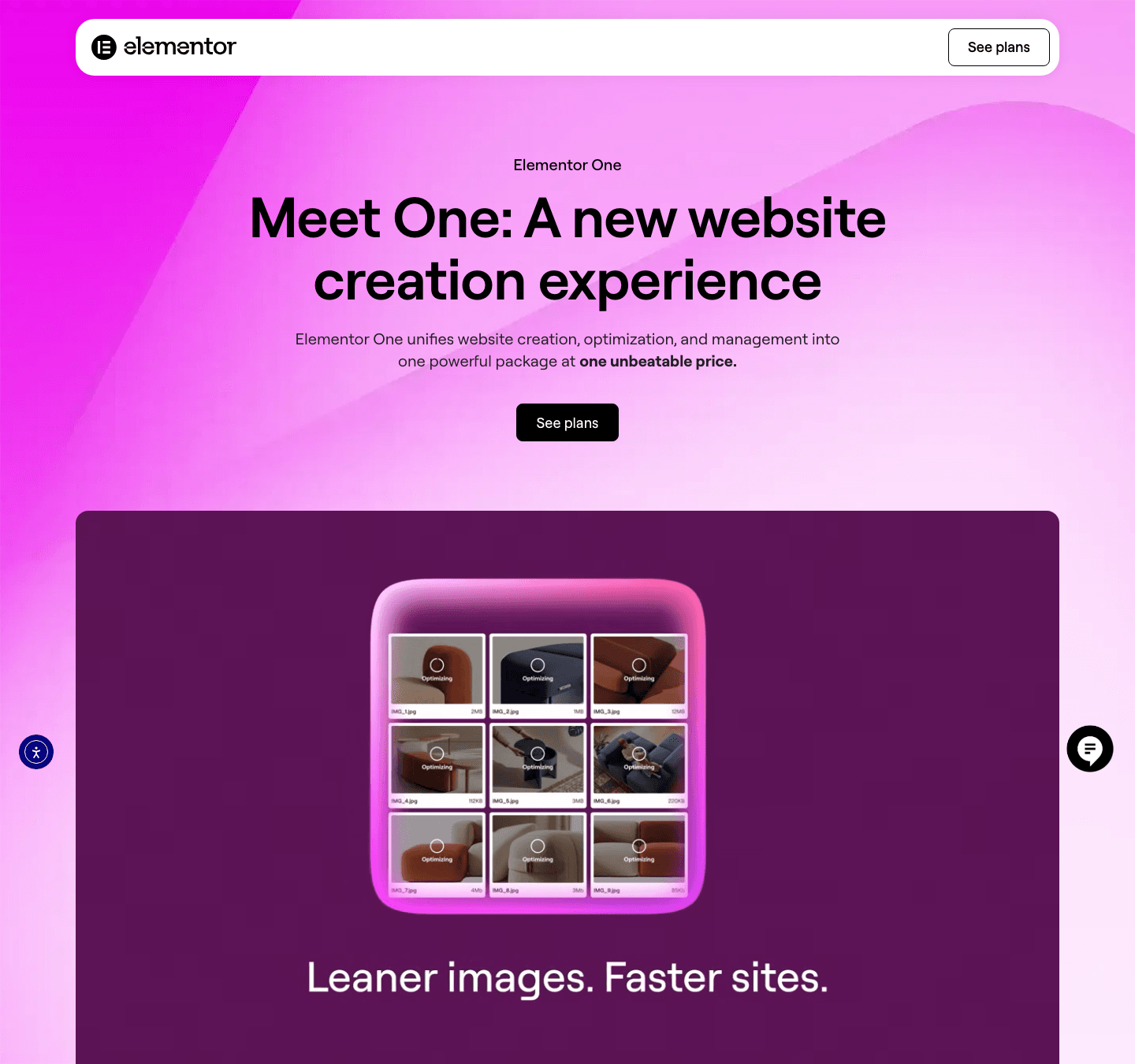
Why it runs: a developer or a shop owner can check 5.2 MB against their own product photo the same afternoon. Elementor says the same thing on a page ("Leaner images. Faster sites." on the Elementor One page) and never in an ad.
4. The tool at work
The card is a screenshot of the product doing the job, with the real interface around it.
- Elementor: "Struggling to create popups that convert? Elementor Pro makes it easy" (278 days), the popup being built inside the editor.
- Elementor: "When it comes to your website, don't settle for less" (121 days and 120 days), the same editor chrome, a different design inside it.
- Cloudinary: "One line of code for the perfect image. Automatically crop or adjust images via API" (210 days, and again at 140 days).
- Getshogun: "Ecommerce price testing made easy" (36 days), the price field floating over a real product page.

Why it runs: the buyer of a design tool is going to live in that interface. Elementor's 278-day and 121-day cards both show the panel layout the reader gets on day one, and its 349-day card goes as far as putting a Custom CSS editor on the creative.
5. The money
A dollar figure on the card, always the reader's money rather than the price of the tool.
- Kittl: "Scale POD to $12K" (84 days, repeated at 58, 43 and 22 days).
- Kittl: "Skip the $500 photoshoot" (37 days).
- Kittl: "Tired of paying $200+ for all the stock platform subscriptions?" (95 days).
- Kittl: "MAKE 10K+ PER MONTH WITH KITTL", printed on the card itself (63 days).
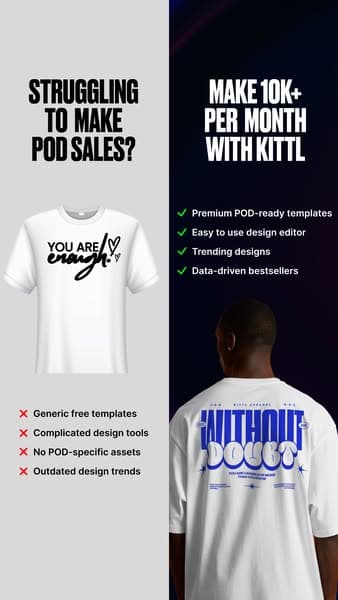
Kittl is alone here too. Five ads in the set carry a dollar sign and all five are Kittl's.
Why it runs: Kittl's print-on-demand ads sell to people who sell T-shirts, so $12K a month is a number that buyer already tracks. The 63-day card goes further and puts it in a table: four red crosses for generic free templates and complicated design tools, four green ticks for premium POD-ready templates and data-driven bestsellers.
6. The no-skill promise
The reader is told what they will not need: a developer, a camera, a crew, a design background.
- Elementor: "Create stunning websites NO CODING NEEDED" (121 days) and "New to web design? Create pro-level WordPress sites with Elementor" (120 days).
- Submagic: "This AI edits your videos so you don't have to" (49 days, repeated at 48 and 47).
- Kittl: "no design skills, no camera, no complexity" (37 days) and "Viral UGC in 20 Minutes. No Creator Fees. No camera or crew needed" (21 days).
- Getshogun: "No developer? No problem. Shogun AI Section Builder takes your vision and turns it into branded, reusable sections in minute[s]" (16 days).
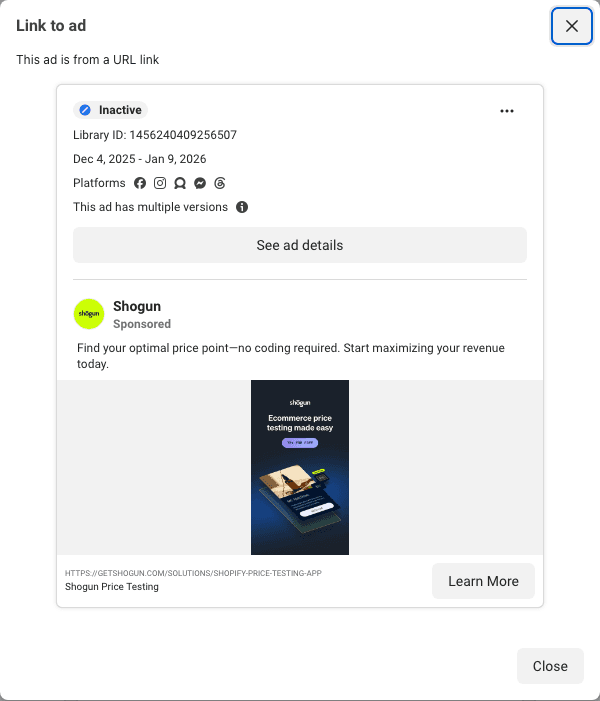
Why it runs: these four companies sell to someone who was told the job needs a specialist. Shogun's buyer is a Shopify owner with no developer, Kittl's is a seller with no studio, Elementor's has never written CSS.
7. The AI tool
The new AI feature is the whole offer, named as a product rather than as a quality.
- Elementor: "Captivate Your Web Visitors! Apply Elementor AI and Add Animations, Visual Effects & More to Your Website" (185 days), on a card reading Build faster websites, faster.
- Submagic: "The New AI Editor. This AI edits your videos so you don't have to" (49 days), and "#1 AI Video Editor" (47 days).
- Kittl: "How to make designs fast and efficiently using Kittl Flows. This is a whole new way to create where AI works with you, not around you" (53 days).
- Getshogun: "Generate Sections Instantly with AI" (16 days). Jitter: "Create custom motion effects in seconds with Jitter AI" (14 days). Alai 2.0: "Highest quality AI slides on the internet" (4 days).
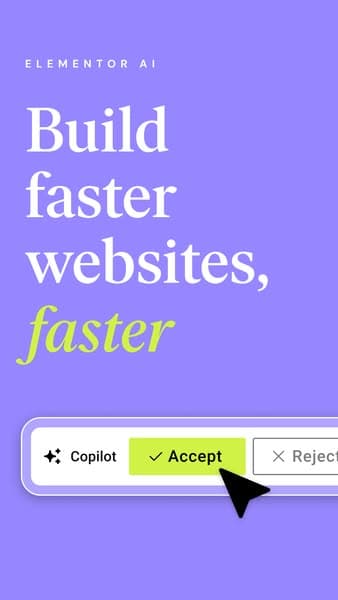
Why it runs: seven of the eight advertisers run it, which makes it the most crowded angle in the set. Elementor's card is the only one of the seven that shows the accept-or-reject moment rather than printing the word AI.
8. The series
One template, one outcome swapped per ad, so a campaign can hold a dozen cards and still read as one thing.
- Cloudinary: four cards on one mosaic of six videos, one promise each: boost conversion (139 days), grow usage (132 days), boost engagement (131 days), amplify reach (131 days). Each lands on its own page,
/ip/gr-valuemap-scalevideo,-growusage,-boostengagement,-amplifyreach. - Kittl: "Join the most successful POD sellers" and "Starting out in POD?" on
/get-started/merchandise-design4, "Start making daily sales" on-design3, 63 and 61 days. - Rayon: three scripts, Master your drawings, Meet the effortless CAD and Hey architecture student, across 20 of its 21 ads, all to one page (70 days down to 2).
- Elementor: 18 ads to
/pages/one, from 82 days down to 6, launched in waves.

Why it runs: Cloudinary's four cards started between 25 November and 3 December 2025 and all four stopped on 13 April 2026, so the series was bought and retired as one line item.
9. The number
Adoption as a figure, with no customer story attached to it.
- Elementor: "Create pro-level WordPress sites with Elementor, powering 13% of all WordPress websites" (120 days).
- Cloudinary: "Four million of you now build with Cloudinary. Thank you." (23 days, and one of the two Cloudinary ads still live at the sweep).
- Kittl: "Loved by 8m+ users" printed under five stars on the 95-day card, and "Top Etsy sellers use Kittl. Why? Premium designs, built-in tools, and faster workflows" (63 days).
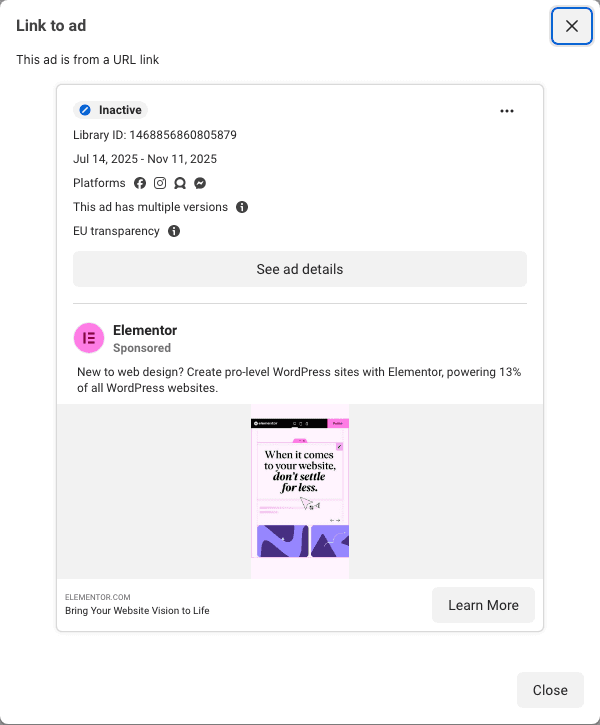
Why it runs: a WordPress user can place their own site inside Elementor's 13%. Elementor ran the same card layout for 121 days with a plain product line in that slot, and swapped the share in for the next 120.
Ad analysis: 5 angles almost nobody in design tools uses
Read against all 229 brand-verified ads, these five come from one advertiser or from nobody at all. The ads that do exist are listed, and linked in the sources, so you can start from them.
- What the product costs. Five ads carry a dollar sign and all five are Kittl's, and every one of them is the reader's money: $200 of stock subscriptions, a $500 photoshoot, $12K of sales. Not one ad in the set says what the tool costs. The closest is Elementor's 349-day card, "Upgrade Your Pro Plan for More Customization Options", which sells an upgrade without naming a figure, and the Elementor One page it belongs beside, which promises "one unbeatable price" and makes you click to see it.
- Licensing and rights as the headline. Zero ads mention a licence, commercial use, security or privacy. Kittl's own landing page treats it as important enough for the second line ("no extra licenses, no extra costs"), and Cloudinary's footer carries ISO 27001, GDPR and AICPA SOC badges, so both companies have the material and neither puts it on a card.
- The switch itself. Zero ads use the words switch, migrate or import. The closest are Rayon's "Use this one tool instead" (70 days) and a testimonial on Kittl's paid page, "I refunded Photoshop the same day." Nobody promises to bring your files, fonts or projects across.
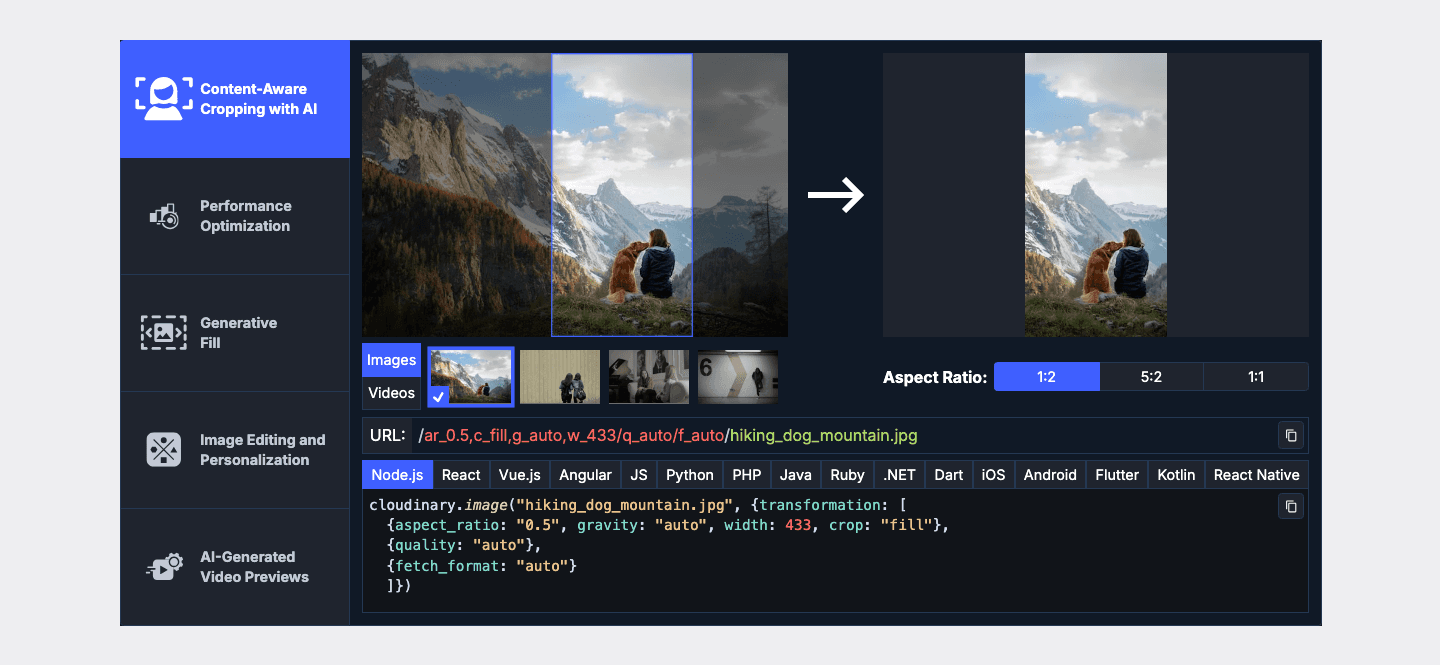
- Interactive proof on the card. Zero. The closest sits on a page: Cloudinary's image-optimization page has an aspect-ratio switch that rewrites the delivery URL and the Node, React or Python snippet under it while you watch. Two ads at 328 and 288 days pointed at that page, and neither card carried any of it.
- A named competitor. One advertiser, Rayon, in 13 of its 21 ads: "Style directly in Rayon, no need to use extra software like Illustrator or Photoshop" (70 days). Nobody else names another tool in an ad, although Kittl names five of them on the page the ads open.
Landing page analysis: what happens after the click
Here is where the ads send people:
- On Meta, 13 of the 209 brand-site ads point at the homepage, 6%. Ten of those 13 are Submagic's, which sends almost everything to
submagic.coand keeps two product pages for the rest. Jitter, Rayon and Alai 2.0 account for the other three. - On Google, there is nothing to compare. Zero ads on file for all twelve swept companies, so unlike the fintech and developer tools sets, there is no search channel here leaning on the homepage.
- So every page below exists because a social ad needed it. The kind of page sorts these advertisers into four tiers. Every page is linked, so open them.
| Tier | The ad points at | In the sweep |
|---|---|---|
| 0 | The homepage | 13 of 209 ads |
| 1 | A product page that already existed | Elementor's Pro upgrade page, Shogun's price testing page |
| 2 | A page that exists because the ad does | Kittl's assets page, Kittl's print-on-demand page |
| 3 | A code, a variant letter or a campaign prefix in the path | Cloudinary's image optimization page, Elementor's wordpress_b, Kittl's save25 page |
Tier 1: the ad points at a product page that already existed
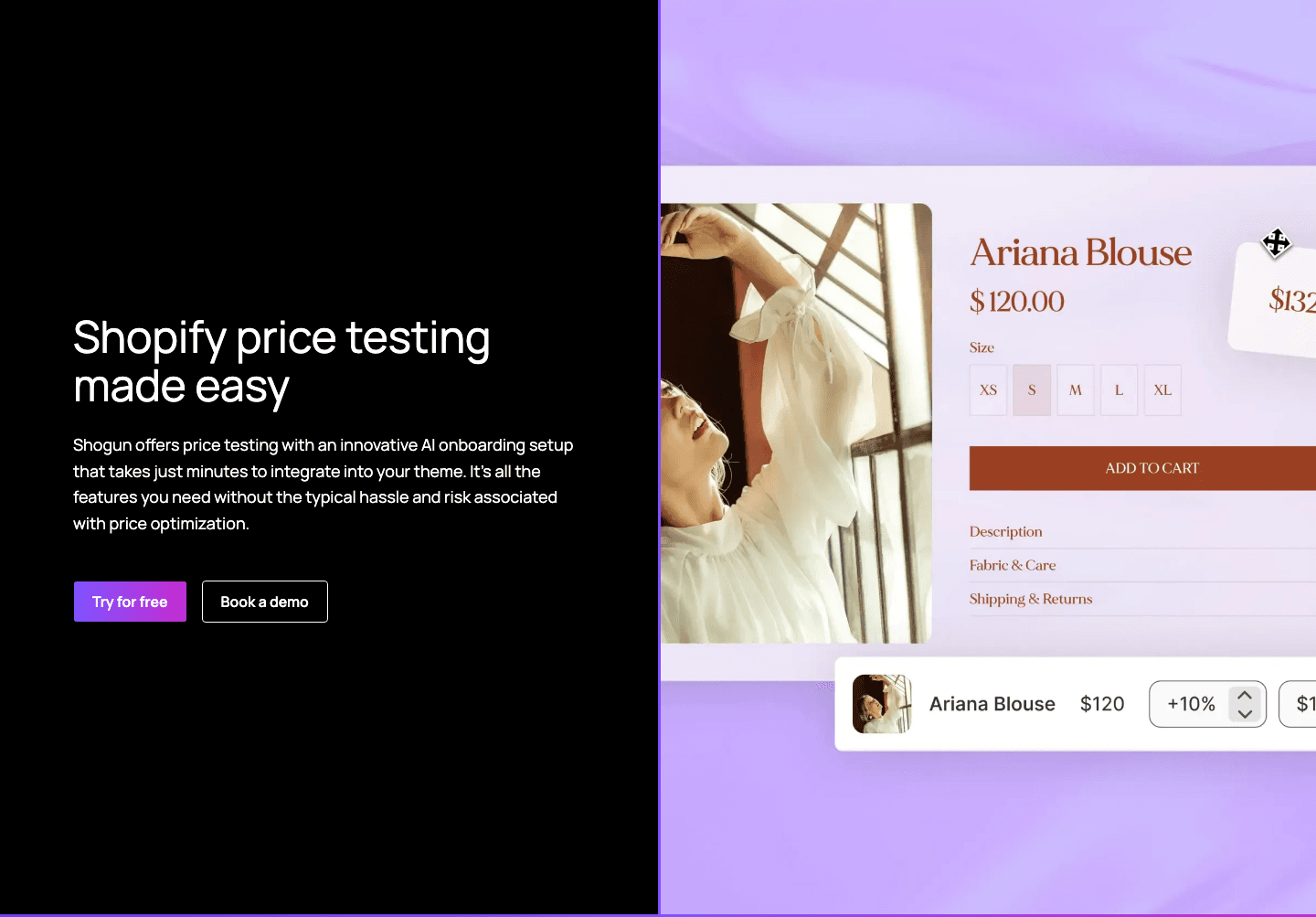
- Shogun's 36-day card says "Ecommerce price testing made easy". The page says "Shopify price testing made easy". One word changed, and that word is the platform the reader is already on.
- The page is reachable from Shogun's own navigation. Nothing was built for the campaign, and Shogun had four ads on that one offer.
- 142 of the 209 ads in this sweep land on tier 1, more than the other three tiers together.
Tier 2: the ad points at a page built for that ad
- Kittl keeps a whole
/get-started/tree that its navigation does not show:assets,etsy,viral-ugc,merchandise-design3,merchandise-design4. Twenty-three ads land in that tree, six of them on the assets page, the longest at 122 days. - Elementor's
/pages/onepage is the same idea one size up: 18 ads pointed at it during the sweep, and the page leads with "See plans" rather than a signup field, because the offer is a bundle sold on its price.
Tier 3: the ad points at a coded or versioned page

- Every Cloudinary paid page sits under
/ip/and carries a coded name:gr-frnt-mt-image-optimization,gr-ss-video-sta-php,gr-mt-pr-image-res-cat. The second half of each name is readable from outside and the first half is not. Twenty pages, 18 ads, all built the same way. - Elementor's
/pages/wordpress_bends in a variant letter, the same tell as av2bsuffix, and nine ads pointed at it. - Kittl goes one further with
/get-started/merchandise-design3/save25, a page per promo code, paired with a card whose whole headline is "SAVE25" (15 days).
How many paid pages each company runs
| Company | Brand-site Meta ads | Distinct pages | Of which read as per-market |
|---|---|---|---|
| Cloudinary | 58 | 20 | 9 |
| Elementor | 60 | 15 | 0 |
| Kittl | 48 | 15 | 0 |
| Submagic | 12 | 3 | 0 |
| Rayon | 21 | 2 | 0 |
| Getshogun | 6 | 2 | 0 |
| Venngage | 2 | 1 | 0 |
| Jitter | 1 | 1 | 0 |
| Alai 2.0 | 1 | 1 | 0 |
- Ad counts barely separate these companies, because the library stops at about 60 per brand per market. Page counts do, from Alai 2.0's one to Cloudinary's 20.
- The nine per-market pages in Cloudinary's row are a false read. Our path rule treated the
/ip/prefix as a country segment; opening the pages shows it is Cloudinary's own paid-page prefix. Not one company in this set runs a page per market, which is the clearest difference from fintech, where Qonto ran 25. - Two rows are worth ignoring. Venngage's one page is a Spanish blog post about the environmental effect of coronavirus that two ads still point at, and 20 of Rayon's 21 ads land on a single campaign page on a separate subdomain.
Try it on yourself. Open your own Ad Library entry, click the ad, look at where it lands. The homepage puts you on tier 0. A variant letter or a promo code in the path puts you on tier 3. In design tools 142 of the 209 ads land on tier 1, a product page doing double duty.
Teardown 1: Cloudinary
Two campaigns taken apart the way we take apart a page in a client audit: the ads, then the page they land on, crop by crop, then the gaps. We picked Cloudinary because six of the seven oldest ads in the sweep are its own, and Kittl because its card and its page say the same sentence more closely than any other pair here.
The campaign. Two cards, Library IDs 693207999842197 and 1261124265575638, both launched 9 May 2025 and running 328 and 288 days by the sweep. Both are dynamic-creative units delivered across Facebook, Instagram, Threads and Messenger, both carry the same body copy, and both land on the same page, cloudinary.com/ip/gr-frnt-mt-image-optimization. Both had stopped by early September, the first on 2 April 2026 and the second on 21 February.
The ads
Read the card top to bottom. The headline is a percentage, "Cut 90% Off Your Image Payload". Under it, one photograph twice: the left copy tagged JPG and 5.2 MB in red, the right copy tagged JPEG XL and 55 KB in green. The dog looks the same in both. The body above the picture is a paragraph the reader can skip: "Say goodbye to image compression woes! Cloudinary optimizes images from AVIF to WebP, delivering the sharpest visuals without sacrificing performance or disrupting your workflow." The button is Sign Up.

The 328-day card is the same offer told as a joke. A vertical creative reading "Lighten Your Load: Deliver Perfect Images on Every Device", two sheep photographs with pink resize handles dragged across them, and a link headline that puns on the pictures: "Nap Time for You. Go Time for Your Images." It carries no number at all, and it ran 40 days longer than the card that does.
The landing page
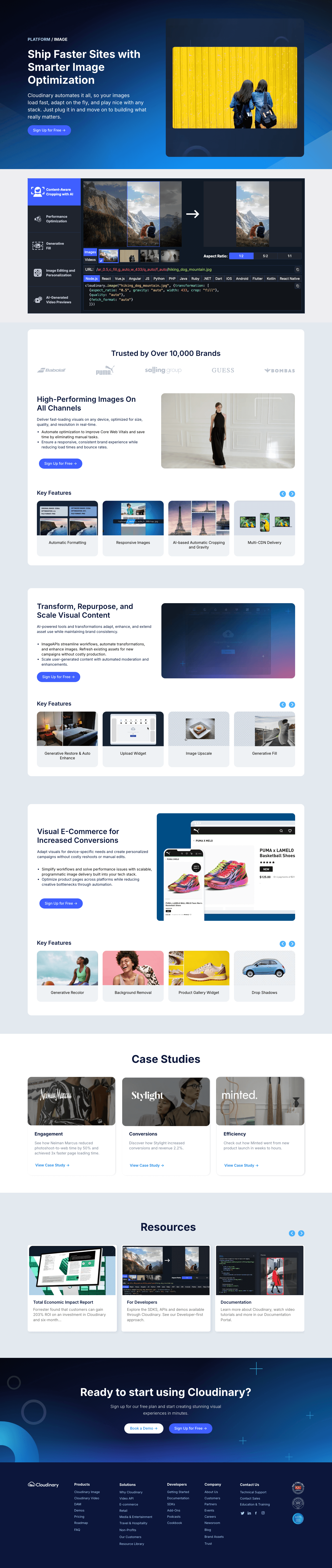
The hero. An eyebrow that places the page inside the product ("PLATFORM / IMAGE"), a headline that sells the result rather than the feature ("Ship Faster Sites with Smarter Image Optimization"), and a subhead that answers the three things an engineer asks in order: does it run by itself (Cloudinary automates it all), does it break my setup (play nice with any stack), what do I have to do (just plug it in). One button, Sign Up for Free. No form field, no price.
The demo. The second screen is the strongest thing on the page and the thing no ad in this sweep carries. A left rail of five capabilities, a mountain photograph being recropped, three aspect-ratio buttons, and below them two lines that change as you click: the delivery URL (/ar_0.5,c_fill,g_auto,w_433,q_auto,f_auto/hiking_dog_mountain.jpg) and the same transformation written for Node.js, with fifteen more languages and frameworks in a tab row beside it, from React and Python to Dart and Kotlin. A reader who clicked the 90% card can confirm the claim here without signing up.
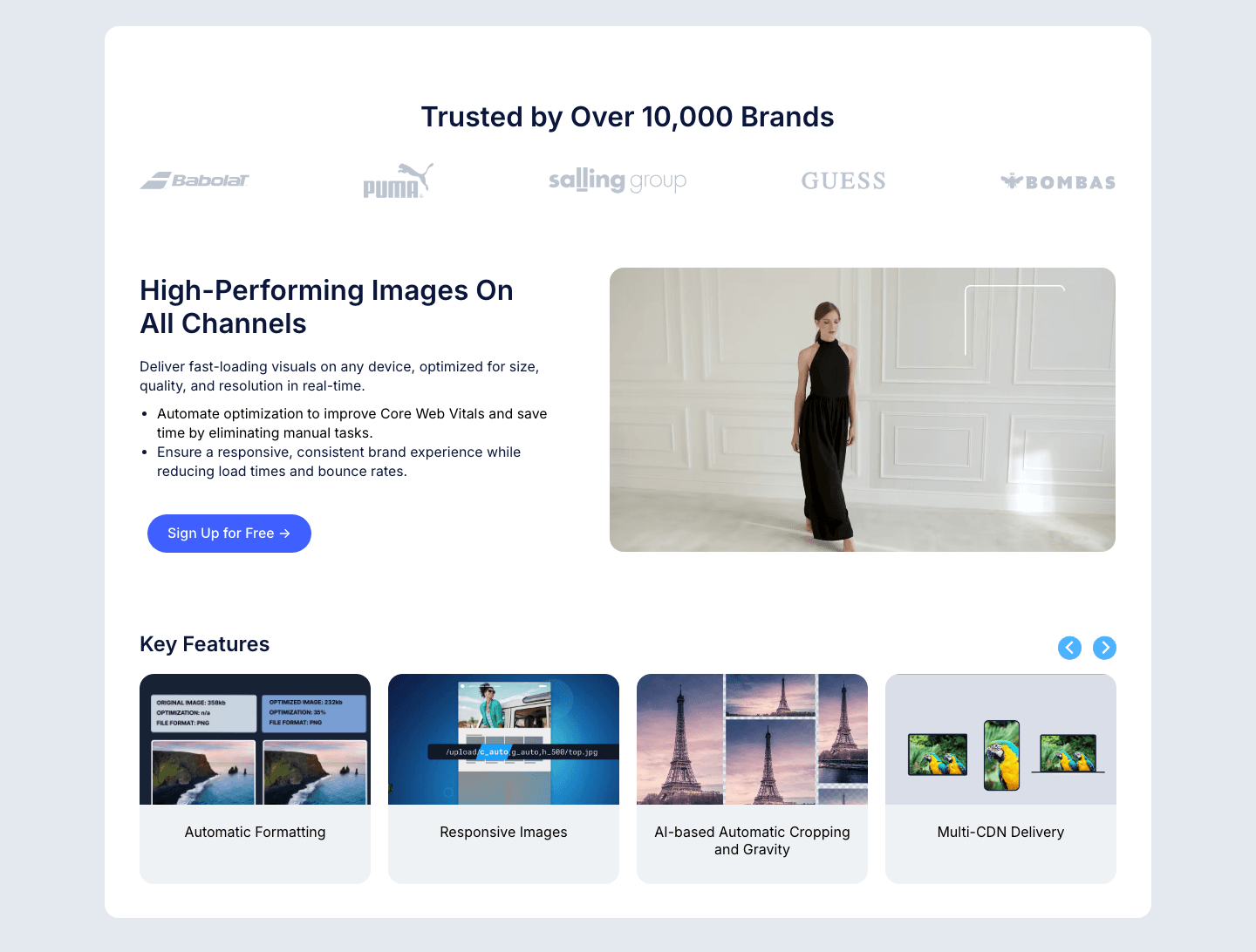
The proof. "Trusted by Over 10,000 Brands" over five logos, then a block headed "High-Performing Images On All Channels" whose two bullets name Core Web Vitals and bounce rates, then a Key Features carousel. The first card in that carousel is the ad's comparison again, an original image at 358 kb beside an optimized one at 232 kb, three screens below the fold and without the dog.
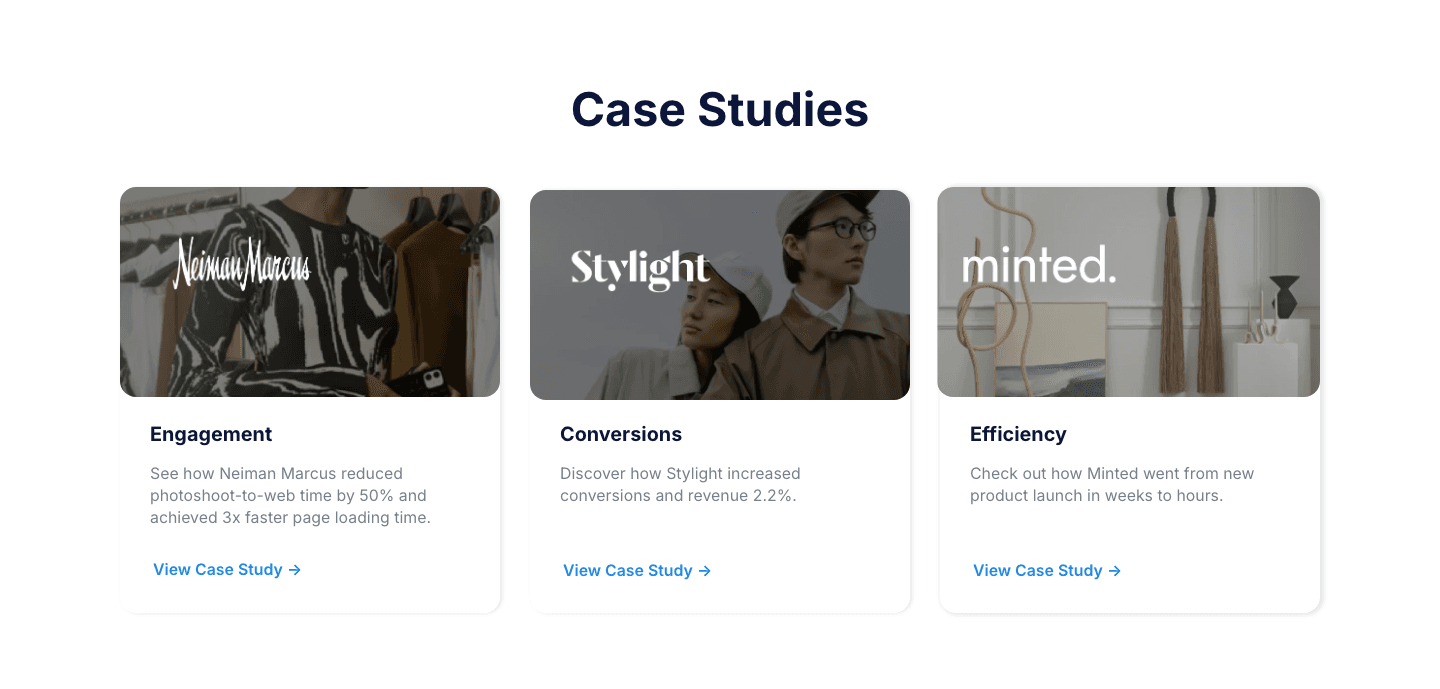
The case studies. Three cards headed Engagement, Conversions and Efficiency: Neiman Marcus cut photoshoot-to-web time by 50% and page loads by 3x, Stylight raised conversions and revenue 2.2%, Minted went from weeks to hours on a product launch. These are the only named customers with figures anywhere between the ad and the signup, and none of the four long-running cards mentions one.
Message match
| The ad says | The page proves it with |
|---|---|
| Cut 90% off your image payload | A features card showing 358 kb against 232 kb, and the live URL demo |
| Optimizes from AVIF to WebP | Automatic Formatting and Multi-CDN Delivery, two of four Key Features |
| Without disrupting your workflow | Sixteen language tabs on the demo, Node and React through Dart and Kotlin |
| Perfect images on every device | Responsive Images and AI-based cropping, shown recropping one photo three ways |
The gaps
Two gaps, both fixable in a week. The ad's headline number and the page's number do not meet: the card promises 90% off the payload, the first features card shows a 35% saving, and the reader who clicked for 90% has to reconcile the two with no note explaining that one is a format change and the other a compression pass. And the three case-study cards are the only named proof on the page, yet they sit below the Key Features carousel on a page 6,798 pixels tall, while "Trusted by Over 10,000 Brands" with no customer attached sits in screen three. A page audit catches both in one pass.
Teardown 2: Kittl
The campaign. One designed card, Library ID 1097275688988614, launched 21 July 2025 and running 95 days, plus five video ads on the same destination, the longest at 122 days. All six point at kittl.com/get-started/assets, a page the site navigation does not link. The card had stopped by 24 October 2025; the page was still serving at the capture.
The ad
The creative is a wall of finished designs with one quote card dropped on top: "One Kittl subscription replaced my $200 content subscriptions," signed Jane H, Freelance Designer. The posters behind it are Kittl templates, so the reader sees what they would make while they read the quote. At the foot, five stars and "Loved by 8m+ users". The body text over the card asks the question the quote answers: "Tired of paying $200+ for all the stock platform subscriptions? Kittl has everything you need to create in one place." The link headline is four words, Too many subscriptions?, and the button is Sign Up.
The landing page
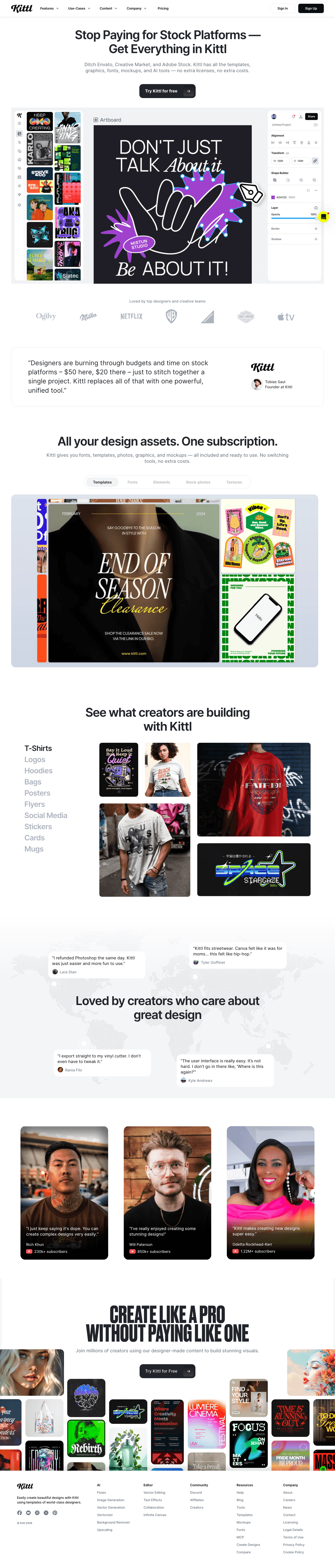
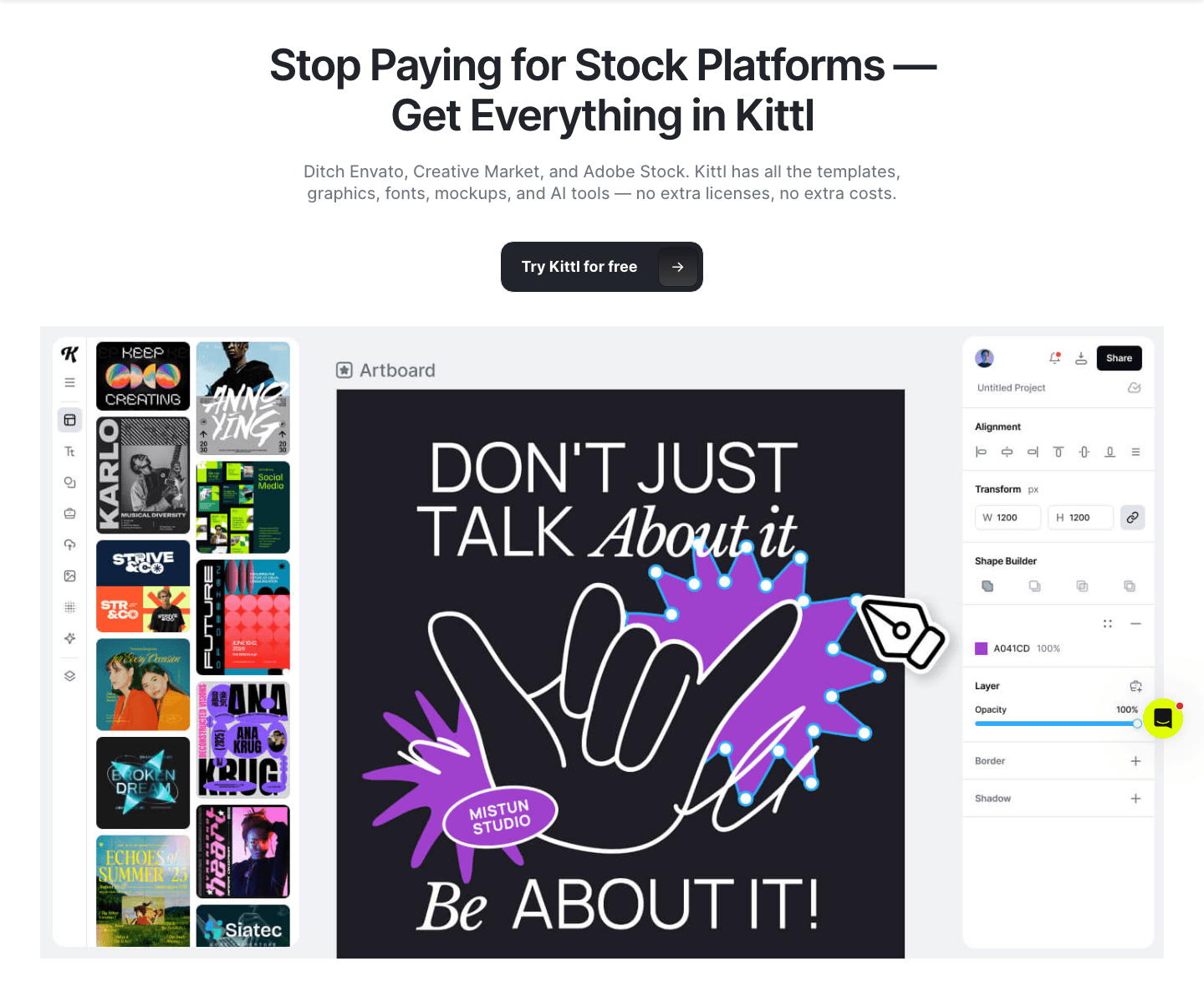
The hero. The headline finishes the ad's sentence: "Stop Paying for Stock Platforms, Get Everything in Kittl". The subhead does what the card would not and names the bill: "Ditch Envato, Creative Market, and Adobe Stock. Kittl has all the templates, graphics, fonts, mockups, and AI tools, no extra licenses, no extra costs." One button, Try Kittl for free. Under it, the editor itself, open on a finished design with the pen tool mid-edit and the layers panel on the right.

The logo wall. Seven marks under one line, "Loved by top designers and creative teams". It is the only part of the page that speaks to a creative team rather than to a solo seller, and it is the second thing on the page.
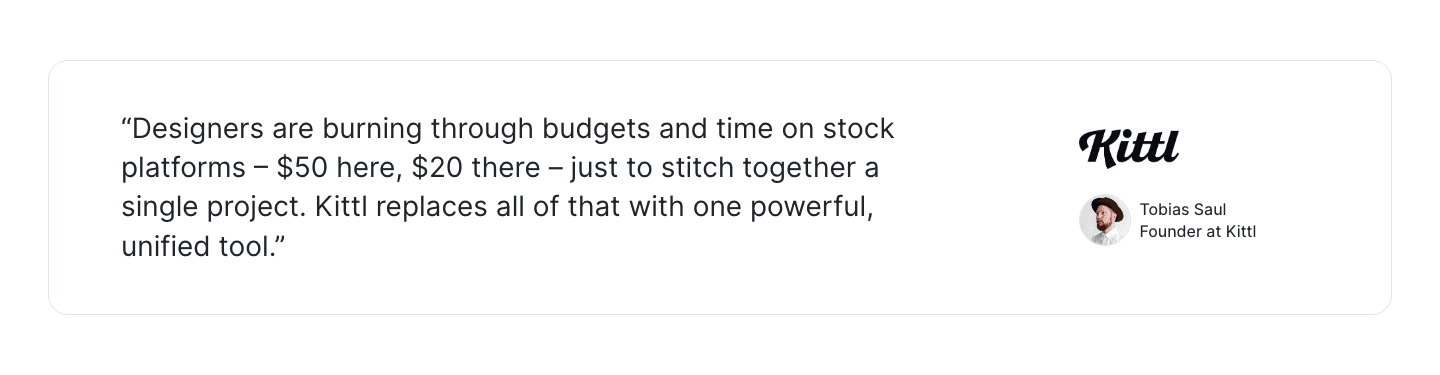
The founder quote. "Designers are burning through budgets and time on stock platforms, $50 here, $20 there, just to stitch together a single project. Kittl replaces all of that with one powerful tool," signed Tobias Saul, Founder at Kittl. The ad said $200; this breaks the $200 into the small payments the reader recognises from their own card statement.

The asset tabs. "All your design assets. One subscription." and a five-tab switcher, Templates, Fonts, Elements, Stock-photos, Textures, each loading a gallery of real work. This is the page answering the question the ad leaves open: whether one subscription really covers all five of the things the reader is paying for separately.
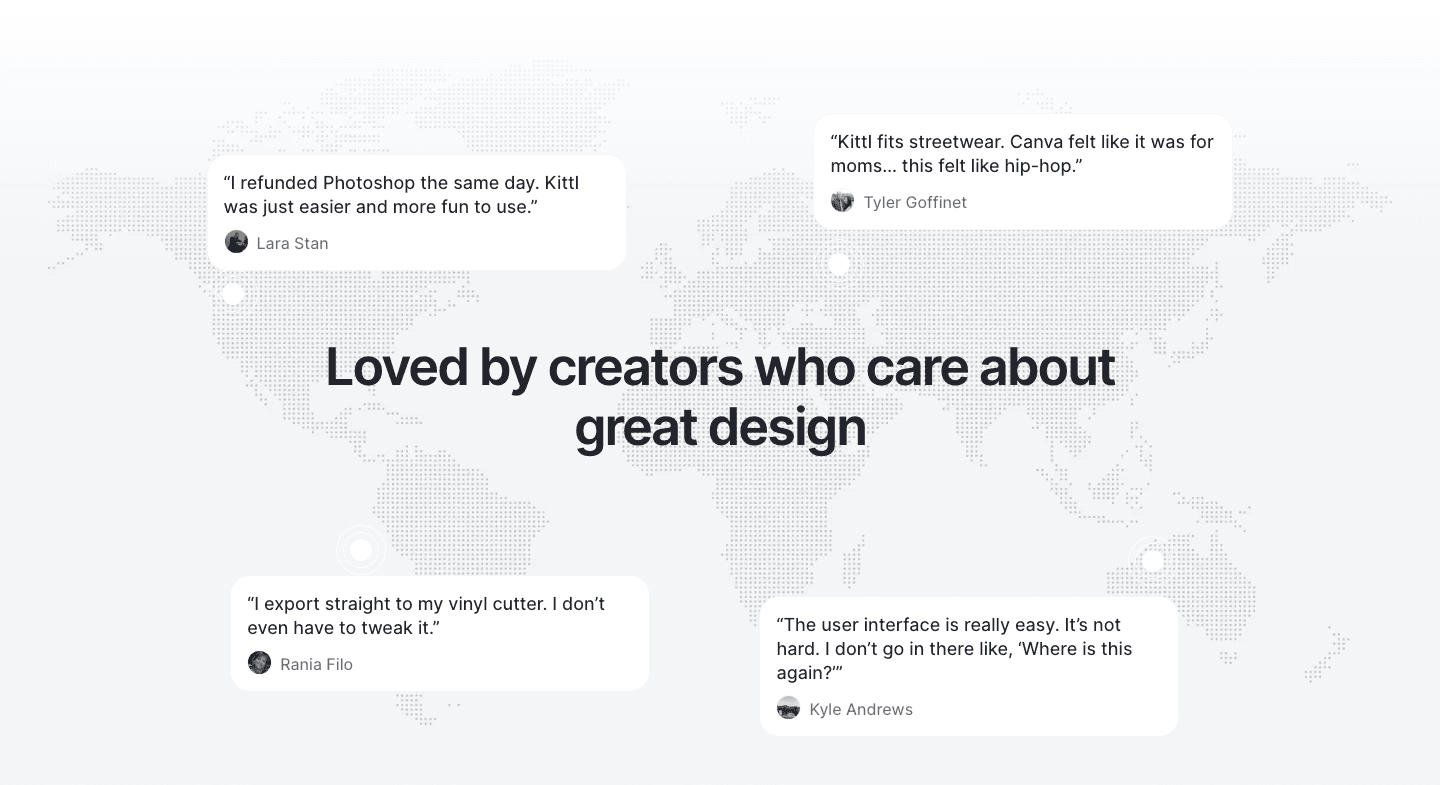
The testimonials. Five quotes floating on a dotted world map under "Loved by creators who care about great design". Two of them name a competitor the ads never touch: "I refunded Photoshop the same day. Kittl was just easier and more fun to use," and "Kittl fits streetwear. Canva felt like it was for moms, this felt like hip-hop." A row of YouTube creators follows, each with a subscriber count beside the quote, from 230k to 1.22M.
Message match
| The ad says | The page proves it with |
|---|---|
| Tired of paying $200+ for stock platform subscriptions | A founder quote breaking $200 into "$50 here, $20 there" |
| Kittl has everything you need in one place | Five asset tabs, Templates through Textures, each loading real work |
| One Kittl subscription replaced my $200 content subscriptions | Two testimonials naming Photoshop and Canva by name |
| Loved by 8m+ users | A logo wall of seven brands and creators with subscriber counts |
The gaps
Two gaps. Envato, Creative Market, Adobe Stock, Photoshop and Canva are all named on the page, and not one of Kittl's 60 ads on file names any of them, so the strongest line Kittl has written is one the reader only reaches after the click. And the page carries no price anywhere, on an offer whose entire argument is that it costs less than the five subscriptions it replaces, so the reader has to sign up to find out whether the trade is good. The competitive audit looks for gaps like these on your own pages, the same way.
Key takeaways: five things to do with this
- Count the subscriptions your buyer already pays. The two longest message families here, Kittl's stack ads and Cloudinary's file-size ads, both put a number on something the reader already owns rather than on the product.
- Put the interface on the card. Elementor's 278-day and 121-day creatives are both screenshots of the editor with a real design inside it, and the buyer is going to spend their week in that panel.
- Build the page the ad needs, then hide it. Kittl's
/get-started/tree and Cloudinary's/ip/prefix are both invisible from the navigation, and between them they carry 41 of the 209 brand-site ads in this sweep. - Put the version in the address. Elementor's
wordpress_band Kittl'ssave25page tell you from outside which variant and which offer the money is behind. - Try one of the five open angles. Nobody prices the tool, nobody mentions licensing, nobody promises the switch, nobody puts a working demo on the card, and only Rayon names a competitor.
How to run this analysis on your own competitors
The Meta Ad Library and the Google Ads Transparency Center are public and free. Search the brand's page, not a keyword, set the country, filter to active ads, sort by start date. Then:
- Group the ads by angle. Use the nine above.
- Keep the ones that have run 45 days or more. The advertiser keeps paying for them. Click through and read the page each one lands on.
- Write down the angles they are not running. Start your next campaign from that list.
Or send us the URL and we do it for you.
How we did the analysis
- Sample: the design tool companies on the benchmark leaderboard, picked by traffic, not by advertiser status. Fifteen were selected, twelve swept: Cloudinary, Elementor, Kittl, Getshogun, Venngage, Submagic, Rayon, Jitter, Alai 2.0, Super, own.page and Folio AI. Super, own.page and Folio AI were swept and had no brand-verified Meta ad; Venngage had two, both pointing at a Spanish blog post, so it has no readable ad here. ReactVision Studio, Runwayml and Ziflow were selected and never swept, so they are set aside rather than counted as having no ads.
- When: the sweeps ran between 1 and 3 September 2026 in the United States, and no new sweep was made for this article. Every day count, every ad count and every "still live" in this post is as of that window. Statuses change; the library links in the sources show the current state.
- Sources: the Meta Ad Library, searched by brand page, and the Google Ads Transparency Center, both through Apify. The Transparency Center returned nothing for all twelve companies.
- Filter: brand-verified ads only. An ad counts when the advertiser's page name and the landing host are the brand's own. That dropped 245 results on the page name and 293 on the landing host, mostly resellers, course sellers and agencies trading on these brand names.
- Ranking: days active. The floor of interest is 45 days, the point at which an ad has survived at least one budget review. 96 brand-verified ads cleared it.
- Reading: every distinct message was read by hand and put in one angle. About half of Meta's headlines come back as a
{{product.name}}template and every video headline is a stub, so those were read from the creative image where we hold one, and from the library's body field where we do not. Four advertisers in this set, Submagic, Rayon, Jitter and Alai 2.0, were found by keyword search rather than by brand page, so their copy is quoted from the library's own fields and none of their creatives is shown here. - Limits: the library returns about 60 ads per brand per market, so Elementor's, Cloudinary's and Kittl's counts are a floor and the shares inside the sample are what to read. Only the United States was swept. Meta publishes reach only in the EU and never publishes spend.
Every ad above links to its primary source in the sources list, so you can check the whole analysis yourself.
Sources
Primary sources, all public and checkable today. Open any Meta ad with its Library ID at facebook.com/ads/library/?id=ID.
- Cloudinary's image-optimization pair, Library IDs 693207999842197 (328 days) and 1261124265575638 (288 days): facebook.com/ads/library/?id=693207999842197 and facebook.com/ads/library/?id=1261124265575638.
- Kittl's subscription card, Library ID 1097275688988614 (95 days): facebook.com/ads/library/?id=1097275688988614. Its POD comparison card: 760436919920997.
- The creatives shown above: Cloudinary 709674755243074 (the transformation carousel) and 811828145182277 (the video series), Elementor 1822051258590831 (the popup builder), 1165813568000809 (Elementor AI) and 1468856860805879 (13% of WordPress), Getshogun 1456240409256507 (price testing).
- The rest of the Cloudinary video series: 25516437911327485 (grow usage), 1471255790627707 (boost engagement), 792703240395330 (amplify reach), with their second runs 1288963176198233, 2196280504151214, 759113749973659 and 722077630539205. The other long Cloudinary ads: 1210428233350957, 1032508831574346, 1439633720687332, 1086729300442999, 1185856286815815, 1800295753888132.
- The Elementor long runners: 604363385854488 (349 days), 1076247120641501, 682372961425724, 1449437623548600, 2054777922133447, 1591235585266041.
- The Kittl ads quoted: 2178423959292871, 1224383205842468, 1426891431677010, 2510351922653672, 4275984305985050, 2261179327748471, 2155522734954308, 1463728831586120, 736499969472682, 1627662057920896.
- The keyword-swept advertisers: Rayon 1513435246527721 and 25528142480103882 and 1017447744673309, Submagic 1432276528392849 and 4455770824658143 and 1984186428904013, Getshogun 742506961962360 and 859298033403728, Jitter 1705266220631284, Alai 2.0 1132201122451145.
- The landing pages, live: cloudinary.com/ip/gr-frnt-mt-image-optimization, kittl.com/get-started/assets, elementor.com/pages/one, getshogun.com/solutions/shopify-price-testing-app.
- The sample: the design tools leaderboard of the Web Anatomy benchmark, selected by traffic. The sibling post on consumer finance: the fintech ads playbook.
- The Google Ads Transparency Center, which returned nothing for this sample: adstransparency.google.com. Ad sweeps made 1 to 3 September 2026 (Meta by brand page and by keyword, Google by advertiser); the landing-page captures made the same week.
Data collected September 2026. Ad statuses and run lengths change; the library links above always show the current state.

Written by
Gabriel Amzallag , Founder, Web Anatomy
5 years CRO + SEO at Qonto (2021–2025). After advising 15+ SaaS on their websites (Payfit, Pigment…), the same patterns kept breaking, so I decided to build the source of truth on what works on the web: the intelligence layer every tool, builder, and team uses to ship sites that perform.
More from the blog
Playbooks
We analyzed the ads the top EdTech companies run. Here is what works.
Which EdTech ads kept running through the summer of 2026, the eight angles they use, and the pages behind them. The takeaways, with the ads to look at.
 Gabriel Amzallag24 min read
Guides
AI SEO content workflow: how to publish one page a day without publishing slop
The four parts of the AI content machine behind Web Anatomy's SEO pages: a roadmap CSV, a page template, a skill file per page type and a daily routine. The agent makes zero strategic decisions.
Gabriel Amzallag10 min readGuides
How to improve your website conversion rate (instead of chasing traffic)
You don't need more traffic. A simple method to improve your website conversion rate: know if it is worth it, generate ideas at three levels, rank them with RICE and measure each change.
Gabriel Amzallag7 min read