
TL;DR
- The SaaS ads that keep running sell one of seven angles: the customer with a number, the AI teammate, the busywork, the price, the invitation, the start, the series. Six of the nine full accounts show up under three or more of them.
- AI is the most common message right now. 101 of the ads mention it, and Zendesk spent 21 ads on a single sentence about self-improving AI. So many brands say it that it no longer sets anyone apart.
- Five angles are almost empty: a named competitor, a speed you can time, the monthly price, security as the headline, anything interactive on the card. Four of them appear in zero ads; the one security ad lasted 6 days.
- 11% of the social ads land on the homepage, against 43% of the search ads. The best pages here are the ones built for one offer: Dropbox's campaign page carries 40 ads on its own.
12 companies swept, 546 Meta ads and 420 Google ads on file, US, late August 2026. How we did it is at the end.
The sample: 12 SaaS companies, their ads, and where the ads land
| Company | Meta ads on file | Ran 45 days or more | Still live | Oldest live ad | Where the ads land |
|---|---|---|---|---|---|
| Shopify | 60 | 50 | 2 | 91 days | free trial, start, Sweden |
| Canva | 60 | 47 | 9 | 89 days | the visual suite, Poland, Spain |
| Squarespace | 60 | 38 | 30 | 192 days | the homepage, services, create a website |
| Figma | 60 | 35 | 46 | 154 days | Figma Make, Figma agents |
| Atlassian | 60 | 27 | 16 | 162 days | Jira, Confluence, Jira Service Management |
| Zendesk | 60 | 21 | 1 | 41 days | a tracking redirect, 38 ads; retail |
| Dropbox | 60 | 20 | 18 | 21 days | one campaign page and its team version |
| DocuSign | 60 | 17 | 29 | 154 days | the IAM page, a webinar, a Deloitte study |
| Zoom | 60 | 8 | 7 | 54 days | the plan-configuration page, 46 ads |
| Plaid | 1 | 1 | 1 | 74 days | one industry page |
| Moloco | 5 | 0 | 0 | none | 4 readable, no landing page on any of them |
| Stripe | 0 | 0 | 0 | none | Google only |
Squarespace and Figma keep their ads running: 30 and 46 creatives still live, the oldest at 192 and 154 days. Zoom and Zendesk are still testing. Zoom has 8 ads past 45 days out of 60. Zendesk has 21 past 45 days and exactly 1 still live, because those 21 were one announcement that ran and then stopped.
Ad analysis: the seven angles SaaS ads use
Every message on Meta fits one of seven angles. For each one: the ads that ran longest, one creative to look at, and why it keeps running. The number in brackets is how many days the ad had been running when we looked.
1. The customer with a number
This is the strongest angle in the set and has the most long runners. The ad names a company, gives a figure and says what changed.
- Atlassian: "Reddit scaled, standardized, and saved $300k+ per year by switching to Jira" (162 days, live), "Udemy unified their people and processes by switching to Jira" (162 days, live), "Udemy eliminated 2,400 hours of meeting time by using Confluence for reporting and collaboration" (147 days, live).
- Atlassian again: "Since starting with Jira Service Management AI agents, Thumbtack has saved both time and money on IT tooling" (151 days), whose card reads the Thumbtack IT team is on track to save 350 hours every year.
- Shopify: "East Fork started in a barn. Now they sell across the planet" (105 days), the card carrying a founder photo and one quote, Shopify opened us up to the world, signed Alex Matisse. And "Eastside Golf is changing the game on courses everywhere" (153 days), signed Olajuwon Ajanaku.
- Zoom: a Sonos customer testimonial (167 days), the only Zoom ad in the set that names a customer.
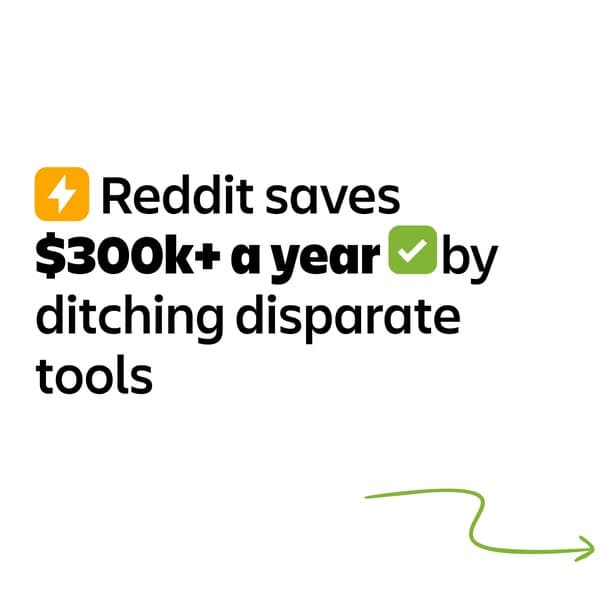
Why it runs: Atlassian lets the numbers make the case. It says Reddit saved $300k and Udemy got 2,400 hours back, and leaves the reader to work out what that would mean for their own team.
2. The AI teammate
101 of the ads in the set mention AI, more than any other word we counted. The better ones say what the AI does. The rest just say AI.
- Zendesk: "Zendesk is defining the future of service with self-improving AI" (69 days at the longest), the same sentence on 21 ads, each carrying a different executive quote.
- Figma: "Try Figma Make today" with the body imagine an AI-powered design tool that can pull from your design system so everything looks just right (105 days, live), and "Design at the speed of thought. Try Figma AI for free." (77 days, live).
- DocuSign: "One AI platform for all your agreements" (96 days, live) and "Docusign AI digitizes and organizes" (123 days, live).
- Zoom: "AI that actually works the way you do", for an assistant that connects the dots across meetings, chats, and docs (54 days, live).
- Canva: "Canva AI can keep you on brand" (58 days, live).
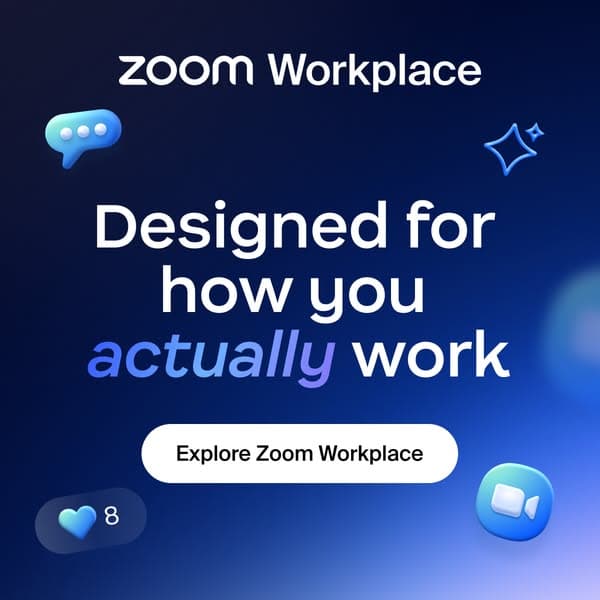
Why it runs: buyers are being asked inside their own company what they are doing about AI this year, and these ads give them an answer. The problem is that the five brands above say much the same thing, so it is hard to tell whose ad is whose.
3. The busywork
This is the oldest complaint in business software, and it still runs: manual work and switching between tools all day.
- Zoom: "Let AI handle your busywork. Less manual tasks, more big wins." and "Cut the clutter. Keep the hours." on one carousel (17 days), plus a free eBook whose body is a list of the same complaints, disengagement, toggling between tools, spending time on low-impact tasks (180 and 179 days, the two longest-running Zoom ads on file).
- DocuSign: "Finding data across thousands of agreements took days. Not anymore." (96 days, live).
- Atlassian: the Reddit card again, which frames the saving as ditching disparate tools rather than buying software (162 days, live).
- Dropbox: "Share every file, comment, and version in Dropbox, not a text thread" (16 days, live).
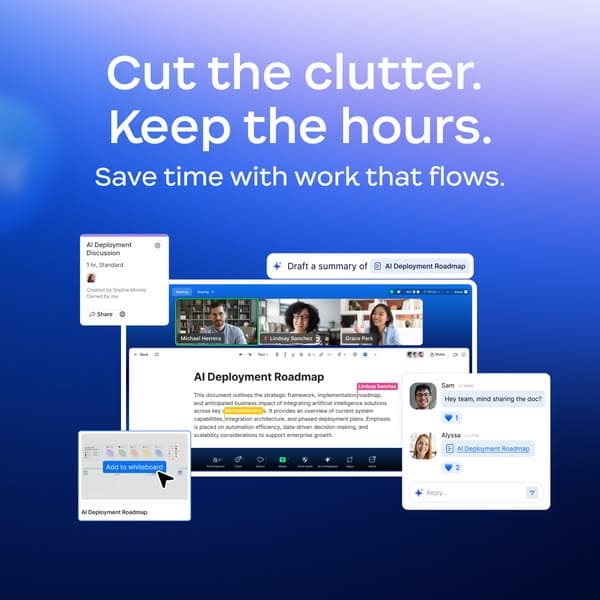
Why it runs: it describes the boring part of the buyer's week in detail and then offers to take it away. Zoom's two oldest ads describe the problem and never show the product.
4. The price
In fintech this angle is nearly empty. In SaaS it is one of the main ones, because most people start on the free plan.
- Atlassian: "Jira is free for 10 users" on the card, under it your all-in-one project management tool powered by AI (162 days, live). "Get started with 10 free seats" for Confluence (147 days, live). "Try Confluence for free" as a headline (146 and 141 days, both live). "Start with Jira Service Management for free" (151 days).
- Squarespace: "Domains starting at $10" (144 days, live) and "Start your dream with Squarespace. Domains starting under $15" (62 days, live). Then the discount: "Save 20% on your website today", 20% off with code SQSP20 (49, 48 and 47 days, all live).
- Canva: "Sign up for free" as the whole headline (49 and 48 days, both live).
- Shopify: the 208-day card's link description is four words, start your free trial.
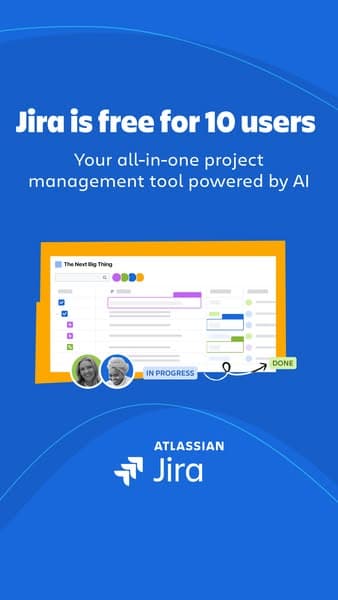
Why it runs: "Free for 10 users" tells a team lead they can start today without asking anyone for budget.
5. The invitation
These cards sell nothing. They offer a report, an eBook, a webinar seat or a conference ticket in exchange for an email, and they run longer than most product ads.
- DocuSign: "Download the Free Report" for a Deloitte study on agreements (105 days twice, and 103 days as video, all live). "Sessions Offered Every Other Tuesday" for a recurring webinar (127 days as an image, 114 days as video, both live). "Transform Your Agreements with Docusign IAM", which sells a 30-minute webinar (96 days, live).
- Zoom: "Free eBook: Removing the Barriers to Productivity" (180 and 179 days).
- Atlassian: the Team Europe conference, run as a dynamic ad against events.atlassian.com (56 and 46 days).
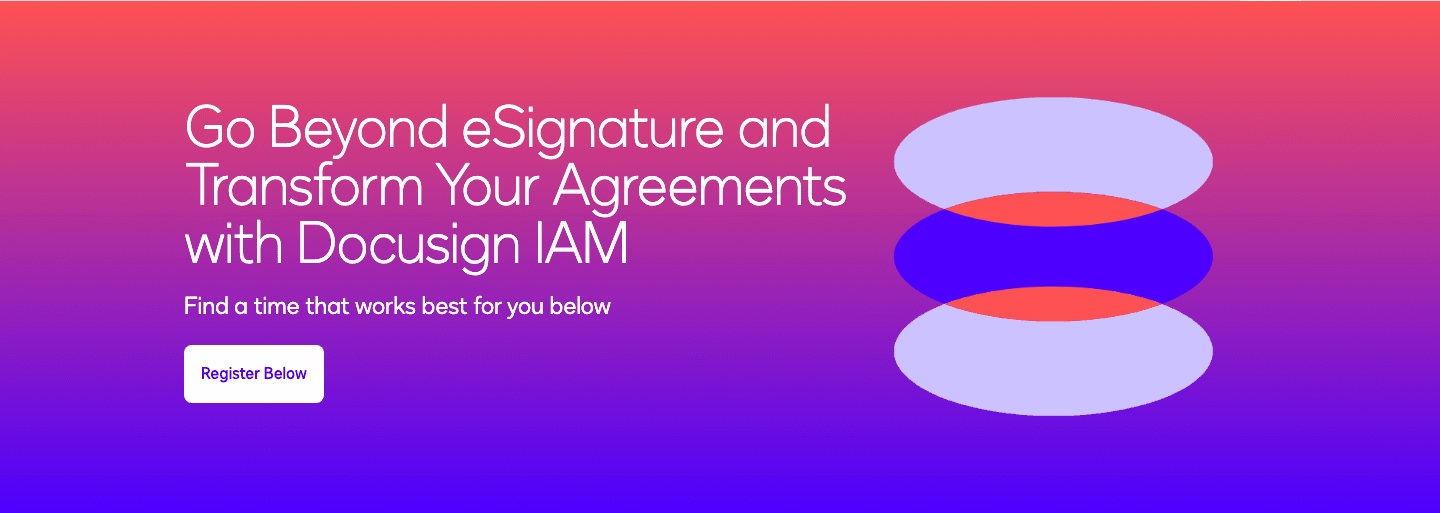
Why it runs: the product never appears on the card, so the ad does not go out of date when the product changes. DocuSign's recurring webinar uses one page and one set of ads, with a new date every other Tuesday.
6. The start
The SaaS brands that sell to individuals, not companies, sell the idea of starting a business.
- Shopify: "Spin your passion into a business" over a record-shop owner (153 days), "Kickstart your business" with the body when it's time to start your business, it's time for Shopify (208 days, the longest-running ad we could open in the sweep).
- Squarespace: "Dream it, Domain it", with the body don't wait to start your dream (62 and 49 days, both live), and "Easily express yourself online", create a site that reflects your personal brand (56 days, live).
- Canva: the back-to-school run aimed at teachers, 3 FREE Canva features that can help you plan lessons faster this back-to-school season (49 days, live).
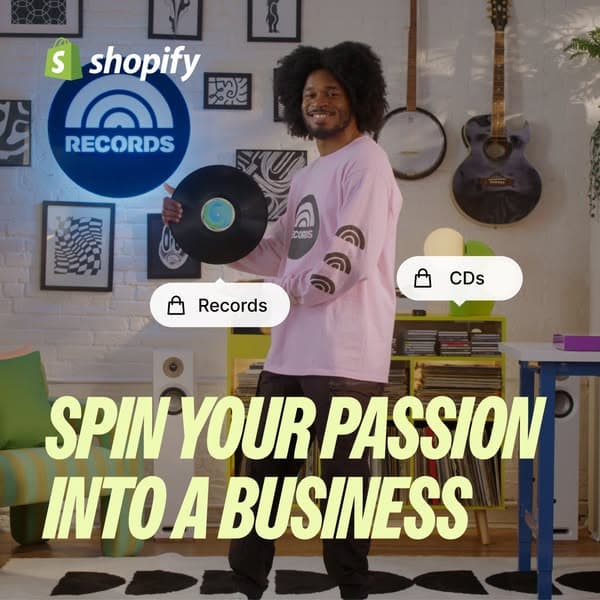
Why it runs: the person seeing the ad wants a shop, and a website is just how they get one. These ads show the shop and mention the software once.
7. The series
One template with many versions, so a big account still looks like one brand.
- Atlassian: one customer per card. Reddit, Udemy and Thumbtack, each with its own number set large on a flat colour block, 147 to 162 days.
- Zendesk: one executive quote per card, three quotes rotated across 21 ads, 53 to 69 days, every one under the same headline.
- Squarespace: two dynamic templates, "Build your website your way" and "Sell what you do directly from your site", running 139 and 143 days with the product screen swapped inside.
- Canva and Shopify: the market version. Canva runs 24 distinct paid pages, 18 of them per market; Shopify runs 17, 11 per market, including a Swedish free-trial page carrying 15 ads.
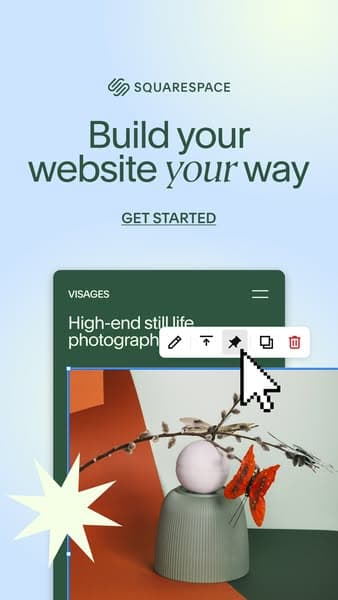
Why it runs: by the second ad the reader knows the format, and by the third they only read the part that changed. It also lets one team keep 60 ads running without writing 60 new ideas.
Ad analysis: five angles almost nobody in SaaS uses
Across all 546 ads, each of these five shows up in one ad or none. Where something close exists, we name it.
- A named competitor. Zero. Atlassian comes closest, twice: "by switching to Jira" (162 days, live) and ditching disparate tools, but it never says what Reddit switched from. Most buyers here already pay for another tool, and not one of these 546 ads names it.
- A speed you can time. Also zero. The closest is DocuSign's "Finding data across thousands of agreements took days. Not anymore." (96 days, live), which says the old duration and never the new one. In fintech, the second-biggest angle is a time you can measure: two minutes to open an account, 90 seconds to onboard a hire. Squarespace's own page promises a website in minutes with AI; the ads pointing at that page never say it.
- The monthly price. Six ads in the readable set carry a currency figure. Three are Atlassian's $300k, which is a customer's saving and not a price. The other three are Squarespace domains at $10 and under $15 (144, 62 and 49 days). Not one ad says what a seat of anything costs per month, so after every click the reader still has to go and find the price.
- Security as the headline. One ad, and it lasted 6 days: Zendesk's "Speed and compliance, no tradeoff", your customers want speed, regulators want proof. The Jira page does promise an audit trail, and every one of these products is sold to companies that run a buying review. No long-running ad leads with security.
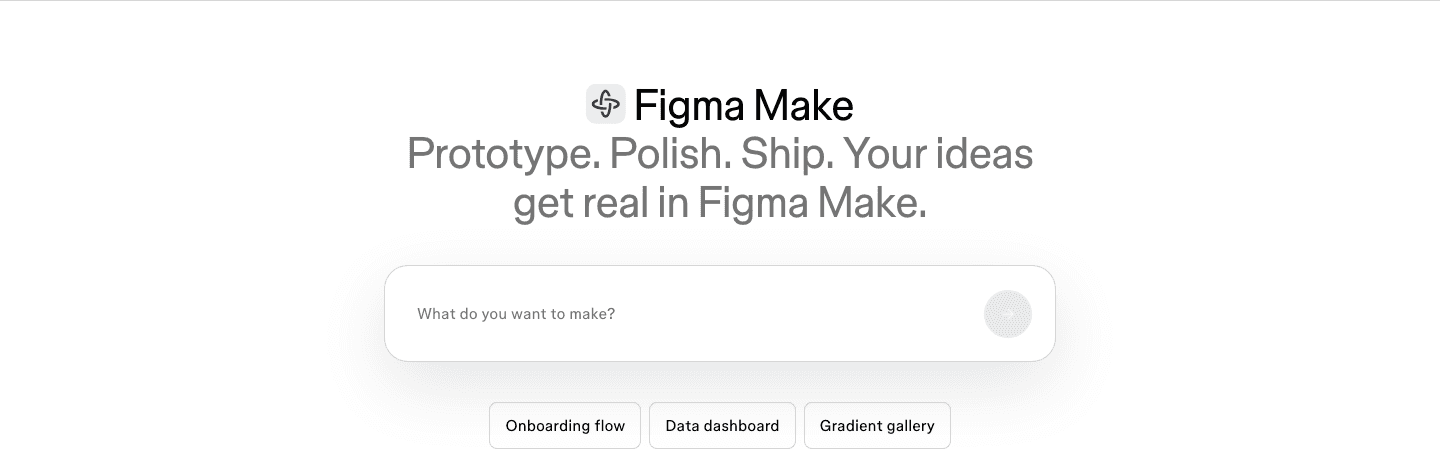
- Anything interactive on the card. None of the ads has a calculator, a quiz or a slider. The nearest thing is on a page: figma.com/make opens with a prompt box asking what do you want to make?, and the 37 ads pointing at it, the oldest 154 days, all show finished work instead.
A sixth, for the calendar: in a sweep covering all of August, one ad named a season, Canva's 3 FREE Canva features that can help you plan lessons faster this back-to-school season (49 days, live), with a companion telling teachers to plan their year (48 days). Half of these products sell to retailers, whose busiest season is Q4, and no ad in these accounts mentions it.
Landing page analysis: what happens after the click
Here is where the ads send people, and the two channels do it differently:
- On Google, 43% of the ads point at the homepage. 180 of 420. Stripe sends 47 of its 60 there, Plaid 46, Squarespace 31, Shopify 29. A search ad answers a query the visitor typed, so the homepage can carry it.
- On Meta, 11% do. 52 of the 476 ads that link to the brand's own site. That is more than in fintech, where the same figure is 4%, and the extra is almost all brand campaigns: Squarespace puts 13 ads on its homepage, Shopify 19, DocuSign 9.
- So the pages worth studying are the other 424. We sort SaaS advertisers into four tiers by the kind of page, from the homepage to a page with a country or a campaign code in its address. Every page below is linked.
| Tier | The ad points at | In the sweep |
|---|---|---|
| 0 | The homepage | 52 of 476 ads: squarespace.com, shopify.com, canva.com |
| 1 | A product page that already existed | Jira, Figma Make, Squarespace services, DocuSign IAM |
| 2 | A page that exists because the ad does | Dropbox's share-more campaign, DocuSign's webinar page, Shopify's free trial |
| 3 | A market or a campaign code in the path | Squarespace's /go/ page, Shopify in Swedish, Canva for Polish teachers |
Tier 1: the ad points at a product page that already existed
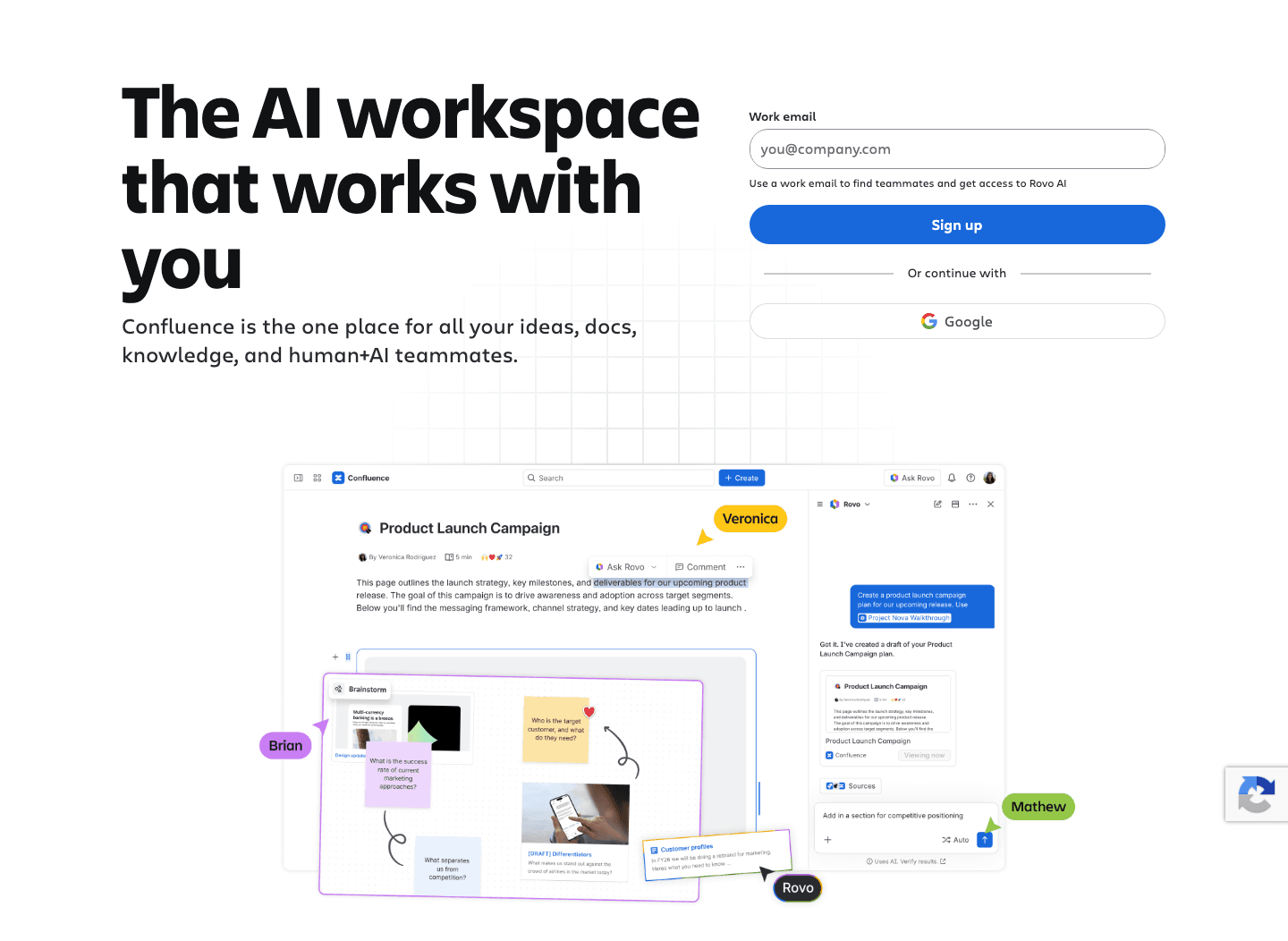
- 244 of the 476 ads land here, more than every other tier put together.
- Atlassian's four Confluence ads and Figma's 37 Figma Make ads point at the page an organic visitor reaches from the nav.
- It works when the product page is already a signup page. Confluence opens with a work-email field, so nothing had to be built for the campaign.
Tier 2: the ad points at a page built for that ad
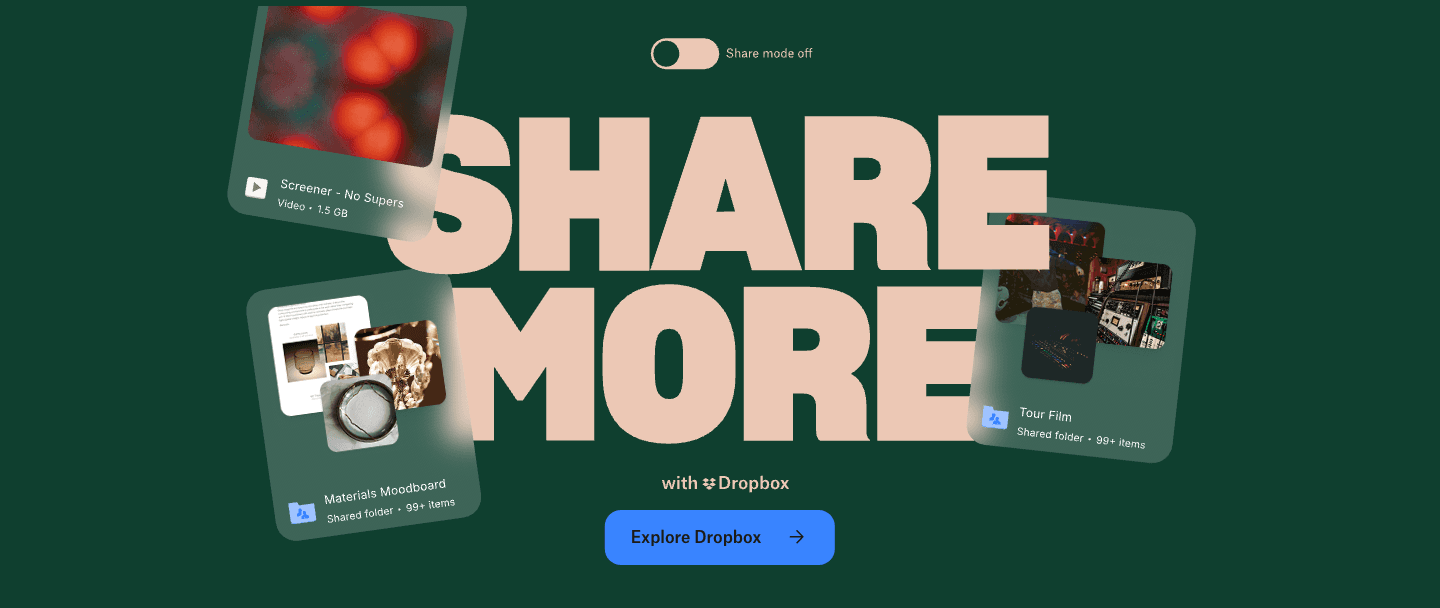
- 84 ads. Dropbox is the clearest case: 40 of its ads land on one campaign page, 8 on the team version, 7 on the Replay version.
- Read the address:
/campaigns/share-more, then/campaigns/share-more/teams. The page has children, one per audience, and the account's structure is visible from outside. - DocuSign's webinar page is the other shape: a different subdomain, a title, a date picker, nothing else to do.
Tier 3: the ad points at a versioned or per-market page
- 96 ads, almost all of them per country. Canva runs pages for Spain, the Netherlands and Poland; Shopify for Sweden, Italy, Spain and France.
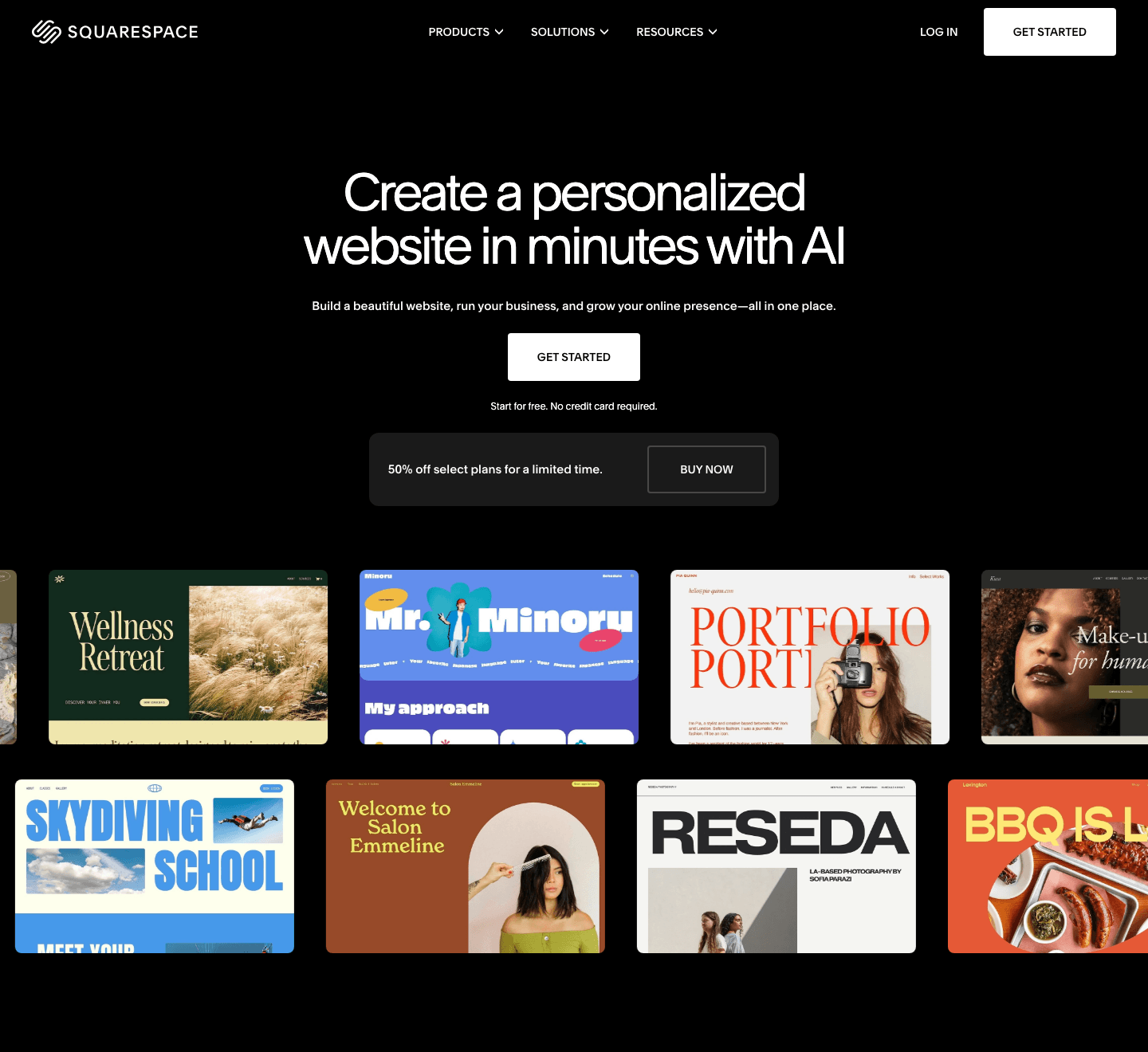
- Squarespace is the exception: squarespace.com/go/create-a-website carries 28 ads with no market in the path at all. The
/go/at the start of the path marks it as an ad page, the same way Gusto numbers its pages in the fintech set. - That page is also the only one in the sweep whose first screen carries a discount, like its ads do. The ads say save 20% today, and the hero carries a 50% off bar and a Buy Now button.
How many paid pages each company runs
| Company | Brand-site Meta ads | Distinct pages | Of which per market |
|---|---|---|---|
| Canva | 53 | 24 | 18 |
| Atlassian | 55 | 22 | 0 |
| DocuSign | 51 | 22 | 0 |
| Shopify | 41 | 17 | 11 |
| Squarespace | 47 | 5 | 1 |
| Zendesk | 15 | 5 | 0 |
| Dropbox | 55 | 4 | 0 |
| Figma | 56 | 3 | 1 |
| Zoom | 50 | 3 | 0 |
- Ad counts barely differ between these companies, because the library stops at about 60 per brand per market. Page counts differ a lot, from Figma's 3 to Canva's 24.
- The companies with the most pages use them in two different ways. Canva's 24 are countries, one language per page. Atlassian's 22 and DocuSign's 22 are products and content: Jira, Confluence, Jira Service Management, then blog posts and guides.
- Zendesk has at least 5, maybe more: 38 of its 60 ads point at a DoubleClick tracking redirect, so where they actually land cannot be read from the library.
Try it on your own account. Open your Ad Library entry, click an ad and look at where it lands. The homepage puts you on tier 0. A campaign page with sub-pages under it, like Dropbox's, puts you on tier 2. Most teams are on tier 1, with one page for every ad.
Teardown 1: Atlassian
We looked at two campaigns the way we look at a page in a client audit: the ads, then the page they land on, then the gaps. Atlassian because 23 ads point at one page and the oldest has run 162 days. Squarespace because two templates ran 143 and 139 days against a page that never repeats their sentence.
The campaign. 23 brand-verified ads pointing at atlassian.com/software/jira, the oldest running since March 24, 2026, which was 162 days when we swept on September 2. Fifty of Atlassian's 60 ads are image, carousel or dynamic units with a real page behind them, the highest share in the set. Four more point at Confluence, one at Jira Service Management and three at a conference, all in the same visual style.
The ads
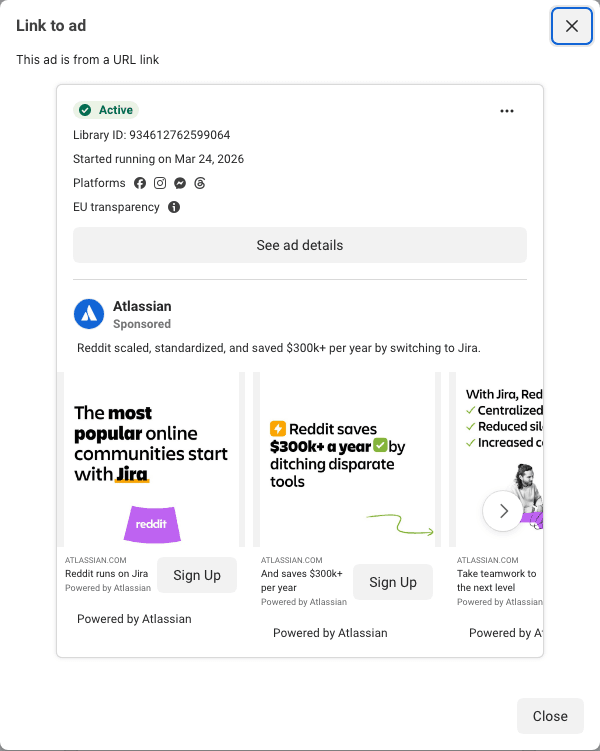
The longest-running card is a carousel with three frames. Frame one compliments the reader's company: the most popular online communities start with Jira, Reddit's logo under it. Frame two is the number: Reddit saves $300k+ a year by ditching disparate tools. Frame three is the checklist, with Jira, Reddit sees: centralized work, reduced silos, increased collaboration. The text above the images says all of it in one sentence, so a reader who never swipes still gets the point.
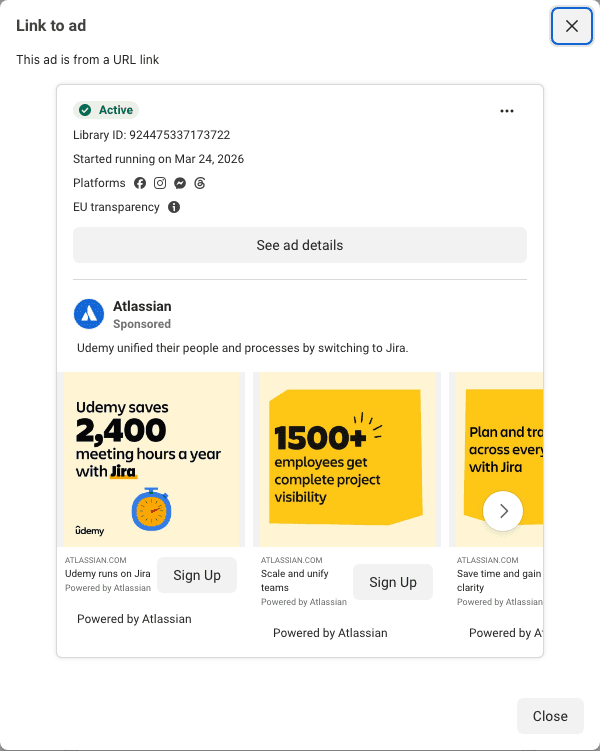
The second card is the same age to the day. It keeps the layout and changes the customer: Udemy, 2,400 meeting hours a year, 1500+ employees with complete project visibility. A third runs the same layout for Confluence with Reddit's $300k on it. Only the customer changes from card to card.
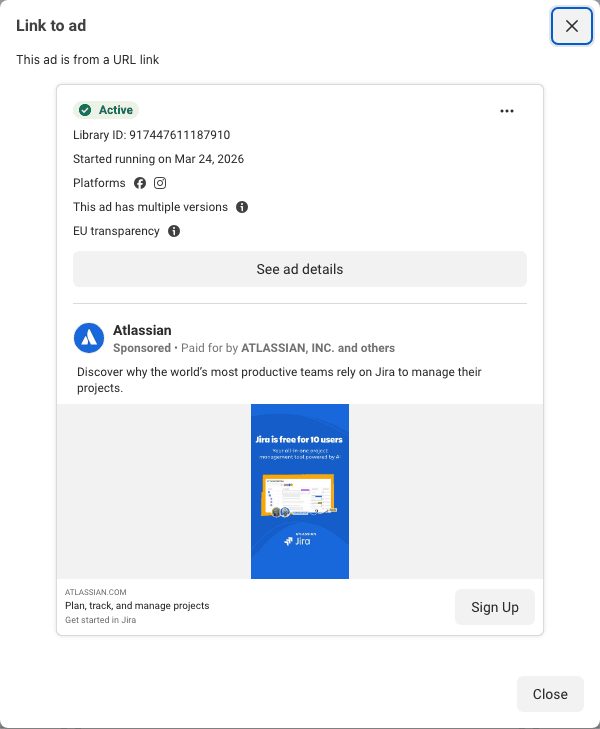
The third is the price card. Jira is free for 10 users, then your all-in-one project management tool powered by AI, then a product screen showing a task move from In Progress to Done. The link headline is "Plan, track, and manage projects". This card has no customer and no story.
The landing page

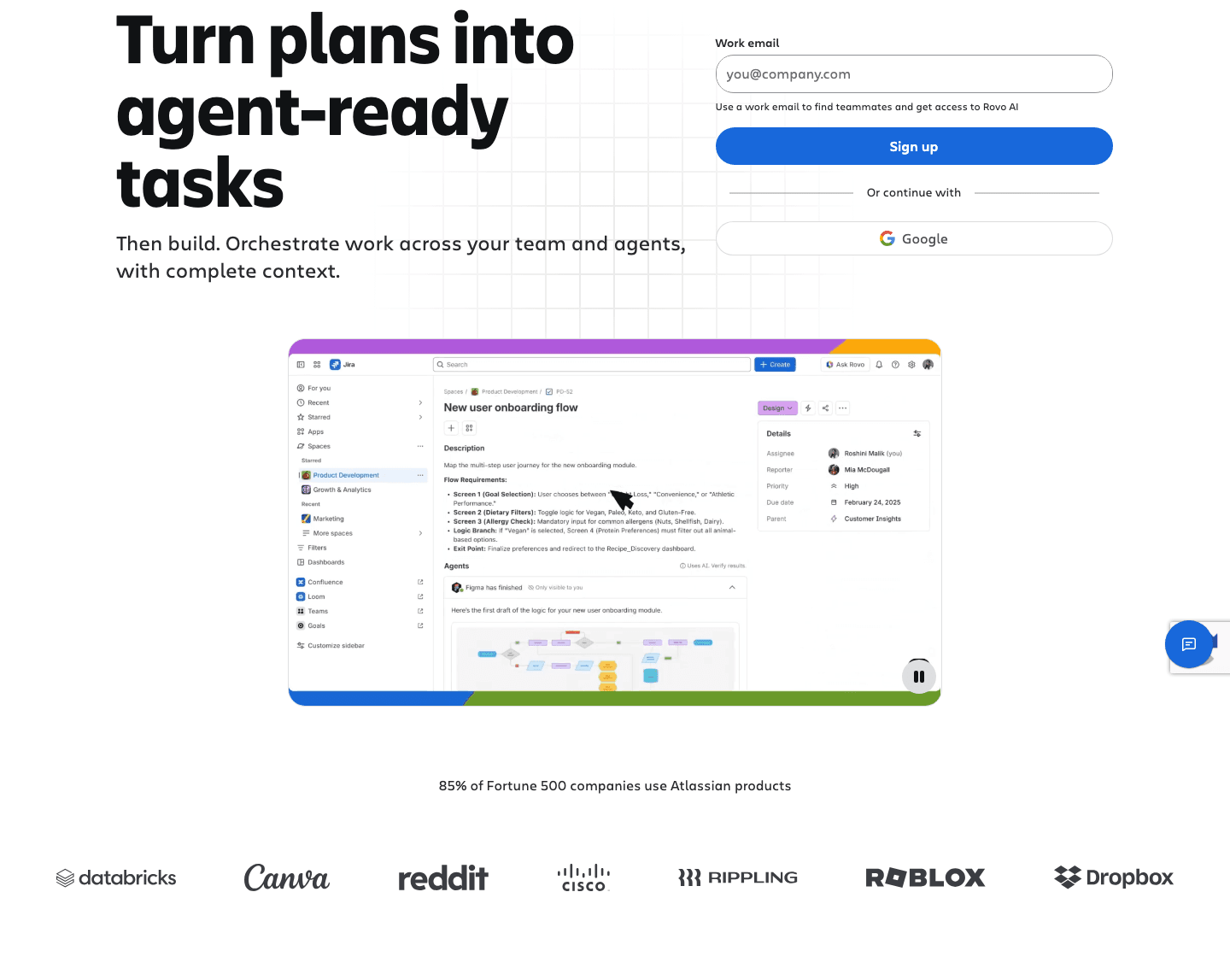
The hero. The headline sells this year's product, turn plans into agent-ready tasks, and the subhead finishes it: then build. Orchestrate work across your team and agents, with complete context. One work-email field, a note saying why it wants a work address, one blue Sign up button, Google as the alternative. Under it, one line and seven logos: 85% of Fortune 500 companies use Atlassian products, then Databricks, Canva, Reddit, Cisco, Rippling, Roblox, Dropbox. The visitor who clicked the Reddit ad meets Reddit's logo before the first scroll.
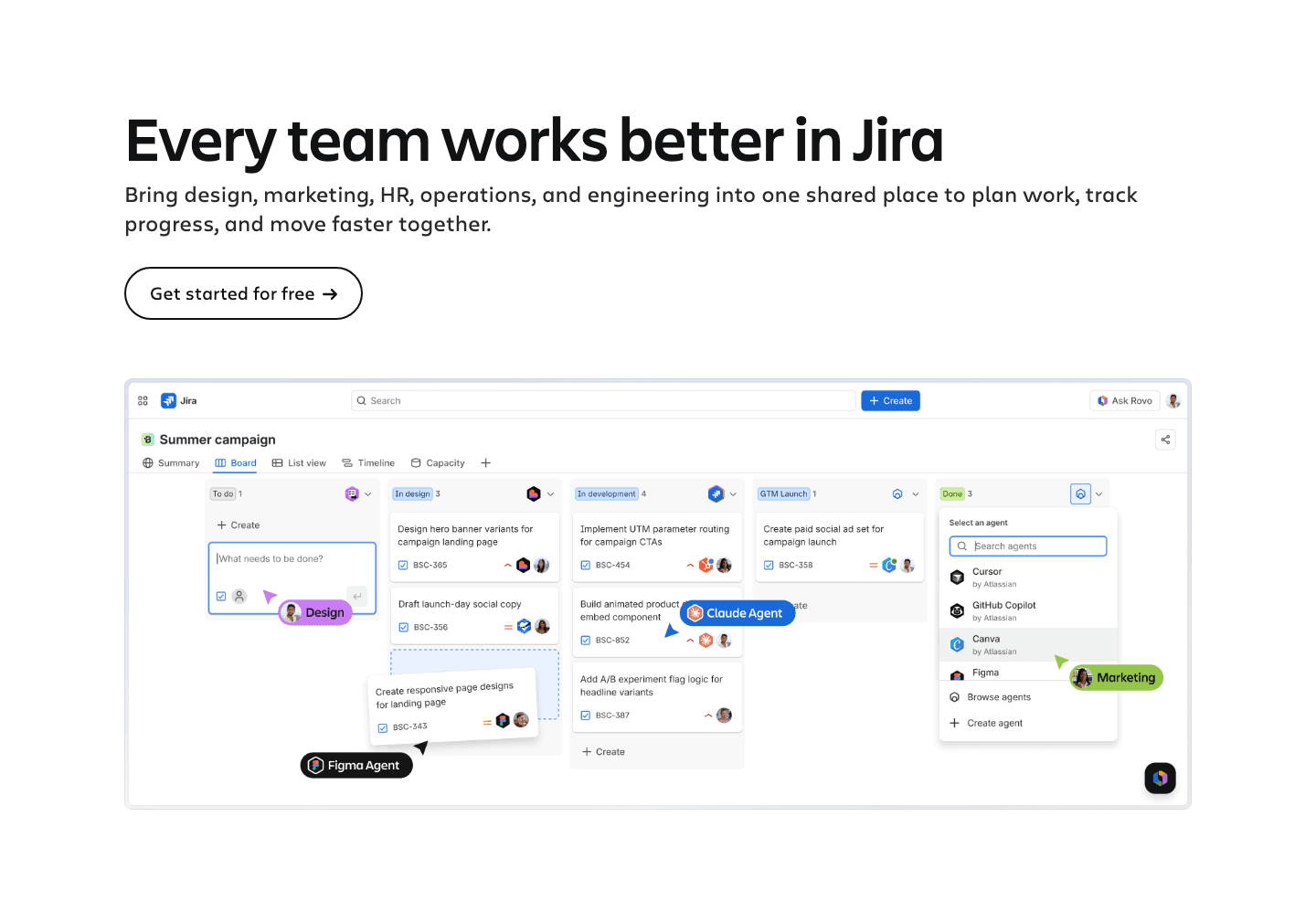
The team band. Every team works better in Jira, then design, marketing, HR, operations and engineering named one by one, with a Get started for free button. The screenshot shows what the hero meant: a summer campaign board with a Figma Agent and a Claude Agent sitting on the cards beside human avatars.
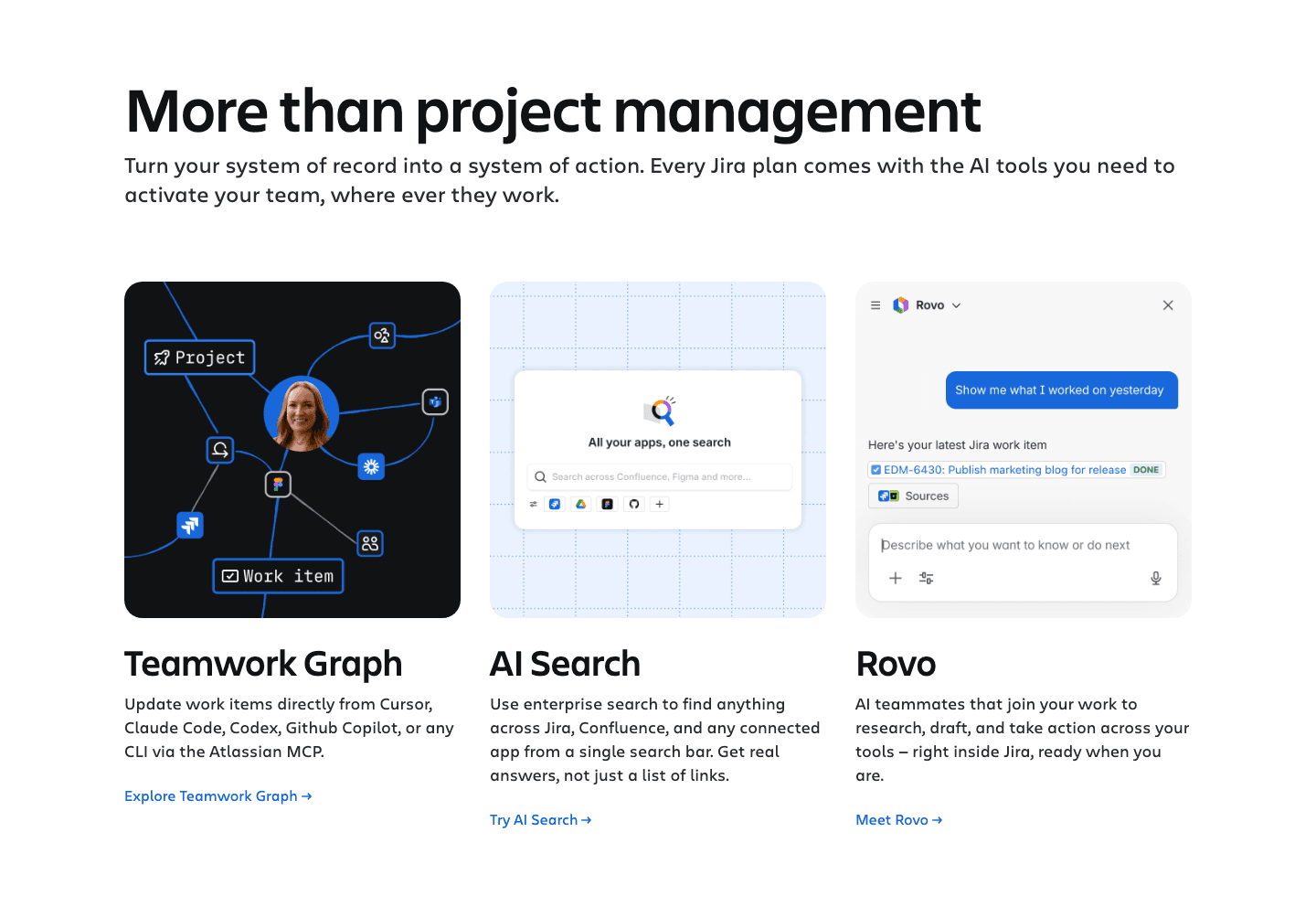
The feature grid. Three blocks, each for a different worry. Teamwork Graph is update work items directly from Cursor, Claude Code, Codex, Github Copilot, or any CLI, which answers "does it fit my stack". AI Search is get real answers, not just a list of links. Rovo is AI teammates that join your work. The band above them makes the promise the ads had no room for: every Jira plan comes with the AI tools you need.
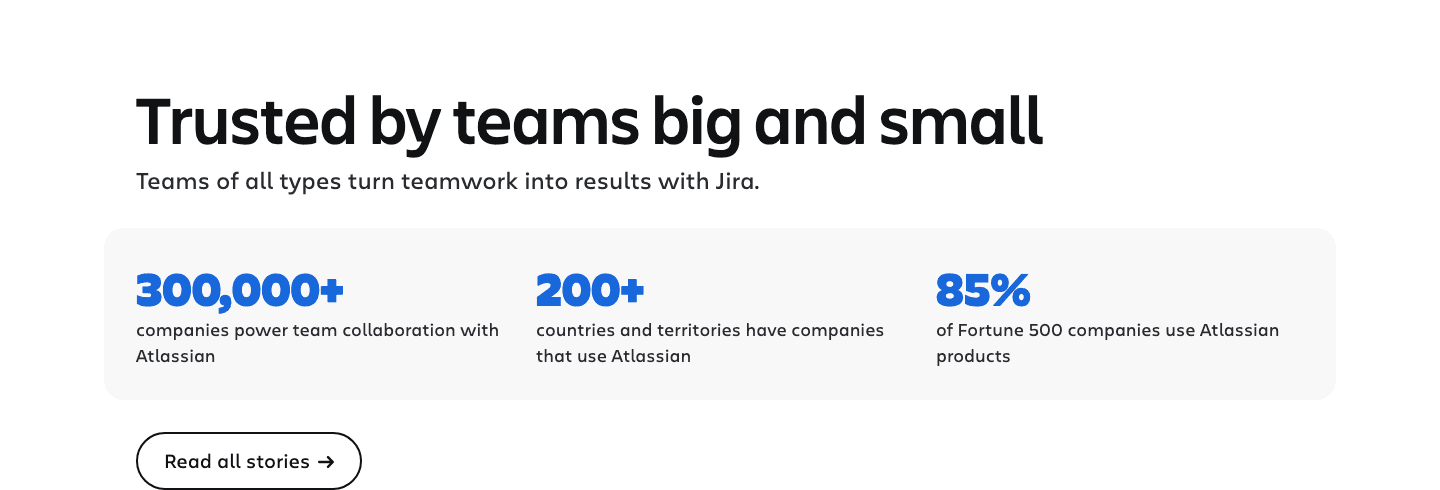
The proof band. Three numbers on a grey strip: 300,000+ companies, 200+ countries and territories, 85% of the Fortune 500, then one button, Read all stories. The ad shows one customer and this band shows how many there are.
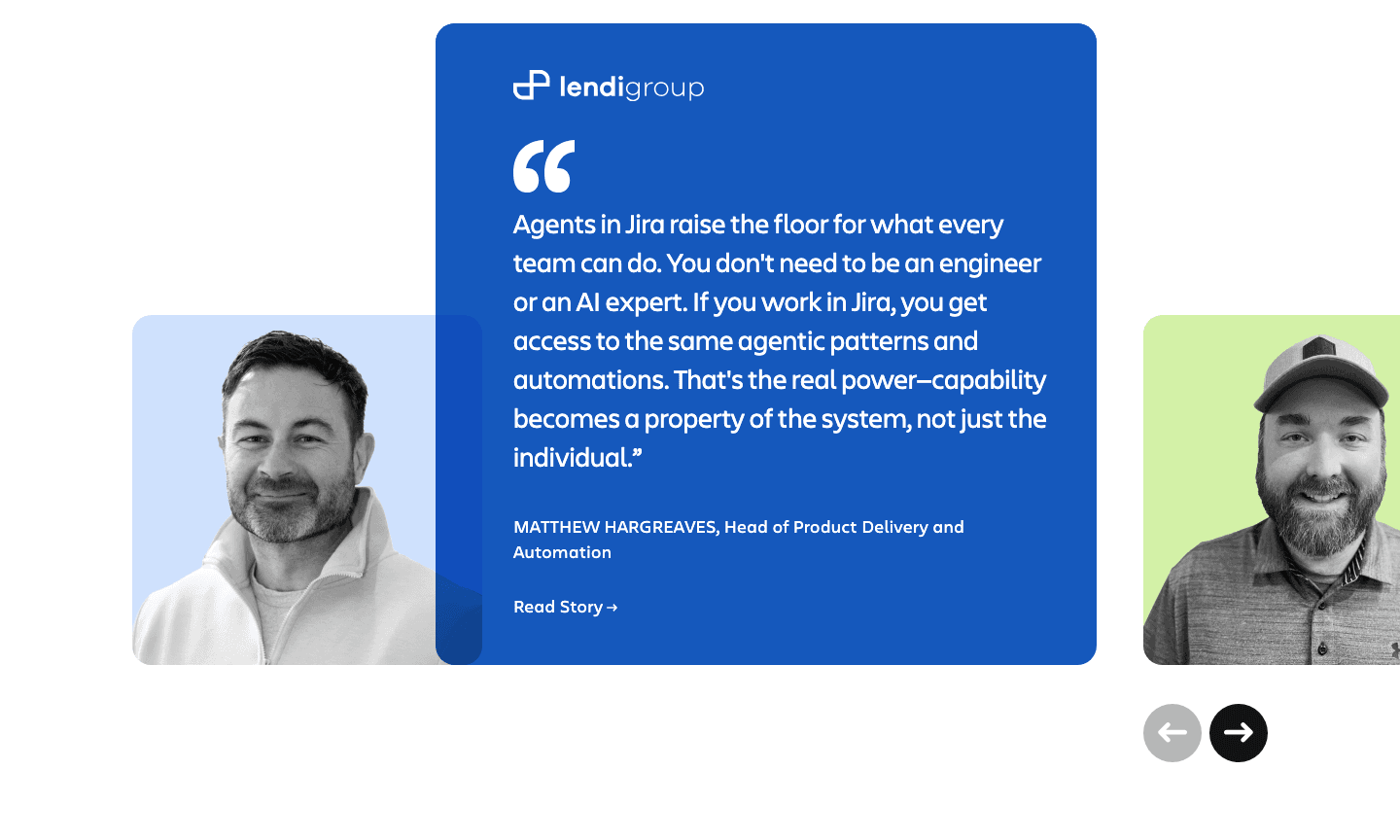
The quote carousel. Named people, named companies, quotes long enough to say something: Lendi Group's head of product delivery on agents raising the floor for what every team can do. Black-and-white portraits sit either side, with arrows to move between them. It makes the same kind of claim as the ads, at more length.
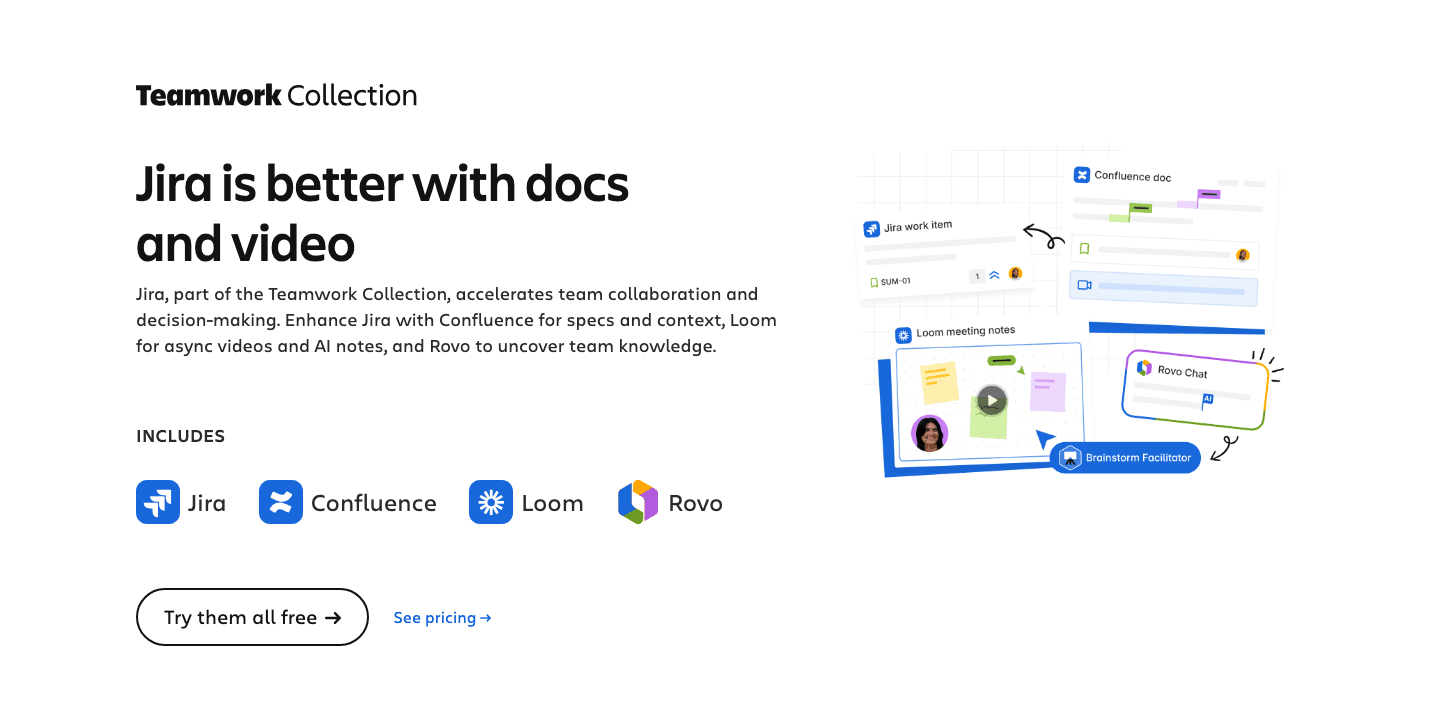
The closer. Jira is better with docs and video, four product logos, and two links: Try them all free, and See pricing. That second link is the only place on the page a visitor can learn what anything costs.
Message match
| The ad says | The page proves it with |
|---|---|
| Reddit saved $300k+ a year by switching to Jira | Reddit's logo in the hero logo row, and a 300,000+ companies band |
| Udemy got 2,400 meeting hours back | A named customer quote carousel with the same shape of claim |
| Jira is free for 10 users | Get started for free on three separate bands, and See pricing at the end |
| Powered by AI | Teamwork Graph, AI Search and Rovo, with the coding agents named |
The gaps
Two gaps, both cheap to fix. The ads sell a number and the page never repeats it: the visitor who clicked "Reddit saves $300k+ a year" lands on a hero about agent-ready tasks, and has to scroll past three bands before anything financial appears. One line under the hero, in the ad's own words, would close that. And the price card promises "free for 10 users" while the page says only get started for free. The "10 users" figure is not on the page.
Finding gaps like these on a page this strong is the job of the expert audit; it is the same reading, applied to your own pages.
Teardown 2: Squarespace
The campaign. Two templates, both launched on November 24, 2025 and both running into April 2026: 143 days for the one pointing at squarespace.com/services, 139 days for the one pointing at squarespace.com/website-design, plus a 99-day variant of the second. Squarespace has 38 ads past 45 days and 30 still live, second only to Figma on live ads, on a total of 5 pages.
The ads
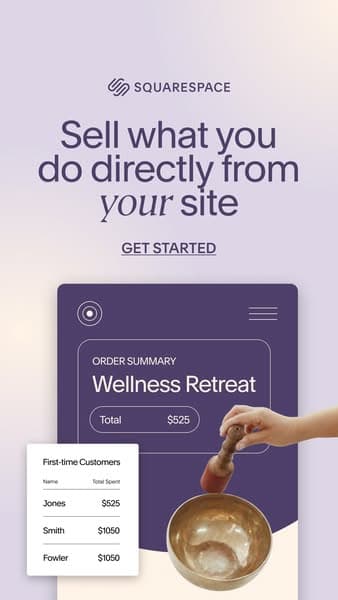
The 143-day creative is one sentence and one screenshot. Sell what you do directly from your site, with "your" set in italic serif against the sans, a GET STARTED link, and a product shot: an order summary reading Wellness Retreat, total $525, and a table of first-time customers with what each one spent. The text above the image talks about the buyer's work more than the software, with Squarespace's all-in-one Commerce tools, you can offer your services and grow your business, and the link headline is the promise in five words: turn your practice into profit.
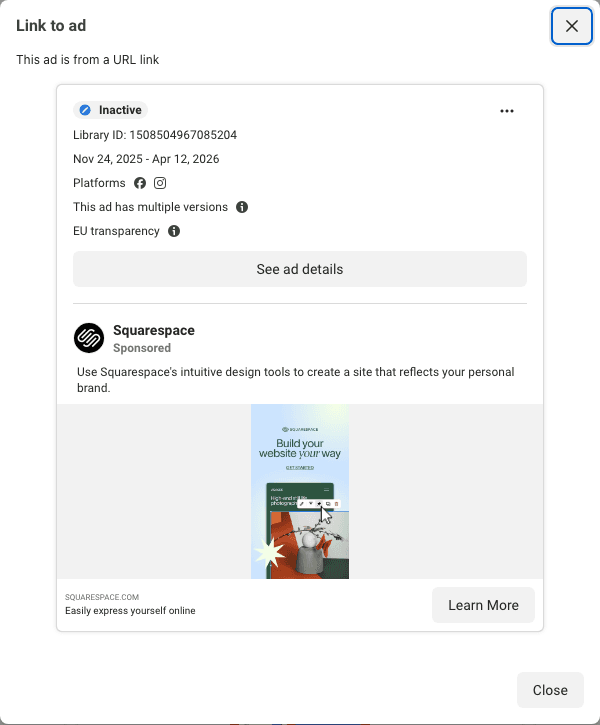
The second template shows the editing tool instead. Build your website your way, same italic emphasis, same GET STARTED underline, and a still-life photography site with an editing toolbar and a cursor parked on it. The text above it is use Squarespace's intuitive design tools to create a site that reflects your personal brand. The first template is for someone who wants to earn money from their site, the second for someone who wants it to look good.
The landing page
The page behind the 143-day ad, squarespace.com/services, runs to 14,870 pixels tall, the longest page in the sweep. Three ads point at it.
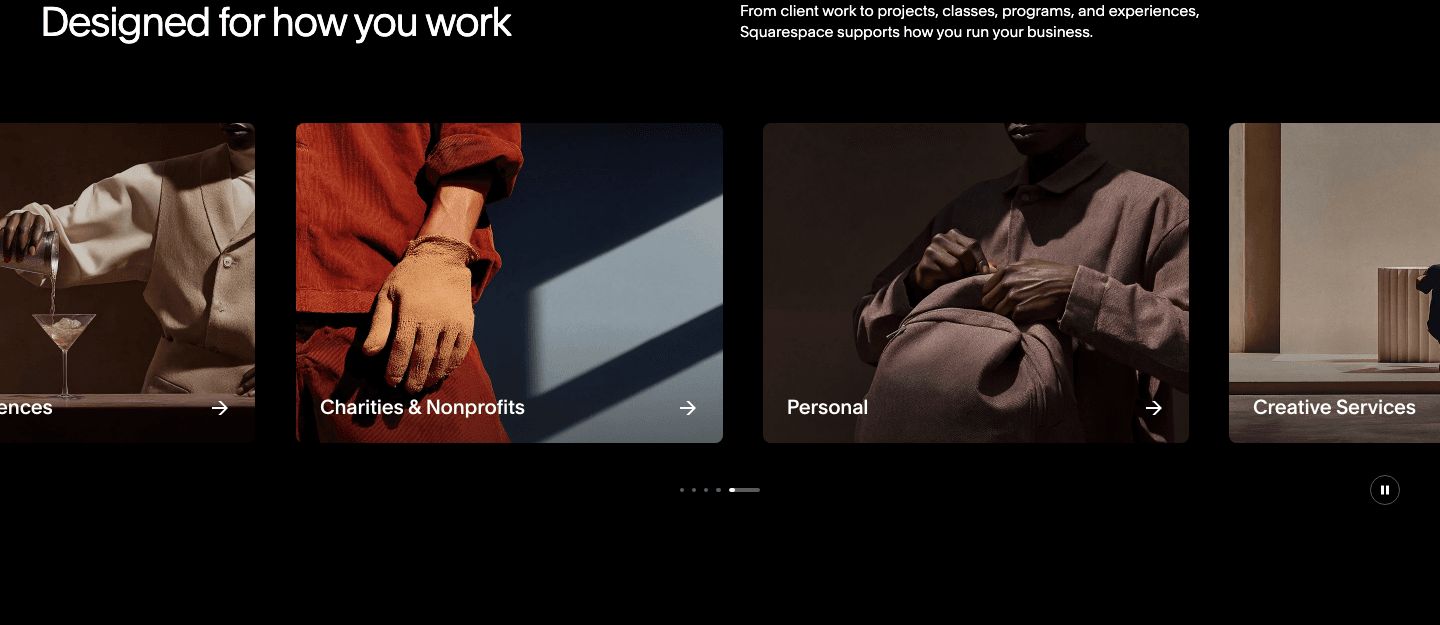
The audience band. Designed for how you work, then a moving carousel of business types: experiences, charities and nonprofits, personal, creative services. The line beside it, from client work to projects, classes, programs, and experiences, tells a visitor arriving from any of a dozen ads that they are in the right place.
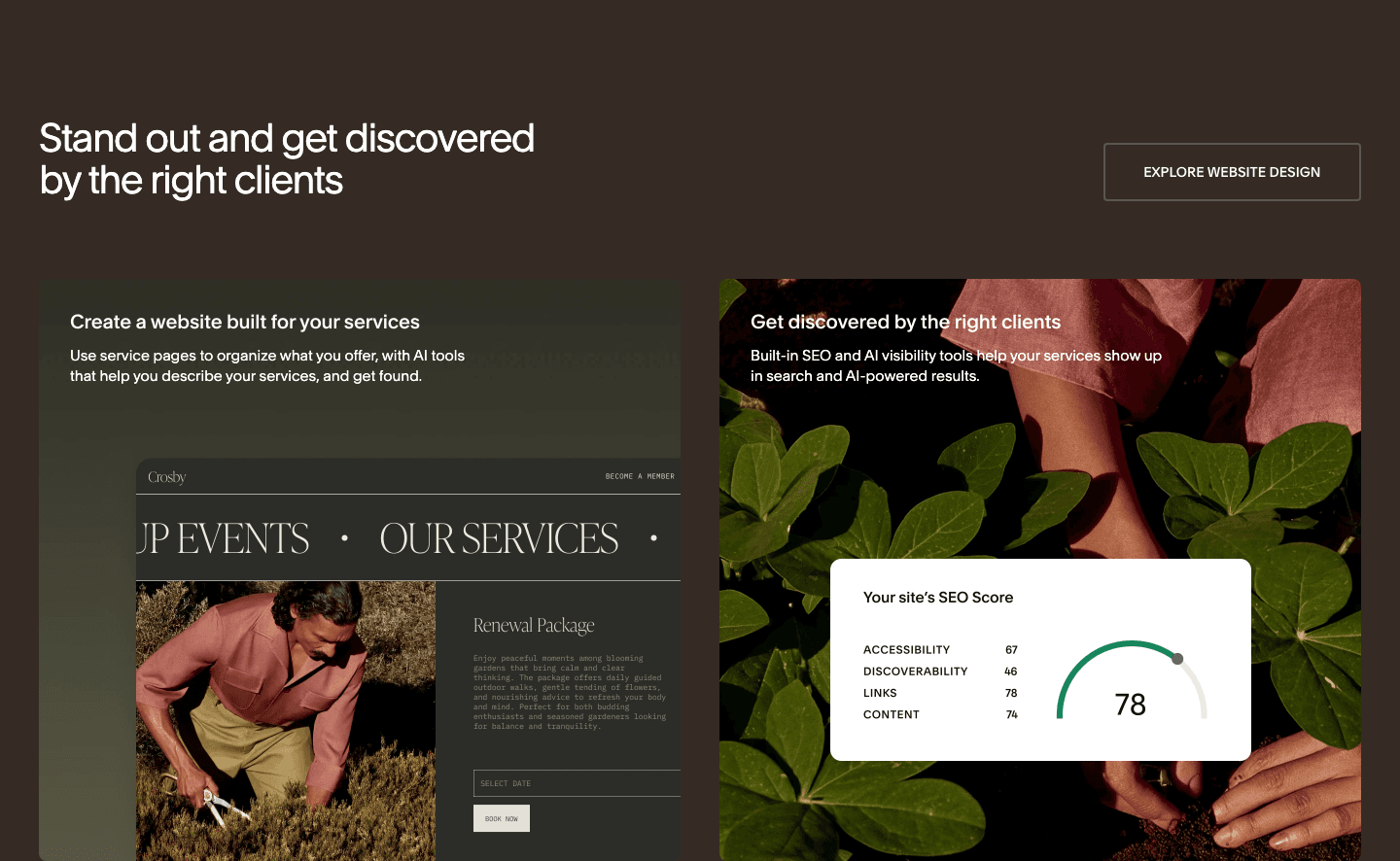
The discovery band. Two cards. Create a website built for your services, with a booking page for a Renewal Package and a Book Now button. Then get discovered by the right clients, shown with a dial reading a site SEO score of 78, with accessibility, discoverability, links and content broken out under it. The dial is the closest thing on the page to something interactive, but it is a still image.
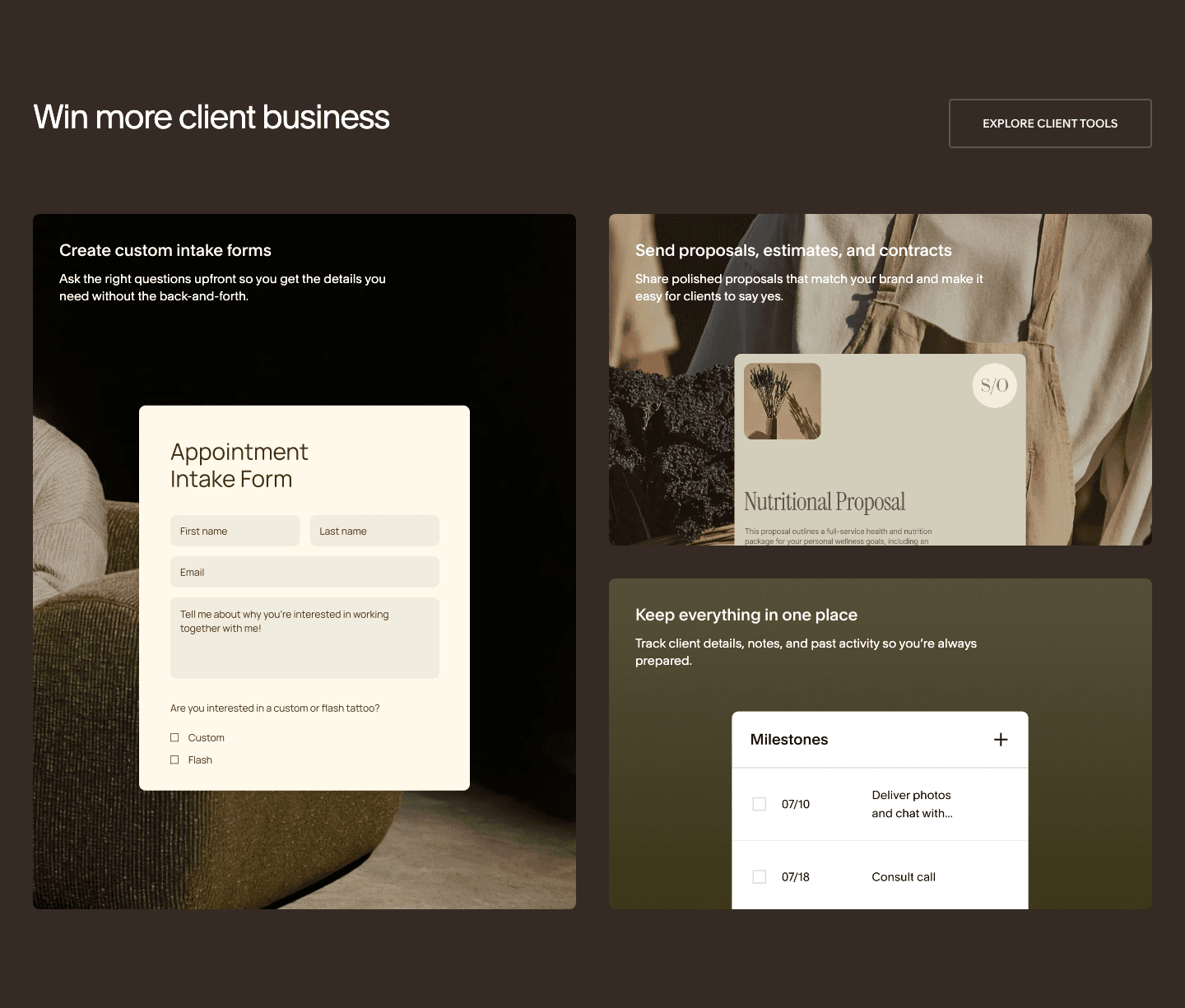
The work band. Win more client business, then the three things a service business actually does: intake forms that get the details without the back-and-forth, proposals and contracts that make it easy for clients to say yes, and a client record holding notes and past activity. Every card shows a real screen, and every caption is one sentence.
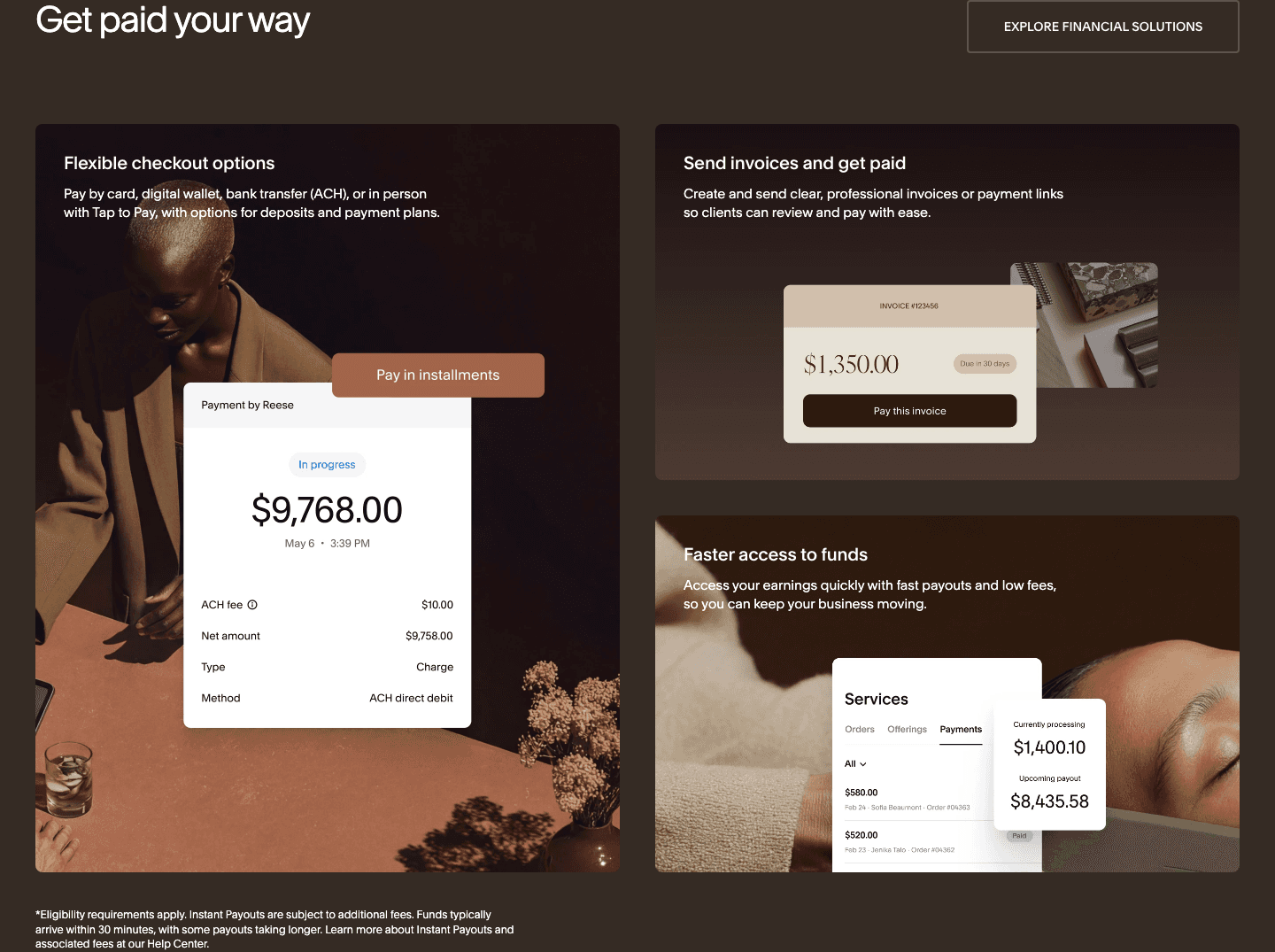
The money band. This is the first band about selling, which is what the ad promised. Checkout, invoices, faster access to funds, and screens carrying real amounts: a payment of $9,768.00 in progress with the ACH fee itemised at $10.00, an invoice for $1,350.00 due in 30 days, an upcoming payout of $8,435.58. A footnote lists who is eligible.
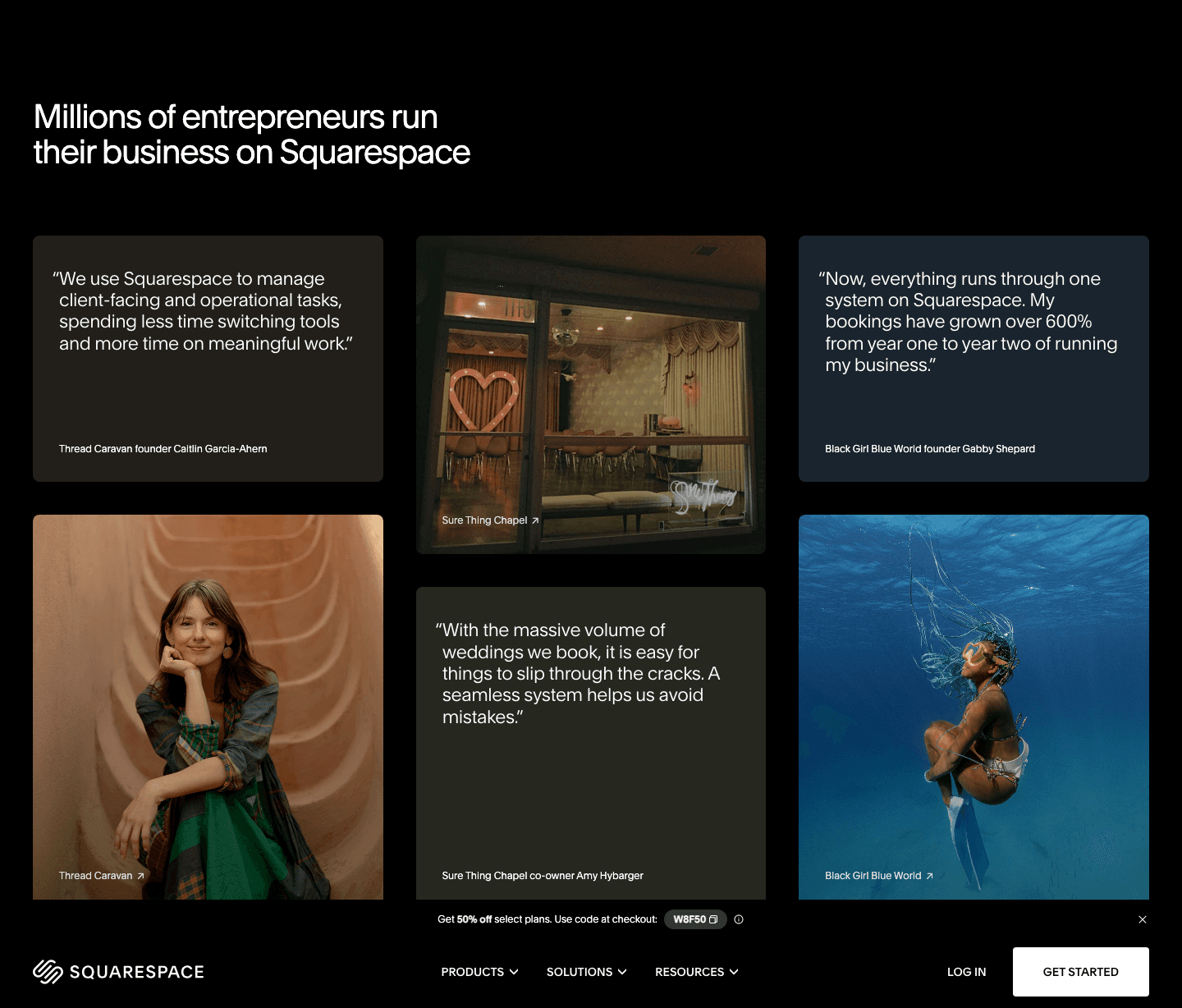
The proof wall. Millions of entrepreneurs run their business on Squarespace, then four named founders with photographs of their businesses, including Black Girl Blue World's Gabby Shepard: my bookings have grown over 600% from year one to year two. A sticky bar rides underneath it offering 50% off select plans with the code W8F50.
Message match
| The ad says | The page proves it with |
|---|---|
| Sell what you do directly from your site | The money band: checkout, invoices, payouts, with amounts on screen |
| Turn your practice into profit | A founder quote reporting bookings up over 600% |
| All-in-one Commerce tools | Four bands covering discovery, intake, payment and follow-up |
| Offer your services and grow your business | An audience carousel naming a dozen kinds of service business |
The gaps
Two gaps. The first is the bigger one: the ad's sentence never appears on the page. Sell what you do directly from your site is a promise about selling, and the visitor who clicked it lands on a band about how they work, then scrolls through four screens before the first dollar sign. The ad's sentence could be the page's headline. Second, the page's offer does not match the ad. The ad shows no price, while a sticky bar at the bottom offers 50% off with a code, which the reader cannot connect to anything they clicked.
Key takeaways: five things to do with this
- Put a customer and a number on the card. The two oldest B2B creatives we could open are Reddit's $300k and Udemy's 2,400 hours, both 162 days. Both name the customer and give a figure.
- Say what the AI does. 101 of the 546 ads mention AI and most of them could swap logos. Zoom's "let AI handle your busywork" survives because it names the job.
- Put the free tier on the creative. "Jira is free for 10 users" has run 162 days. If your product has a free plan, put its limit in the ad.
- Build a page with children. Dropbox runs one campaign page, with a teams version and a Replay version under it. That is 55 ads on 4 pages, and each page can be measured on its own.
- Take one of the five open angles. A named competitor, a timed promise, a monthly price, security as the headline, something interactive on the card. Nobody in this market uses them yet.
How to run this analysis on your own competitors
The Meta Ad Library and the Google Ads Transparency Center are public and free. Search the brand's page, not a keyword, set the country, filter to active ads, sort by start date. Then:
- Group the ads by angle. Use the seven above. In our set, six of the nine full accounts run three or more.
- Keep the ones that have run 45 days or more. The advertiser keeps paying for them. Click through and read the page each one lands on.
- Write down the angles they are not running. Start your next campaign from that list.
Or send us the URL and we do it for you.
How we did the analysis
- Sample: the SaaS companies on the benchmark leaderboard, picked by traffic, not by advertiser status. Fifteen were selected, twelve swept. Set aside: Wise, Calendly and Weebly were not swept; Stripe was swept and has no brand-verified Meta ads, only Google; Plaid and Moloco were reached by keyword search rather than a brand page, returning 1 readable ad for Plaid and 4 for Moloco with no landing page on any of them. That leaves 9 companies with a full readable account: Atlassian, Canva, DocuSign, Dropbox, Figma, Shopify, Squarespace, Zendesk and Zoom. Plaid and Moloco stay in the table so the reader can see they were looked at.
- Sources: the Meta Ad Library, searched by brand page, and the Google Ads Transparency Center, both through Apify, in seven sweeps between August 25 and September 2, 2026, US region.
- Filter: brand-verified ads only. An ad counts when the advertiser page name matches the brand and the landing host is the brand's own domain. 546 Meta ads survived that, 356 of them readable, and 231 of those are image, carousel or dynamic units with a real page behind them.
- Ranking: days active. We count an ad from 45 days, by which point it has usually been through at least one budget review. 264 ads clear it.
- Reading: every distinct message was read by hand and put in one angle. Dynamic ads return a
{{template}}instead of copy, so those were read from the creative image where one was captured, and from the landing path where none was. Nothing is quoted from an ad we could not open or from a field the library left templated. - Limits: the library returns about 60 ads per brand per market, so every per-company count here is a minimum. The shares inside the sample are the numbers to read. Zendesk's destinations are mostly a DoubleClick redirect, so its page count is unreadable. Our page captures ran from a European address, so two per-market pages came back in the wrong language and one behind a language prompt; none of those are shown or quoted. Meta publishes reach only in the EU and never publishes spend.
Every ad above links to its primary source in the sources list, so the whole analysis is independently checkable.
Sources
Primary sources, all public and checkable today. Open any Meta ad with its Library ID at facebook.com/ads/library/?id=ID.
- Atlassian's Reddit carousel, Library ID 934612762599064, running since March 24, 2026: facebook.com/ads/library/?id=934612762599064
- Atlassian's Udemy carousel 924475337173722, its Confluence pair 1886919976008034 and 25831209689889559, its Thumbtack card 1965946484263334, the free-tier card 917447611187910, the Confluence image ads 2679328722441992 and 848750261574883, and the Team Europe pair 27381556314796928 and 1618178363295771.
- Squarespace's two teardown templates: 830814856326431 (services) and 1508504967085204 (website design), plus the 99-day variant 1481531113092594. Other Squarespace ads quoted: 1244725967720955, 1031798856046995, 2121801748732154, 1015010068175317, 1419268780030746, 4115747708721557, 2284497672360159, 998384959698803.
- Shopify's creatives: 949336410447476 and 660375433571716 and 1448592443101900 (the founder cards), 1238141341576372 (the 208-day card), plus 2332667747260436, 855203029997113, 25532833593005095, 2101456733921243.
- The AI ads: Zendesk 1545058484178958, 981897014471337, 2074725473446908 and 1691610832101040; Figma 1890163895014834, 1157288153272174 and 1665850477751550; DocuSign 4315649682084891 and 3103243073195240; Zoom 1009171885430478; Canva 1470248711611611 and 1775391387204480.
- The busywork and invitation ads: Zoom 2090082488423074, 2779746702378467, 1170489784557801 and 525217993652002; DocuSign 1603420494082987, 1028317762860886, 2043382819878950, 986284410651192, 1977445479567988, 1691010445577603 and 957507100396463; Dropbox 816933427668603, 2280700302684334 and 2179663186317454.
- The open-angle ads: Zendesk 1021470643948234 (security), 1377187541036921 (retail AI); Canva 3483571901795615 and 1708516613787638 (the seasonal pair); Shopify 1313893093686104; Plaid 1005433491965854.
- The landing pages, live: atlassian.com/software/jira, atlassian.com/software/confluence, squarespace.com/services, squarespace.com/go/create-a-website, dropbox.com/campaigns/share-more, figma.com/make, events.docusign.com
- The sample: the SaaS leaderboard of the Web Anatomy benchmark, selected by traffic.
- The Google Ads Transparency Center for the search ads: adstransparency.google.com
- Ad sweeps and page captures made August 25 to September 2, 2026. The sibling analysis of a different market is the fintech ads playbook.
Data collected September 2026. Ad statuses and run lengths change; the library links above always show the current state.

Written by
Gabriel Amzallag , Founder, Web Anatomy
5 years CRO + SEO at Qonto (2021–2025). After advising 15+ SaaS on their websites (Payfit, Pigment…), the same patterns kept breaking, so I decided to build the source of truth on what works on the web: the intelligence layer every tool, builder, and team uses to ship sites that perform.
More from the blog
Playbooks
We analyzed the ads the top developer tools companies run. Here is what works.
Which developer tools ads kept running in September 2026, the eight angles they use, and the pages behind them. With the ads to open and read yourself.
 Gabriel Amzallag23 min read
Playbooks
We analyzed the ads the top HR tech companies run. Here is what works.
Which HR tech ads kept running in 2026, the eight angles they use, and the pages behind them. The takeaways, with the ads to look at.
Gabriel Amzallag26 min readPlaybooks
We analyzed the ads the top marketing software companies run. Here is what works.
Which marketing software ads keep running in 2026, the angles they use, and the pages behind them. Seven angles that work, five almost nobody runs.
Gabriel Amzallag23 min read