
TL;DR
- The ads that keep running sell one of seven angles: the document, the free offer, the competitor's numbers, the AI, the before and after, the conference, the series. Five of the seven advertisers run three or more of them, SEMrush and SimilarWeb four.
- The longest-running ad in the set is a free ebook. HubSpot's Instagram guide card ran 858 days, and not one of the 41 HubSpot long runners we could read points at a product page or a price.
- Five angles are almost empty here: the price on the card, a named competitor, the switch itself, interactive proof, and the chore the buyer already hates.
- 8 of the 282 Meta ads that land on the brand site go to the homepage, and all 8 belong to one company. Brevo runs 20 paid pages, 16 of them per market; Birdeye runs one page for all 14 of its ads.
15 companies selected, 10 swept, every brand-verified ad in the public Meta library, 1 September 2026. How we did it is at the end.
The sample: 10 marketing software companies, their ads, and where the ads land
| Company | Meta ads on file | Ran 45 days or more | Still live | Oldest live ad | Where the ads land |
|---|---|---|---|---|---|
| HubSpot | 60 | 51 | 2 | 53 days | the Instagram kit, the first-party data toolkit, an Academy lesson |
| SEMrush | 60 | 41 | 7 | 92 days | the homepage, the SEO toolkit page, the AI toolkit page |
| Brevo | 60 | 38 | 37 | 175 days | the US email page, the French one, the German one |
| Mailchimp | 60 | 28 | 0 | none | the pricing page (38 ads), marketing automation |
| SimilarWeb | 60 | 18 | 6 | 26 days | one ad page and its version 2 |
| Birdeye | 15 | 2 | 14 | 53 days | one campaign page, 14 ads |
| Salesforce | 3 | 0 | 2 | 29 days | the Dreamforce page |
| Moloco | 5 | 0 | 0 | none | nothing readable |
| Linktree | 0 | 0 | 0 | none | nothing on file |
| Veed.io | 0 | 0 | 0 | none | nothing on file |
Brevo has found its ads: 38 of its 60 have passed 45 days and 37 are still live, the oldest at 175 days. HubSpot has the deepest archive and the quietest account, 51 ads past 45 days and 2 still running on the day we looked. Birdeye and Salesforce are at the other end, 16 of their 18 ads under 45 days old, which is what a campaign looks like in its first two months.
Ad analysis: the seven angles marketing software ads use
208 of the 323 ads on file can be read, by their copy or by their creative, and 100 of those have run 45 days or more. Every message in that set fits one of seven angles. For each one: the ads that ran longest, one creative to look at, and why it keeps running. The number in brackets is how many days the ad had been running when we looked.
1. The document
A free file in exchange for a click. Nothing about the product on the card.
- HubSpot: "Free eBook Download" over an Instagram guide (858 days, and 786 days on a second ad for the same page).
- HubSpot: "Free Branding Guide", with "100% Free. Complete Guide." under the link (786 days).
- HubSpot: "Social Media Content Calendar", described as "Get it now, use it forever." (786 days).
- HubSpot: "Make your ads count", for a collection of "50 Facebook ads that really work" (362 days).
- HubSpot: "Enhance Your Ad Strategy", for an ebook called The State of Data-Driven Advertising (330 days).
- Salesforce: "Engage mobile workers." for an updated e-book (13 days).

Why it runs: of the 41 HubSpot ads past 45 days we could read, 31 offer a file or a free Academy lesson and the other 10 offer a video. Not one points at a product page or a price, so none of them goes out of date when the product changes.
2. The free offer
The product itself at no cost, with the limits spelled out on the card.
- Brevo: "No card. No limits. No catch." over "300 emails a day. Unlimited contacts. AI generator. CRM included. All free." (126 days, live).
- Brevo: "Start for free now", with "Rated 4.5/5 on G2 & Capterra" and "300 emails/day free" (102 days, live).
- Brevo: "Email. CRM. Automation. All free." over "No limited trial. No credit card required." (74 days, live).
- Brevo: "Actually free. Forever." (18 days, live), the same body as the 126-day card with a new headline.
- SimilarWeb: "Get a 7-day free trial", over "Here's your sign to get a 7-day free trial to Similarweb." (23 days, live).
- Salesforce: "Register for free on Salesforce+." for the Dreamforce stream (14 days, live).
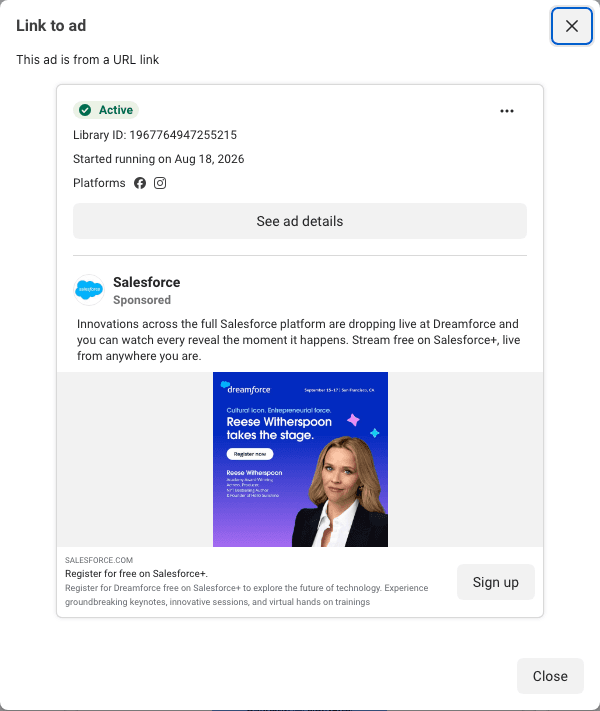
Why it runs: Brevo's four cards all carry the same three limits, 300 emails a day, unlimited contacts and no card asked for. All three are limits a reader can check against the product, and all four cards land on a page that offers the plan.
3. The competitor's numbers
Look at what the other company is doing. Two of the seven advertisers sell this and nothing else.
- SimilarWeb: "Steal competitor strategies." (374 days), the oldest creative in the company's set.
- SimilarWeb: "Most people have no idea you can legally spy on any company's marketing strategy" (182 days).
- SimilarWeb: "How to spy on your competitors, part 2", which asks "If you knew exactly where your competitors' customers were coming from, would you still waste time guessing?" (108 days, and a second cut at 41 days).
- SEMrush: "Uncover competitor strategies", over "See where your competitors get traffic, their top keywords, and the strategies driving their growth" (73 days).
- SEMrush: "Try the Semrush Advertising toolkit", over "Better ads start with better intel." (72 days).
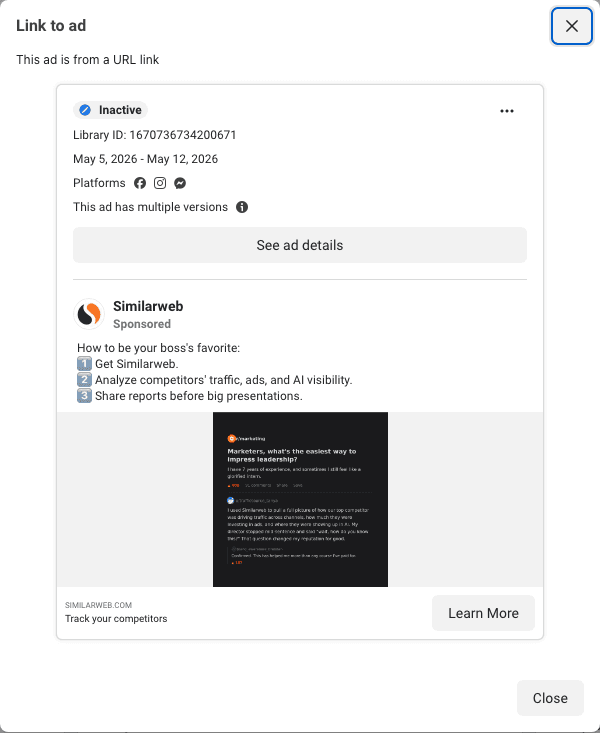
Why it runs: SimilarWeb almost never shows its own interface. 45 of its 48 readable ads are a person talking to a phone camera, and the two designed cards we could open are screenshots of other people's posts rather than of the product.
4. The AI
48 of the 208 readable ads mention AI, which makes it the most repeated word in the set. The ads split in two: being found by AI, and being helped by it.
- SEMrush: "Reddit's citations in ChatGPT dropped from 10% to 2% in days. That's how fast AI platforms can rewrite visibility." (173 days).
- SEMrush: "Hot take: Your next customer might never consider your brand. An AI agent will do it for them." (92 days, live).
- SEMrush: "AI reads beyond your website", over "SEO isn't just about websites anymore. AI now reads Reddit, LinkedIn, and reviews too." (88 days, live).
- SimilarWeb: "Think ChatGPT referrals can't be tracked? Think again." (52 days).
- Birdeye: "AI powered review responses" and "AI powered listings management", two ticks in a five-tick list (46 days, live).
- HubSpot: "Discover HubSpot AI Essentials", over "Turn hours into minutes with AI-powered teammates that work as hard as you do." (41 days).
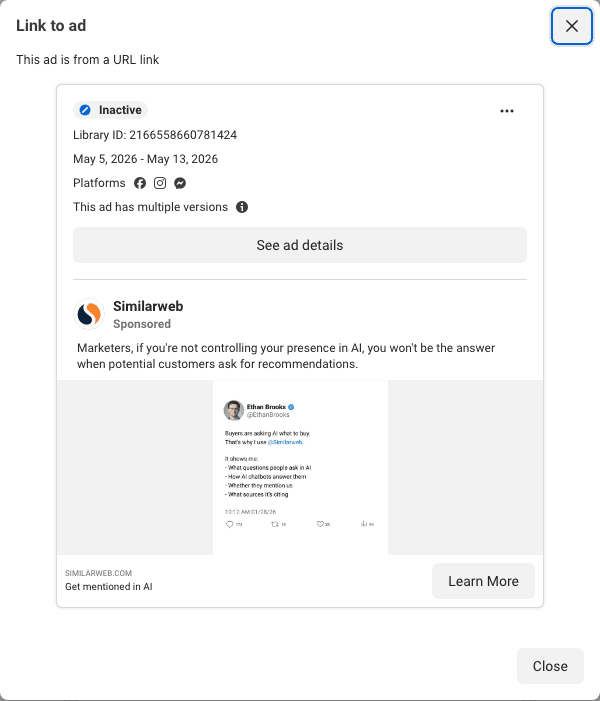
Why it runs: the SEMrush and SimilarWeb cards name a platform a reader can go and check, ChatGPT, Reddit, LinkedIn. The ads that only say "AI-powered" sit lower in the set: Birdeye's and HubSpot's AI ads are 46 and 41 days old, against 173 for the Reddit figure.
5. The before and after
One customer, two numbers, the same measure on both sides. Birdeye is the only company here that runs it.
- Birdeye: Jackson Creek Dental Group, 6 Google reviews at 4.0 stars before Birdeye, 590 at 5.0 with it (46 days, live).
- Birdeye: the same layout under a dynamic ad that has been running since 10 July 2026 (53 days, live), with several versions behind one library entry.
- Birdeye: two more cuts of the same card at 23 and 21 days, both live.
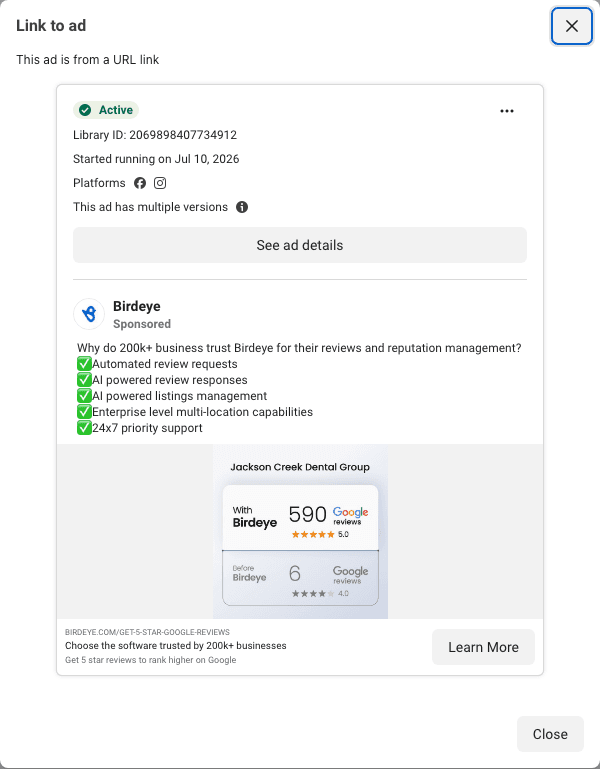
Why it runs: the reader can count both numbers, and the business is named, so the claim can be checked on Google. 13 ads in the whole set carry a number as proof, and 12 of the 13 are Birdeye's.
6. The conference
An event, sold like a product, months in advance.
- SEMrush: "Alright then. @spotlight_conf is back, and yes, it's London. October 13." (137 days).
- SEMrush: "Meet marketers who could change your career. Build connections that lead to jobs, mentorships, and partnerships at Spotlight." (109 days, and the same carousel again at 108 days).
- SEMrush: a dynamic unit pointing at the conference site (75 days, live).
- Salesforce: Dreamforce, "No matter your role, Dreamforce has a session for you. Tune in for hands-on trainings, insights built for your industry, and 72 hours of content." (29 days, live).

Why it runs: neither ad shows the software. SEMrush's carousel counts the people ("1200+ marketers") and Salesforce's counts the hours (72), so each card still hands the reader a figure.
7. The series
One template, many versions, so an account can run a lot of ads that still look like one campaign.
- Mailchimp: 38 of its 40 readable ads point at one page, the marketing pricing page, under a single dynamic template.
- HubSpot: one Instagram ebook, five creatives, two page addresses, 858 and 497 days.
- Brevo: the same free-plan promise in English, French and German, on three landing pages that differ only by language. The French card reads "Gratuit pour toujours. 300 emails/jour." (56 days, live).
- SimilarWeb: three versions of one ad page, /fb, /fb-2 and /fb-, carrying 29, 26 and 1 ads.
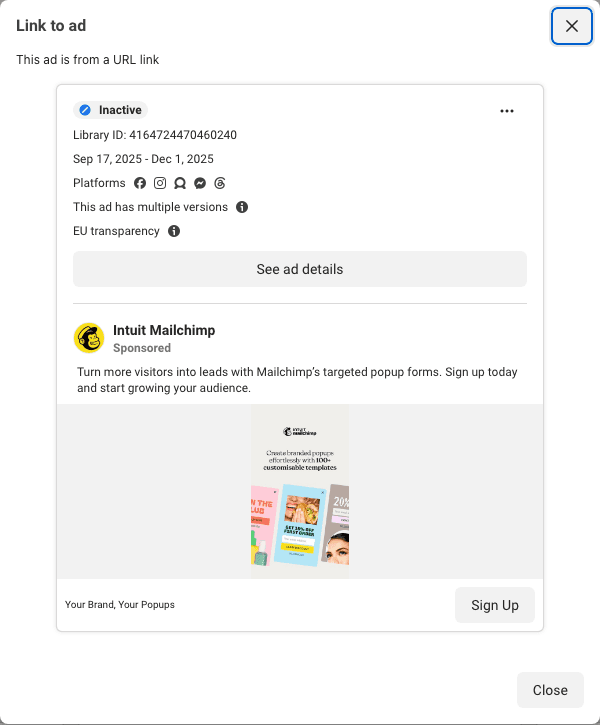
Why it runs: Mailchimp changes the picture and keeps the destination, HubSpot changes the destination and keeps the picture. Either way the team only writes one offer.
One angle sits outside the seven because a single company runs it: the joke. SEMrush has seven long-running reels with no product in them at all, "If only he could hear us" (111 days), "We promise we have it all together" (108 days), "How to trigger a social media manager 101" (105 days), "When your hard work is rewarded with more work" (88 days). They are the second-largest group inside SEMrush's 45-day club, behind its AI ads.
Ad analysis: five angles almost nobody in marketing software uses
Read against all 208 readable ads, these five appear in two ads or fewer. The ads that do exist are listed, and linked in the sources, so you can start from them.
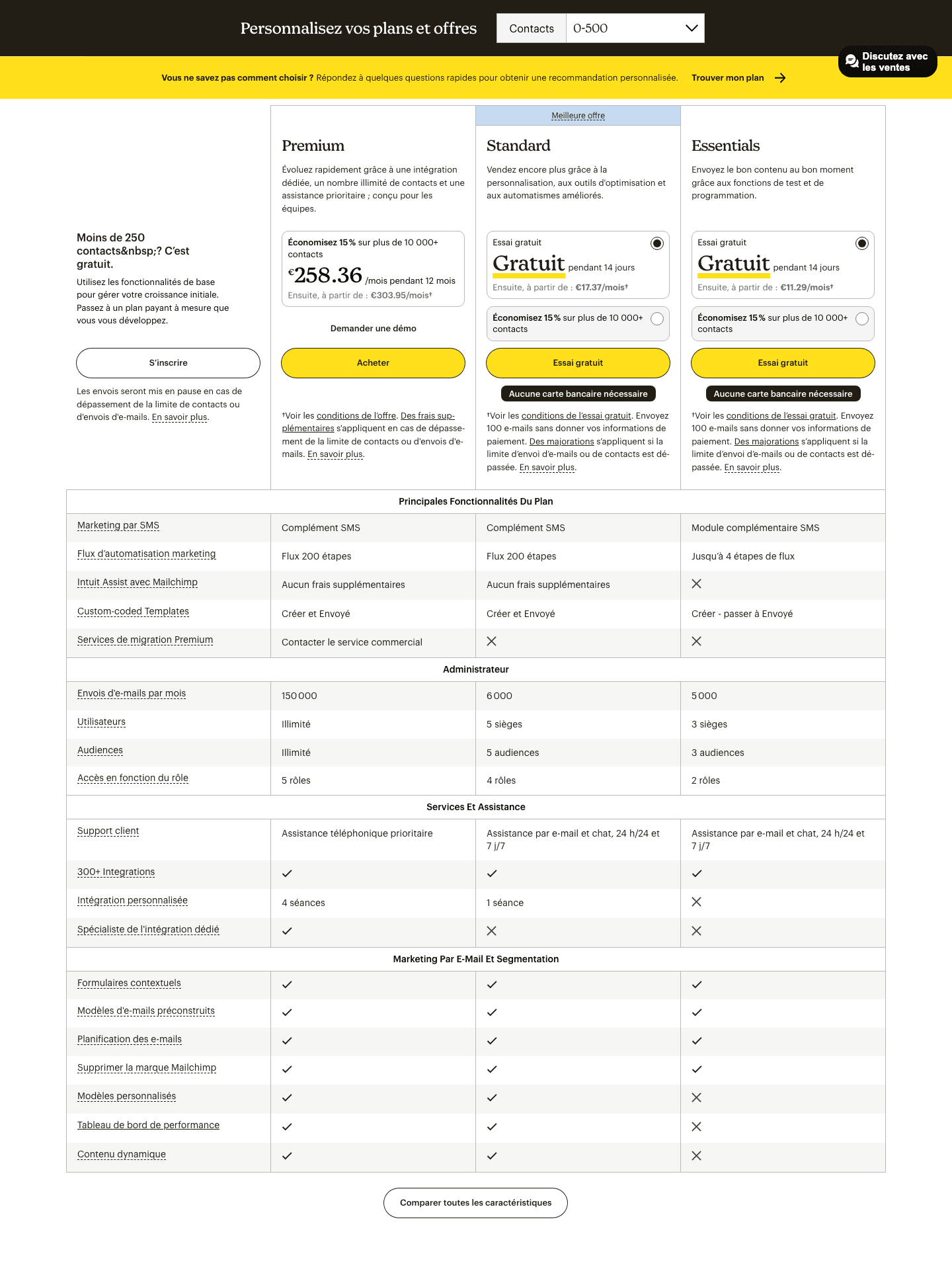
- The price on the card. Not one ad in the set says what a month costs. The closest is SimilarWeb's creator videos handing out discount codes, "Use code BONDAR20 for 20% off" (80 days), and Brevo's four cards, which say the word free six times between them and never a number of euros. Mailchimp's own page, two clicks away, shows a French visitor €17.37 a month for its Standard plan.
- A named competitor. Brevo runs the only ads addressed at another company's customers, and the copy still names nobody: "Start the switch. It's free." (20 days, and a video cut at 7 days) lands on a page called competitor-price-increase. SimilarWeb comes close in a video about asking an AI agent for competitive intelligence (48 days). Nobody writes a rival's name on a card.
- The switch itself. The same two Brevo ads are the whole category: "Your subscriber list doesn't have to stay where it is. Import to Brevo in minutes. Easy migration." Nobody else in the set promises to move your data, in a market where every buyer already owns a tool.
- Interactive proof. No ad in the set carries a calculator, a score or a number the reader supplies. The closest things are quizzes: SimilarWeb's "Pop quiz: Yahoo or TikTok? ChatGPT or X?" (49 days) and SEMrush's quiz about which brands AI prefers (117 days). Both ask a question and neither shows a result.
- The chore the buyer already hates. Two ads in the whole set name a piece of daily work and offer to take it away, and both are SimilarWeb's "would you still waste time guessing?" (108 and 41 days). The fintech playbook has a whole angle built on this one, with four companies in it.
A sixth, for the calendar: two ads in the set print a date, and both are event dates, SEMrush's October 13 in London and Salesforce's September 15 to 17. In a market that lives by launch weeks and quarter ends, nobody sells a deadline.
Landing page analysis: what happens after the click
Here is where the ads send people:
- 282 of the 323 Meta ads link to the brand's own site. 8 of those land on the homepage, under 3%, and all 8 are SEMrush. 11 more end on a social post or a video rather than a page.
- This sweep returned no Google ads on file for any of the 10 companies. Everything below is Meta.
- The kind of page sorts these advertisers into four tiers, from the homepage to a page built and versioned for one campaign. Every page below is linked, so open them. We read each capture before calling it a tier, and two pages changed tier once we had looked at them.
| Tier | The ad points at | In the sweep |
|---|---|---|
| 0 | The homepage | 8 of 282 ads, all SEMrush |
| 1 | A page that already existed | Mailchimp's pricing page, HubSpot's download pages |
| 2 | A page that exists because the ad does | Birdeye's campaign page, Brevo's US email page |
| 3 | A version number or a market in the path | Brevo in German, SimilarWeb's version 2, SEMrush's SEO toolkit 2, HubSpot's lesson in Spanish |
Tier 1: the ad points at a page that already existed
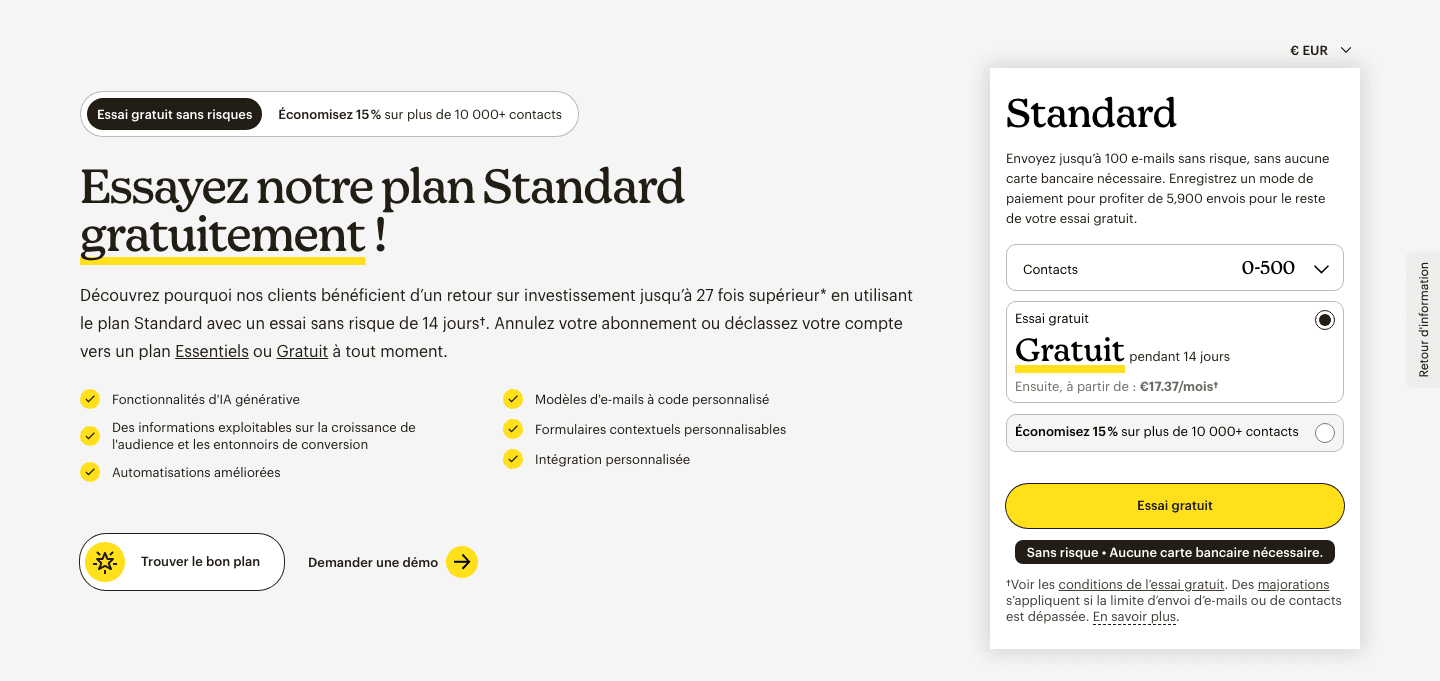
- 38 Mailchimp ads land on mailchimp.com/pricing/marketing, the same page a visitor reaches from the navigation. It is the single biggest destination in the sweep.
- Our capture of it is 7,881 pixels tall and carries the plan table, four award badges, an FAQ and 18 numbered footnotes.
- The page follows the visitor's country: opened from France on 1 September, it redirected to the French edition, in euros.
Tier 2: the ad points at a page built for that ad
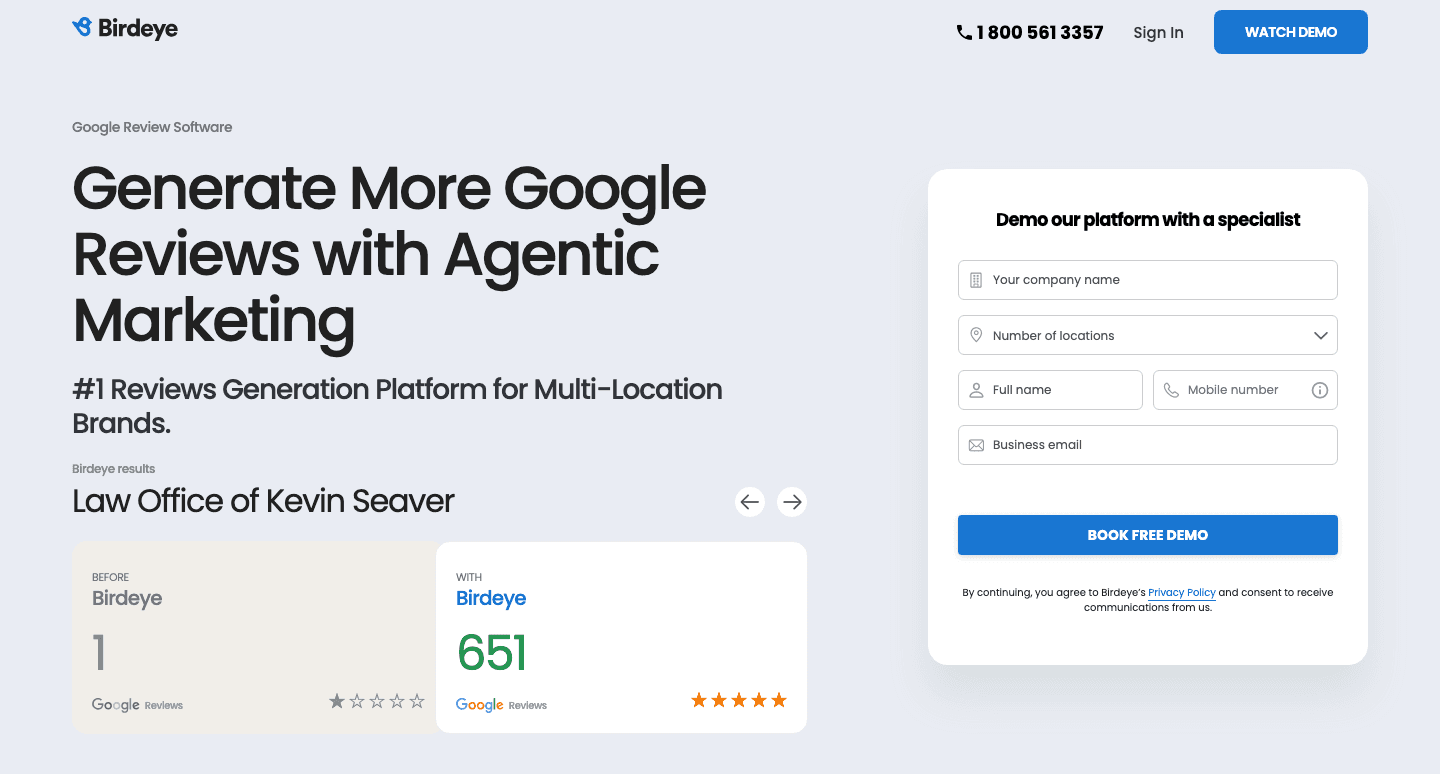
- All 14 of Birdeye's brand ads land on birdeye.com/cmp/how-to-get-google-reviews. The
cmpin the address stands for campaign, and the capture's header carries a phone number, a Sign In link and a Watch Demo button, with no navigation into the rest of the site. - Brevo's nine tier-2 ads point at /landing/email-marketing-service-us and /landing/competitor-price-increase, two addresses nobody reaches by browsing.
- Reading the path alone put Birdeye's page in tier 1, and the capture is what moved it here.
Tier 3: the ad points at a versioned or per-market page
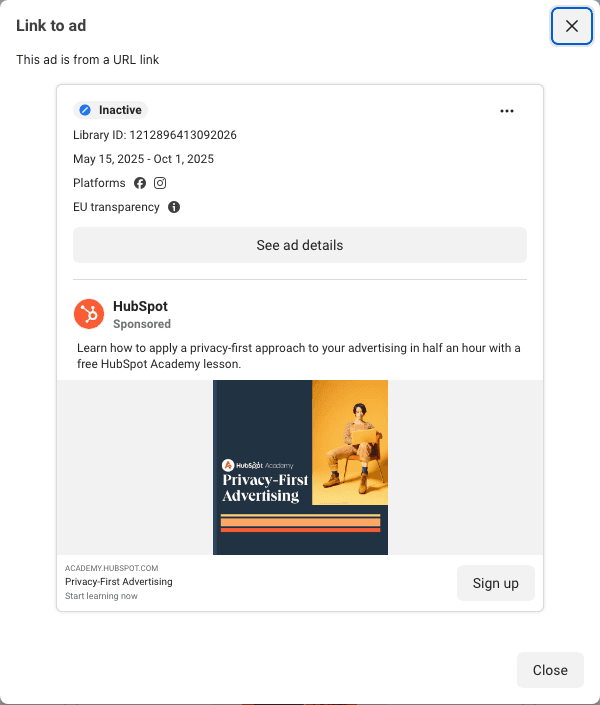
- HubSpot runs the same Academy lesson twice, in English on academy.hubspot.com/lessons/privacy-first-advertising (139 days) and in Spanish on the /es/ address (358 days, "Privacidad y Publicidad").
- Brevo runs 16 of its 20 pages per market, the most in the set: German, French and English versions of one email page.
- SimilarWeb reads its version numbers out loud. /fb carries 29 ads, /fb-2 carries 26, /fb- carries 1. SEMrush does the same with seo-toolkit-1 and seo-toolkit-2.
How many paid pages each company runs
| Company | Brand-site Meta ads | Distinct pages | Of which per market |
|---|---|---|---|
| Brevo | 60 | 20 | 16 |
| SEMrush | 38 | 19 | 13 |
| HubSpot | 39 | 16 | 1 |
| Mailchimp | 60 | 10 | 4 |
| SimilarWeb | 60 | 4 | 1 |
| Salesforce | 3 | 2 | 0 |
| Birdeye | 14 | 1 | 0 |
- Ad counts barely separate these companies, because the library stops at about 60 per brand. Page counts do, from Birdeye's 1 to Brevo's 20.
- Brevo and SEMrush, the two selling in several languages at once, are the two with the most pages per market.
- Nobody in this set hides behind a tracking redirect. All 282 brand-site ads name the page they open, which is why every row above can be counted.
Try it on yourself. Open your own Ad Library entry, click an ad, look at where it lands. The homepage puts you on tier 0. A cmp or lp folder puts you on tier 2. A number or a language code in the path puts you on tier 3.
Teardown 1: HubSpot
Two campaigns taken apart the way we take apart a page in a client audit: the ad, then the page it lands on, piece by piece, then the gaps. We picked HubSpot because it owns the longest-running campaign in the sweep, and Birdeye because its ad and its page say the same sentence more closely than any other pair here.
The campaign. One free ebook, How to Use Instagram for Business, advertised without a break from 25 September 2023 to 30 January 2026 across two addresses. Five creatives point at offers.hubspot.com/instagram-for-business-cr012, the longest of them at 497 days; two more point at the older instagram-for-business page, the oldest at 858 days. All of them were inactive by the September 2026 sweep, which is how you can see the whole run.
The ads
The first creative is the whole offer in one picture. A book cover reading "How to Use Instagram for Business, Now with Stories & Videos!", one line of body text ("Our Instagram cheat sheet."), a link headline that names the thing itself ("Free eBook Download") and a description that lists four outcomes in the order a social manager cares about them: get followers, build your audience, set goals, measure success.

The 497-day creative is the same book with a new cover. Same headline, same body, same button. The only thing that changed is the picture and the address it opens, which is how HubSpot can tell which cover pulls better without rewriting a word.
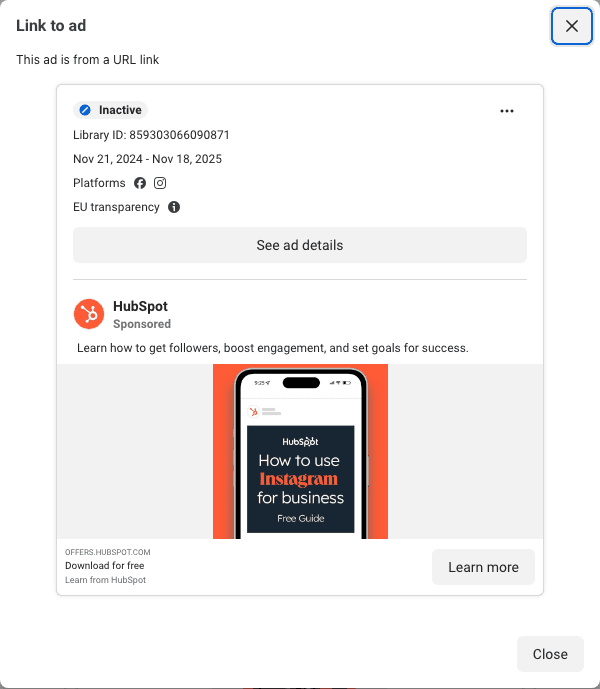
The third creative (362 days) moves the cover inside a phone frame and changes the link headline to the instruction itself, "Download for free". The body drops the word cheat sheet and says what the reader will be able to do: get followers, boost engagement, set goals.
The landing page


The hero. A small label reads "Free Ebook & Templates", the headline reads "Free Instagram for Business Kit", and the subhead repeats the ad's four promises in the ad's order, with one addition: navigate algorithm updates. The book from the card is here at four times the size, co-branded with Agorapulse. The header above it carries the HubSpot logo and one button, and no navigation at all.

The contents list. Six bullets under the heading "Everything you need to get started with Instagram". The first one counts the templates (22). The third names a person, "a featured chapter from Instagram expert Jenn Herman". The last one is about the reader's own standing at work: setting goals, measuring success, and proving the value of Instagram to your executives.

The preview. Four pages of the ebook itself in a carousel, opening on the table of contents with page numbers: Introduction 03, Identifying Goals and Creating a Strategy 04, Engagement and Followers 06, the Jenn Herman chapter 33, Additional Resources 39. The reader can see the thing is 39 pages long before giving anything away.

The closer. "Learn the ins and outs of Instagram", two lines of text and the third "Download for free" button of the page. Then a footer with five links, all legal. There is nothing else to click on the whole page.
Message match
| The ad says | The page proves it with |
|---|---|
| Free eBook Download | A label reading Free Ebook & Templates and a button reading Download for free, three times |
| Our Instagram cheat sheet | Six bullets of contents and 39 numbered pages in the preview |
| Get followers, build your audience, set goals, measure success | The same four promises, same order, in the hero subhead |
| The book cover on the card | The same cover beside the headline, four times larger |
The gaps
Two gaps, both fixable in a week. In the capture, nothing on the page asks for anything: three buttons say "Download for free" and there is no field beside any of them, so a visitor who clicked a download ad has to click a fourth time before the trade is even named. And the page carries no number of its own. An ebook that was worth advertising for 858 days has a download count, a reader quote or a publication date behind it somewhere, and the only evidence on the page is the table of contents.
Find revenue opportunities for your website, backed by real data. Get your 3 free opportunities by email.
Teardown 2: Birdeye
The campaign. 15 ads on file, 14 of them pointing at one page. Those 14 launched between 10 July and 20 August 2026 and all 14 were still live on 1 September. The parent unit started on 10 July 2026 and the library shows it has several versions behind one entry. Birdeye is the youngest advertiser in this sweep and the only one running a before-and-after creative.
The ad
Read the card from the top. The body opens with a question ("Why do 200k+ business trust Birdeye for their reviews and reputation management?") and answers it with five green ticks: automated review requests, AI powered review responses, AI powered listings management, enterprise level multi-location capabilities, 24x7 priority support. The picture is one named customer and two numbers in the same unit: before Birdeye, 6 Google reviews at 4.0 stars; with Birdeye, 590 at 5.0. The link headline repeats the trust figure, the description says what the figure buys you ("Get 5 star reviews to rank higher on Google"), and the address under it reads birdeye.com/get-5-star-google-reviews.
The landing page
Our sweep captured this page in 13 crops and no full-page image, so the crops below are what we read. The page runs 11,003 pixels tall in the capture.
The hero. Three things side by side. A headline, "Generate More Google Reviews with Agentic Marketing", under a label that says what the product is in plain words, Google Review Software. The ad's own device, a before-and-after block, this time for the Law Office of Kevin Seaver: 1 review at 1 star before, 651 at 5 stars with. And a form headed "Demo our platform with a specialist" asking for company name, number of locations, full name, mobile number and business email, under a blue button reading BOOK FREE DEMO.
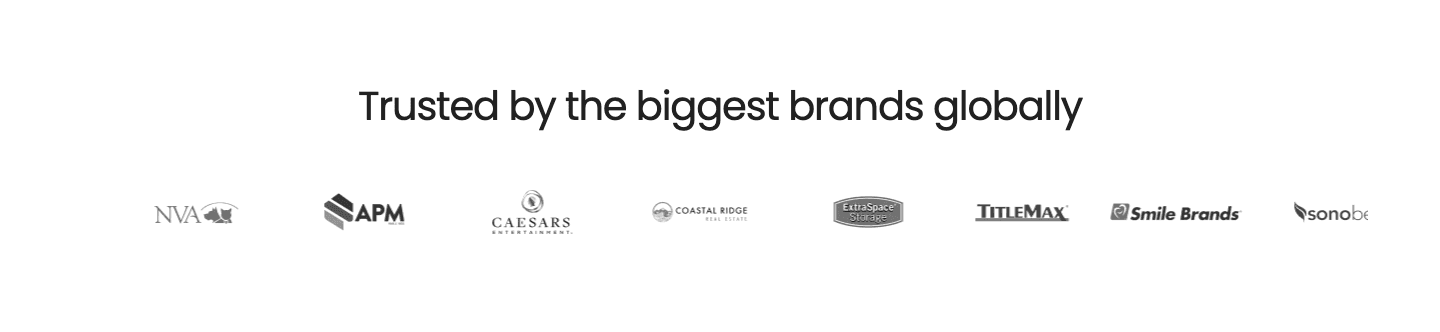
The logo wall. "Trusted by the biggest brands globally", then eight marks: NVA, APM, Caesars Entertainment, Coastal Ridge, Extra Space Storage, TitleMax, Smile Brands, Sonobello. The ad's 200k+ is a number nobody can check. These eight are names a reader can look up, and every one of them runs many sites at once, which is the buyer the headline above names.
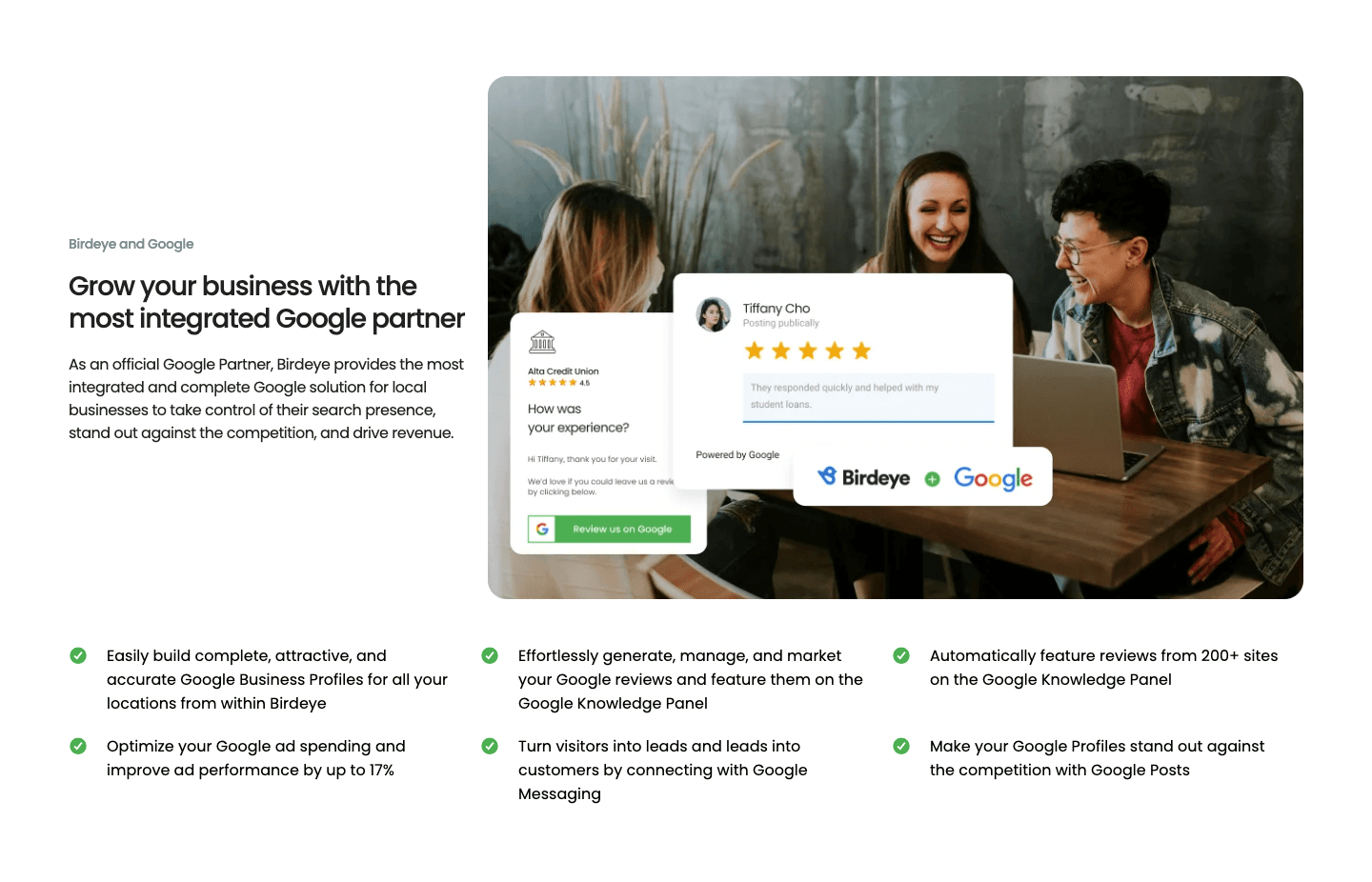
The Google band. "Grow your business with the most integrated Google partner", with six ticks under a screenshot of a review request. Two of them carry figures of their own: reviews featured on the Google Knowledge Panel, and ad performance improved "by up to 17%". This is the section that answers the ad's description, rank higher on Google.
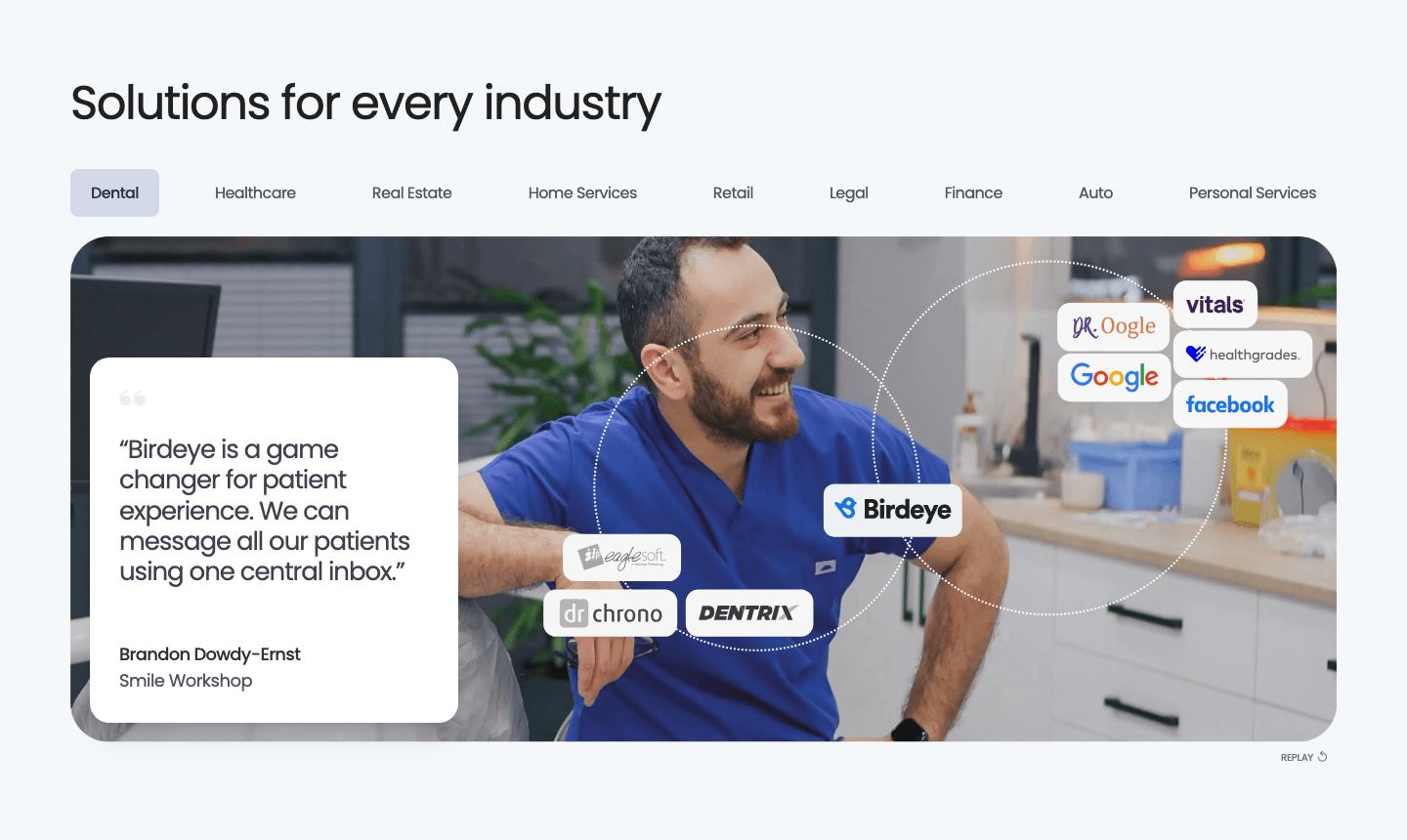
The industry switcher. Nine tabs, Dental first, then Healthcare, Real Estate, Home Services, Retail, Legal, Finance, Auto and Personal Services. Each one shows a named customer: on the Dental tab, Brandon Dowdy-Ernst of Smile Workshop, beside the practice software Birdeye plugs into. The ad's own example was a dental practice, and the page opens on the Dental tab.
Message match
| The ad says | The page proves it with |
|---|---|
| 6 Google reviews before Birdeye, 590 with it | The same before and after in the hero, on another named customer: 1 review, then 651 |
| Trusted by 200k+ businesses | Eight named brands on the logo wall, and one customer per industry tab |
| AI powered review responses | The reviews band, where Birdeye calls itself the only AI-powered reviews software for location-based businesses |
| Get 5 star reviews to rank higher on Google | The Google partner band, with reviews on the Knowledge Panel and ads improved by up to 17% |
The gaps
Two gaps. The ads disagree with each other about the headline number: one live creative says "Choose the software trusted by 200k+ businesses" while another, also live on 1 September, says 150k+ in the headline with 200k+ still in the body underneath it. And the page leads with a phrase no ad in the set uses. Every creative sells Google reviews, the display URL says get-5-star-google-reviews, and the first words on the page are "Generate More Google Reviews with Agentic Marketing", so the words the visitor clicked for arrive second.
Key takeaways: five things to do with this
- Offer something to read before something to buy. HubSpot's whole 45-day club is made of files, lessons and videos, 41 ads of it, and its oldest ran 858 days.
- Build a page for the offer. 274 of the 282 social ads here land somewhere other than the homepage. If your ad points at the homepage, that is the first fix.
- Put the ad's picture on the page. HubSpot puts the same book cover on both. Birdeye puts the same before-and-after block on both, with a different customer so the page adds something.
- Put the version or the market in the address. Brevo runs 16 of its 20 pages per market and SimilarWeb numbers its ad pages /fb and /fb-2. Anyone outside can see which version is winning, including you.
- Try one of the five open angles. The monthly price, a named competitor, the migration itself, something interactive, or the chore the buyer already hates. In 208 ads, each one appears twice or less.
How to run this analysis on your own competitors
The Meta Ad Library and the Google Ads Transparency Center are public and free. Search the brand's page, not a keyword, set the country, filter to active ads, sort by start date. Then:
- Group the ads by angle. Use the seven above.
- Keep the ones that have run 45 days or more. Somebody keeps paying for those. Click through and read the page each one lands on.
- Write down the angles they are not running. Start your next campaign from that list.
Or send us the URL and we do it for you.
How we did the analysis
- Sample: the marketing software companies on the benchmark leaderboard, picked by traffic, not by advertiser status. Fifteen were selected. Five were not swept at all: ZoomInfo, Ahrefs, Webflow, Klaviyo and Buffer. Of the ten swept, Linktree and Veed.io had no brand-verified ad on file, and none of Moloco's four readable ads, pulled by a keyword search, passed the brand check. That leaves seven advertisers: HubSpot, SEMrush, Brevo, Mailchimp, SimilarWeb, Birdeye and Salesforce, the last with three ads.
- Sources: the Meta Ad Library, searched by brand page where the brand has one, and the Google Ads Transparency Center, both through Apify. The Google side came back empty for all ten companies in this sweep, so this post is Meta only.
- Filter: brand-verified ads only. An ad counts when the library page name is the brand's and the landing host is the brand's own domain. Everything else is dropped: 186 ads failed the page-name check and 161 the landing-host check, most of them from the keyword searches for Salesforce, Moloco and Linktree.
- Ranking: days active. The floor of interest is 45 days, the point at which an ad has survived at least one budget review.
- Reading: every distinct message was read by hand and put in one angle. 208 of the 323 ads on file could be read; the rest are formats the library returns without usable copy, including 87 dynamic units with no creative attached. Dynamic ads return a template instead of a headline, so those were read from the creative image and the landing path.
- Limits: the library returns about 60 ads per brand per market, so a count of 60 is a floor and the shares inside it are what to read. Meta publishes reach only in the EU and never publishes spend. Landing pages were captured on 1 September 2026 and are described here as captured, not as they stand today.
Every ad above links to its primary source in the sources list, so you can check the whole analysis yourself.
Sources
Primary sources, all public and checkable today. Open any Meta ad with its Library ID at facebook.com/ads/library/?id=ID.
- HubSpot's 858-day Instagram ebook ad, Library ID 283661904436831: facebook.com/ads/library/?id=283661904436831. The second ad on the same page, 208210878976874.
- The Instagram kit campaign on the cr012 page: 1421677228514169, 2599574267060401, 426365847026168, 1152525792662625 (497 days each) and 859303066090871 (362 days).
- HubSpot's other document ads: 650096470635039 (branding guide), 1502181780568359 (content calendar), 1973044899828492 (50 Facebook ads), 932622308732486 (data-driven advertising), 572990701946664 (first-party data), 561209663439983 and 690910043750533 (the Facebook and Instagram guide), 1212896413092026 and 1051982656579631 (the Academy lesson in English and Spanish), 2023776781705851 (AI Essentials), 887790277280129 (the Canva playbook).
- Brevo's free-plan ads: 1709278550496055, 831598139773164, 1031368339341506, 1922544802430622, and the French card 1866264898092624. The switch ads: 1380413410632166 and 1061683876198476.
- SimilarWeb: 1485728599527943 (374 days), 1432878801084055, 1344941017171381 and 1337133934546527 (the busywork pair), 749869687870556, 2108065706398859 (the discount code), 1879428416554096 (the free trial), 1254856683001497 (the quiz), 1733377364774056, and the two designed cards 1670736734200671 and 2166558660781424.
- SEMrush: 1134854755454185 (the Reddit figure), 1911253396258693, 1948048259175344, 613884737978472, 3168238739993535, 902848619373611, 2140095943158191 and 1525171488470146 (the Spotlight carousels), 2017882722162982, 1651854859553933 (the joke).
- Birdeye: 2069898407734912 and its rendered version 4369762679929271, plus 2864138790613525 and 1583155193257157.
- Mailchimp: 4164724470460240 (the popup card), 1666062187704490, 743098725006910. Salesforce: 1579288670497008, 1967764947255215, 2563347490599617.
- The landing pages, live: offers.hubspot.com/instagram-for-business-cr012, birdeye.com/cmp/how-to-get-google-reviews, mailchimp.com/pricing/marketing, brevo.com/landing/email-marketing-service-us, lp.similarweb.com/fb-2.
- The sample: the marketing leaderboard of the Web Anatomy benchmark, selected by traffic. The same method, run on another market: the fintech ads playbook.
- The Google Ads Transparency Center, checked and empty for this set: adstransparency.google.com.
- Ad sweep and landing-page captures made 1 September 2026, regions US, France and the United Kingdom.
Data collected September 2026. Ad statuses and run lengths change; the library links above always show the current state.

Written by
Gabriel Amzallag , Founder, Web Anatomy
5 years CRO + SEO at Qonto (2021–2025). After advising 15+ SaaS on their websites (Payfit, Pigment…), the same patterns kept breaking, so I decided to build the source of truth on what works on the web: the intelligence layer every tool, builder, and team uses to ship sites that perform.
More from the blog
Playbooks
We analyzed the ads the top HR tech companies run. Here is what works.
Which HR tech ads kept running in 2026, the eight angles they use, and the pages behind them. The takeaways, with the ads to look at.
 Gabriel Amzallag26 min read
Guides
Programmatic SEO: a practical guide from 10 city pages to 300
How Staycation went from 10 hand-made city pages to 300 with programmatic SEO, and grew purchases from search by 90%: how to find your topics, four rules, the template, and how to produce and measure the pages.
Gabriel Amzallag12 min readPlaybooks
We analyzed the ads the top B2C companies run. Here is what works.
Which consumer ads keep running in 2026, the eight angles they use, and the pages behind the click. Eleven brands, 969 ads, every claim beside its ad.
Gabriel Amzallag26 min read