
TL;DR
- The ads that keep running sell one of nine angles: the leak, the busywork, the clock, the free trial, the gift, the test, the counter, the customer with a number, the series. Each company runs two to five of them.
- Only 10 of 128 ads had run 45 days or more, and 7 belong to ShipStation.
- A quarter of the ads that link to the brand's own site land on the homepage, and all of those belong to one advertiser. The company with the oldest ads sends every click to a page built for an offer, with the offer code already in the form.
- The price is never on the card. 7 brand ads carry a dollar figure, and not one of them is what the product costs.
6 advertisers, 128 Meta ads, swept September 1, 2026 in the US. How we did it is at the end.
The sample: 6 ecommerce companies with ads on file, and where the ads land
| Company | Meta ads on file | Ran 45 days or more | Still live | Oldest live ad | Where the ads land |
|---|---|---|---|---|---|
| SumUp | 60 | 2 | 54 | 62 days | the Solo reader, the Terminal, the loyalty program, plus 37 to a Facebook link |
| StoreClaw | 27 | 1 | 27 | 55 days | the homepage, a Shopify page, an Amazon blueprint |
| ShipStation | 18 | 7 | 13 | 64 days | the $25 offer page, the social page, the free trial page |
| Shogun | 11 | 0 | 0 | none | price testing, A/B testing, the Shopify app store |
| Uscreen | 6 | 0 | 4 | 1 day | launch a fitness app, three case studies |
| Webgility | 6 | 0 | 6 | 7 days | a books audit, the ecommerce clinic |
ShipStation has found its ads: 7 of its 18 have passed 45 days, 13 are still live, and the oldest live one had been running 64 days when we looked. Everyone else is still looking. SumUp has 60 ads on file and 2 past the floor, StoreClaw has 27 ads and 1, and Webgility's whole account is 7 days old.
In fintech, 456 of 762 ads had passed 45 days. Here it is 10 of 128.
Ad analysis: the nine angles ecommerce ads use
Every message on Meta fits one of nine angles. For each one: the ads, one creative to look at where we could open it, and why it keeps running. The number in brackets is how many days the ad had been running on September 1, 2026.
1. The leak
Money the store has already earned and is losing.
- StoreClaw: "Unlock Hidden DTC Profit Opportunities" (55 days, live, the oldest ad StoreClaw has), on a body that opens "Your DTC store works 24/7" and answers "your profit tracker should too".
- StoreClaw: "Know Your Real Profit by Morning" (12 days), which lists what the real number has to include: shipping, returns, subscriptions, ad costs.
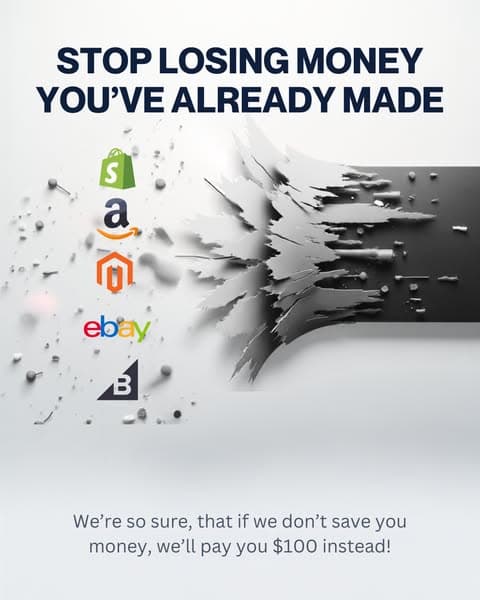
- Webgility: "You're losing revenue to 'Almost Right' financials" and "Most ecommerce sellers are losing upto 20% revenue due to guess-work margins, leaked fees, and broken inventory attribution" (7 days, live, on 4 ads at once).
Why it runs: an ecommerce operator already suspects money is being lost somewhere, so the ad only has to say where.
2. The busywork
The B2B pain angle, for store owners: spreadsheets, headcount, and the mess behind a growing store.
- Webgility: "I didn't start an ecommerce business to spend my nights buried in spreadsheets" (7 days, live), then "As your business grows, so does the mess behind the scenes. Sales, fees, taxes, refunds, payouts, inventory".
- ShipStation: "Ready for more orders? ShipStation helps you scale fulfillment without adding headcount" (22 days and 12 days, both live).
- ShipStation: "automated workflows, flexible order and shipment management" in the primary text of its longest-running card (65 days).
- StoreClaw: "Running an online store shouldn't feel so complicated" (6 days).
Why it runs: Webgility quotes the seller's own complaint, nights spent in spreadsheets, and ShipStation names the cost the buyer wants to avoid, more staff.
3. The clock
Speed, with a unit of time attached.
- StoreClaw: "Know Your Real Profit by Morning" (12 days), the only overnight promise in the set.
- Shogun: "Generate Sections Instantly with AI" (16 days), on a body that promises branded, reusable sections in minutes.
- Webgility: a free 30-minute session, offered every Thursday, on an ad that opens "Most books can't answer this" (3 days).
- Uscreen: "From 0 to 1,000 Fitness Members in 90 Days" (1 day, live).
Why it runs: a number of minutes or days is something the reader can check after signing up.
4. The free trial
The most common promise in the set, and the one attached to the longest-running ads.
- ShipStation: "Free for 30 days, no credit card required" (65 days), with "Start Your Free Trial Today" as the link headline and Sign Up as the button.
- ShipStation: "For qualifying shippers, we'll handle your entire onboarding setup for free" (18 days and 17 days, both live).
- StoreClaw: "Try StoreClaw free" closes the body of 16 of its 27 ads.
- Shogun: a "Try for free" button printed inside the creative itself (36 days).
- Webgility: "Get Your Free Audit" (live), a call with a person instead of an account to try.
Why it runs: the buyer can try the tool before paying for it. ShipStation's 65-day ad and the page it lands on both say "no credit card required", and the signup form is on the first screen.
5. The gift
Money handed to the buyer, on top of the product.
- ShipStation: "Sign up today to receive a $25 Visa gift card", the offer behind 13 of its 18 ads, the oldest of them live at 64 days.
- Webgility: "We're so sure, that if we don't save you money, we'll pay you $100 instead!" printed at the bottom of the creative (7 days, live).

Why it runs: both companies sell something the buyer cannot judge before using it, so the ad offers a dollar amount up front. ShipStation pays everyone who signs up. Webgility pays only if its audit finds no savings, so its $100 also says something about the product.
6. The test
An angle fintech does not have: the ad sells experimenting on your own store.
- Shogun: "Ecommerce price testing made easy" on the creative, "Find your optimal price point" and "no coding required" in the primary text, "Shogun Price Testing" as the link headline (36 days, ended January 2026).
- Shogun: a second variant, "Maximize revenue with price testing", same layout, same button (36 days).
- Shogun: two more ads for A/B testing, pointing at a different page (6 days each).
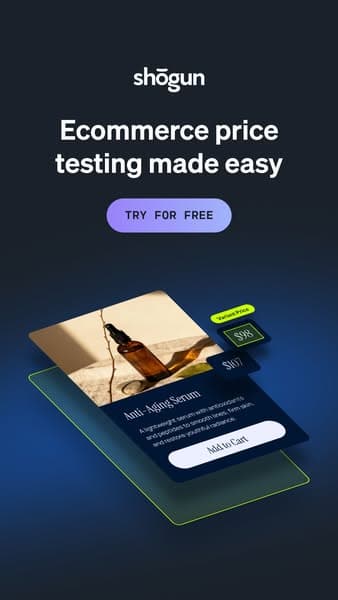
Why it runs: the creative shows the product at work: one product card with two prices on it.
Shogun is alone on this angle, and it is the only company in the set whose ads all stopped: 11 ads on file, none live in September.
7. The counter
Only SumUp runs this: the card reader itself, photographed, with three specs and a price cut.
- SumUp: "SumUp Terminal", then "Quick, easy Wi-Fi connection", "Pocket-sized POS", "Battery built for all-day business" (23 days, live).
- SumUp: "Small box. Big potential." for the Solo reader (25 days, live), and "Take payments faster, easier, and on the move" for the Terminal (25 days, live).
- SumUp: "20% Off" on the Solo (7 days) and "20% Off Hardware" on the Terminal (8 days).
- SumUp: "Your counter just got an upgrade" for POS Lite (25 days, live).
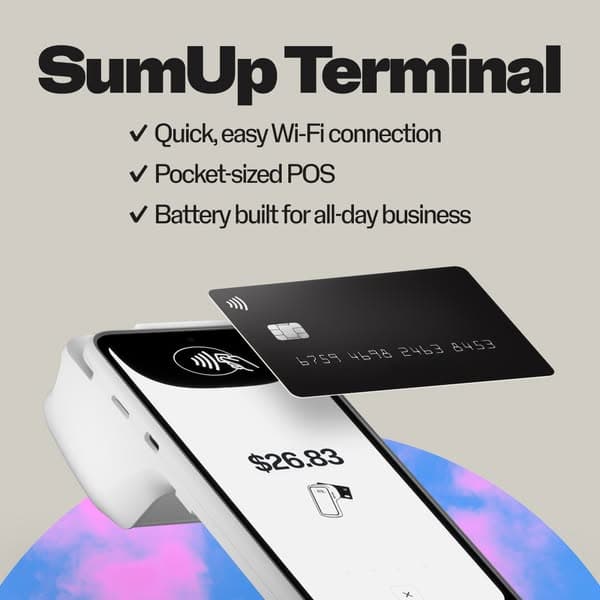
Why it runs: the buyer is a merchant with a counter, and the ad shows the device that will sit on it. SumUp is the only advertiser in the set with a physical product to photograph.
8. The customer with a number
Only Uscreen runs this.
- Uscreen: "How ClayShare Built a 5-Figure Membership in 1 Year", with "4,000+ members and $26K+ MRR" in the body (live).
- Uscreen: "From 0 to 1,000 Fitness Members in 90 Days", about a solo fitness creator who "hit 1,000+ members in 3 months" (1 day, live).
- Uscreen: "How Pilates Content Scales Beyond Social", naming the devices the classes run on (live).
Why it runs: each of these ads points at the case study it quotes, so the reader clicks and gets the rest of the story.
9. The series
One template with many versions, so an account can run a lot of ads that still look like one campaign. Four companies do it.
- StoreClaw: 27 ads and 3 headlines between them, one of which covers 15. Every ad carries its own campaign code in the address, from tdfb1036 to tdfb6006, so the same video can be measured 27 ways.
- SumUp: the same copy, "Everything you need to sell, manage, and grow", on 13 ad IDs, 11 of them carousels, the oldest 62 days and live.
- ShipStation: "Bring on the rush." on 3 ads, "Let's get you up to speed." on 3, "Scale with confidence" on 2, and one card running under two Library IDs at once for 65 days.
- Shogun: the same layout twice, with one line swapped.
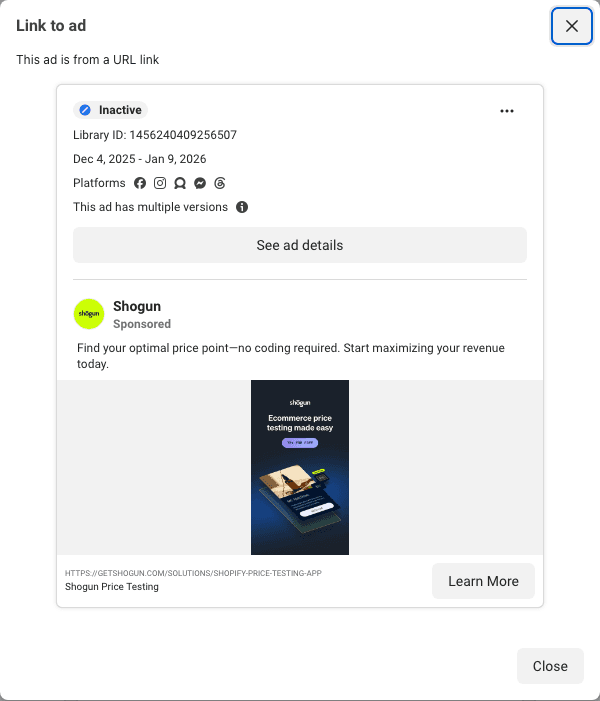
Why it runs: by the third ad, the reader knows the format and only reads the part that changes. The advertiser learns which version works without making a new ad each time.
Ad analysis: six angles almost nobody in ecommerce uses
Read against all 128 ads, these six appear once or not at all. The closest existing ad is named, so you can start from it.
- A named competitor. Not one ad names another product. The closest is SumUp, which points 3 ads at a pricing page that leads with the words "flat pricing compared to the competition" (41 days, live). The comparison is on the page, never on the card.
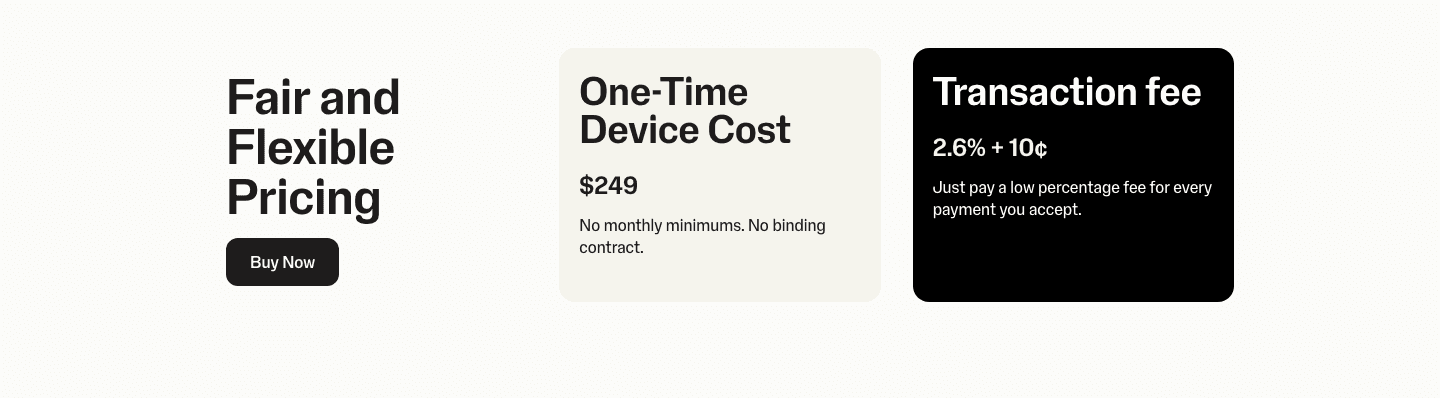
- The price of the product. 7 brand ads carry a dollar figure: 2 are ShipStation's $25 gift card, 4 are Webgility's $100 guarantee, and 1 is a customer's revenue inside a Uscreen case study. None of them is a price. SumUp comes closest with "20% Off Hardware" (8 days), a discount with no number to discount from. The Terminal costs $249 and 2.6% plus 10 cents per payment, and you only learn that after the click.
- Trust as the headline. These products connect to a store, a bank feed and a set of books, and not one ad leads with safety. The closest is Webgility's promise of reconciliations "guaranteed by human accountants" (7 days), and that line sits in the body text, not the headline.
- The switch itself. Nobody promises to move you off the tool you have. ShipStation gets closest and does it on the page, not in the ad: "Peak season breaks platforms. Switch before the rush" is the first line under the headline of its offer page.
- Interactive proof. No ad in the set gives the reader a number to change. Shogun's creative is the nearest thing, because it shows one product priced two ways (36 days). StoreClaw's ads talk about calculating real profit in 16 of them and never show a calculation.
- The season with a date. This is ecommerce, and in a September sweep not one ad names Q4, Black Friday or any date at all. ShipStation's "Bring on the rush." (30 days, live) is the closest, and it names no date.
Landing page analysis: what happens after the click
Here is where the ads send people:
- 84 of the 128 ads point at the brand's own site. 21 of those land on the homepage, about 25%, and all 21 belong to StoreClaw. Take one advertiser out and the homepage rate for this market is zero.
- 37 ads point at a Facebook link rather than a website. All of them are SumUp's, and we cannot read the page behind a Facebook link.
- 5 point at the Shopify app store. Shogun's ads for its AI section builder skip the website and land on the app store listing.
- Not one Google ad was on file for any of the nine companies swept, so unlike the fintech post there is no search comparison to make here.
The kind of page sorts these advertisers into four tiers. Every page below is linked, so open them.
| Tier | The ad points at | In the sweep |
|---|---|---|
| 0 | The homepage | 21 of 84 ads, all StoreClaw |
| 1 | A page that already existed | Shogun's price testing page, Webgility's books audit, Uscreen's fitness app page |
| 2 | A path that exists for ads | ShipStation's free trial page, 1 ad |
| 3 | A version or a market in the path | ShipStation's offer-25 page, its social page, SumUp's loyalty page |
Tier 1: the ad points at a page that already existed
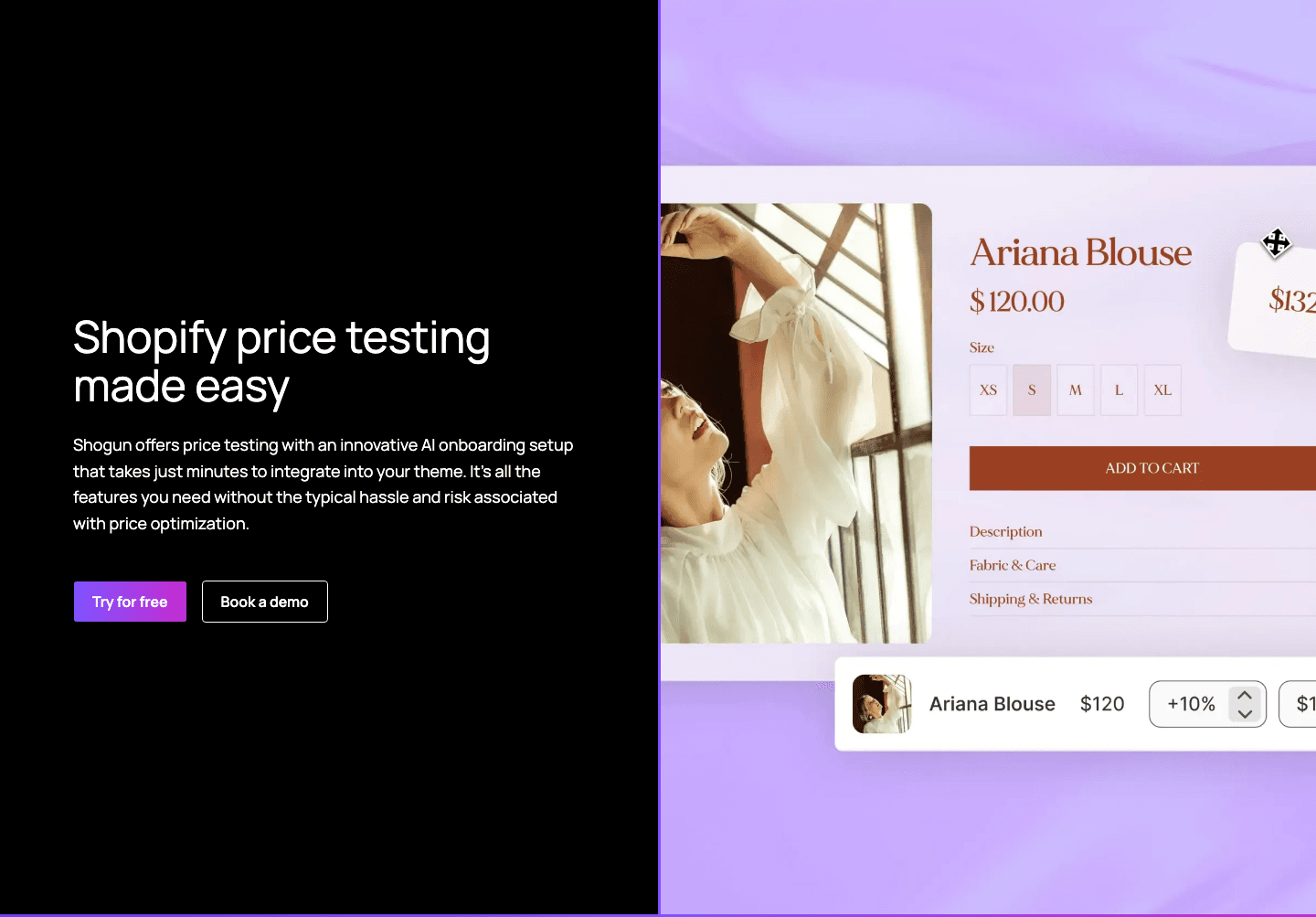
- The creative says "Ecommerce price testing made easy". The page says "Shopify price testing made easy". Only one word changed.
- Nothing here was built for the campaign. It is the page a visitor reaches from the site's own navigation, and for a single product it is often enough.
- 24 of the 84 ads sit on this tier, spread across 4 companies.
Tier 2: the ad points at a path that exists for ads
- Exactly 1 ad in the sweep does this: ShipStation's, pointing at shipstation.com/start-a-free-trial, running 74 days before it stopped on February 1, 2026.
- We did not capture that page, because the only ad pointing at it had already stopped when we swept. It is named here so the tier is not silently empty.
Tier 3: the ad points at a versioned or per-market page
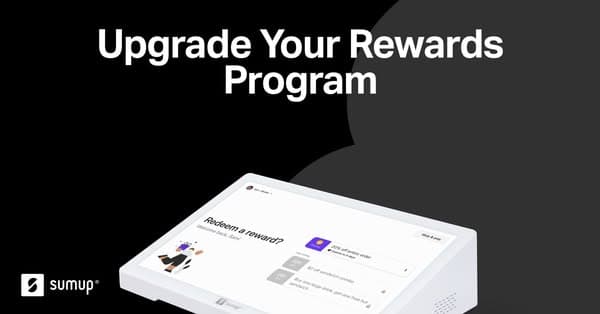
- SumUp's longest-running ad that points at its own site, 45 days and live, lands on the loyalty program page with the campaign and the ad set written into the address.
- Read SumUp's tier carefully: the
/en-us/in the path is a market prefix on an ordinary product page, not a page built for a campaign. Its ads land on the same Solo and Terminal pages an organic visitor sees. - ShipStation's pages are built for the campaign. offer-25 is a page that exists because an offer exists, and the offer code is already filled into the form when you arrive.
How many paid pages each company runs
| Company | Brand-site Meta ads | Distinct pages | Of which per market |
|---|---|---|---|
| SumUp | 21 | 6 | 0 |
| Uscreen | 6 | 4 | 0 |
| StoreClaw | 27 | 3 | 0 |
| ShipStation | 18 | 3 | 2 |
| Shogun | 6 | 2 | 0 |
| Webgility | 6 | 2 | 0 |
- Nobody here runs a page per market, and only 2 of the 6 sell outside the US in these ads. The per-market count on ShipStation's row is the automatic reading of its
/lp/prefix, andlpis not a market. It is a folder for campaign pages. - Page counts are flat across the market: 2 to 6, where fintech's leaders ran 10 to 26.
- No company in this set hides its ads behind a tracking redirect, so every destination above can be opened and read.
Try it on yourself. Open your own Ad Library entry, click the ad, look at where it lands. The homepage puts you on tier 0. An offer in the path with the code prefilled puts you where ShipStation is. Most teams are on tier 1, with one page for every ad.
Teardown 1: ShipStation
Two campaigns taken apart the way we take apart a page in a client audit: the ad, then the page it lands on, then the gaps. ShipStation because it owns 7 of the 10 long runners in the market. Webgility because its ad and its page repeat each other more closely than any other pair here.
The campaign. 18 ads on file, 13 live on September 1, 2026, pointing at 3 pages. Two campaigns, built the same way. The first ran at the social page from October 14, 2025 to January 23, 2026, in two waves: a pair of ads for 36 days, then a second pair for 65 days starting the day the first pair stopped, carrying the same creative under two Library IDs. The second started June 29, 2026 at the offer page: 13 ads behind one offer, 4 of them still live at 64 days.
The ads
Read the 65-day ad top to bottom. The primary text is one sentence and it is all offer: free for 30 days, no credit card required, discounted shipping rates, automated workflows, flexible order and shipment management. The creative under it is a grid of carrier badges around the ShipStation mark, under the line "The right carrier for the right product". The link headline repeats the offer, "Start Your Free Trial Today", and the description repeats the reassurance, "No credit card required". The button is Sign Up, not Learn More. Library ID 662318636817182 shows it as it ran.
The current campaign adds a $25 gift card to the trial and keeps the same layout. Three creatives rotate: "Scale with confidence" over "Ready for more orders? ShipStation helps you scale fulfillment without adding headcount. Try it free + get $25" (22 days), "Let's get you up to speed." over free onboarding for qualifying shippers (18 days), and "Bring on the rush." over a promise about busy seasons (30 days).
The landing page
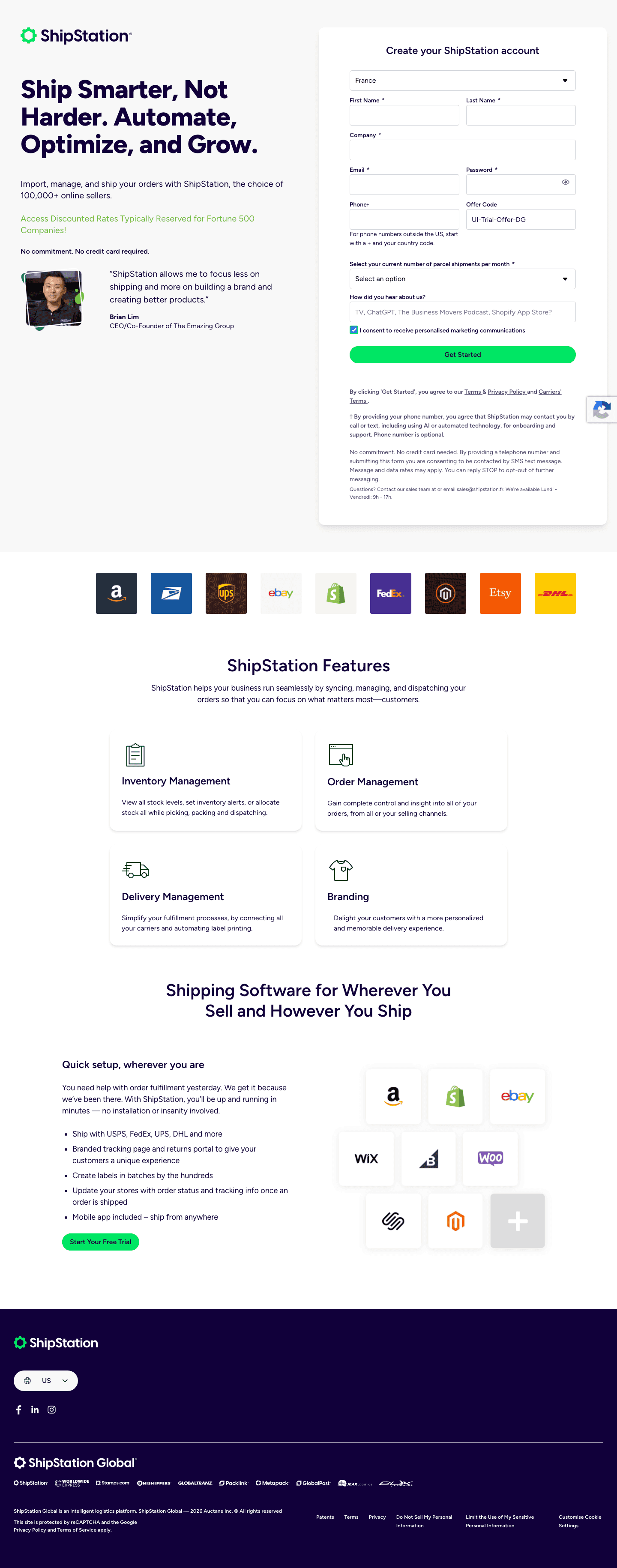
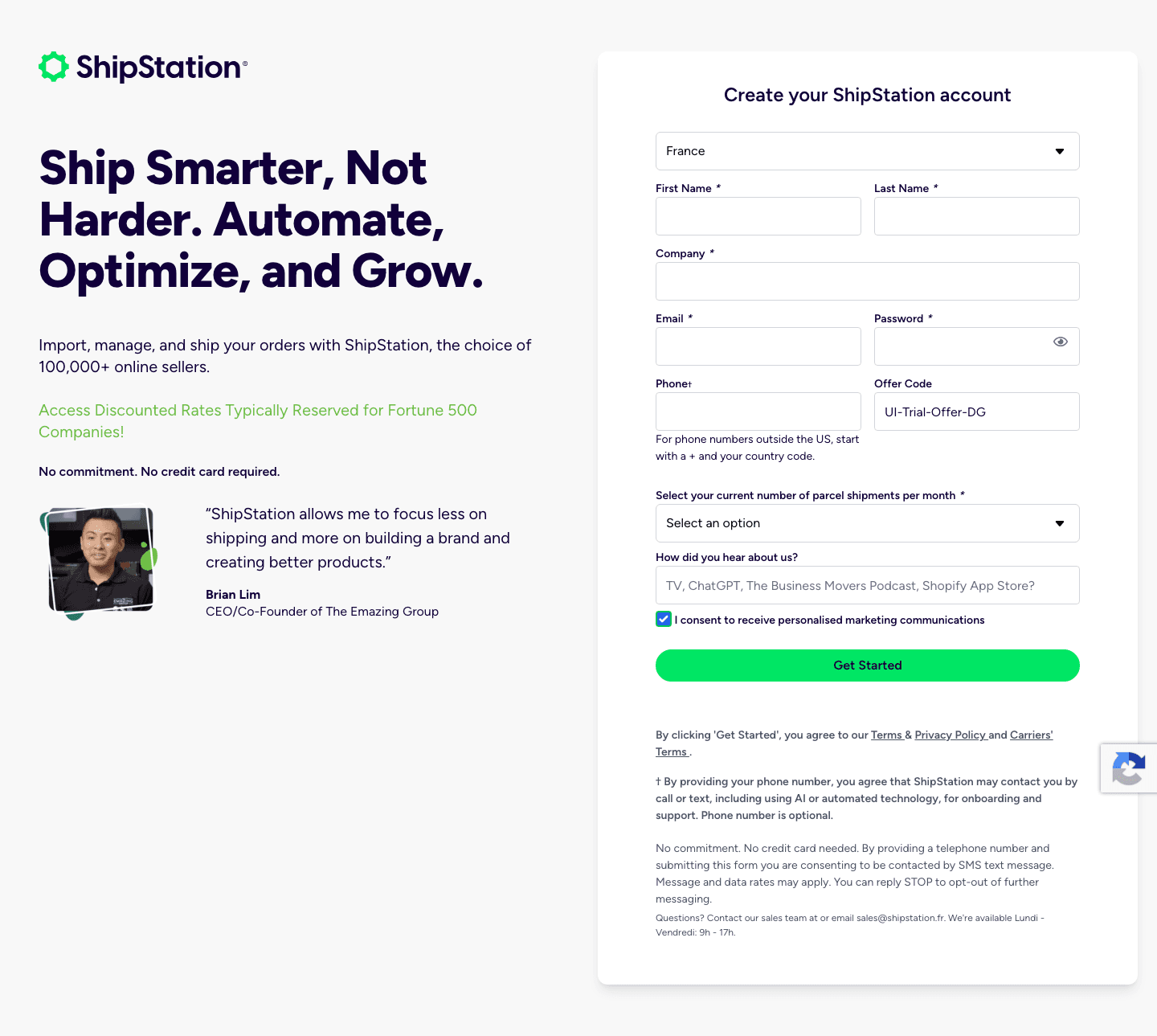
The hero. Four things on one screen. A headline that is a verb and a promise, "Ship Smarter, Not Harder. Automate, Optimize, and Grow." A subhead with the proof number, the choice of 100,000+ online sellers. A green line that adds the thing the ad did not say, discounted rates normally reserved for Fortune 500 companies. And the ad's own reassurance repeated word for word under it: no commitment, no credit card required. The form on the right is the signup itself, with an offer code already filled into its own field.

The logo row. Amazon, USPS, UPS, eBay, Shopify, FedEx, Magento, Etsy, DHL. These are the same badges that filled the creative, so the page looks like the ad. A buyer of a shipping tool first wants to know whether it works with their carrier and their store, and the page answers that before it lists a single feature.
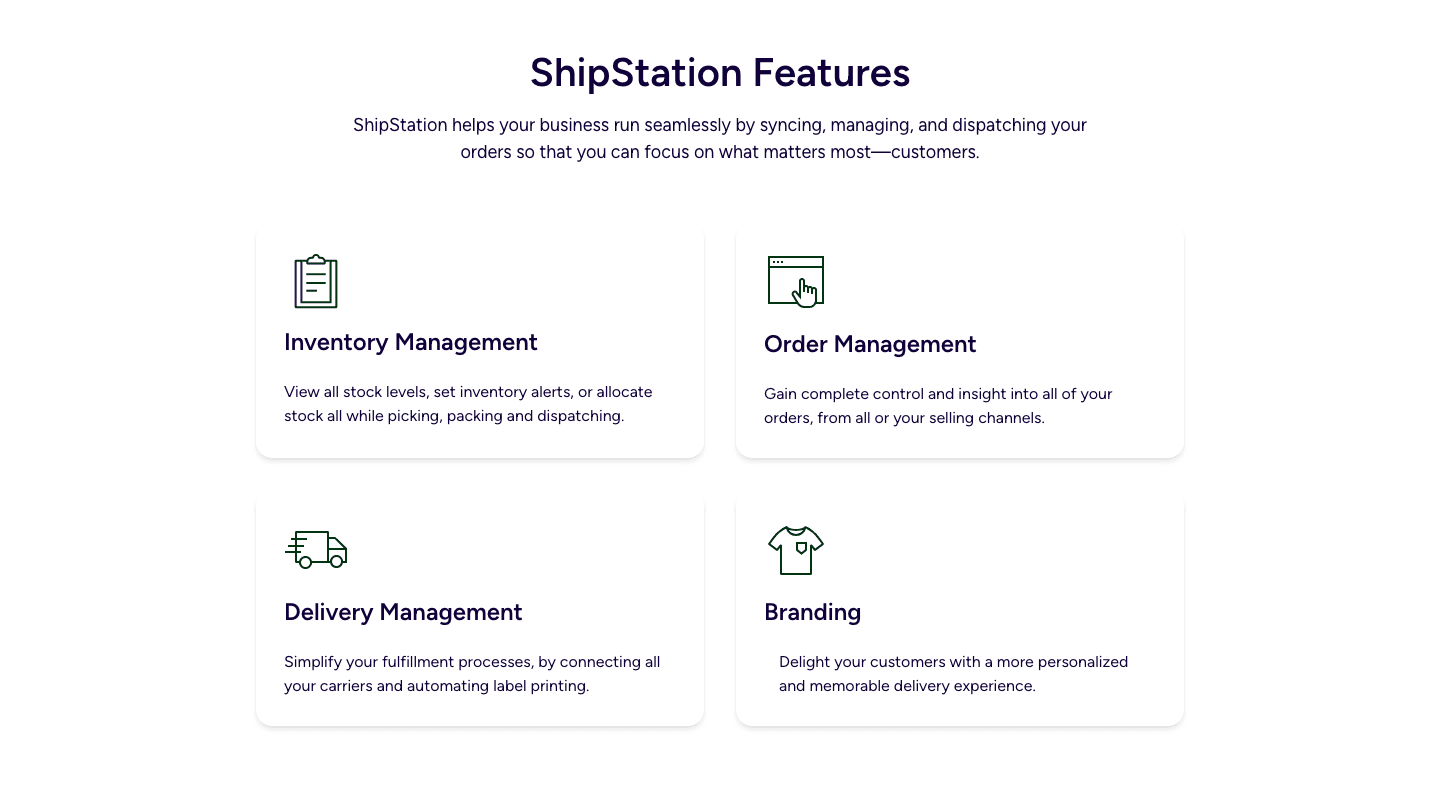
The feature grid. Inventory, orders, delivery, branding, one sentence each. It is the weakest band on the page: the four sentences describe categories, make no promise, and carry no number.
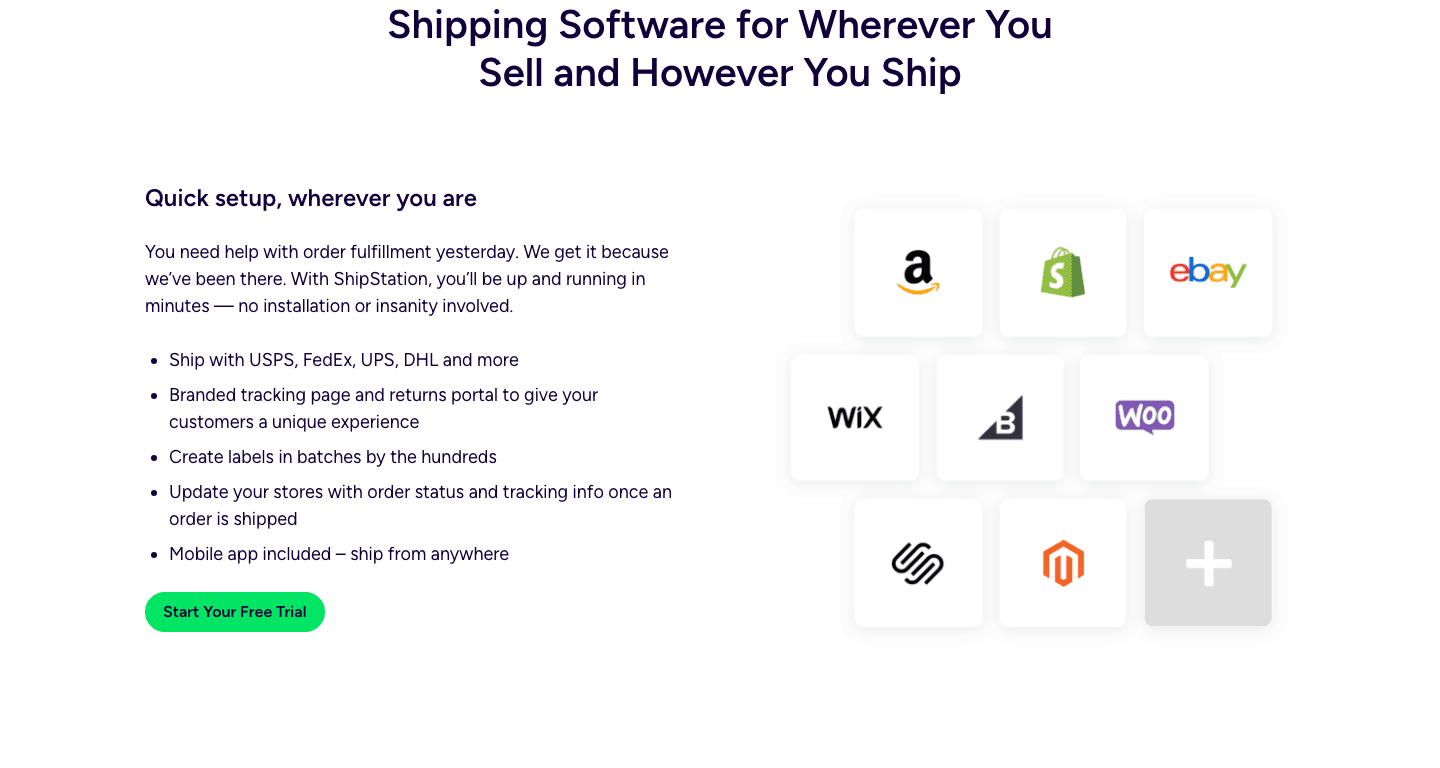
The setup band. "You need help with order fulfillment yesterday. We get it because we've been there." Then five bullets that are all verbs: ship with USPS, FedEx, UPS, DHL and more, branded tracking page and returns portal, create labels in batches by the hundreds, update your stores with order status, mobile app included. A second Start Your Free Trial button closes it, so the reader does not have to scroll back up.
The current campaign's page is the same layout with the gift added:
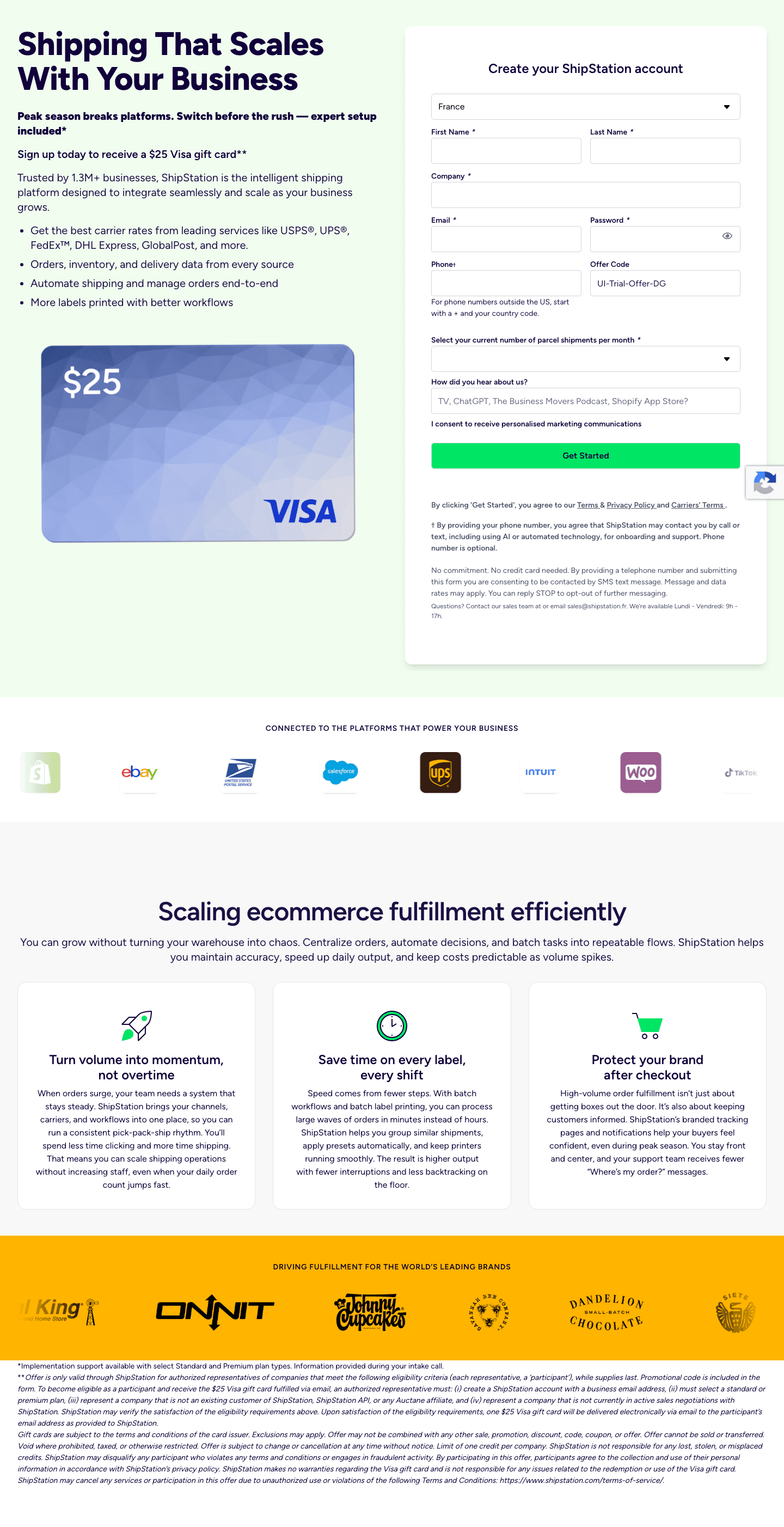
The offer page. "Shipping That Scales With Your Business", then a line none of the ads uses: "Peak season breaks platforms. Switch before the rush." Then the gift, "Sign up today to receive a $25 Visa gift card", with a picture of the card so the reader knows exactly what arrives. Underneath, three named benefits about surging orders, a row of platform logos, and a band of customer brands. A long legal footnote at the bottom lists the offer's conditions.
Message match
| The ad says | The page proves it with |
|---|---|
| Free for 30 days, no credit card required | The same words under the headline, above a form with no card field |
| Discounted shipping rates | Rates typically reserved for Fortune 500 companies, in green, in the hero |
| Automated workflows | Five verbs in the setup band, ending in a second trial button |
| Try it free and get $25 | A picture of the $25 Visa card beside the form, with the terms below |
The gaps
Two gaps, both fixable in a week. The proof number changes between pages: the social page says 100,000+ online sellers, the offer page says 1.3M+ businesses. Both may be true, of different things, but a visitor who sees both cannot tell which one to believe. And the form guesses the visitor's country from where they are: our capture, loaded from Europe, arrived with France preselected in the country dropdown and French support hours in the fine print, on a page whose ads were running in the US. A visitor in that case has to fix the first field before filling in anything else.
Find revenue opportunities for your website, backed by real data. Get your 3 free opportunities by email.
Teardown 2: Webgility
The campaign. 6 ads, all live, all launched between August 25 and August 31, 2026, all pointing at 2 pages. The account is 7 days old, so none of its ads is near 45 days. We picked it because its ad and its page were clearly built together.
The ad
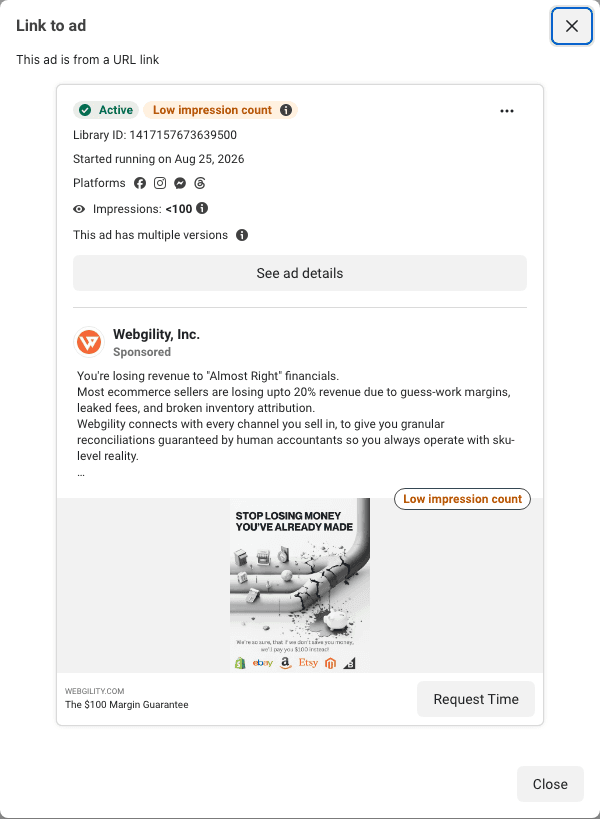
The primary text is three sentences. First the problem: you're losing revenue to "Almost Right" financials. Then how big it is: most ecommerce sellers are losing upto 20% revenue due to guess-work margins, leaked fees, and broken inventory attribution. Then how it works: Webgility connects with every channel you sell in, to give granular reconciliations guaranteed by human accountants. The link headline is the guarantee: "The $100 Margin Guarantee".
The creative is a picture of the loss. "STOP LOSING MONEY YOU'VE ALREADY MADE" over a cracked pipe with the contents running out onto a piggy bank, and along the bottom the logos of the channels the reader sells on: Shopify, eBay, Amazon, Etsy, Magento, BigCommerce. Then the offer: "We're so sure, that if we don't save you money, we'll pay you $100 instead!" One of the 4 variants ends on Contact Us, another on Request Time.
The landing page
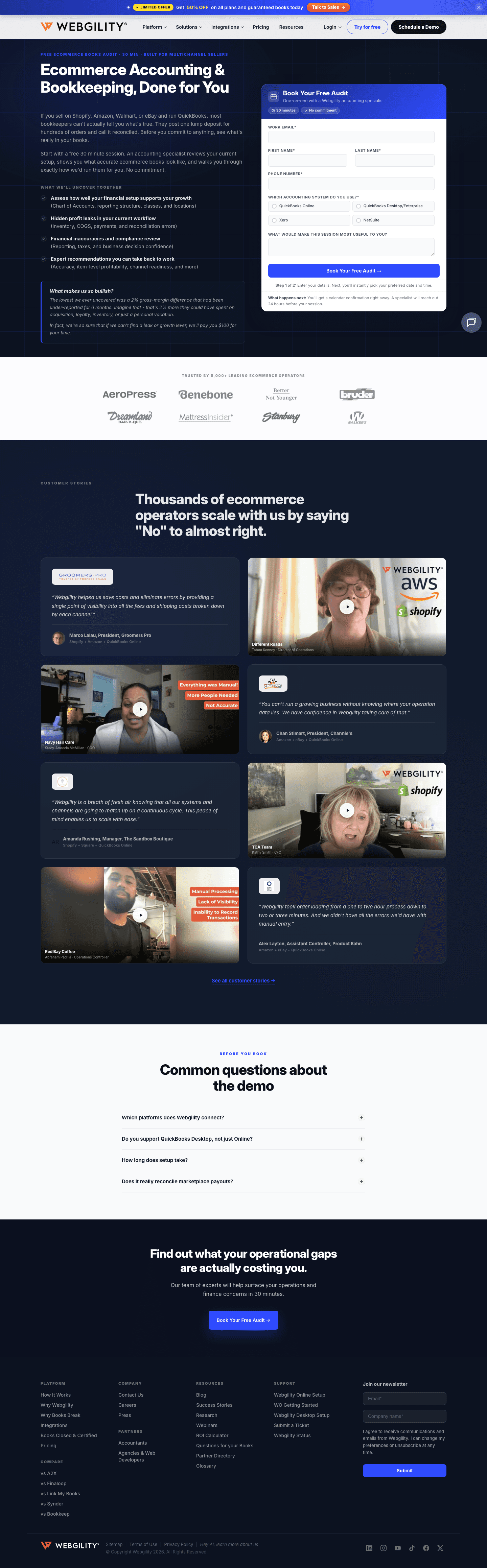
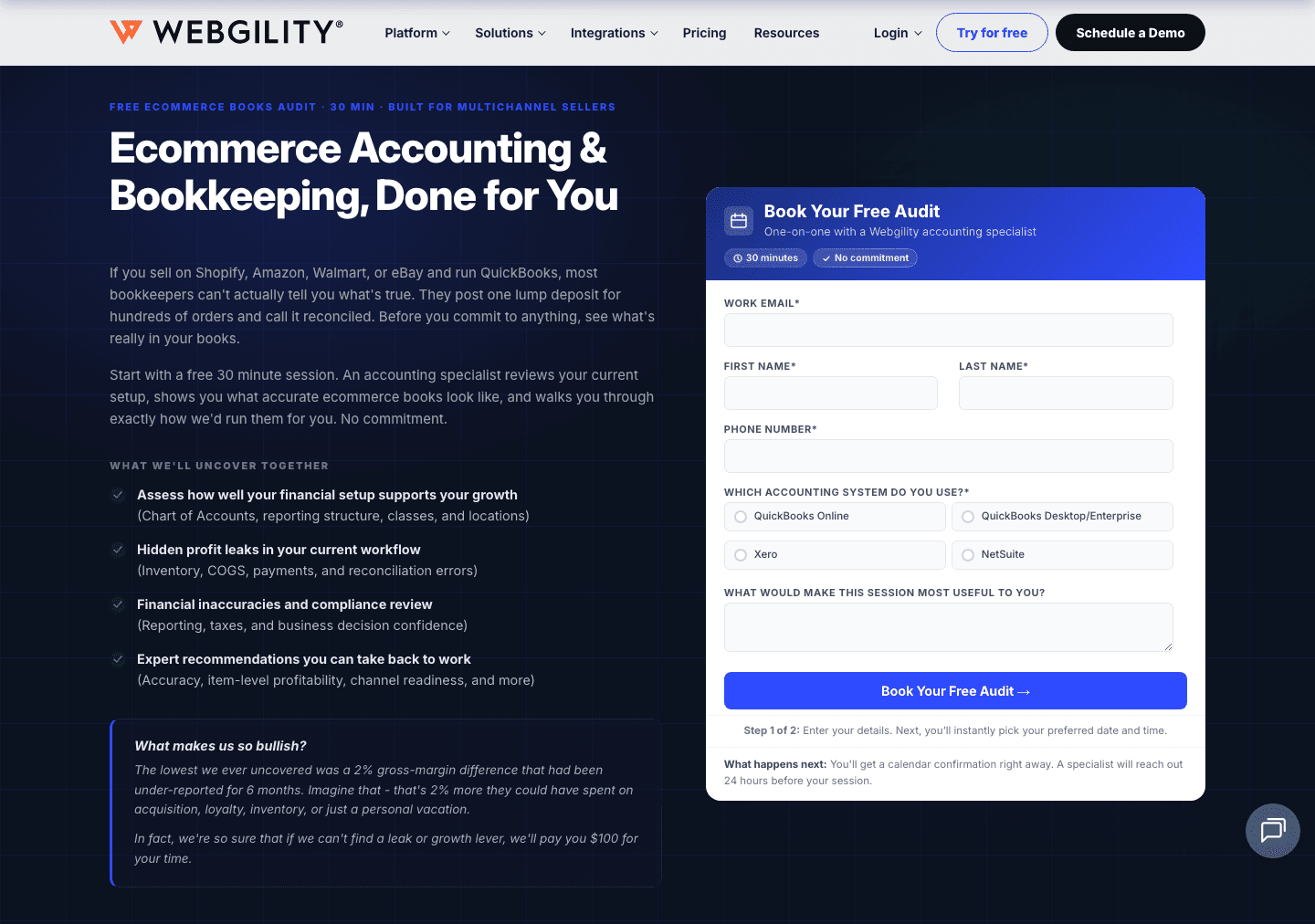
The hero. The eyebrow sets the terms before the headline does: free ecommerce books audit, 30 min, built for multichannel sellers. The headline sells the outcome, "Ecommerce Accounting & Bookkeeping, Done for You". The paragraph under it names the reader precisely, someone selling on Shopify, Amazon, Walmart or eBay while running QuickBooks, and then names the failure: bookkeepers post one lump deposit for hundreds of orders and call it reconciled. Four ticks say what the 30 minutes covers. And in a bordered box at the bottom, the ad's guarantee, repeated and made specific: the lowest leak they ever found was a 2% gross-margin difference under-reported for 6 months, and if they cannot find a leak, they pay $100 for your time. The form beside it asks 5 things and tells you what happens next.

The logo cloud. Eight ecommerce brands under one line, trusted by 5,000+ leading ecommerce operators. It is small and sits right after the form.
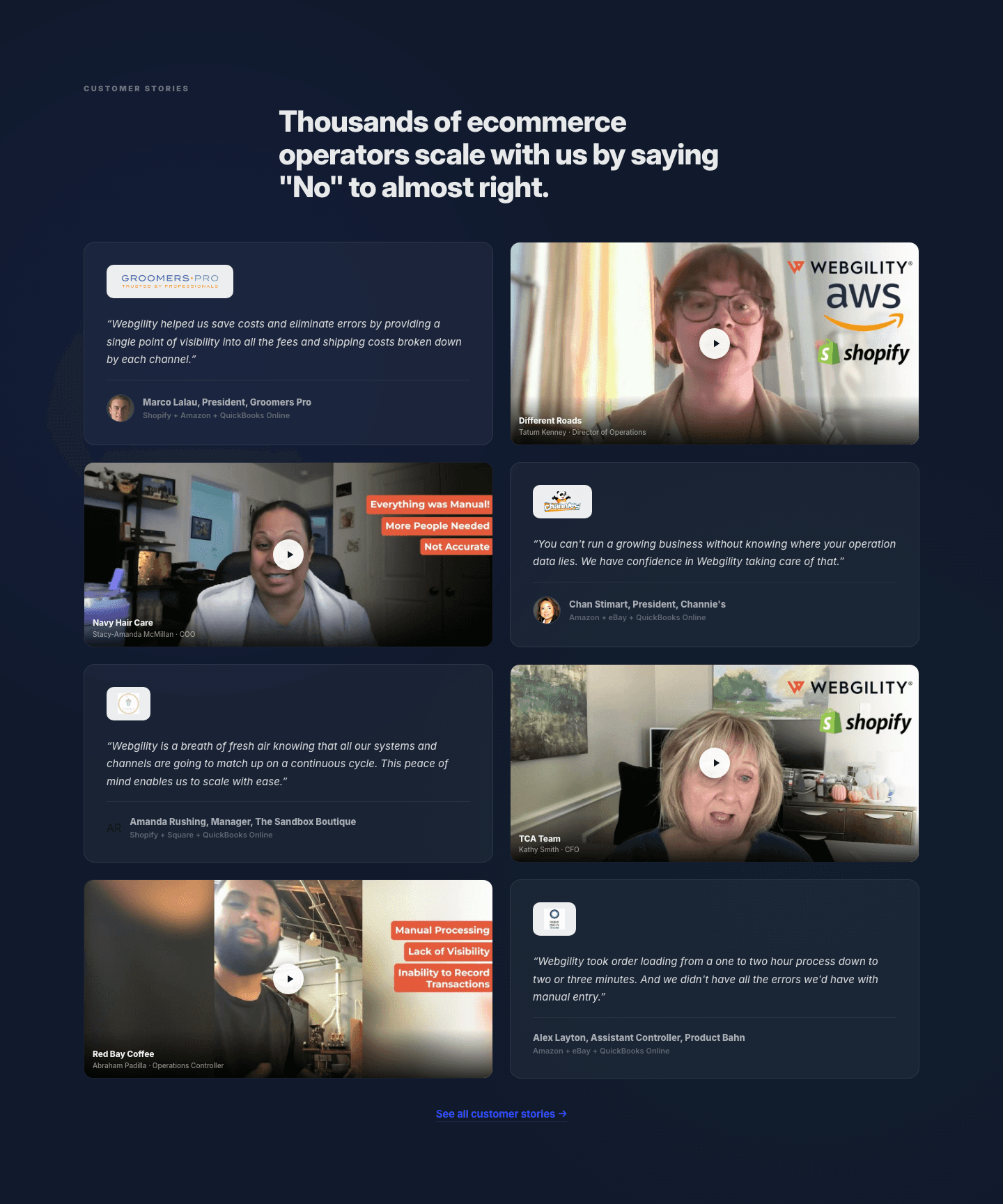
The proof. Eight customers, four of them on video, each with a name, a title, a company and the exact stack they run: Shopify plus Amazon plus QuickBooks Online, Amazon plus eBay plus QuickBooks Online, Shopify plus Square plus QuickBooks Online. A seller reading this looks for their own combination, and when they find it, the quote beside it is about a business like theirs. The strongest one carries a number: order loading went from one to two hours down to two or three minutes.
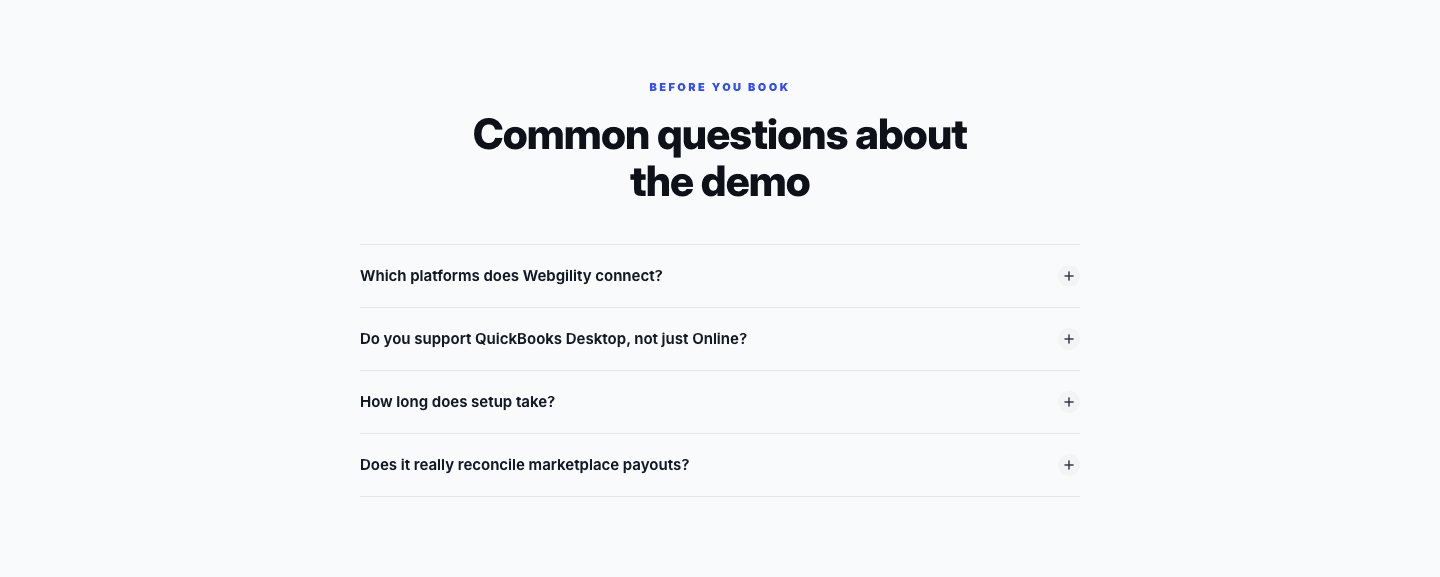
The FAQ. Four questions, under the heading "Common questions about the demo": which platforms it connects, whether QuickBooks Desktop is supported, how long setup takes, whether it really reconciles marketplace payouts. Each one is a reason a seller might not book the call.

The closer. "Find out what your operational gaps are actually costing you", the 30 minutes repeated, one button. The page ends on the idea the ad opened with, money the seller is losing.
Message match
| The ad says | The page proves it with |
|---|---|
| Stop losing money you've already made | A hero that names the leak, then a 2% margin gap found over 6 months |
| The $100 Margin Guarantee | The guarantee restated in a bordered box, with the condition attached |
| Losing upto 20% revenue across every channel | Customer stories tagged with the exact channel and accounting stack |
| Guaranteed by human accountants | A booking form for a one-to-one session with an accounting specialist |
The gaps
Two. The ad promises a $100 guarantee and the page pays it off, but the two use different wording for the condition: the creative says "if we don't save you money", the page says "if we can't find a leak or growth lever". A reader asked to trust a guarantee may notice the two conditions are different. And the video customer stories, the best proof on the page, sit three screens below the form. One named operator with their stack, moved up beside the hero, would reach the visitor before they decide whether to fill it in.
A UX audit suggests changes like this one, where the page stays the same and only the order of its sections changes.
Key takeaways: five things to do with this
- Name the leak, not the growth. StoreClaw has run one video for 55 days on a single idea: profit you have already made and cannot see. Webgility's newest ads say the same thing.
- Put the offer in the primary text, not in the picture. ShipStation's 7 long runners all sell a 30-day trial or a $25 gift card.
- Build the page for the offer and prefill it. 21 of the 84 brand-site ads still land on a homepage. ShipStation's page arrives with the offer code already in the form.
- Say the price. Not one ad in this market says what the product costs, and only one page we opened does it plainly. A price on the card would stand out.
- Take a date. In a September sweep, no ad names a season or a date. The nearest thing was "Bring on the rush." No ad in the set mentions Black Friday.
How to run this analysis on your own competitors
The Meta Ad Library and the Google Ads Transparency Center are public and free. Search the brand's page rather than a keyword, set the country, filter to active ads, sort by start date. Then:
- Group the ads by angle. Use the nine above.
- Keep the ones that have run 45 days or more. The advertiser keeps paying for them. Click through and read the page each one lands on.
- Write down the angles they are not running. Start your next campaign from that list.
Or send us the URL and we do it for you.
How we did the analysis
- Sample: the ecommerce companies on the benchmark leaderboard, picked by traffic, not by advertiser status. 16 were selected and 9 were swept. Set aside without a sweep: ClawTeams, Volusion, Hello Charles, Tresl, Sendcloud, Jimdo and Stamped. Swept with nothing brand-verified on file: SellerClaw, Shippit and PaymentKit. That leaves 6 advertisers: ShipStation, SumUp, StoreClaw, Shogun, Uscreen and Webgility. StoreClaw was found by a name search rather than a brand page, so its set is what the library returned for the name, admitted by the landing host.
- Sources: the Meta Ad Library, searched by brand page, and the Google Ads Transparency Center, both through Apify. The Transparency Center returned nothing for any of these 9 companies, so every number in this post is a Meta number.
- Filter: brand-verified ads only. An ad counts when the page name matches the brand and the landing host is the brand's own domain, an app store, or a link from the brand's own page. That check is what dropped the searches for Shippit and SellerClaw, which returned a wood-carving tool store, a mushroom coffee brand and a freelance job posting, none of them the company we were looking for. 51 ads were dropped for a mismatched host, 7 for a mismatched page name, 7 for being in another language.
- Ranking: days active, measured on September 1, 2026. The floor of interest is 45 days, the point at which an ad has survived at least one budget review. Only 10 of the 128 ads on file clear it.
- Reading: every distinct message was read by hand and put in one angle. Dynamic ads return a template instead of copy, so those were read from the creative image and the landing path, and where no creative could be opened the ad is counted but not quoted. 20 ads returned a template with no creative and are counted only.
- Limits: the library returns about 60 ads per brand per market, so SumUp's 60 is a ceiling rather than a count, and the shares inside the sample are what to read. This sweep covers the US only. Meta publishes reach in the EU and never publishes spend, so nothing here says what any of it cost.
Every ad above links to its primary source in the sources list, so you can check the whole analysis yourself.
Sources
Primary sources, all public and checkable today. Open any Meta ad with its Library ID at facebook.com/ads/library/?id=ID.
- ShipStation's 65-day card, Library ID 662318636817182, and its twin 1193141252734502, both running November 19, 2025 to January 23, 2026: facebook.com/ads/library/?id=662318636817182
- ShipStation's current offer campaign: 1021924770487176 (64 days, live), 27230701799943786, 1043068981734710, 2118964168997600, plus the image ads 3765857630220704, 4546654035623977, 1686599522612289, 1431680878802117 and 1573374537515217. The tier 2 ad is 1219612323357172, 74 days to February 1, 2026.
- Webgility's guarantee ads, Library IDs 1648144273567918 and 1417157673639500, both live since August 25, 2026: facebook.com/ads/library/?id=1417157673639500. Also 1043066871689488 and the video ads 1395023849379178 and 1880113932964128.
- Shogun's price testing pair, 1456240409256507 and 1511400226760675, and the A/B testing ads 1215334207233808 and 860065443502131. Its Shopify app store videos: 4139075193031110 and 742506961962360.
- SumUp's long runners: 1984617892197433 (45 days, the loyalty program) and 1512324623697847 (62 days, a carousel to a Facebook link). Its hardware ads: 1385055650241390, 1539965987276589, 2104716510122226 and 1338416586012554. Its pricing-comparison ads: 1766476661468063, 1367639598898759 and 1966144327406944.
- StoreClaw's 55-day ad, 2433504293802937, and the profit series: 1845439513285409, 1678243117644202, 1503075004922476 and 2747878478940763.
- Uscreen's case-study ads: 921193190511216, 1548360856786414 and 1420471559961319.
- The landing pages, live: shipstation.com/lp/social, shipstation.com/lp/offer-25, webgility.com/ecommerce-books-audit, getshogun.com price testing, sumup.com Terminal, sumup.com Solo
- The sample: the ecommerce leaderboard of the Web Anatomy benchmark, selected by traffic.
- The Google Ads Transparency Center, which returned no ads for these companies: adstransparency.google.com
- Ad sweep and page captures made September 1, 2026 (Meta by brand page, US).
Data collected September 2026. Ad statuses and run lengths change; the library links above always show the current state.

Written by
Gabriel Amzallag , Founder, Web Anatomy
5 years CRO + SEO at Qonto (2021–2025). After advising 15+ SaaS on their websites (Payfit, Pigment…), the same patterns kept breaking, so I decided to build the source of truth on what works on the web: the intelligence layer every tool, builder, and team uses to ship sites that perform.
More from the blog
Playbooks
We analyzed the ads the top HR tech companies run. Here is what works.
Which HR tech ads kept running in 2026, the eight angles they use, and the pages behind them. The takeaways, with the ads to look at.
 Gabriel Amzallag26 min read
Playbooks
We analyzed the ads the top marketing software companies run. Here is what works.
Which marketing software ads keep running in 2026, the angles they use, and the pages behind them. Seven angles that work, five almost nobody runs.
Gabriel Amzallag23 min readGuides
Programmatic SEO: a practical guide from 10 city pages to 300
How Staycation went from 10 hand-made city pages to 300 with programmatic SEO, and grew purchases from search by 90%: how to find your topics, four rules, the template, and how to produce and measure the pages.
Gabriel Amzallag12 min read