
TL;DR
- The ads that keep running sell one of nine angles: the busywork, the close, the gift, the document, the fee, the clock, the integration, the customer with a number, the series. The seven advertisers in the lists below run two to eight of them each, and Ramp runs eight.
- Gift ads are more common here than in any market we have swept. 25 ads offer a demo in exchange for a gift card, AirPods, a Yeti cooler, an Oura ring or a Blackstone grill. All of them come from Bill and Ramp.
- Social ads almost never land on the homepage (2 of 281, against 19 of 60 for search). The biggest advertisers build a page per offer or per market, and you can see it in the URL.
- Almost nobody sells tax season, a price or a named rival. Not one ad in 329 names a competitor, one advertiser puts a price on the card, and two ads in the set carry a deadline.
15 companies selected, 11 swept, every brand ad in the public Meta and Google libraries, late August 2026. How we did it is at the end.
The sample: 10 accounting software companies, their ads, and where the ads land
| Company | Meta ads on file | Ran 45 days or more | Still live | Oldest live ad | Where the ads land |
|---|---|---|---|---|---|
| Shine (FR) | 60 | 54 | 30 | 166 days | capital deposit, the pro account, a free ebook |
| Qonto (FR) | 60 | 48 | 7 | 447 days | a card page per market, company creation |
| Ramp | 60 | 35 | 60 | 190 days | business cards, Ramp is for everyone, an AI report for accountants |
| Bill | 60 | 20 | 60 | 159 days | proven beats promises, the Sage Intacct page, an Amazon gift card |
| Spendesk | 60 | 2 | 0 | none | future of company spend and its German, Spanish and French twins |
| TaxGPT | 17 | 3 | 17 | 48 days | tax preparation, tax planning |
| Webgility | 6 | 0 | 6 | 7 days | a free books audit |
| Rydoo | 4 | 4 | 0 | none | the card page, an expense app page |
| Ignition | 1 | 0 | 1 | 5 days | |
| Ledgy | 1 | 0 | 0 | none | the homepage |
Shine keeps its ads running: 54 of the 60 on file have passed 45 days, and the three live capital-deposit creatives have been running since March. Bill works the other way, all 60 live but only 20 past 45 days, because Bill relaunches its offer every few weeks and the offer is what changes. Spendesk has 60 ads on file, 2 past 45 days, and none still running on the day we looked.
Ad analysis: the nine angles accounting software ads use
The messages on Meta sort into nine angles, plus a few outliers covered after the list. For each angle: the ads that ran longest, one creative to look at, and why it keeps running. The number in brackets is how many days the ad had been running when we looked.
1. The busywork
Four advertisers run it, and each ad names a manual job: exports, spreadsheets, invoices to chase.
- Ramp: "Automate the busywork" (143 days) and "Ramp replaces the spreadsheet." (65 days).
- Bill: "Stop the manual exports. BILL's 2-way sync with Sage Intacct automates your AP, AR, and spend data in real-time." (157 days).
- Spendesk: "Leave manual processes behind. Spendesk automates your workflows and brings every expense, invoice, and purchase together." (18 days) and, in French, "Moins de saisies manuelles, moins de relances." (35 days).
- Qonto: "Fini les factures à récupérer manuellement" (149 days).

Why it runs: it names a chore the buyer already hates and promises to take it away.
2. The close
Accounting has a deadline the rest of software does not, and four of the ten advertisers sell against it by name.
- Ramp: "Close your books faster with automated expenses." (132 days) and "Ramp closes the books automatically." (66 days).
- Spendesk: "Close the books in days, not weeks" (28 days) and "Month-end used to be chaos. Spendesk brings it under control." (18 days).
- Bill: "Hey CFOs: close your books faster with BILL Spend & Expense" (41 days) and "Closing the books take forever?" (35 days).
- Webgility: "Closing your books and getting fully reconciled each month is where most ecommerce sellers fall short." (3 days).
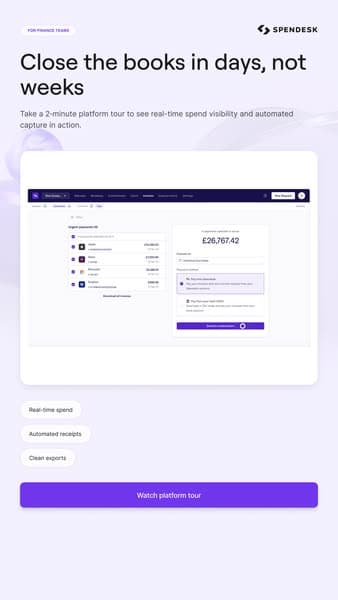
Why it runs: every buyer in this market closes the books at month-end, so an ad that names the close does not have to explain the problem.
3. The gift
Two companies pay for demos with objects, and between them they run 25 of these ads, more than in any other industry we have swept.
- Bill: "Take a demo. Get a $250 Amazon Gift Card." (125 days), "Accelerate your firm's growth and get a $150 Visa gift card." (76 days), "Have over 20 employees? Book a demo, claim a free YETI cooler." (66 days), "Hey CFOs: Keep your team's spend on beat. Get AirPods Pro 3." (35 days), a Nintendo Switch 2 offer aimed at treasurers (35 days), and "CFOs: Demo BILL, get a Blackstone griddle" (14 days).
- Ramp: "Free Oura Ring for Accounting Partners" (58 days), "Free AirPods Pro for Accounting Partners" (41 days), "Get a Blackstone Grill when you take a demo with Ramp" (35 days).
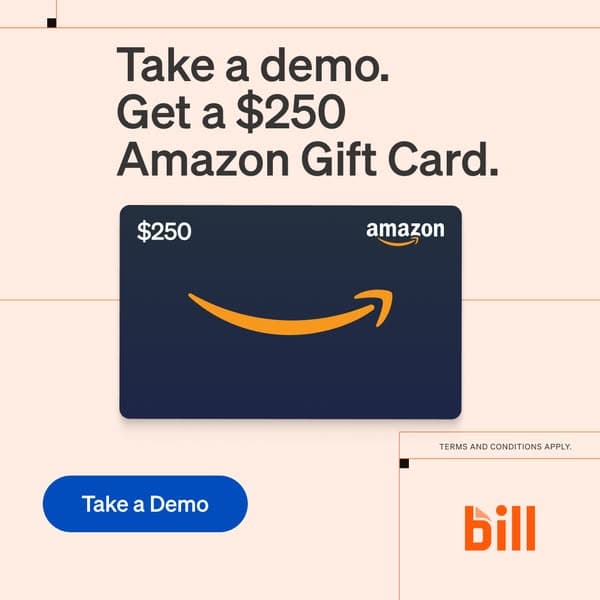
Why it runs: the gift takes the place of a price, and neither company puts a price in an ad. When the offer changes, only the object does: Bill has moved from a $250 Amazon card to a Yeti cooler, AirPods and a Blackstone griddle.
4. The document
Nothing is for sale on the card: a guide, a report or an ebook, in exchange for an email.
- Ramp: "The practical guide to using AI for accountants" (154 days, live) and "Get the 2026 CPA Firm Benchmarking Guide." (12 days), the second co-branded with CalCPA.
- Shine: "Micro vers société : le guide d'une transition réussie" (161 days), an ebook on moving from sole trader to company, still running under three separate ad IDs after 248, 166 and 143 days.
- Spendesk: "Join our community for Finance leaders" for CFO Connect (83 days).
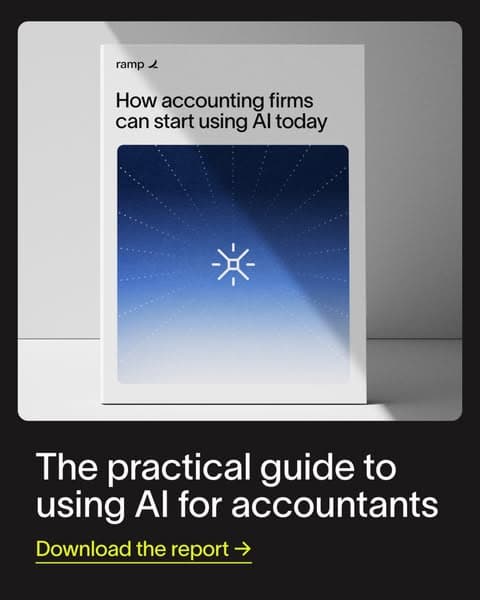
Why it runs: the product never appears on the card, so the ad does not go out of date when the product changes. Ramp's accountants guide, at 154 days, has run longer than its busywork (143 days) and close (132 days) ads.
5. The fee
Shine and Qonto, the two selling to freelancers and small companies, sell on price, and they write the price as a number.
- Shine: "Stop aux frais cachés ! Découvrez Shine, le compte pro transparent et sans frais mensuels." (215 days), "Un compte pro gratuit, pensé pour les indépendants." (158 days), and an invoicing tool described on the card as "Logiciel de facturation 100 % gratuit" (145 days).
- Qonto: "1 mois d'essai gratuit" (148 days) and, on the creative, "30 jours d'essai gratuit" (203 days).
- Ramp: "Stop paying FX fees on every cross-border swipe. 1% back on CAD and USD, no FX fees." (25 days).
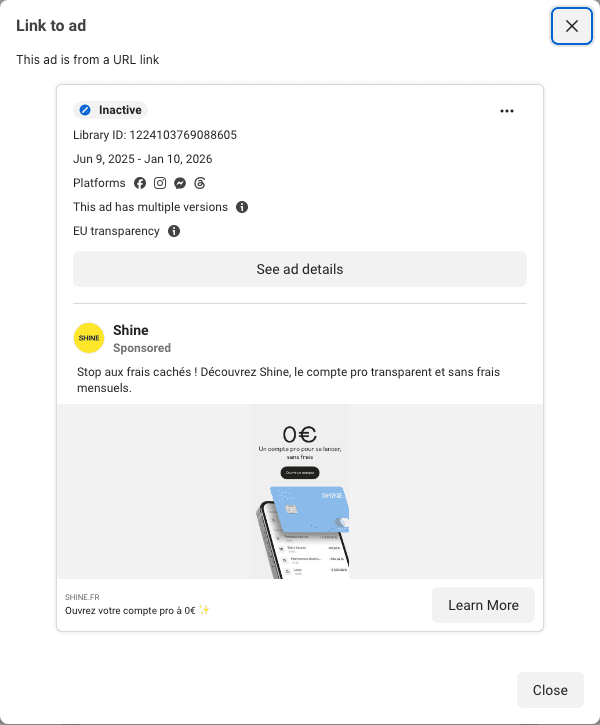
Why it runs: Shine's card shows the price at the size of a headline, and no other advertiser in the set does. Shine has kept that card running for 215 days.
6. The clock
Speed, always with a unit. Every speed ad in this set carries a number.
- Shine: "Déposez votre capital avec Shine et obtenez un certificat en ligne sous 12h." (261 days), "Votre compte pro en 5 minutes" (140 days), and "Ouverture en 5 min" on the page the ads land on.
- Qonto: "Ouvrez votre compte en 10 min" (183 days) and "Ouverture en 10 min" (45 days).
- TaxGPT: "Prepare tax returns in 10 minutes" (48 days) and, on a later card, "Ten minutes. Ready to send." (13 days).
- Ramp: "Open in under a minute." (79 days).
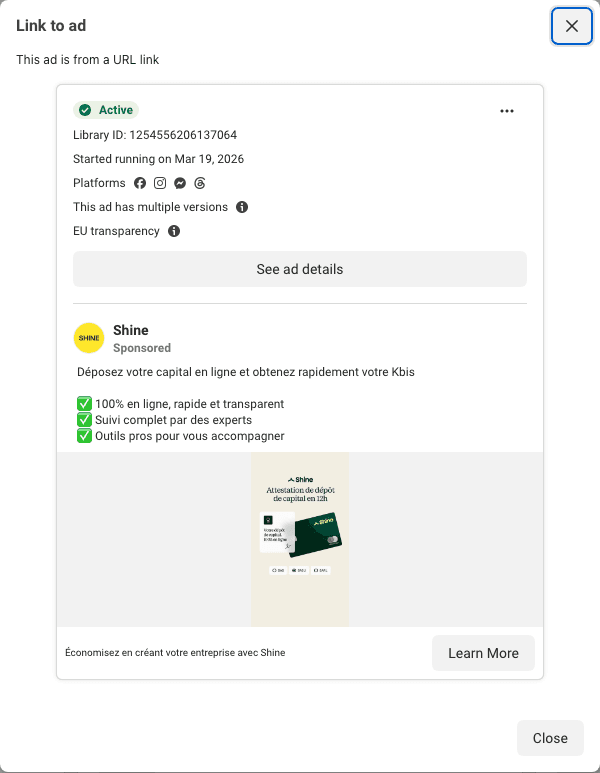
Why it runs: the reader can check the number on the page the ad opens. Shine's 12 hours appears there four times, twice in the hero, once in the feature list and once in the three-step strip.
7. The integration
Accounting software is bought by people who already own accounting software. Bill and Webgility put the logo of the tool the buyer is keeping on the card, and TaxGPT puts it on the page.
- Bill: "Master your financial operations with BILL + Sage Intacct" (157 days), the creative being the two logos and the line "The perfect match is always in sync"; and "Built to scale with your stack" (158 days).
- Webgility: "Webgility connects with every channel you sell in, to give you granular reconciliation." (7 days), with the Shopify, Amazon, Magento, eBay and BigCommerce logos on the card.
- TaxGPT: the tax-software logo row sits on the page rather than the card.
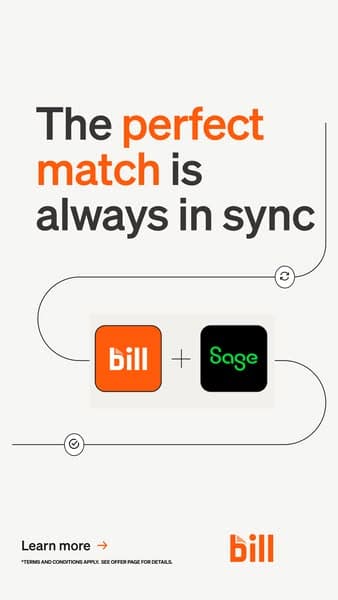
Why it runs: the buyer's first question is whether the tool works with the ledger they already have. Bill has been running the Sage card since March.
8. The customer with a number
Social proof here usually carries a figure, most often a count of firms or companies. Qonto's customer quote is the exception.
- Bill: "90 of the top 100 US accounting firms trust BILL." (76 days) and "See how BILL helps 450,000+ businesses automate payments." (34 days).
- Ramp: "70,000+ companies can't be wrong." with "4,000+ construction companies run expenses through Ramp" underneath (73 days), and "Cursor, Notion, Perplexity, and Vercel all run on Ramp." (79 days).
- Shine: "Plus de 100 000 clients satisfaits" (142 days).
- Qonto: a named customer carousel, "Simple, intuitif, un vrai gain de temps", signed Emmanuel (93 days).

Why it runs: a reader can compare a count of firms with their own firm. "Trusted by" without a number is rare among the long runners here.
9. The series
One template, many variants: one per vertical, per language or per job title.
- Ramp: "Ramp is for everyone", one ad per vertical, each ending "If that rings true, Ramp is for you." Manufacturing, retail and healthcare run 13 to 65 days.
- Spendesk: "Finance belongs in the future, not in a museum", in four languages at once: "Las finanzas son del futuro" (14 days), "Finance gehört in die Zukunft." (15 days), "Leave the exhibits behind." (16 days).
- Bill: six near-identical AirPods ads launched on the same day (35 days each), one per job title.
- Shine: one yellow template across the pro account, company creation and the invoicing tool.
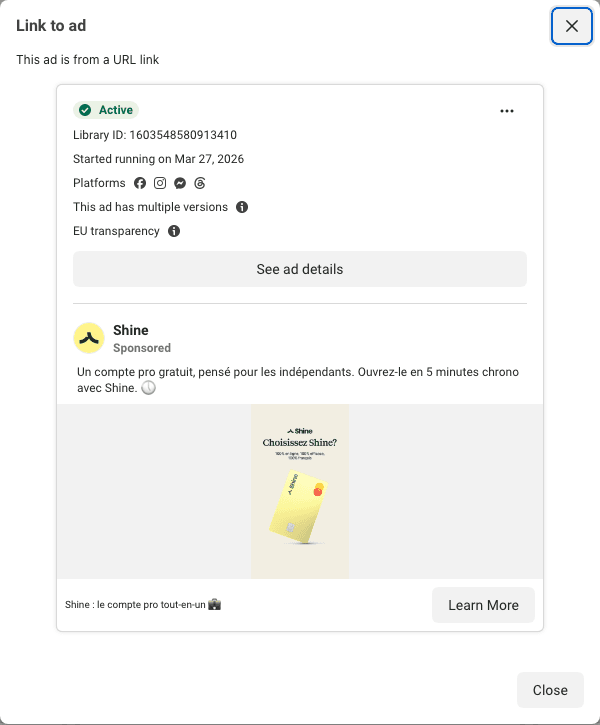
Why it runs: the reader recognises the format on the second ad and reads only the variable on the third.
One angle sits outside the nine because a single company runs it: the guarantee. Webgility, "if we don't save you money, we'll pay you $100 instead", 7 days old and live.
Ad analysis: five angles almost nobody in accounting software uses
Read against all 329 ads, these five appear in two ads or fewer. Where an ad does exist it is listed, so you can open it.
- A named competitor. Zero ads. Not one of the 329 names a rival product, and the closest thing to a comparison in the whole set is a line on Shine's page, not in an ad: "Shine est en moyenne 2 à 4 fois moins cher qu'un compte professionnel dans une banque traditionnelle." Bill names Sage and QuickBooks often, but always as partners.
- The real price on the card. One advertiser. Shine puts "0 €" at headline size (215 days) and "Logiciel de facturation 100 % gratuit" on a second card (145 days). Among Bill, Ramp, Spendesk, TaxGPT, Rydoo and Webgility, not one ad says what the product costs. Qonto's "1 mois d'essai gratuit" is a trial, which is a different promise.
- Interactive proof in the ad. Zero calculator cards. TaxGPT has an ROI calculator on its landing page and never puts one in a creative. The closest is Ramp's "What's your meal cap? Most finance teams have never compared their limits to anyone else's." (43 days), which asks for the reader's own number and then makes them click to get it.
- The tax calendar. Two ads carry a date at all: Ramp's sweepstakes, which ends 10/9/26 (13 days), and Bill's Nintendo Switch offer (35 days). Accounting runs on filing deadlines, and no ad in the sweep sells one. A late-August sweep will understate this.
- The person doing the work. Almost every card in the set is a product screenshot or a stock photograph. Two ads show a practitioner: Ignition's founder ad, "Guy didn't build Ignition from a whiteboard. He built it from years of running an accounting firm and being frustrated by the same broken process you're probably living with" (5 days, and it sends people to Instagram), and Webgility's live clinic, "I teamed up with a member of Webgility's in-house accounting team to dive directly into a real set of books, live, every Thursday" (3 days).
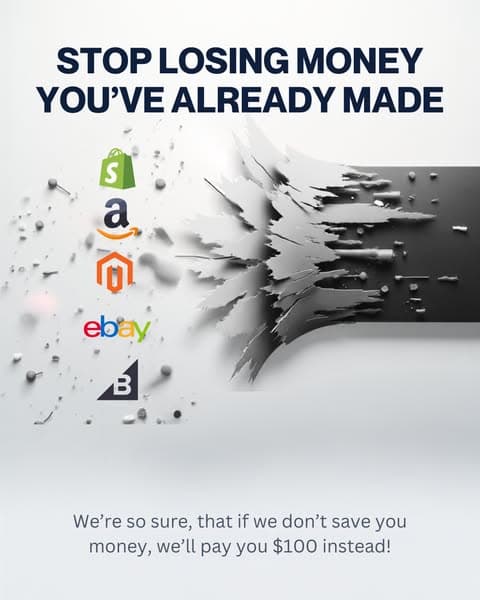
Webgility runs the guarantee and the live clinic at once, and its oldest live ad is 7 days old. Watch whether those ads pass 45 days.
Landing page analysis: what happens after the click
Here is where the ads send people, and the two channels do it differently:
- On Google, 19 of the 60 ads point at the homepage. All 60 of the Google ads in this sweep are Ramp's, and a search ad answers a query the visitor typed, so the homepage can carry it.
- On Meta, 2 of 281 do. One Qonto ad and one Ledgy rebrand announcement. A social ad has to create the intent, and the page then has to deliver what the ad said.
- So the pages worth studying are the social ones. The kind of page sorts these advertisers into four tiers, from the homepage to a page built and versioned for one offer. Every page below is linked, so open them.
| Tier | The ad points at | In the sweep |
|---|---|---|
| 0 | The homepage | 2 of 281 ads |
| 1 | A product or content page that already existed | 155 ads: Shine's capital deposit page, Webgility's free books audit, Spendesk's launch page |
| 2 | A page that exists because the ad does | 3 ads: Ramp's TBPN page |
| 3 | A version number or a market in the path | 121 ads: Bill's proven-beats-promises page, Shine's free-account page, Qonto in Portuguese, Spendesk in German |
Tier 1: the ad points at a page that already existed
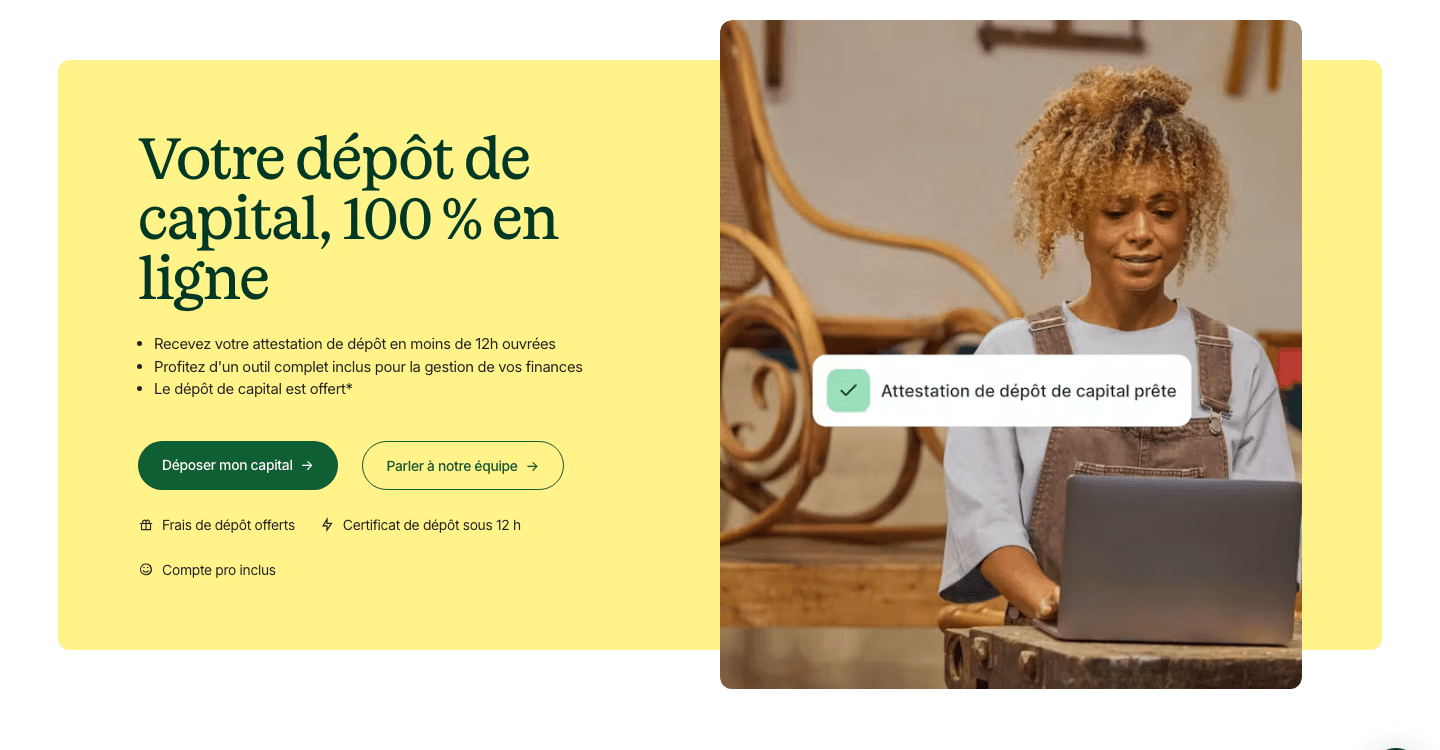
- Nine Shine ads, the oldest 261 days, land on shine.fr/depot-de-capital, a page an organic visitor reaches from the nav.
- Nothing was built for the campaign, and for a single, well-defined job (deposit your share capital, get the certificate) that is often enough.
- Webgility's free books audit is also a standing page, but the whole page is one booking form.
Tier 2: the ad points at a page built for that ad
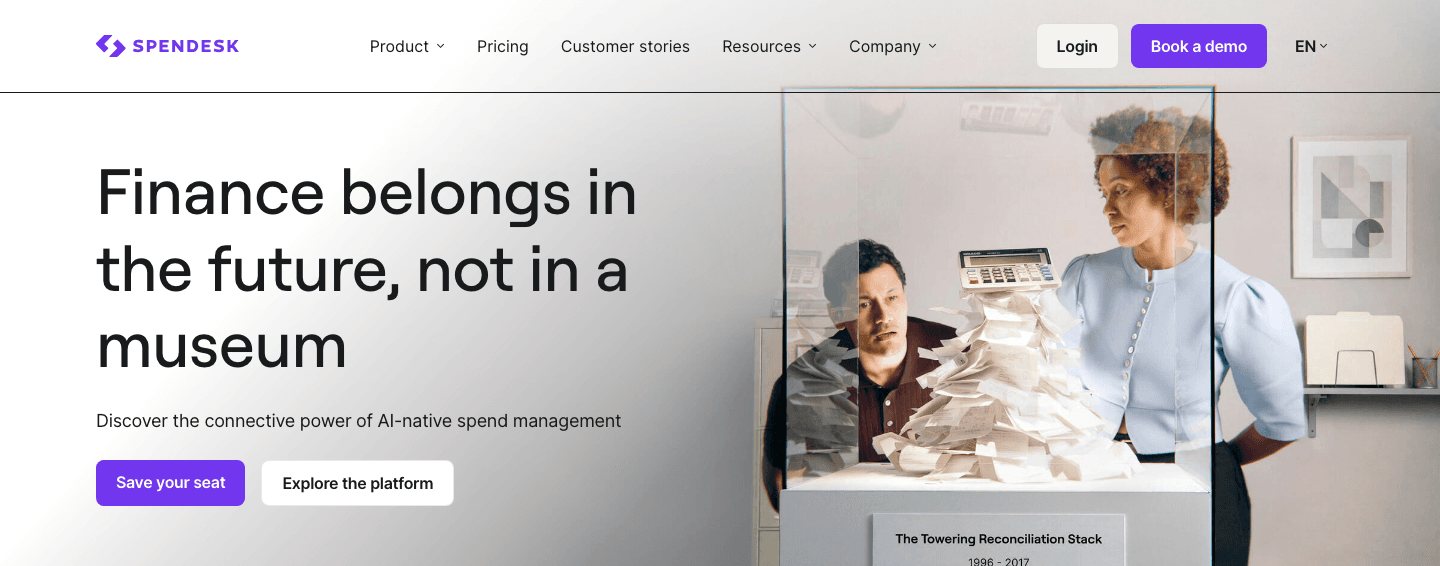
- Three ads in the whole sweep are on a path that exists only for advertising: ramp.com/lp3/tbpn, a partnership page served under its own address so the show's traffic can be counted on its own. The
lp3in the path is a template number, so Ramp has built more than one of these. - Spendesk's future-of-company-spend was built for the campaign, but its URL does not say so: 14 ads point at it, its headline is the ads' headline, and its button says "Save your seat". It is filed at the site root, so from outside it reads as tier 1.
Tier 3: the ad points at a versioned or per-market page
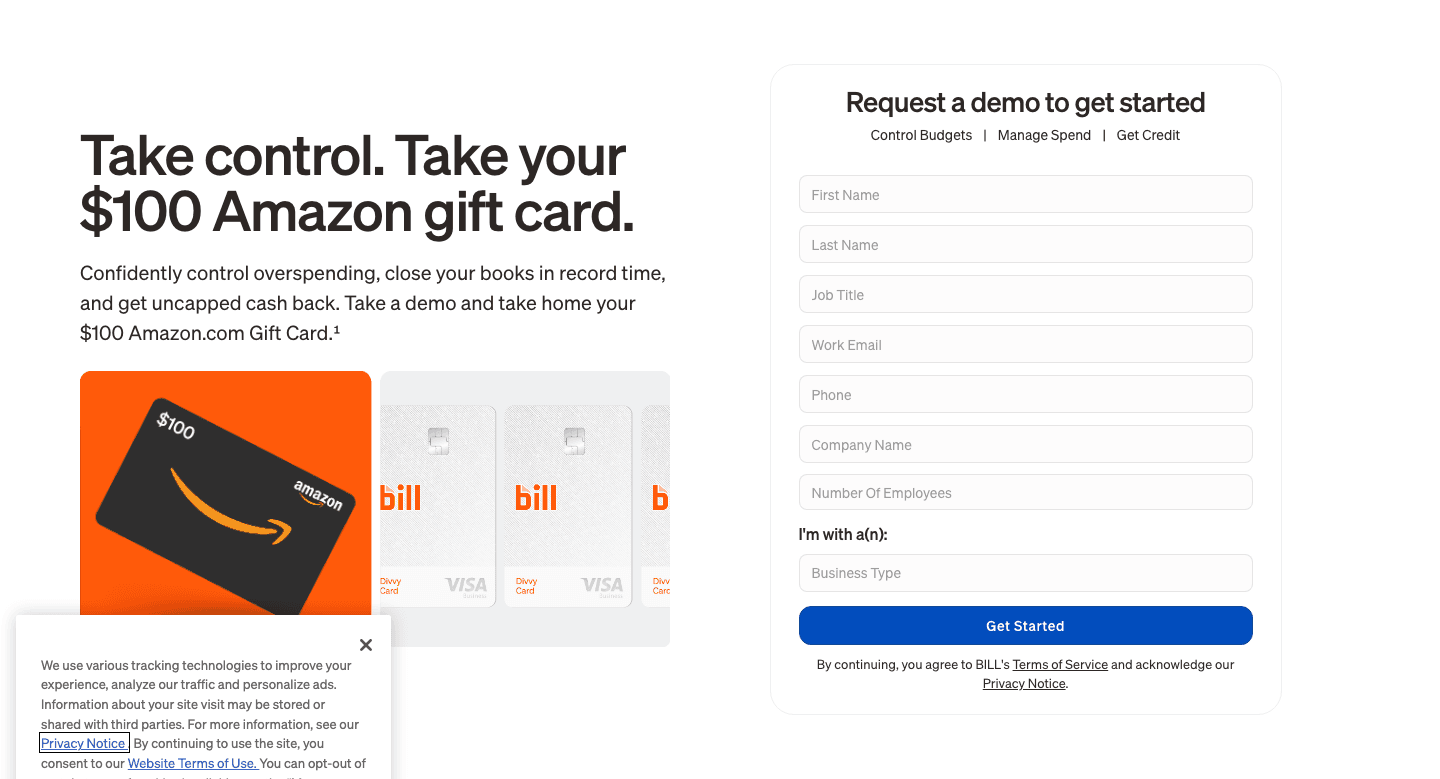
- Of the 121 ads on this tier, 87 carry a real market code in the path (Qonto in
pt,frandfr-be; Spendesk inde,esandfr) and 34 sit under an/lp/prefix, which is a paid-page namespace rather than a market. Bill, Shine and Rydoo all use one. - Bill runs /lp/software-tech-demo, /lp/proven-beats-promises and /lp/amazon-gift-card side by side, one per offer, all live at once. Shine runs /lp/compte-pro-gratuit next to the ordinary /compte-pro.
- Three
/lp/pages live at the same time means three offers running side by side, and you can read that from the address alone.
How many paid pages each company runs
| Company | Brand-site Meta ads | Distinct pages | Of which per-market |
|---|---|---|---|
| Qonto | 58 | 26 | 25 |
| Shine | 60 | 15 | 0 |
| Ramp | 52 | 12 | 0 |
| Spendesk | 51 | 10 | 7 |
| Bill | 32 | 5 | 0 |
| TaxGPT | 16 | 3 | 0 |
| Rydoo | 4 | 2 | 0 |
| Webgility | 6 | 2 | 0 |
- Ad counts barely separate these companies, because the library caps at about 60 per brand per market. Page counts separate them, from 2 for Rydoo and Webgility to 26 for Qonto.
- Qonto and Spendesk, the two selling across several European markets, are the two with a paid page per market. Everyone else has zero, including Shine and Bill, whose
/lp/paths are offers rather than languages. - Bill's 5 pages against 32 brand-site ads is the tightest ratio in the set: roughly 6 ads per page, all pointing at a handful of offers.
Try it on yourself. Open your own Ad Library entry, click an ad, look at where it lands. The homepage puts you on tier 0. A market code or an /lp/ prefix puts you on tier 3. Most teams are on tier 1, with one page for every ad.
Teardown 1: Bill
Two campaigns taken apart the way we take apart a page in a client audit: the ads, then the page they land on, crop by crop, then the gaps. Bill because it runs the most designed creative in the set and puts its whole argument on one page. Shine because one of its ads ran for 261 days on a single page.
The campaign. Eight ads, all live, all pointing at bill.com/lp/proven-beats-promises, launched between June 15 and August 16, 2026, the oldest 78 days when we swept. Five of the eight are dynamic creative, which means Meta assembles the card per viewer; what stays fixed is the offer and the destination. Bill's wider account has 29 designed creatives and 5 distinct destination pages, which is few pages for 32 brand-site ads.
The ads
The oldest live Bill creative, running since March 26, 2026, is the pattern the account repeats. A photograph of two people mid-conversation, two small product chips floating over it ("Send recurring invoice", "Bill pay automated") so the reader sees the software without a screenshot, a two-line headline whose second line is the thing being sold ("AP automation that scales / with your finance team"), and a plain dark button. The primary text is two sentences, one about fewer approval headaches and one offering a reward: "See how BILL can eliminate approval headaches and fit into your stack without breaking your workflows. Plus, get a reward for getting time back during your next close."
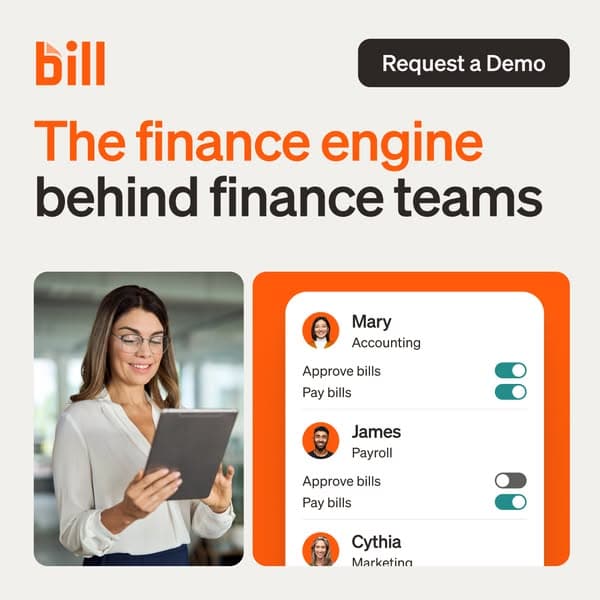
The second creative in that ad set, same day, same destination, swaps the photograph for the product. An approvals list with three named people and two toggles each, "Approve bills" and "Pay bills", one of them deliberately off. The grey toggle shows the permissions feature without any copy. The link headline underneath names the audience: "Modern finance built for businesses that build software."
The third shape is the offer creative, 125 days old and aimed at firms rather than finance teams: "BILL: The Accounting Firm Solution", with "Take a demo, get a $250 DoorDash gift card" in the body while the card itself reads Amazon.
The landing page

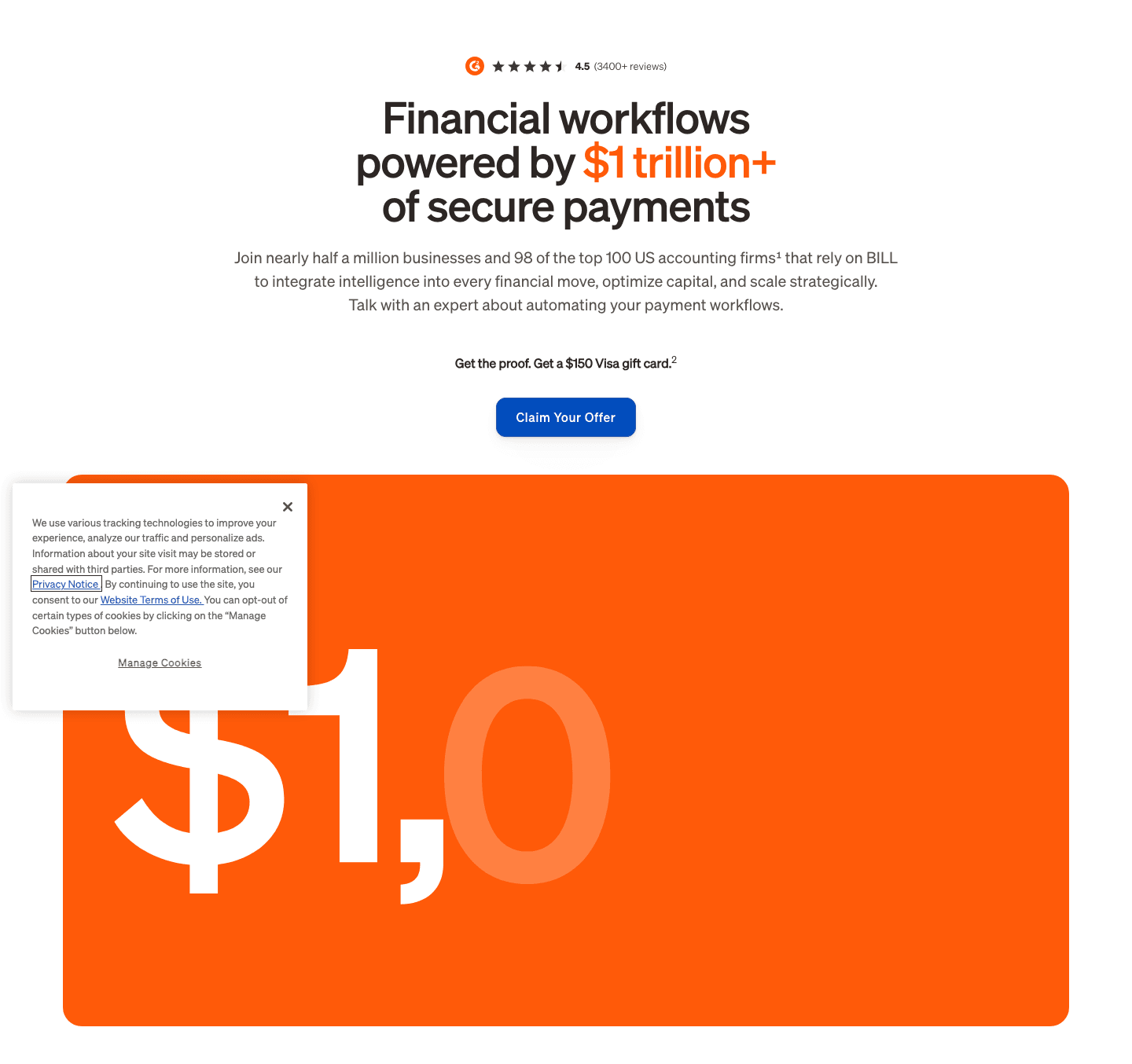
The hero. Four moves in one screen: a G2 badge reading 4.5 across 3,400+ reviews, a headline that is a number and nothing else ("Financial workflows powered by $1 trillion+ of secure payments"), a subhead naming the buyer ("nearly half a million businesses and 98 of the top 100 US accounting firms"), and then, in small bold type directly above the button, the offer: "Get the proof. Get a $150 Visa gift card." The button says "Claim Your Offer", not "Request a demo".
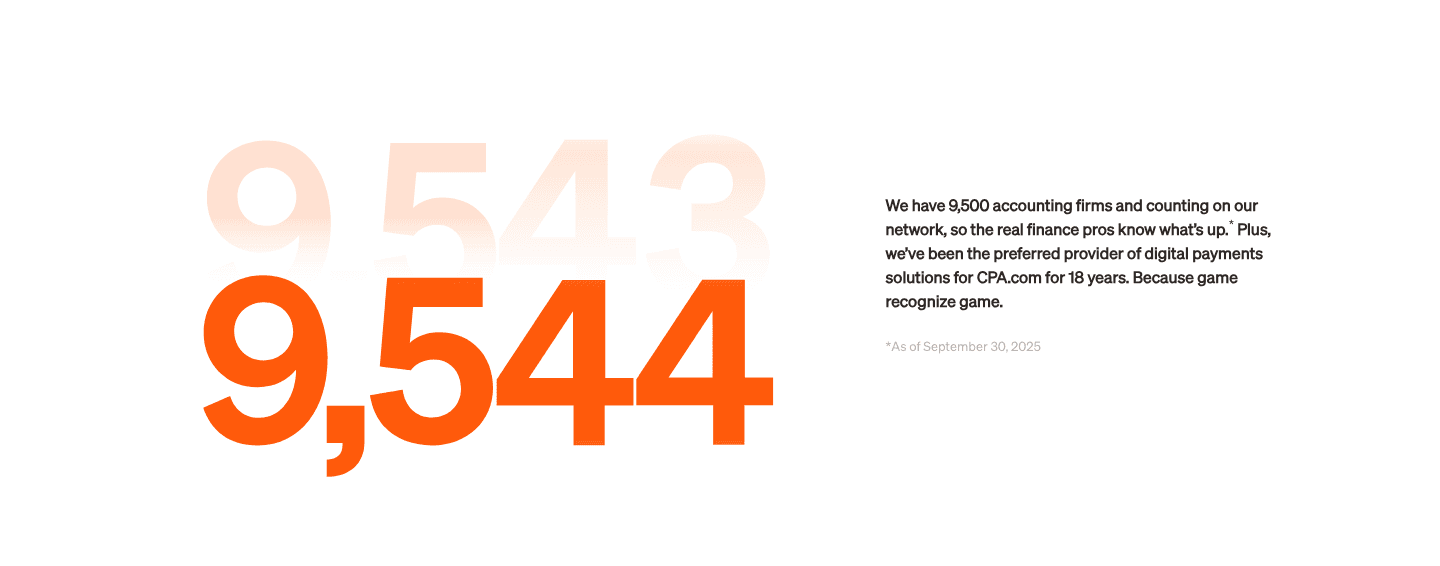
The counter. A single number, 9,544, drawn at the height of the browser window, with 9,543 ghosted behind it so the count reads as still moving. Beside it: "We have 9,500 accounting firms and counting on our network, so the real finance pros know what's up." A footnote dates the figure to September 30, 2025.
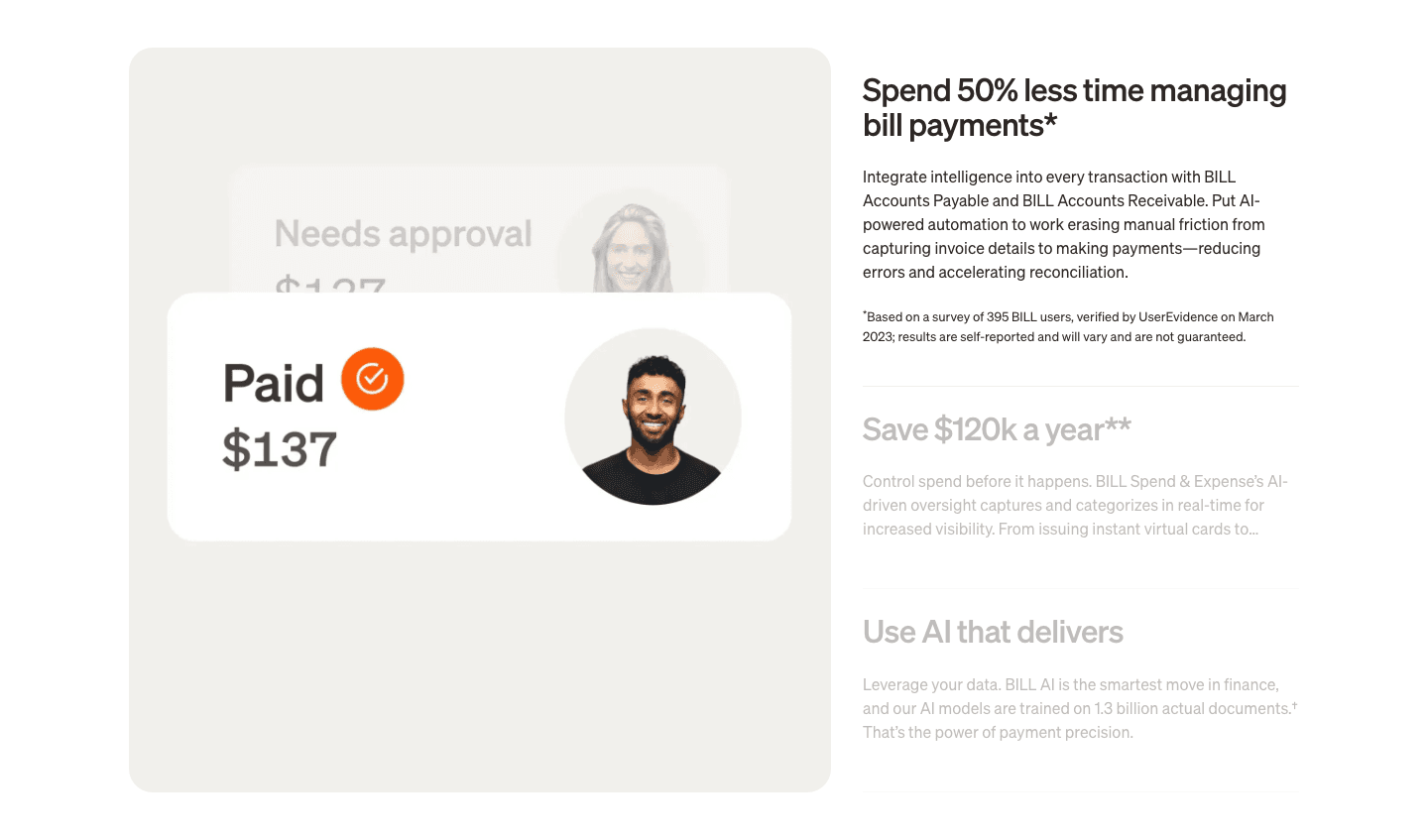
The feature grid. Three claims stacked as a scroll-linked list, only one lit at a time: "Spend 50% less time managing bill payments", "Save $120k a year", "Use AI that delivers". Each carries a footnote naming the survey, the sample size and the date ("a survey of 395 BILL users, verified by UserEvidence on March 2023; results are self-reported"). The visual beside it is one approval card flipping from "Needs approval $137" to "Paid $137".
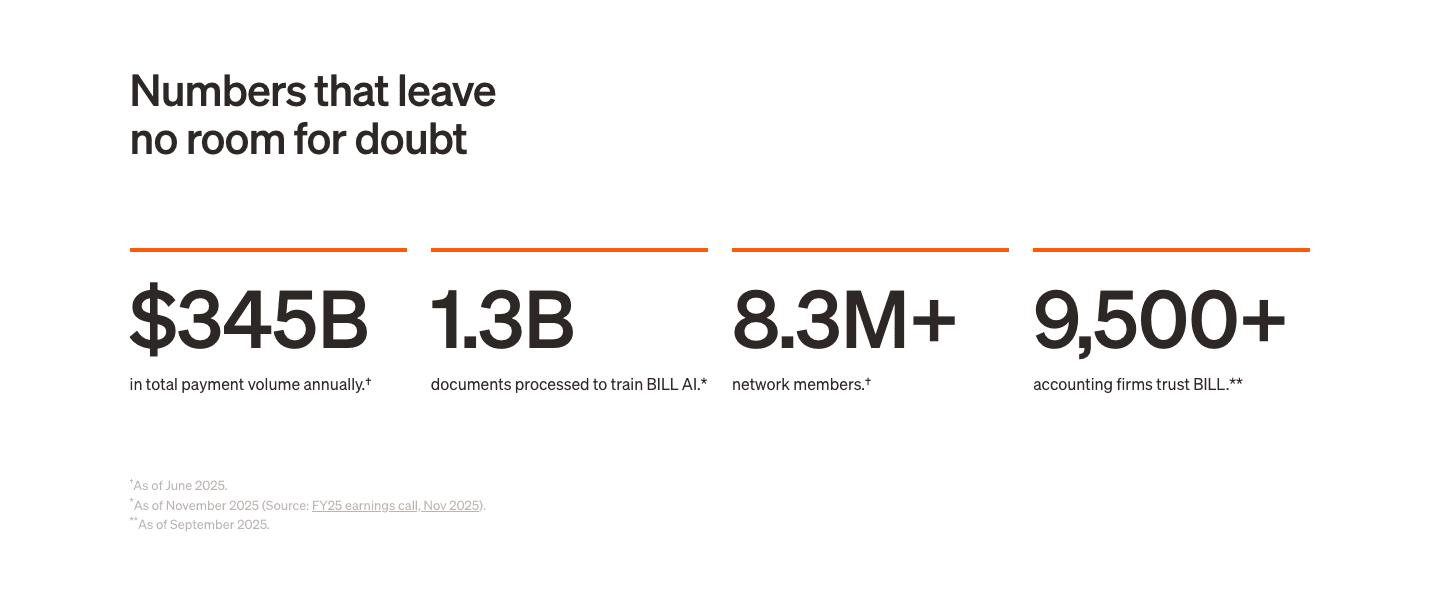
The proof wall. Under "Numbers that leave no room for doubt": $345B in annual payment volume, 1.3B documents used to train Bill's AI, 8.3M+ network members, 9,500+ accounting firms. Every one is dated in the footnotes, one of them to an earnings call.
The integration band. Six logos, one sentence, promising that 2-way accounting integrations, custom file exports and an API keep "AP, AR, corporate cards, and expenses in line with your books." It repeats the ad's "fit into your stack" promise for a buyer whose first question is whether the tool works with their ledger.
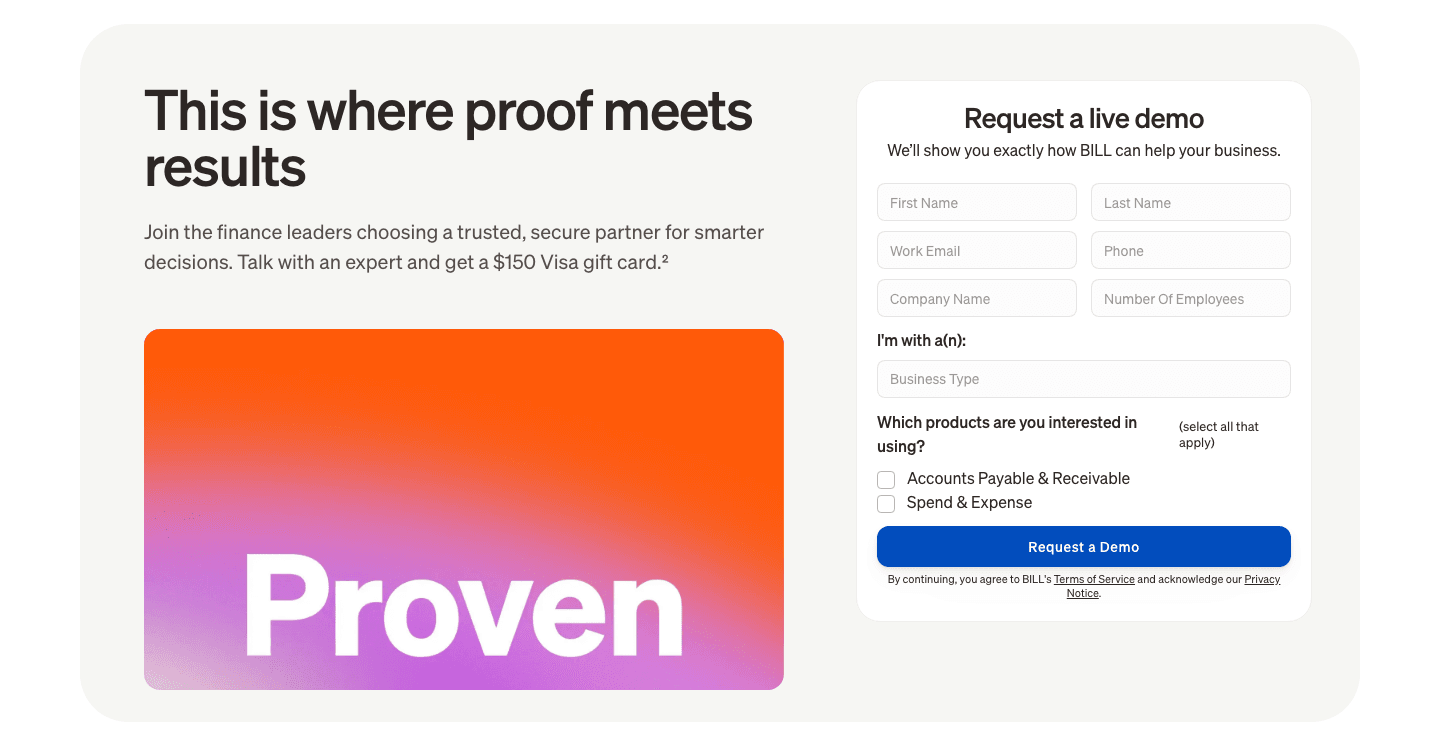
The form. "This is where proof meets results", the gift card named a third time, and eight fields with two product checkboxes (Accounts Payable & Receivable, Spend & Expense) so the routing happens before a salesperson reads it.
Message match
| The ad says | The page proves it with |
|---|---|
| Get a reward for getting time back during your next close | "Get the proof. Get a $150 Visa gift card." directly above the hero button |
| 90 of the top 100 US accounting firms trust BILL | "98 of the top 100 US accounting firms" in the subhead, plus the 9,544 counter |
| Fit into your stack without breaking your workflows | The six-logo integration band and the 2-way sync sentence |
| AP automation that scales with your finance team | The Paid/Needs approval card and the 50% less time claim, footnoted |
The gaps
Two gaps, both fixable in a day. The gift changes from ad to ad: the ads offer $250 Amazon, $150 Visa, a Yeti cooler, AirPods Pro 3, a Blackstone griddle and a Nintendo Switch, and one single ad offers DoorDash in the body and Amazon on the card. A reader who clicked for one and lands on another has to reconcile them before they fill in eight fields. And the hero's headline is a number about Bill ($1 trillion of payments) where the subhead's number is about the reader's peers (98 of the top 100 firms); the second matters more to this buyer, and it is set in smaller type.
Find revenue opportunities for your website, backed by real data. Get your 3 free opportunities by email.
Teardown 2: Shine
The campaign. Nine ads pointing at shine.fr/depot-de-capital, the oldest launched July 2, 2025 and retired March 20, 2026 after 261 days, and three more launched March 19 and 20, 2026 that were still live at 165 and 166 days when we swept. So one page has carried paid traffic without a break for more than 14 months. Shine's account has 24 designed creatives across 15 distinct pages, the second widest page count in the set after Qonto.
The ads
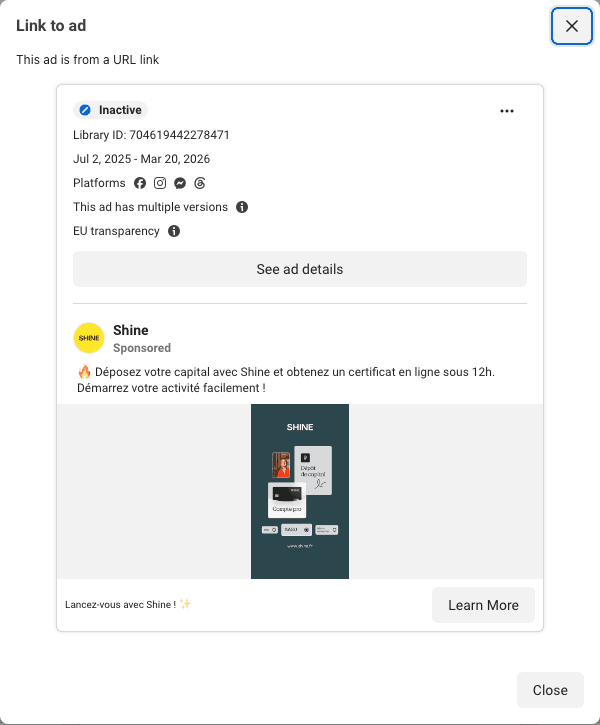
The 261-day creative is three objects on a dark green panel: a payment card, a document labelled "Dépôt de capital", and a phone showing the pro account. The primary text is one promise with a unit in it, "Déposez votre capital avec Shine et obtenez un certificat en ligne sous 12h". The copy is about the piece of paper the buyer needs, and says nothing about the product.
The live replacement, running since March 19, 2026, keeps the promise and drops everything else. The card now says one thing, "Attestation de dépôt de capital en 12h", and the body underneath is a three-item checklist: "100% en ligne, rapide et transparent", "Suivi complet par des experts", "Outils pros pour vous accompagner". The link headline changed to "Économisez en créant votre entreprise avec Shine", which moves the ad from speed to money without touching the creative.
The landing page

The hero. The ad's sentence, repeated in the first line of the page: "Votre dépôt de capital, 100 % en ligne", with three bullets under it, the first of which is the ad's number ("Recevez votre attestation de dépôt en moins de 12h ouvrées"). Two buttons, one to start and one to talk to a human. Under them, three reassurance chips: deposit fees waived, certificate in under 12 hours, pro account included. The photograph carries a product notification reading "Attestation de dépôt de capital prête", so the outcome the ad promised is on screen before the reader scrolls.
The proof band. One sentence, one rating and one link: "150 000 entreprises et indépendant·es nous font confiance", 4.8 on Trustpilot, and a link to read the reviews. It is the second thing on the page because the buyer is about to wire their share capital to a company they found in a Facebook ad.
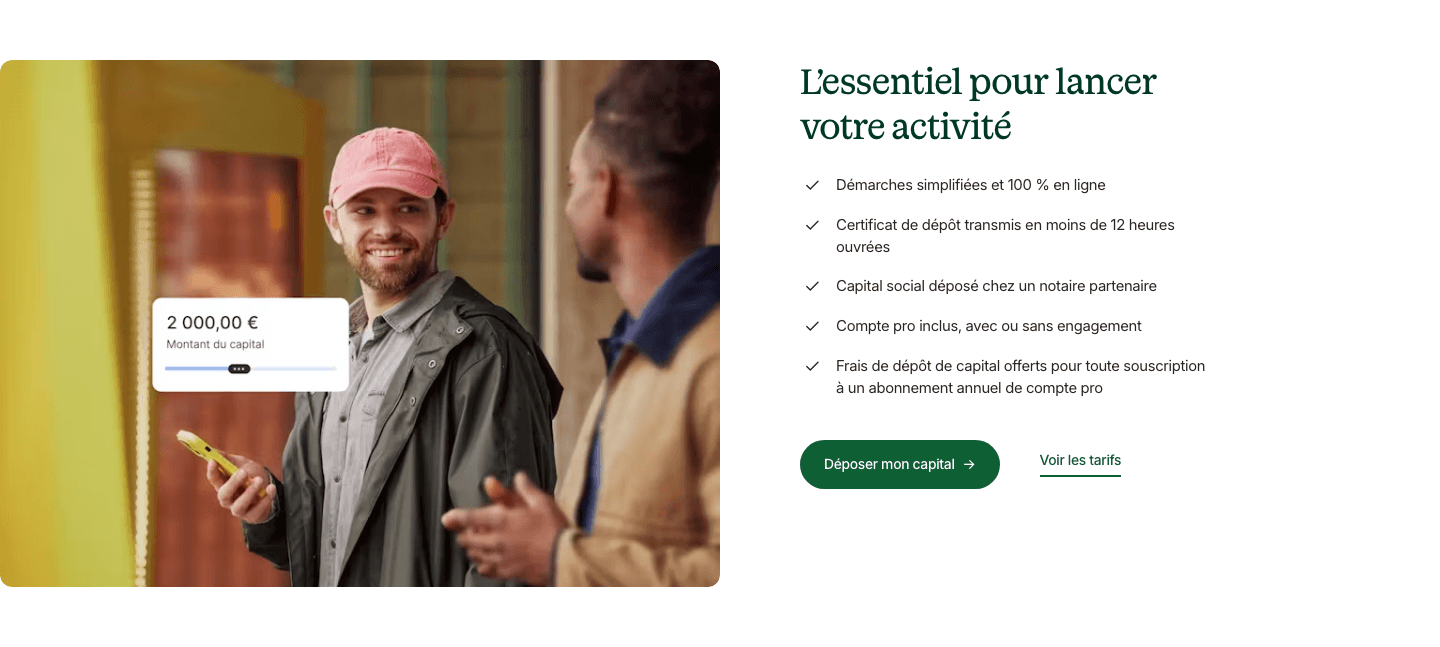
The feature list. Five ticks, in the order a founder asks: is it all online, when do I get the certificate (under 12 working hours, again), where does my money sit (with a partner notary), do I get an account with it, what does it cost (deposit fees waived on an annual pro subscription). The image beside it shows a capital amount of 2,000 euros, which is what a real first deposit looks like.
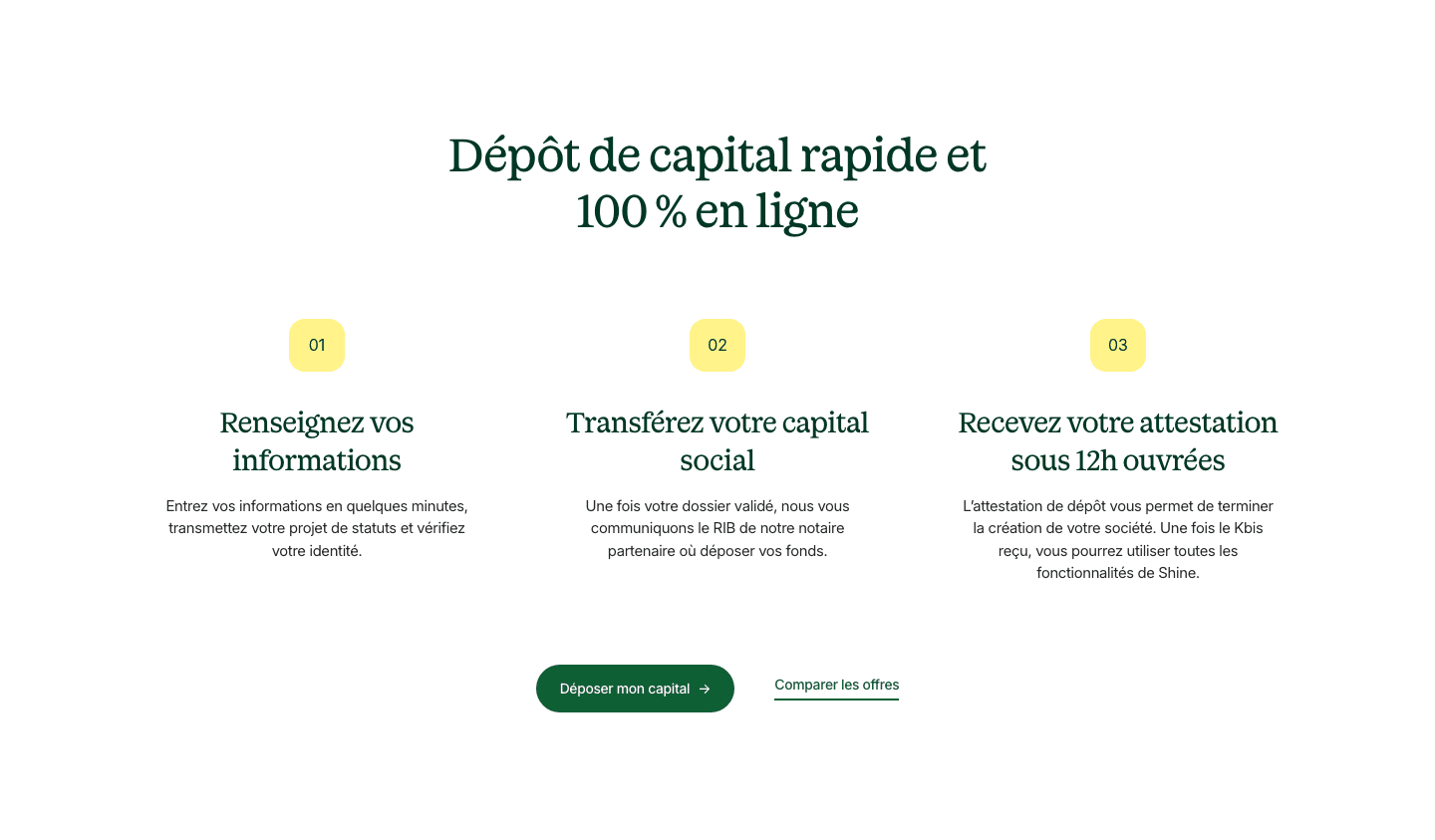
The three steps. Numbered 01, 02, 03, and the third one is the ad's promise for the fourth time on the page: "Recevez votre attestation sous 12h ouvrées". The steps show how the ad's 12-hour claim is kept.
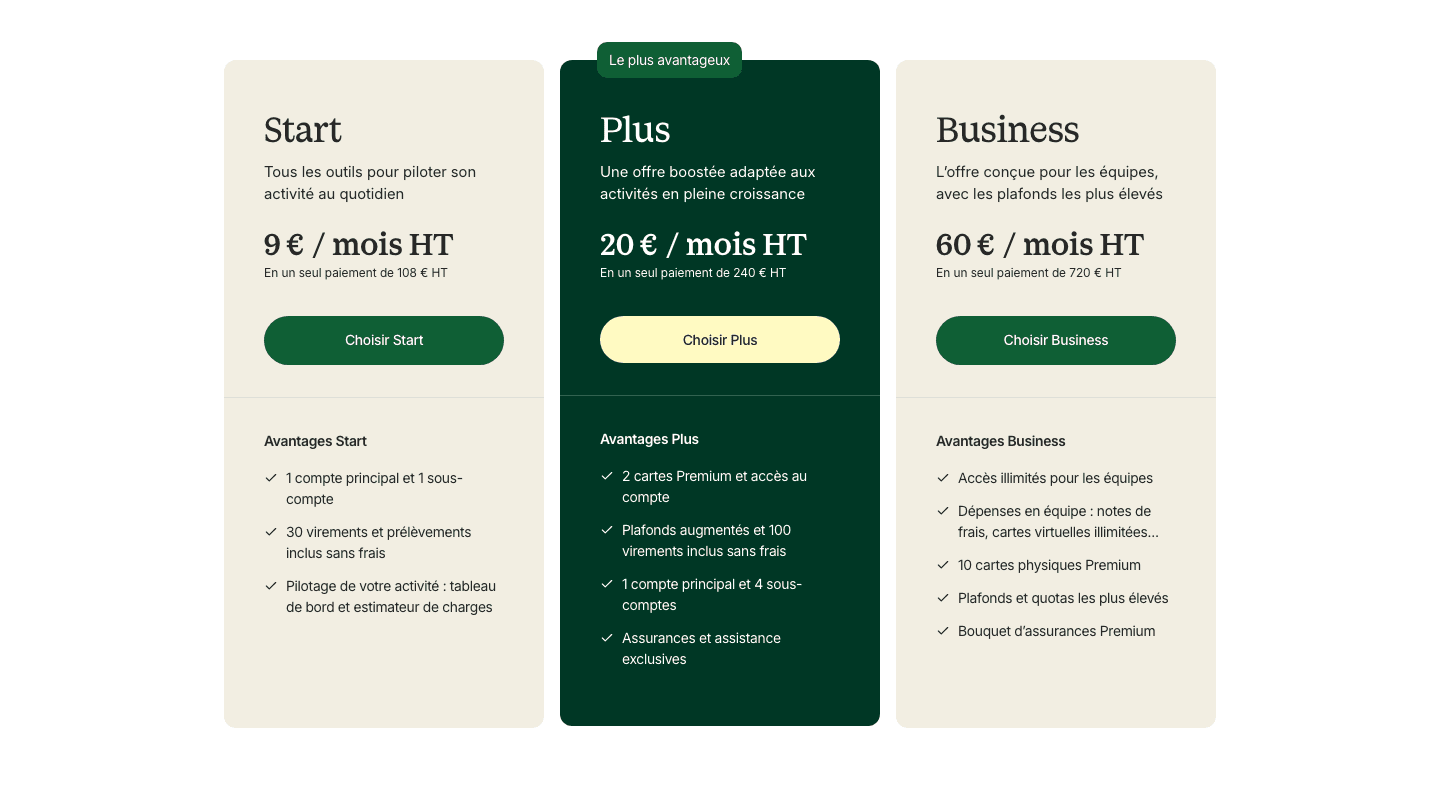
The price. Three plans on the page itself, 9, 20 and 60 euros a month, each with its annual total spelled out, and above them a "Pack dépôt de capital" band showing 69 euros struck through and 0 euros. Shine is the only advertiser in this sweep that prints a price in an ad, and there is no demo form between the reader and that price.
Message match
| The ad says | The page proves it with |
|---|---|
| Un certificat en ligne sous 12h | The same number in the hero, the feature list and step 03 |
| Le dépôt de capital est offert | The pack band showing 69 euros struck through to 0 euros |
| Suivi complet par des experts | The second button, "Parler à notre équipe", beside the primary one |
| Outils pros pour vous accompagner | The features carousel: pro account, invoicing, electronic invoicing |
The gaps
Two gaps, and the first is a contradiction a reader will find on their own. The hero and the three-step band both promise the certificate "en moins de 12h ouvrées"; the pricing band, three screens down, describes the same pack as "certificat de dépôt en 3 jours ouvrés". Both are on the page the ad paid to reach, and the slower number sits next to the price. And the pricing band arrives before the three steps, so the page asks for a monthly commitment before it has explained what happens after you click. Moving the steps above the plans costs nothing.
The competitive audit does the same reading on your own page, against the competitors you lose deals to.
Key takeaways: five things to do with this
- Sell the job the buyer needs done. The long runners here sell a capital deposit certificate, a month-end close, a guide, a gift. Shine's 261-day ad never describes software.
- Build a page per offer and give it a prefix. Bill runs 3
/lp/pages at once against 5 pages total; Webgility runs 2. If every ad points at one page, the creative is the only thing a test can change. - Put the ad's number on the page four times. Shine's 12 hours appears twice in the hero, once in the feature list and once in the steps.
- Date your proof. Bill footnotes every number on its page with a survey, a sample and a month, for buyers who check figures for a living.
- Take one of the five open angles. Not one of the 329 ads names a competitor, 1 advertiser puts a price on the card, and no ad sells tax season.
How to run this analysis on your own competitors
The Meta Ad Library and the Google Ads Transparency Center are public and free. Search the brand's page, not a keyword, set the country, filter to active ads, sort by start date. Then:
- Group the ads by angle. Use the nine above. In this market each advertiser runs two to eight.
- Keep the ones that have run 45 days or more. The advertiser keeps paying for them. Click through and read the page each one lands on.
- Write down the angles they are not running. Start your next campaign from that list.
Or send us the URL and we do it for you.
How we did the analysis
- Sample: the accounting companies on the benchmark leaderboard, picked by traffic, not by advertiser status. Fifteen were selected. Pennylane, BIGTIME, Deskera and Agent Mode by Receiptor AI were never swept and are not in any count here. Fazeshift was swept and nothing survived the brand filter. That leaves 10 advertisers: Bill, Ignition, Ledgy, Qonto, Ramp, Rydoo, Shine, Spendesk, TaxGPT and Webgility. Qonto, Ramp and TaxGPT also appear in the fintech playbook; they sell into both markets and their accounting-facing ads are what is read here.
- Sources: the Meta Ad Library, searched by brand page, and the Google Ads Transparency Center, both through Apify, across the FR and US markets between August 25 and September 1, 2026.
- Filter: brand-verified ads only. An ad counts when the advertising page name and the landing host both belong to the brand. That filter did most of the work in this industry: "Ramp" is also a maker of ATV loading ramps, boat-trailer tools and truck tuners, and 160 ads were dropped on the landing host alone.
- Ranking: days active. The floor of interest is 45 days, the point at which an ad has survived at least one budget review.
- Reading: every distinct message on Meta was read by hand and put in one angle. Dynamic ads return a template instead of a headline, so those were read from the creative image and the landing path. 94 of the 329 ads carry a designed creative we could open; those are the ones quoted from the card.
- Limits: the library returns about 60 ads per brand per market, so a company's count is a floor and the shares inside the sample are what to read. Spendesk's captures are its European ad sets, which had all rotated off by the sweep date. Meta publishes reach only in the EU and never publishes spend. A late-August sweep will understate anything seasonal, tax deadlines included.
Every ad above links to its primary source in the sources list, so you can check the whole analysis yourself.
Sources
Primary sources, all public and checkable today. Open any Meta ad with its Library ID at facebook.com/ads/library/?id=ID.
- Bill's oldest live creative, Library ID 1449670210233040, running since March 26, 2026: facebook.com/ads/library/?id=1449670210233040
- Shine's 261-day capital-deposit creative, Library ID 704619442278471: facebook.com/ads/library/?id=704619442278471. Its live replacement, Library ID 1254556206137064: facebook.com/ads/library/?id=1254556206137064
- The Bill creatives shown above: 26096483586714361, 1846775329342400, 1290003122571083. Other Bill ads quoted: 1267197878704929, 1062492366102009, 4385517468432327, 1758682791823247, 2627558567658888, 1740279986997766, 1512815453210106, 1361733289270787, 2136015517322272, 1505077694706363, 1253930860142497.
- The Shine creatives shown above: 1224103769088605, 1603548580913410. Other Shine ads quoted: 29905255232454408, 948933807818484, 928179256600648, 1624847779427595, 807073488797616, 4360480464167326, 2148551515917278, 2506257196443673.
- The Ramp ads: 1289792406399534 (the accountants guide), 902799269543448 (the CalCPA benchmarking guide), 837174806056550, 844288765359643, 1505682641254381, 1013278344888502, 1539824671071375, 1315042994075411, 1018376167309540, 1038069355243029, 1928956207817977, 1013482384842703, 28207932782158967, 1037029862406589, 3369287133232058, 908381818492002.
- The Spendesk ads: 4328826024034136, 1092398439637707, 1634956801114369, 2063875887891689, 1266344672205107, 1337403814477851, 1573255927521433, 1167118305227949, 680959989467461.
- The other advertisers: Qonto 1940755553983705, 2063221794419024, 558494110662455, 2189105201515001, 1432326075353610, 1474617034707797, 943512325044759; TaxGPT 27490958273896220, 1015300787883396, 1067256189568663; Webgility 1648144273567918, 1880113932964128, 1043066871689488, 1395023849379178; Rydoo 1183807100075899, 1744984119708671; Ignition 1055505157215744; Ledgy 795232525314377.
- The landing pages, live: bill.com/lp/proven-beats-promises, bill.com/lp/amazon-gift-card, shine.fr/depot-de-capital, shine.fr/lp/compte-pro-gratuit, spendesk.com/future-of-company-spend, webgility.com/ecommerce-books-audit, ramp.com/lp3/tbpn
- The sample: the accounting leaderboard of the Web Anatomy benchmark, selected by traffic.
- The Google Ads Transparency Center for the search ads: adstransparency.google.com
- Ad sweeps made August 25 to September 1, 2026 (Meta by brand page, Google by advertiser), across the FR and US markets. Landing pages captured in the same window.
Data collected August and September 2026. Ad statuses and run lengths change; the library links above always show the current state.

Written by
Gabriel Amzallag , Founder, Web Anatomy
5 years CRO + SEO at Qonto (2021–2025). After advising 15+ SaaS on their websites (Payfit, Pigment…), the same patterns kept breaking, so I decided to build the source of truth on what works on the web: the intelligence layer every tool, builder, and team uses to ship sites that perform.
More from the blog
Playbooks
We analyzed the ads the top HR tech companies run. Here is what works.
Which HR tech ads kept running in 2026, the eight angles they use, and the pages behind them. The takeaways, with the ads to look at.
 Gabriel Amzallag26 min read
Playbooks
We analyzed the ads the top marketing software companies run. Here is what works.
Which marketing software ads keep running in 2026, the angles they use, and the pages behind them. Seven angles that work, five almost nobody runs.
Gabriel Amzallag23 min readGuides
Programmatic SEO: a practical guide from 10 city pages to 300
How Staycation went from 10 hand-made city pages to 300 with programmatic SEO, and grew purchases from search by 90%: how to find your topics, four rules, the template, and how to produce and measure the pages.
Gabriel Amzallag12 min read