
TL;DR
- The ads that keep running sell one of eight angles: the document, the free plan, the spam folder, the hours back, the busywork, the customer story, the series, the code. Most brands run three.
- The document wins this market. HubSpot's oldest ad on file ran 858 days, sells a free Instagram ebook, and never mentions the product. Most of its 51 long runners give something away.
- Six angles are almost empty: a named competitor, the switch itself, the price on the card, interactive proof, a joke, a date. Brevo started the first two this summer and nobody else has.
- Social ads never land on the homepage here. One ad of 257. The page is built for the offer, and the best of them put the field in the hero.
15 companies selected, 7 swept, 5 with ads on file, every brand ad in the public Meta library, September 2026. How we did it is at the end.
The sample: 15 lead generation companies, their ads, and where the ads land
| Company | Meta ads on file | Ran 45 days or more | Still live | Oldest live ad | Where the ads land |
|---|---|---|---|---|---|
| HubSpot | 60 | 51 | 2 | 53 days | the Instagram kit, the first-party data toolkit, a free Academy lesson |
| Brevo | 60 | 38 | 37 | 175 days | the US landing page, the German one, creator pages |
| Lemlist | 60 | 32 | 9 | 68 days | lemwarm, find phone numbers, the wall of love |
| Mailchimp | 60 | 28 | 0 | none | the pricing page, automation tools |
| ActiveCampaign | 60 | 24 | 2 | 43 days | deliverability, the 13-hours report, the money-back page |
Brevo has found its ads: 37 of the 60 on file were still running the day we swept, the oldest of them for 175 days. HubSpot is the opposite shape and just as deliberate: 51 of its 60 ads passed 45 days, the oldest ran 858 days, and only 2 were live, because its ebook ads run for years and then stop together. Mailchimp had nothing live at all, and 28 ads past 45 days, most of them from one pricing campaign that ran from September to December 2025.
Ten of the fifteen companies we selected have nothing on file. ZoomInfo, Gong, Unbounce, Outreach, Perspective, Surfe, Popupsmart and Invoca were not swept; Salesloft and Close were swept and had no ad we could verify as theirs. That is the first finding of the post: in this market the sellers of lead generation tools mostly do not buy social ads, and the five that do are email platforms.
Ad analysis: the eight angles lead generation ads use
Every message on Meta fits one of eight angles. For each one: the ads that ran longest, one creative to look at where we have it, and why it keeps running. The number in brackets is how many days the ad had been running when we looked.
1. The document
A guide, a template, a report or a swipe file in exchange for an email. Nothing for sale on the card. This is the widest angle in the set and the one with the oldest ads by a distance.
- HubSpot: "Free eBook Download" over "Our Instagram cheat sheet." (858 days, and a second copy at 786 days).
- HubSpot: "Social Media Content Calendar", "Plan and bulk upload your social media posts with this free template." (786 days), and "Free Branding Guide" (786 days).
- HubSpot: "Make your ads count", "50 Facebook ads that really work and what you can learn from them." (362 days), and the State of Data-Driven Advertising ebook (330 days).
- ActiveCampaign: "How To Get 13 Hours Back Each Week", a survey of 1,000 marketers (110 days).
- Lemlist: the ElevenLabs outbound playbook, "How did ElevenLabs grow outbound from 5% to 35% of pipeline in under 6 months?" (15 days in English, 32 days in French).

Why it runs: the offer never expires, so the ad never goes stale. The HubSpot card above ran from September 2023 to January 2026 without a change.
2. The free plan
The price is zero, and the card says so three ways: free forever, free for 14 days, free credits to try.
- Brevo: "No card. No limits. No catch.", "300 emails a day. Unlimited contacts. AI generator. CRM included. All free." (126 days, live).
- Brevo: "Email. CRM. Automation. All free.", "No limited trial. No credit card required." (74 days, live), and "Start for free now" with "Rated 4.5/5 on G2 and Capterra" (102 days).
- ActiveCampaign: "Create your first automation today with our 14-day free trial!" (66 days).
- Lemlist: "Get 100 free leads to test lemlist!" (97 days) and "Get 25 B2B phone numbers for free" (102 days).
- Mailchimp: never on the card, always on the page. All 38 ads of its pricing campaign land on a plan card that reads free for 14 days, no card required.
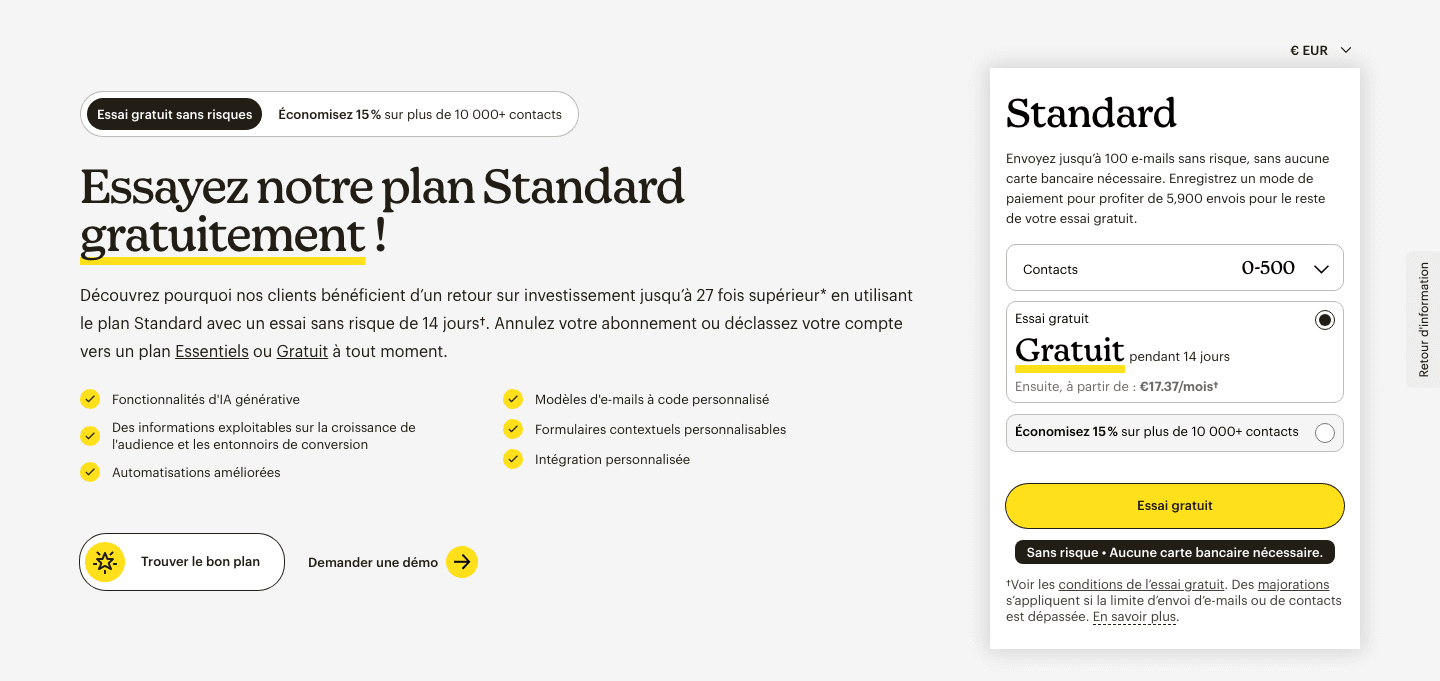
Why it runs: it removes the only thing the reader has to decide. Brevo goes further and counts the free tier out loud, 300 emails a day, so the reader can check the promise against their own volume.
3. The spam folder
Email platforms selling to people who send email have one shared fear, and two of them name it in the headline.
- ActiveCampaign: "Better open rates (even during the 14-day trial)" over "Nearly 1 in 5 emails never reach the inbox" (205 days, the oldest ActiveCampaign ad on file).
- ActiveCampaign: "Emails going to spam? Try ActiveCampaign FREE", with "ActiveCampaign averages 8% better deliverability than any other platform on the market" (191 days).
- Lemlist: "Avoid the spam folder.", "If your open rate is below 50%, it's probably already happening" (102 days, and a French twin at 77 days).
Why it runs: it is a fear the reader can check in five seconds, in their own sent folder. Both companies attach a number to it rather than an adjective, and both point at a product page that is about deliverability only.
4. The hours back
Time, always as a figure, never as the word fast.
- ActiveCampaign: "How To Get 13 Hours Back Each Week" (110 days), the same claim as a video, "How To Save 13 Hours Each Week" (85 days), then as a money figure, "AI saves them 13 hours per week (and $4,739 monthly)" (29 days), then smaller, "What Would You Do With 5 Extra Hours Each Week?" (20 days).
- Lemlist: "you're wasting hours searching for valid phone numbers, only to call the wrong ones" (102 days).
Why it runs: one number, carried across four creatives and two formats for four months. The report behind it exists so the number has a source.
5. The busywork
The same pain one level up: the job is repetitive, the software should do it.
- ActiveCampaign: "Autonomous marketers break through busywork", which opens "The blank cursor blinks. Your deadline approaches." (81 days).
- ActiveCampaign: "Automate your WhatsApp customer service", "Tired of answering the same WhatsApp questions over and over?" (101 days), and "Built to deliver better outcomes, faster." (72 days).
- Mailchimp: five ads on the automation page (62 days), which opens "You work hard. Now work smarter."
- Lemlist: "Clone your voice now", "Cold LinkedIn messages ignored? Send a voice note that sounds like you. Record once, send automatically at scale." (60 days).
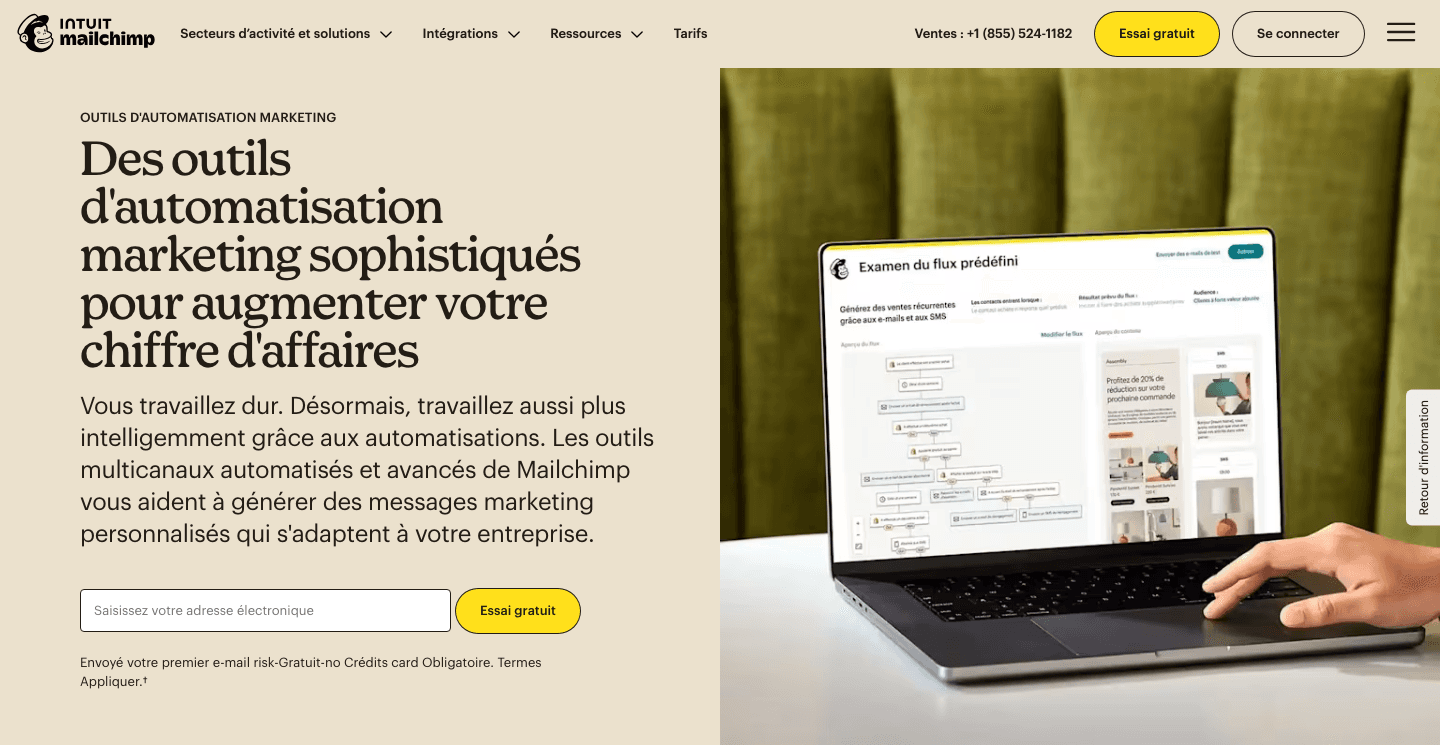
Why it runs: it names the exact task the buyer is doing by hand this week, then shows the product doing it. The page above is the whole angle in one screen.
6. The customer story
Social proof, and in this market it is a named company with a multiple attached.
- Lemlist: the Spendesk story, "How do you double the outbound meetings your AEs book?" (100 days), and the Pennylane story, a growth lead and a BDR on their move from manual prospecting (89 days).
- Mailchimp: the Gruppo Terroni case study, in Spanish (122 days) and in English (62 days).
- Lemlist: "Explore our Wall of Love" (56 days, live), whose body is a reply to an unhappy customer: "We're sorry, Maxime."
- ActiveCampaign: "Woops! leveraged ActiveCampaign's 950+ app integrations to grow their business, and so can you!" (66 days).
Why it runs: the multiple is the message. Lemlist's card promises to double a number the reader tracks weekly, and the story page is where the proof lives.
7. The series
One template, many variants, so a small idea can carry a big account.
- HubSpot: one ebook, three headlines, three ads live at once: "Drive High Quality Leads" (198 days), "Find High-Intent Leads" (198 days), "How To: Facebook Ads" (197 days). Same guide, same page, three different reasons to click.
- HubSpot: the Instagram kit as a dark book cover (858 days), a cream square (497 days), then a phone mockup (362 days), each on its own page address.
- Mailchimp: 38 ads, one pricing page.
- Brevo: the same free-plan card in English, French and German, each on its own market path, for example "9,000 emails a month for 0 euros" in German.
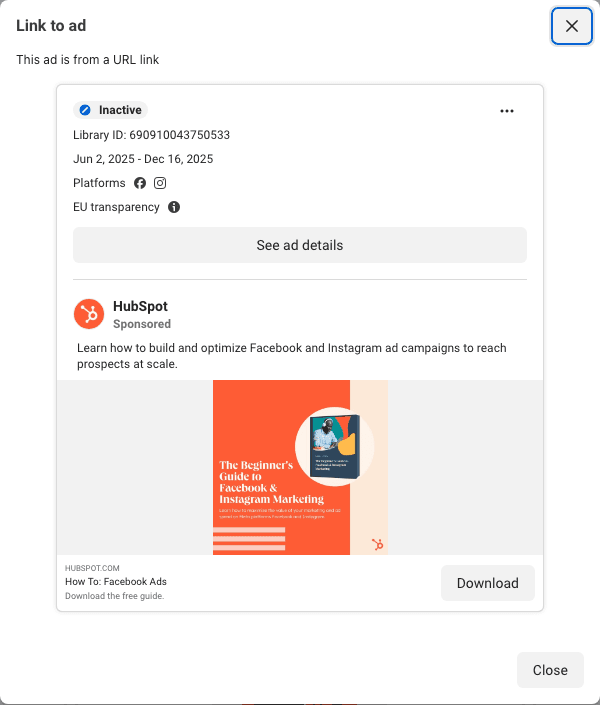
Why it runs: the asset is expensive and the headline is cheap. Three headlines on one ebook is three tests for the price of one production.
8. The code
Brevo, and only Brevo: a creator's discount code on the card, and a page named after the creator behind it.
- "50% off with MICHELLE50" (105 days and 104 days), landing on a German welcome page for Michelle.
- "Get 50% with MIKE50" (103 days and 99 days), landing on a page called welcome-micah.
- "50% off with FELIX50" (94 days), on a welcome page for Felix.
- Three more for MELODY50 in French (40, 38 and 38 days).
Why it runs: the code tells Brevo which creator sent the person, and the welcome page finishes the introduction in the creator's name. It is the only angle in the set where the ad is not in the brand's own voice.
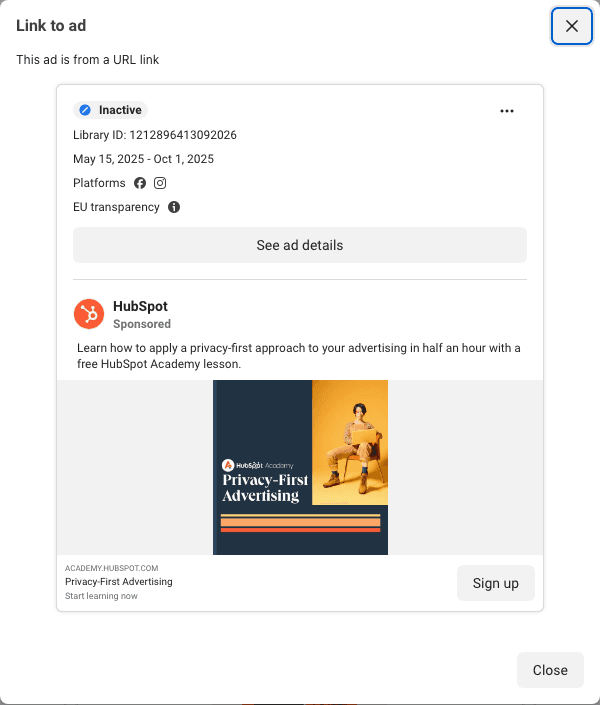
Two more angles sit outside the eight because a single company runs each. The lesson: HubSpot sells a free Academy course, "Learn how to apply a privacy-first approach to your advertising in half an hour" (139 days, plus a Spanish version at 359 days). The guarantee: ActiveCampaign runs nine ads at one page, "Marketing results in 30 days (or a full refund)" (90 days). Nobody else in the set teaches, and nobody else promises money back.
Ad analysis: six angles almost nobody in lead generation uses
Read against all 300 ads in the set, these six appear in a handful of ads or none. The ads that do exist are listed, and linked in the sources, because they are where to start.
- A named competitor. Brevo started it this summer and it is still new: "Brevo vs Mailchimp, which one suits your business?" (23 days, in French) and "They call 250 contacts free. Brevo: 300 contacts and 9,000 emails a month." (19 days in French, 18 days in German). Not one ad from HubSpot, Mailchimp, Lemlist or ActiveCampaign names a rival. No ad in this angle has reached 45 days yet.
- The switch itself. Two ads, both Brevo, both young: "Start the switch. It's free.", "Your subscriber list doesn't have to stay where it is. Import to Brevo in minutes." (20 days and 7 days). In a market where every buyer already uses a competing tool, two ads in 300 promise the migration.
- The price on the card. Not one ad says what the product costs per month. The closest are Brevo's German card, which puts a zero on it ("9,000 emails a month for 0 euros"), and ActiveCampaign's "$4,739 monthly", which is a saving, not a price (29 days). Mailchimp's landing page prints 17.37 euros a month; its 38 ads never do.
- Interactive proof. No calculator, no quiz, no "see your own number" card in the whole set. The closest is ActiveCampaign's 13 hours, which is an average from a survey, so it is everybody's number rather than the reader's.
- The joke. Zero. Not one funny card, not one meme, in 300 ads. In our fintech sweep the single longest-running creative was a joke that had run for 386 days. Here nobody tries.
- A date. Two ads carry a deadline word, and in both it belongs to the reader ("Your deadline approaches"), not to an offer. The only dated campaign in the set is Brevo's Black Friday code, at 28 and 27 days. Everything else is evergreen, which is why so much of it runs for years.
Landing page analysis: what happens after the click
The ad is half the campaign. Where it sends people is the other half:
- On Meta, 1 ad of 257 lands on the homepage. That is one ActiveCampaign ad, 66 days, and it is the exception that proves the rule. Everything else points at a page built for an offer.
- Google is empty for this set. Nothing on file for any of the fifteen companies, so every number in this post is Meta.
- So the pages worth studying are all social. The kind of page sorts these advertisers into four tiers, from the homepage to a page with a market or a person's name in the address. Every page below is linked, so open them.
| Tier | The ad points at | In the sweep |
|---|---|---|
| 0 | The homepage | 1 ad of 257 (ActiveCampaign, 66 days) |
| 1 | A page that already existed | 158 ads: HubSpot's Instagram kit, Mailchimp's pricing page, ActiveCampaign's deliverability page |
| 2 | A page that exists because the ad does | 9 ads: Brevo's US landing page, its competitor page |
| 3 | A market or a name in the path | 89 ads: Brevo in German, Mailchimp in Spanish, Lemlist in French, Brevo's creator pages |
Tier 1: the ad points at a page that already existed

- Four HubSpot ads, the longest at 308 days, land on this toolkit page. It is a content page, not a campaign page, and it was there before the ads were.
- The cheapest tier, and in this market the most common: 158 of the 257 ads.
- It works when the page is already the offer. It fails when the ad promises one feature and the page is about the whole product, which is what happens in the second teardown below.
Tier 2: the ad points at a page built for the ad
- Seven Brevo ads, the longest at 173 days and still live, land on brevo.com/landing/email-marketing-service-us. The word landing is in the address. You cannot reach that page from Brevo's navigation.
- Two more land on a page about a competitor's price increase, which exists because someone else raised prices.
- Nine ads of 257. This tier is almost empty here, and it is the cheapest upgrade available to everyone else in the table.
Tier 3: the ad points at a per-market or per-person page

- Brevo runs paid pages for the US, France and Germany, and a welcome page per creator. Sixteen of its twenty pages carry a market in the path.
- Mailchimp points Spanish ads at a Spanish pricing path while the English path localizes itself: our capture of the English URL from France came back in French, prices in euros.
- Lemlist runs a French ads directory, lemlist.com/fr/ads, with seven ads pointing at one page in it.
How many paid pages each company runs
| Company | Brand-site Meta ads | Distinct pages | Of which per market |
|---|---|---|---|
| Brevo | 60 | 20 | 16 |
| Lemlist | 38 | 18 | 6 |
| HubSpot | 39 | 16 | 1 |
| ActiveCampaign | 60 | 12 | 4 |
| Mailchimp | 60 | 10 | 4 |
- Ad counts do not separate these companies, because the library caps at about 60 per brand per market. Page counts do, from Mailchimp's 10 to Brevo's 20, and the shape of those pages separates them further: 16 of Brevo's 20 are per market, 1 of HubSpot's 16.
- Not one company in this set hides behind a tracking redirect, so every count above is readable from outside. That is rarer than it sounds.
- The counts stop at the brand's own site. Lemlist sends 11 ads to no page at all, because its "Chat With Us" video ads open a message thread instead, and HubSpot sends 21 to YouTube and other hosts.
Try it on yourself. Open your own Ad Library entry, click the ad, look at where it lands. The homepage puts you on tier 0. A market code or a campaign name in the path puts you on tier 3. Most teams are on tier 1 with one page, wondering why the creative tests never move the number.
Teardown 1: HubSpot
Two campaigns taken apart the way we take apart a page in a client audit: the ads, then the page they land on, then the gaps. HubSpot because its ebook campaign is the oldest thing in the sweep and the page behind it explains why. Mailchimp because 38 ads point at one page and the ad and the page do not say the same sentence.
The campaign. One offer, the Instagram for Business Kit, advertised without a break from September 2023 to January 2026. Five ads point at the current page address, the longest for 497 days, and two older ads point at the original address, one for 858 days and one for 786. Every card carries the same body line and a different picture of the same book.
The ads
Read the card from the top. The body is four words, "Our Instagram cheat sheet.", which is the whole offer in the reader's own words rather than the publisher's. The creative is the cover of the thing being given away, with the subtitle doing the dating work ("Now with Stories and Videos"). The link headline is "Free eBook Download", the description lists the four outcomes ("get followers, build your audience, set goals, and measure success"), and the button says Learn more. HubSpot the product is not on this card at all.
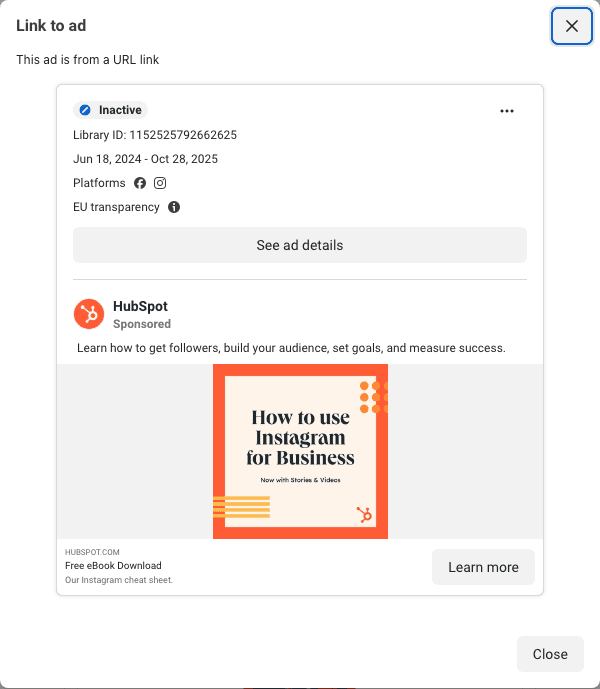
The second card is the same offer with the cover redrawn, running 497 days on the newer page address. This is the series angle inside one campaign: same body, same description, new picture. A third version puts the cover inside a phone (362 days) and changes only the headline, to "Download for free".
The landing page


The hero. A badge that repeats the ad's first two words ("Free Ebook and Templates"), a headline that is the offer's name ("Free Instagram for Business Kit"), a subhead that is the ad's description with one more promise added ("navigate algorithm updates"), and one orange button, "Download for free". The book from the card is redrawn at three times the size on the right. The partner's name, Agorapulse, is legible here and not on the card.

The contents. Six lines, and the order is the argument. The first line is the countable thing, "22 free Instagram post and story templates". The third names a person, "a featured chapter from Instagram expert Jenn Herman". A reader deciding whether an ebook is worth an email address is really asking how much is in it, and this list answers in numbers and names.

The proof. A slider showing the inside of the book, starting with its table of contents and its page numbers, up to page 39. This is the strongest thing on the page: it shows the product before the trade, which is the one thing most gated downloads refuse to do.

The closer. A short block, a photograph and the same button as the hero, then a footer with five legal links and nothing else. No navigation, no product menu, no second offer. The page has one job and does not take a second one.
Message match
| The ad says | The page proves it with |
|---|---|
| Free eBook Download | A Free Ebook and Templates badge, then a Download for free button, twice |
| Our Instagram cheat sheet | A six-line contents list, starting with 22 free templates |
| Get followers, build your audience, set goals, measure success | The same four promises in the hero subhead, in the same order |
| Nothing about HubSpot | Nothing about HubSpot: the page sells the kit, and only the kit |
The gaps
Two, and both are fixable in a week. There is no field anywhere on the page: both buttons are the only way in, so a reader who clicked an ad for an ebook has to click a second time before seeing a single input. Mailchimp's automation page, in the same sweep, puts the email field in the hero. And the page has no proof of its own, not one number of downloads, not one review, not one logo beside Agorapulse's, on an offer that has been advertised since 2023.
Finding gaps like these on a page this strong is the job of the competitive audit; it is the same reading, applied to your own pages.
Teardown 2: Mailchimp
The campaign. 38 ads at one page, mailchimp.com/pricing/marketing, the longest running 75 days, from September to December 2025, across Facebook, Instagram, Messenger and Threads. Every one is a dynamic ad, which means Meta assembles the card per viewer and the copy fields come back as templates. What stays fixed is the offer and the destination, and the offer is readable on the creative.
The ad
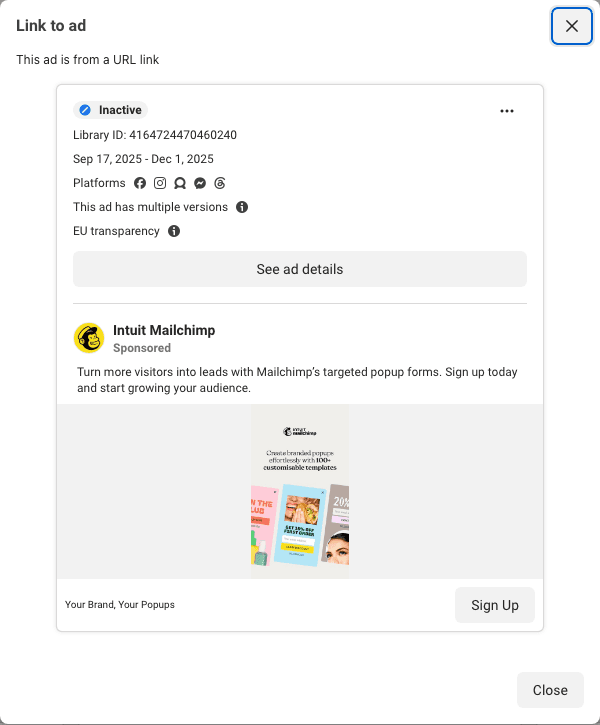
The body promises one feature and one outcome: "Turn more visitors into leads with Mailchimp's targeted popup forms. Sign up today and start growing your audience." The creative shows three popups from real stores with the line "Create branded popups effortlessly with 100+ customisable templates". The link headline is "Your Brand, Your Popups" and the button says Sign Up. It is a good ad: one feature, one number, a picture of the thing itself.
The landing page

The hero. Not a hero, a plan card. The headline offers the Standard plan free, the paragraph carries the page's biggest claim ("a return up to 27 times higher") with a footnote, and six ticks list what the plan includes. On the right, a contacts dropdown set to 0 to 500, "Free for 14 days", the price after that (17.37 euros a month), one yellow button and a black strip reading "No risk, no credit card required". The popups from the ad appear once, as the fifth tick, under a different name.
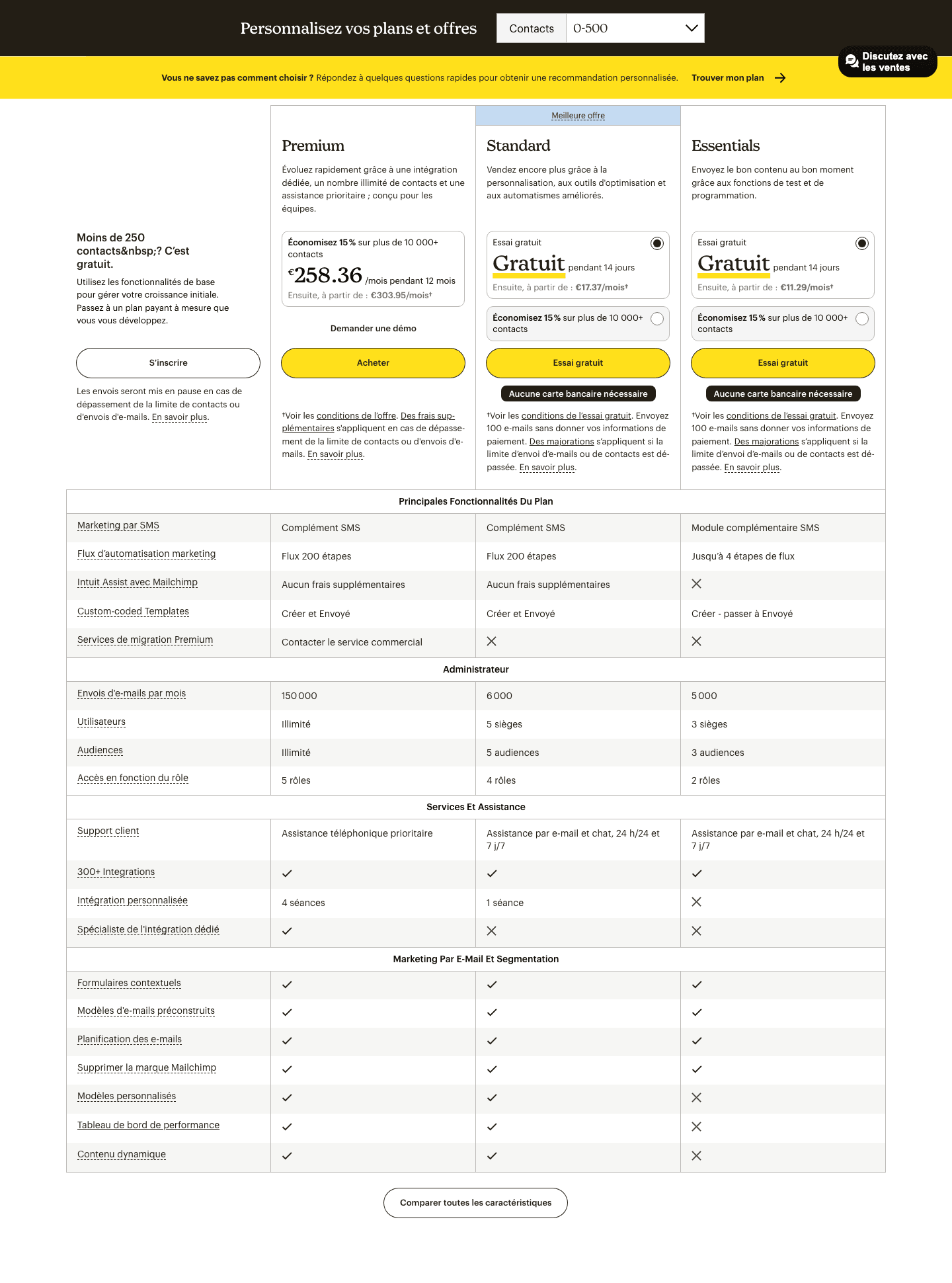
The feature grid. Three plans across, twenty rows down, in four groups. Popup forms are one ticked row in the last group. The page is doing pricing work, and doing it well: the middle plan is marked as the best offer, the cheapest plan shows what it lacks with a cross rather than a blank, and the 12-month price sits beside the price that follows it.
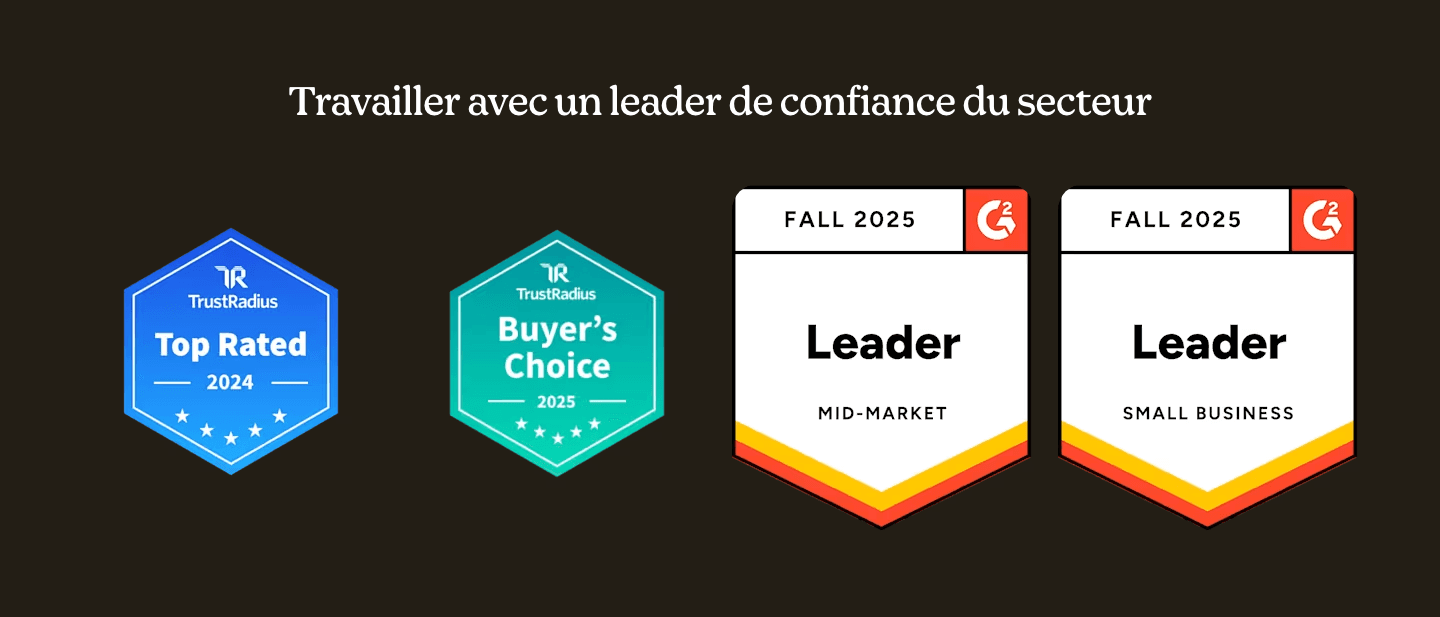
The proof. One dark band, four badges, one line of text: "Work with a trusted industry leader". TrustRadius Top Rated 2024, Buyer's Choice 2025, and two G2 Fall 2025 Leader badges, one for mid-market and one for small business. No customer, no number, no quote.
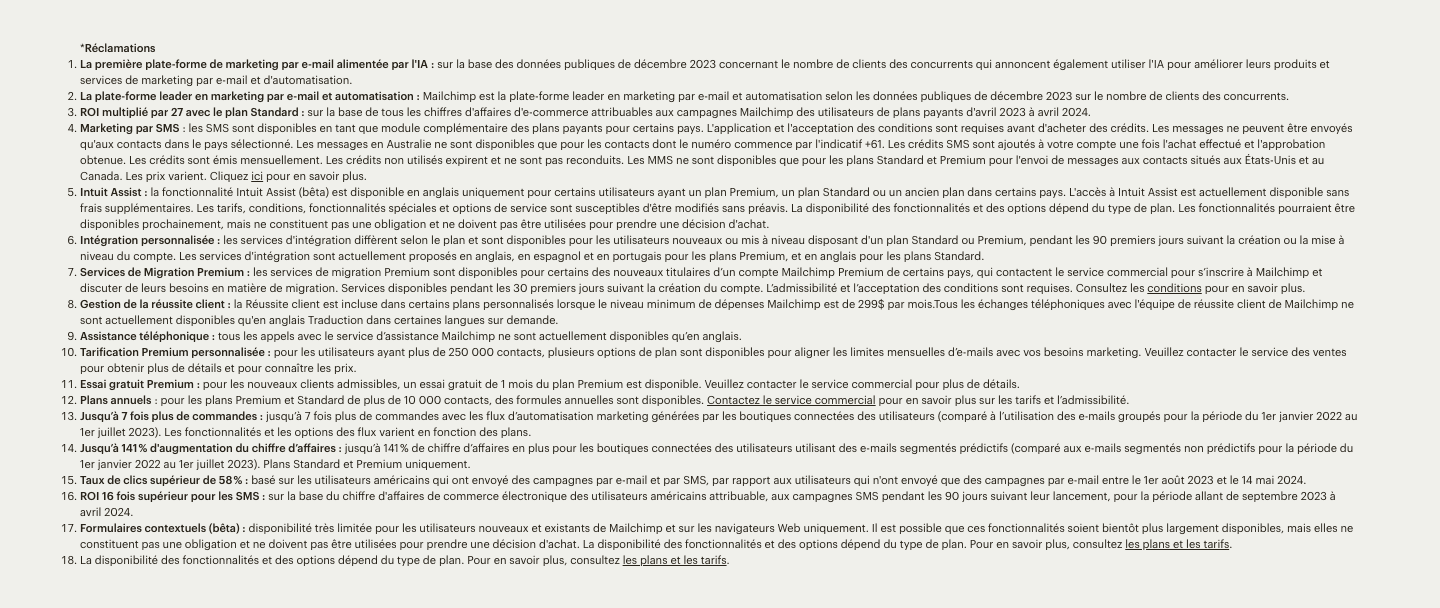
The footnotes. Eighteen numbered claims at the foot of the page, each tied to a number above it: what "up to 27 times the return" was measured on, which months, which plans. It is the most honest block on the page and worth copying. If a number on your page carries a footnote, the number is checkable, and a buyer who checks one usually stops checking.
Message match
| The ad says | The page proves it with |
|---|---|
| Targeted popup forms | One ticked row in a 20-row table, and one tick in the hero list |
| 100+ customisable templates | No count anywhere. The only templates the page names are email ones |
| Sign up today | A plan card with a free 14-day trial and no card required |
| Start growing your audience | A 27x return claim with a footnote, and four award badges |
The gaps
Two, and the first is the expensive one. The ad sells popup forms; the page sells plans, and the visitor has to find the feature they clicked for 14 rows down a comparison table. Mailchimp already knows how to do this, because its automation tools page, which takes only five ads, answers its ads in the hero with a headline about revenue, an email field and four numbers. The second: before the page says what the product does, it asks how many contacts you have, and the price moves when you answer. That is a fine question for a visitor who arrived from a pricing search, and a strange first question for one who arrived from a popup ad.
Key takeaways: five things to do with this
- Give something away before you sell anything. The document angle carries the oldest ads in this market by a distance: 858 days for HubSpot's Instagram ebook, 330 for its advertising report, 110 for ActiveCampaign's survey. Not one of those cards mentions the product.
- Build the page the offer implies, and put the field on it. Of 257 social ads, one lands on a homepage. The best pages here sell one thing, HubSpot's kit page has no navigation at all, and the best of the best put the input in the hero.
- Show the inside of the thing. HubSpot's page runs a slider through the ebook's own pages, table of contents and page numbers included. The offer stops being a promise and becomes a preview.
- Write three headlines per asset, not three assets. One HubSpot ebook carried "Drive High Quality Leads", "Find High-Intent Leads" and "How To: Facebook Ads" at the same time, all near 198 days.
- Take one of the six open angles. A named competitor, the switch, the price, a calculator, a joke, a date. Brevo started two of them this summer with ads under a month old. Everyone else in this market has left them alone.
How to run this analysis on your own competitors
The Meta Ad Library and the Google Ads Transparency Center are public and free. Search the brand's page, not a keyword, set the country, filter to active ads, sort by start date. Then:
- Group the ads by angle. Use the eight above. Most brands run three.
- Keep the ones that have run 45 days or more. Those are earning their budget. Click through and read the page each one lands on.
- Write down the angles they are not running. That list is your next campaign.
Or send us the URL and we do it for you.
How we did the analysis
- Sample: the lead generation companies on the benchmark leaderboard, picked by traffic, not by advertiser status. Fifteen were selected. ZoomInfo, Gong, Unbounce, Outreach, Perspective, Surfe, Popupsmart and Invoca were not swept in this run and are set aside, not counted as absent from Meta. Salesloft and Close were swept and produced no ad we could verify as theirs. That leaves five advertisers: HubSpot, Brevo, Lemlist, Mailchimp and ActiveCampaign.
- Sources: the Meta Ad Library, searched by brand page, through Apify, in the US and France, on September 1, 2026. The Google Ads Transparency Center returned nothing on file for this set, so every number here is Meta.
- Filter: brand-verified ads only. An ad counts when the page name matches the brand and the landing host is the brand's own domain or a link from that page. Of the 420 rows captured, 300 passed that filter and 189 were readable in English.
- Ranking: days active. The floor of interest is 45 days, the point at which an ad has survived at least one budget review. 173 of the 300 cleared it.
- Reading: every distinct message was read by hand and put in one angle. Dynamic ads return a template instead of copy, so those were read from the creative image and the landing path. Ads whose creative we could not open are counted in the totals and never quoted.
- Limits: the library returns about 60 ads per brand per market, so every count per company is a floor and the shares inside the sample are what to read. All five advertisers sit at exactly 60, which means all five are capped. Meta publishes reach only in the EU and never publishes spend.
Every ad above links to its primary source in the sources list, so the whole analysis is independently checkable.
Sources
Primary sources, all public and checkable today. Open any Meta ad with its Library ID at facebook.com/ads/library/?id=ID.
- HubSpot's Instagram kit ads: 283661904436831 (858 days), 208210878976874 (786 days), 1152525792662625 and 1421677228514169 and 2599574267060401 and 426365847026168 (497 days), 859303066090871 (362 days).
- HubSpot's other documents: 1502181780568359 (the content calendar), 650096470635039 (the branding guide), 1973044899828492 (50 Facebook ads), 932622308732486 and 918764023468628 (the data-driven advertising report), 572990701946664 (the first-party data toolkit), 1473044650497136 and 561209663439983 and 690910043750533 (one guide, three headlines).
- HubSpot's Academy lesson: 1212896413092026 (139 days), its dynamic twin 1207231547442028, and the Spanish version 1247203666320233 (359 days).
- Mailchimp's pricing campaign: 4164724470460240 (75 days, the popup ad shown above), plus 1247660447387357, 1803084490355689 and 1192093366320222. The automation ads: 1666062187704490. The case study ads: 796129266168042 and 1210048007685452.
- Brevo: 1709278550496055 (no card, no limits, no catch), 831598139773164 and 3251602371668595 (start for free now), 1031368339341506 (the free carousel), 1261422091988662 (the oldest live dynamic ad), 3390917704416660 (175 days, French). The creator codes: 910565308275545, 3909553332508941, 1473394034453603. The open angles: 806808485655917 (Brevo vs Mailchimp), 3457862921055151 (the free-tier comparison), 1380413410632166 and 1061683876198476 (start the switch), 2365955600888444 (9,000 emails for 0 euros), 831049752708571 (Black Friday).
- ActiveCampaign: 660635426643493 (205 days, deliverability), 663206159432672 (191 days), 815535561079864 (the 13-hours report), 1555819912125801 (the video), 879918038224602 (13 hours and $4,739), 2457724331289046 (5 extra hours), 1379620620180035 (WhatsApp), 25432555736418549 (busywork), 711302028163914 (better outcomes), 34070683972575760 and 4356022028016113 (the money-back guarantee), 2250455508792395 (the one homepage ad).
- Lemlist: 722897777163487 and 820952310459207 (the spam folder), 1425610525139456 (25 phone numbers), 1869315233859412 (100 free leads), 673197435839901 (voice clone), 1927196081500306 (Spendesk), 904000962504083 (Pennylane), 1022751963638224 (the wall of love), 1728286208202950 and 1049519111167013 (the ElevenLabs playbook).
- The landing pages, live: offers.hubspot.com/instagram-for-business-cr012, offers.hubspot.com/first-party-data-resources, mailchimp.com/pricing/marketing, mailchimp.com/solutions/marketing-automation-tools, brevo.com/landing/email-marketing-service-us, activecampaign.com/platform/deliverability, lemlist.com/lemwarm.
- The sample: the lead generation leaderboard of the Web Anatomy benchmark, selected by traffic. The sibling post for the same method in another market: the fintech ads playbook.
- Ad sweep made September 1, 2026 (Meta by brand page, US and France); the landing page and ad card captures made the same week.
Data collected September 2026. Ad statuses and run lengths change; the library links above always show the current state.

Written by
Gabriel Amzallag , Founder, Web Anatomy
5 years CRO + SEO at Qonto (2021–2025). After advising 15+ SaaS on their websites (Payfit, Pigment…), the same patterns kept breaking, so I decided to build the source of truth on what works on the web: the intelligence layer every tool, builder, and team uses to ship sites that perform.
More from the blog
Guides
Landing page personalization: 4 use cases you can build with AI
A practical workflow for landing page personalization: build one template, collect useful visitor data, define content rules, and apply four proven use cases with AI.
 Gabriel Amzallag6 min read
Playbooks
We analyzed the ads the top consumer app companies run. Here is what works.
Which app ads keep running in 2026, the eight angles they use, and the pages behind them. The quiz beats the pitch, and almost nobody lands on a store.
Gabriel Amzallag23 min readPlaybooks
We analyzed the ads the top B2B companies run. Here is what works.
Which B2B ads keep running, the eight angles behind them, and the pages the clicks land on. Two teardowns, HubSpot and Atlassian, with the ads to open.
Gabriel Amzallag24 min read