
TL;DR
- The ads that keep running sell one of eight angles: the quiz, the question, the offer, the one feature, the segment, the customer with a number, the joke, the series. Most brands run three.
- The quiz is the app angle. Noom's whole account asks you to answer something before it sells anything, and the page it lands on is the quiz itself. That campaign is 530 days old.
- App ads do not go to the app store. 2 of 385 ads do. Only 7 land on a homepage. The page is built for the ad, and the address tells you so.
- Five angles are almost empty: a named competitor, the price of the subscription, AI, the store rating, privacy. Not one ad in the set mentions AI.
8 companies swept, every brand ad in the public Meta and Google libraries, US, August and September 2026. How we did it is at the end.
The sample: 8 consumer app companies, their ads, and where the ads land
| Company | Meta ads on file | Ran 45 days or more | Still live | Oldest live ad | Where the ads land |
|---|---|---|---|---|---|
| Lemonade | 60 | 59 | 59 | 386 days | car, pet, UK, 11 blog posts |
| Noom | 60 | 46 | 39 | 530 days | one quiz page, 56 of 60 ads |
| AllTrails | 60 | 41 | 39 | 264 days | plans, meta, plans in French |
| Robinhood | 60 | 18 | 4 | 145 days | EU crypto pages, one per market |
| Joinblink | 60 | 10 | 2 | 12 days | intranet guides, demo, the homepage |
| Chime | 25 | 10 | 20 | 89 days | join pages, the Play Store |
| GoodRx | 60 | 7 | 19 | 119 days | three article pages; 57 ads carry no link |
| Streamable | 0 | 0 | 0 | none | nothing verified |
Lemonade, Noom and AllTrails have found their ads: between them, 146 creatives have passed 45 days and 137 are still running today. Blink is looking, and doing it in public: 60 ads on file, 10 past 45 days, 2 still live, 13 different pages behind them. Neither is wrong. One account is harvesting, the other is searching. Four more companies (Mozilla, Revolut, Surfshark and Typeahead 2.0) were selected and not captured in this run; they are named again at the end.
Ad analysis: the eight angles consumer app ads use
Every message on Meta fits one of eight angles. For each one: the ads that ran longest, one creative to look at, and why it keeps running. The number in brackets is how many days the ad had been running when we looked.
1. The quiz
The app angle. The ad does not describe the product, it asks you to answer something, and the answer is the first step of onboarding.
- Noom: "Take this FREE 5min quiz" (406 days), under the headline "What's stopping you?"
- Noom: "Take our FREE 5-minute quiz and see how long it takes to reach your goal weight" (441 days).
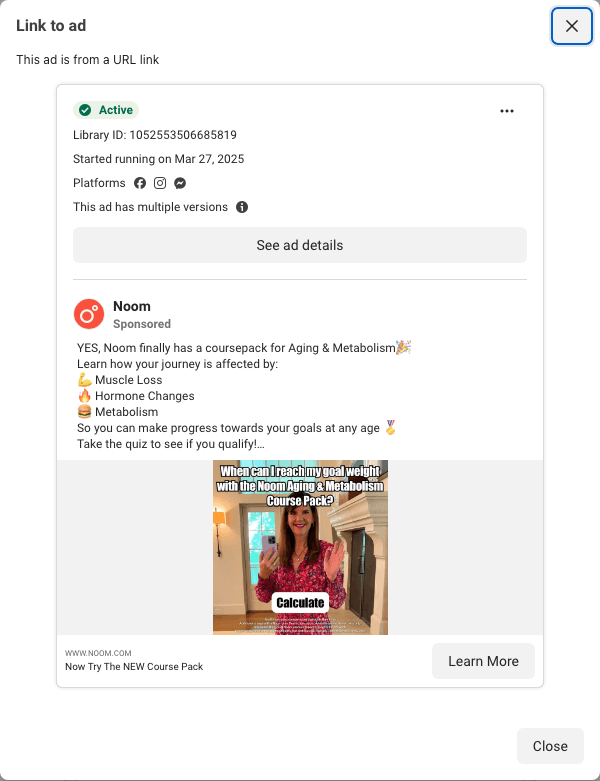
- Noom: the oldest card we could open puts a Calculate button inside the picture (523 days), and the same button turns up on cards at 516 and 209 days.
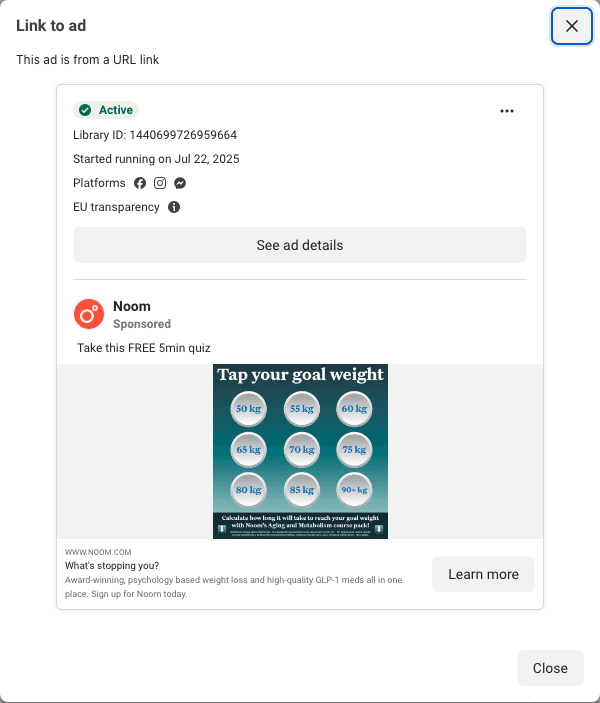
Why it runs: one company runs this angle, which is the reason to write it down first. A quiz card asks for a tap, not a decision, and the tap is worth something to Noom whether or not the person buys. The other six advertisers ask for a purchase on the card.
2. The question
The headline is a question the reader answers in their head before scrolling past. Fifty-one of the ads carry one.
- GoodRx: "What Are Symptoms and Complications of Beta Thalassemia?" (486 days) and "Causes of Anemia: What Are Myelodysplastic Syndromes?" (487 days), the oldest ads GoodRx has on file.
- Noom: "What's stopping you?" on every quiz card (406 days).
- Joinblink: "Is your intranet stuck in the '80s?" (126 days) and "Is your staff WhatsApp a bit of a mess?" (14 days).
- AllTrails: "Heading to the parks?" (90 days).
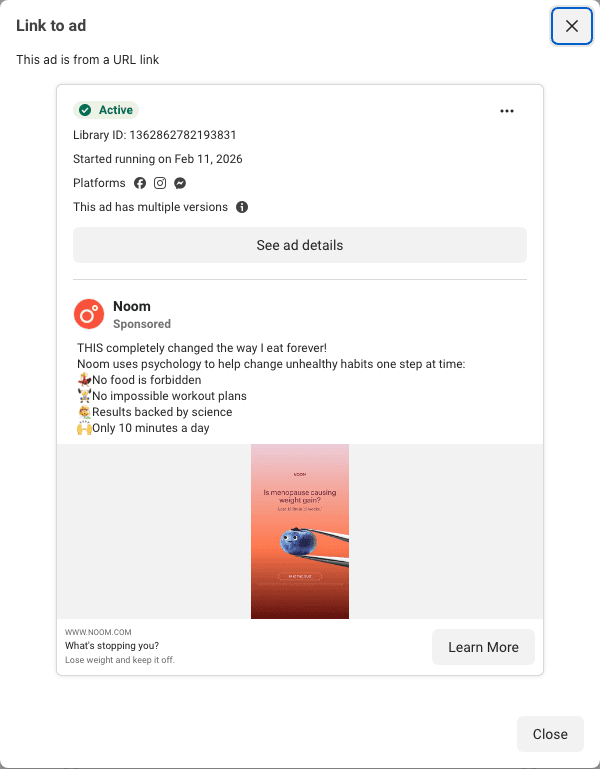
Why it runs: a question costs the reader nothing and sorts the audience by itself. The people who answer yes are the ones worth the click.
3. The offer
A number the reader can take today: a discount, a free month, cash for signing up.
- Chime: "Open a Chime Checking Account in 2 minutes, we'll spot you up to $200" (326 days, the longest-running text card in the set).
- AllTrails: "30% off AllTrails Plus" (97 days and 95 days, two versions of the same card).
- Robinhood: "Get 10 euros in crypto when you sign up for Robinhood today" (28 days) and 50 euros for the same thing in France (145 days).
- Noom: six months of a custom health plan free in a January sale (15 days).
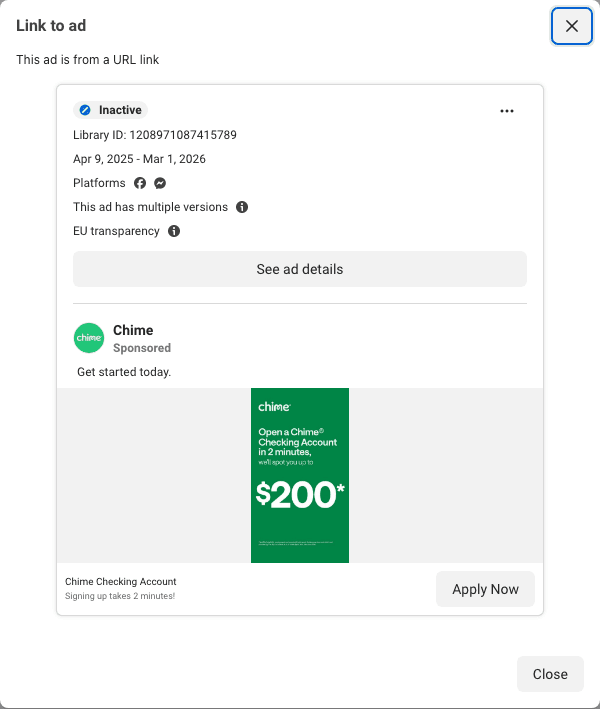
Why it runs: it is the only angle that names a number the reader gets rather than a number the product does. Chime pairs it with a duration, so the card answers cost and effort at once.
4. The one feature
Not the app. One thing the app does, described so plainly you could check it.
- AllTrails: "Adventure confidently with offline maps that work when service doesn't" (90 days). The 109-day version of the same idea lists what downloads: maps, top trails, park fees and permits, seven variants of it.
- Robinhood: "Trade 50+ crypto assets 24 hours a day, 7 days a week" (22 days).
- Joinblink: "Blink Events keeps your whole frontline in the know" (4 days).
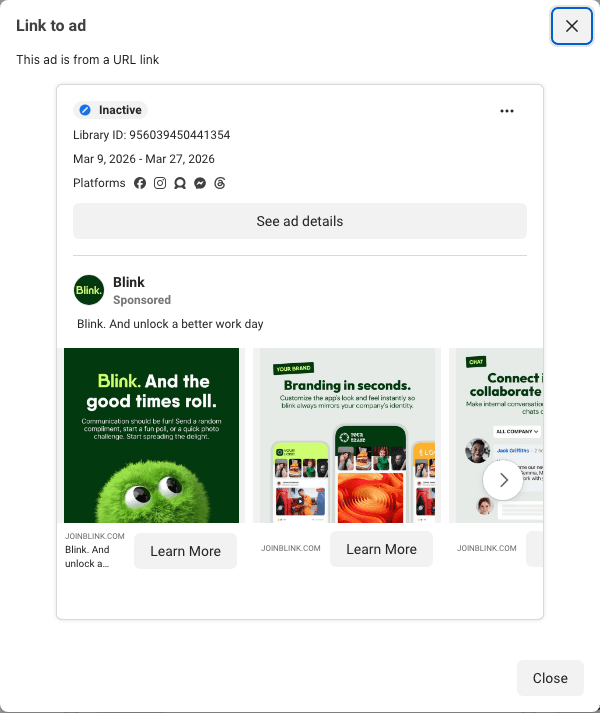
Why it runs: an app is a bundle of features and nobody downloads a bundle. AllTrails has run offline maps for 109 days and never once run "the best hiking app" as a headline.
5. The segment
The ad names who it is for, and the name is narrow enough to sting.
- Noom: "Can I (52) lose my menopausal weight gain in 2026?" written on the picture (209 days), and a card that opens "Menopause weight gain feels unfair" (120 days).
- Lemonade: "We're not mad you're under 25" (324 days) and "If your teen's commute is mostly from their room to the fridge, your car insurance rate should reflect that" (252 days).
- Joinblink: one ad per trade, emoji to match: restaurant teams (13 days), bus drivers (14 days), airline crews (13 days).
- Noom again: "Want to lose weight in 2025 without medication? Read this" (138 days), aimed squarely at the people who do not want a GLP-1.
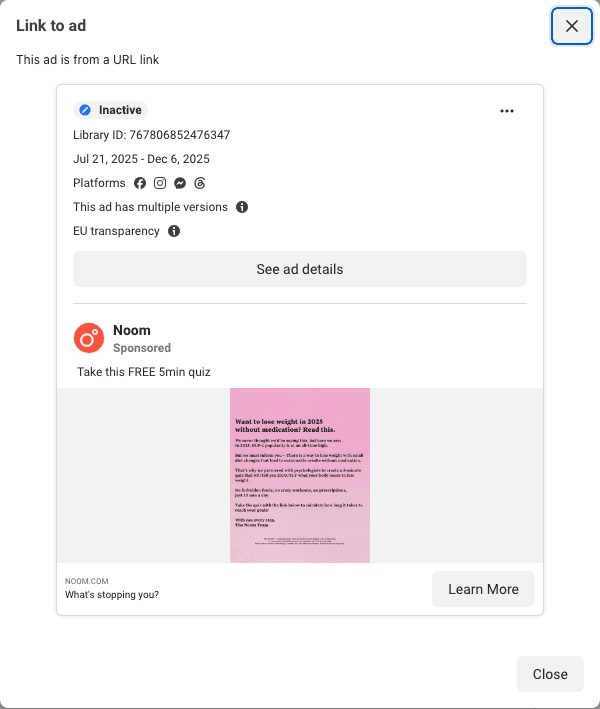
Why it runs: the reader recognises themselves and stops scrolling. It also lets one product carry ten ads without repeating a word.
6. The customer with a number
Proof counts here only when it carries a figure.
- Noom: "15 months on Noom and I'm down nearly 90 pounds. Completely changed my life" printed over a photograph (441 days).
- Joinblink: Domino's, "94% adoption across corporate locations, 81% of employees actively using it every month" (4 days).
- AllTrails: "Over 500,000 trails to choose from" (120 days) and "AllTrails Plus members spend 3x more time outside" (61 days).
- Chime: "1 million+ 5 star app reviews" (24 days).
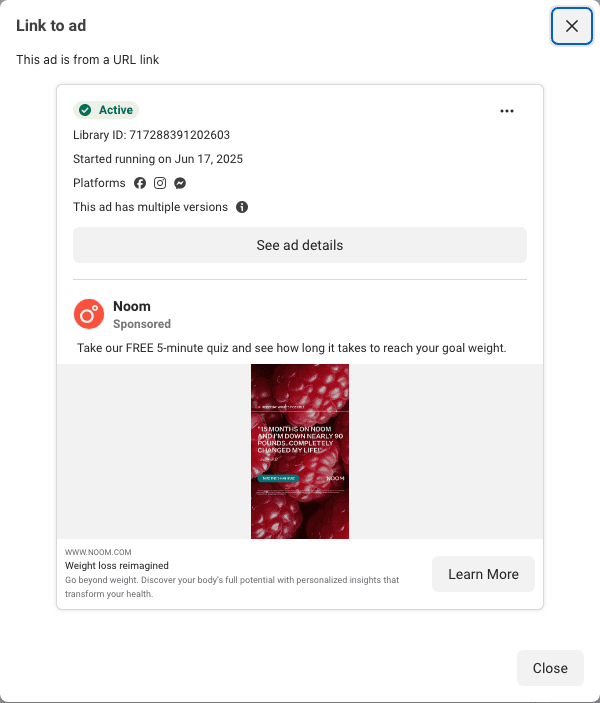
Why it runs: the number does the arguing. Noom goes further: the quote is the creative and the button under it is still the quiz, so the proof and the ask sit in one picture.
7. The joke
Two companies, and the older one has built a whole account on it.
- Lemonade: a four-panel comic about getting car insurance online (386 days, the oldest live creative in the sweep).
- Lemonade: "Why say goodbye to your puppy's manhood AND a bunch of cash in the same day?" (124 days) and "Also covers accidentally swallowing socks, bottle caps, rocks" (119 days).
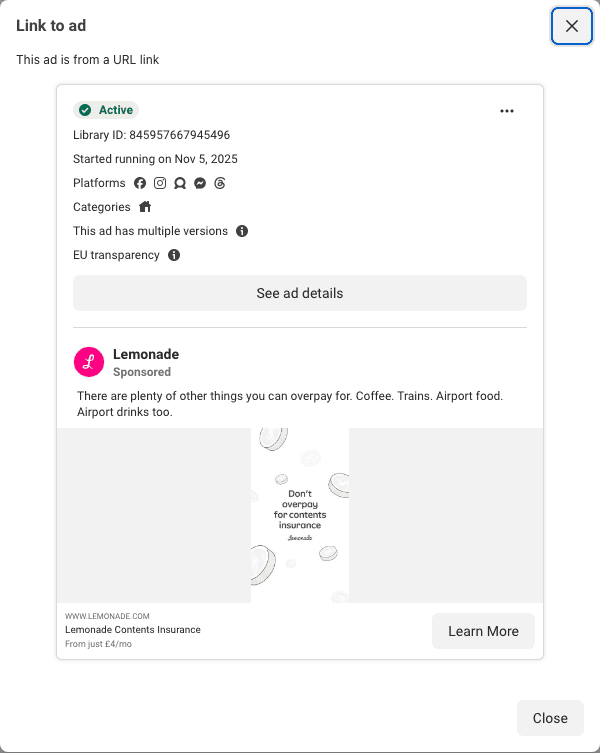
- Lemonade UK: "There are plenty of other things you can overpay for. Coffee. Trains. Airport food." (122 days).
- Joinblink: "Blink's had a glow-up. Come take a look." (102 days), and a green fuzzy monster on the first card of a carousel (18 days).
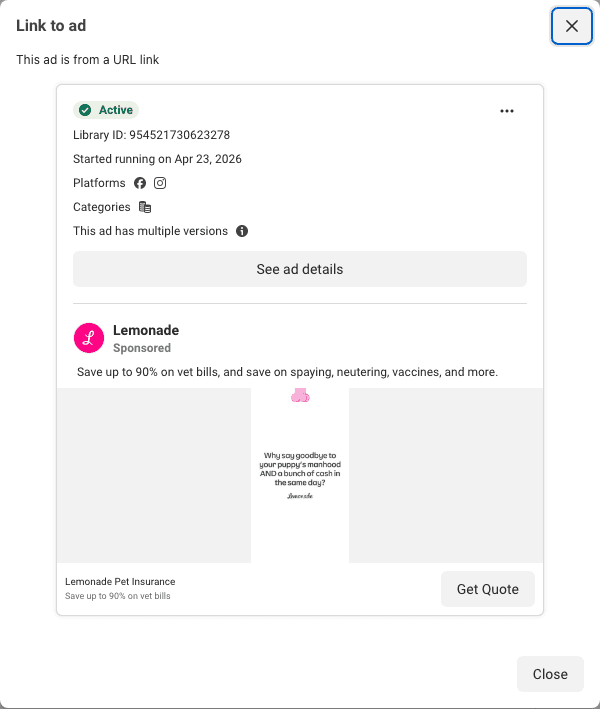
Why it runs: the joke is the brand, not the campaign. Lemonade has 59 of 60 ads past 45 days, the highest rate in the set, and almost every one is funny.
8. The series
One template, many variants, so an account can be big without being noisy.
- Noom: the same Calculate card, new photograph, new question, nineteen ads, 523 days down to 49.
- AllTrails: "Find your trail" seven times (109 days down to 58), "Summer planning starts here" four times (68 days).
- Lemonade: the pet line, 29 ads to one page, one handwriting.
- Robinhood: the same crypto ad in French, Lithuanian, German, Polish and Spanish, one page per market (145 days down to 66).
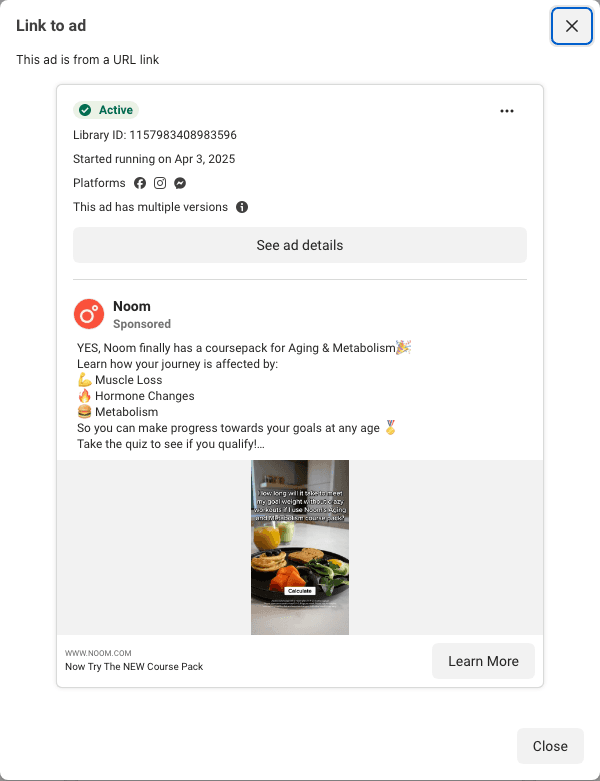
Why it runs: the reader recognises the format on the second ad and reads only the variable on the third.
One angle sits outside the eight because a single company runs it: the letter. Twice, Noom has bought a page of small type on a flat colour, opened it with a line addressed to one kind of reader, and signed it from the team (138 days, and a second at 120 days). It looks nothing like an ad, which is the point.
Ad analysis: five angles almost nobody in consumer apps uses
Read against all 385 brand-verified ads, these five appear in two ads or fewer. The ads that do exist are listed, and linked in the sources, because they are where to start.
- A named competitor. Blink names two: "Why SharePoint & Viva fall short for internal comms" has run 126 days, and "Is your staff WhatsApp a bit of a mess?" names the thing it is replacing (14 days). Nobody else in the set names anything. No app ad here says "switch from" a brand.
- The price of the subscription. AllTrails points 36 ads at its plans page and not one says what Plus costs. Noom's 56 ads never name a price either. The only prices in the set are an insurance premium and a medication: Lemonade's contents card carries "From just £4/mo" under the picture (122 days), and GoodRx quotes $39 a month for a weight loss plan (6 days).
- AI. Not one of the 385 ads mentions it. In a year when every app shipped an assistant, the closest thing here is Noom saying its results are backed by science (120 days). A whole angle sits empty in the category most likely to own it.
- The store rating as the ad. One ad: Chime's "The #1 Most Loved Banking App" over "1 million+ 5 star app reviews" (24 days), one of only two in the set that point at a store listing. AllTrails calls itself the number one hiking app once, inside body copy (42 days). Lemonade's own landing page leads a band with 4.9 stars in the App Store, and no Lemonade ad ever says it.
- Privacy and safety. Nine ads carry a line about security and all nine are Blink's, always as a bullet inside a list ("Secure chat and groups for every depot", 14 days). Not one consumer ad leads with what the app does with your data.
A sixth, for the calendar: in a late-summer sweep only Noom used a date, and it was a New Year sale still on file (15 days). Nobody else tied an ad to a moment.
Landing page analysis: what happens after the click
The ad is half the campaign. Where it sends people is the other half, and the two channels do it differently:
- On Google, 50% of the ads point at the homepage. Lemonade sends 39 of 60 there, GoodRx 34 of 60, Robinhood 24, Chime 22. A search ad answers a query the visitor typed, so the homepage can carry it.
- On Meta, 2% do. 7 of the 310 ads that link to the brand's own site, and all 7 are Blink's. A social ad has to create the intent, and the page then has to finish the ad's sentence.
- Almost nothing goes to a store. 2 ads out of 385. For a category sold on installs, that is the most surprising number in the sweep: these companies want the browser, where they can measure what happens next.
| Tier | The ad points at | In the sweep |
|---|---|---|
| Store | An app store listing | 2 of 385 ads, both Chime's |
| 0 | The homepage | 7 ads, all Blink's |
| 1 | A page that already existed | 152 ads: Lemonade's car page, AllTrails' plans page, Blink's intranet guides |
| 2 | A page that exists because the ad does | 13 ads: Chime's debit campaign page, Blink's demo page |
| 3 | A version number or a market in the path | 138 ads: Noom's quiz, Chime's intro offer v2b, Robinhood's EU crypto page, AllTrails in French |
Tier 1: the ad points at a product page that already existed
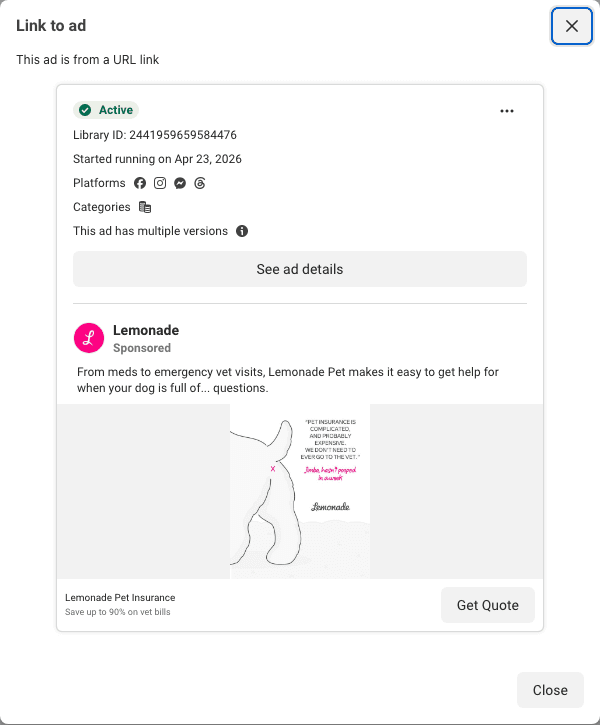
- This card has run 124 days and lands on lemonade.com/pet, the page an organic visitor reaches from the nav.
- 29 Lemonade ads point there and 14 more at the car page. Nothing was built for the campaign.
- The cheapest tier, and where 152 of the ads in this sweep sit. For a two-product line with a strong voice, often enough.
Tier 2: the ad points at a page built for that ad
- Thirteen ads, the rarest kind here. Chime runs a debit campaign page and a Prime versus Plus page you cannot reach from the navigation, and Blink buys its way to a demo form with an ad that ran 121 days.
- No creative survived the sweep for any of the thirteen, so there is no card to show here. The path is the evidence:
/join/campaigns/is a folder a marketing team owns. - Both Chime pages answered our capture with a bot wall, which is its own signal. Pages built for paid traffic are the ones defended hardest.
Tier 3: the ad points at a versioned or per-market page
- Read Noom's address:
/programs/health-weight/exsf01. That suffix is a slot in a testing program, and 56 ads point at it. Chime does the same thing more plainly with/join/promos/intro-offer-v2b, version 2, variant b. - Robinhood runs ten pages for ten European markets,
/eu/fr,/eu/lt,/eu/de,/eu/pl,/eu/es, each with its own ad in its own language. - AllTrails keeps a French plans page with 9 ads behind it, against 36 on the English one.
How many paid pages each company runs
| Company | Brand-site Meta ads | Distinct pages | Of which per market |
|---|---|---|---|
| Joinblink | 41 | 13 | 0 |
| Lemonade | 60 | 10 | 2 |
| Robinhood | 60 | 10 | 10 |
| Chime | 23 | 6 | 0 |
| AllTrails | 60 | 3 | 1 |
| Noom | 56 | 1 | 0 |
- Ad counts barely separate these companies; the library caps at about 60 per brand per market. Page counts do, from Noom's 1 to Blink's 13.
- Both ends are defensible. Noom has one page and pours everything into it; Blink has thirteen and two live ads, which is what searching looks like.
- Robinhood is the per-market case: each of its ten pages is a country, and the ads match one for one.
- GoodRx is left out. 57 of its 60 ads carry no landing link in the library data, so its page count cannot be read from outside.
Try it on yourself. Open your own Ad Library entry, click the ad, look at where it lands. The homepage puts you on tier 0. A store listing means you have handed the measurement to Apple and Google. A version number in the path puts you on tier 3, the only tier where you can tell which page won.
Teardown 1: Noom
Two campaigns taken apart the way we take apart a page in a client audit: the ad, then the page it lands on, then the gaps. Noom because the ad and the page say the same sentence better than anyone else in the set. Lemonade because one creative has run 386 days and the page it lands on is only half the reason.
The campaign. 56 of Noom's 60 ads on file point at one address, noom.com/programs/health-weight/exsf01. The oldest started on 20 March 2025 and the newest on 12 July 2026, so this is not a campaign, it is a standing account: 46 ads past 45 days, 39 still live, one of them at 530 days. Every claim below is checkable in the Ad Library today.
The ads
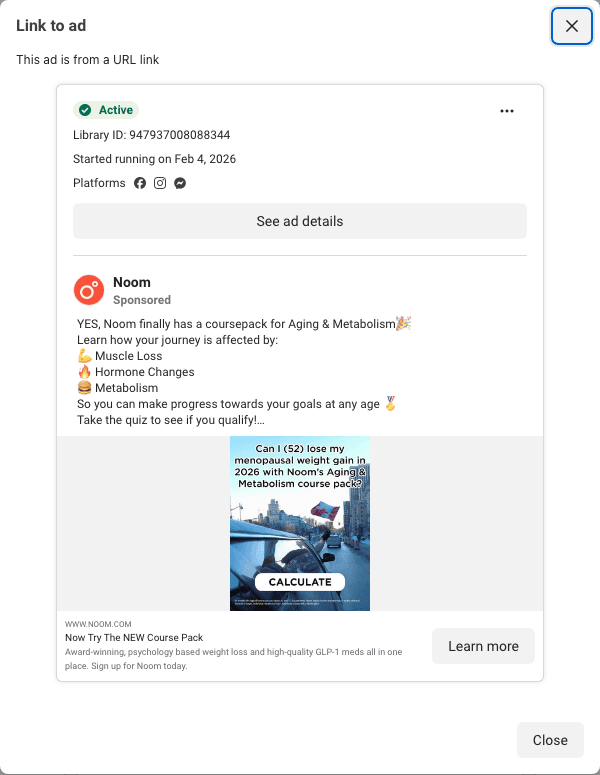
The first creative is the quiz angle at its purest. The picture is a photograph somebody could have taken on their phone. Written across it, in the font people use for captions, is a question in the first person: can I, at 52, lose my menopausal weight gain with Noom's Aging and Metabolism course pack. Under it, a white button that says CALCULATE. The button does nothing inside the picture, which is the trick: you have to tap the ad to press it. This one has run 209 days, and the same construction is on cards at 523 and 516 days.
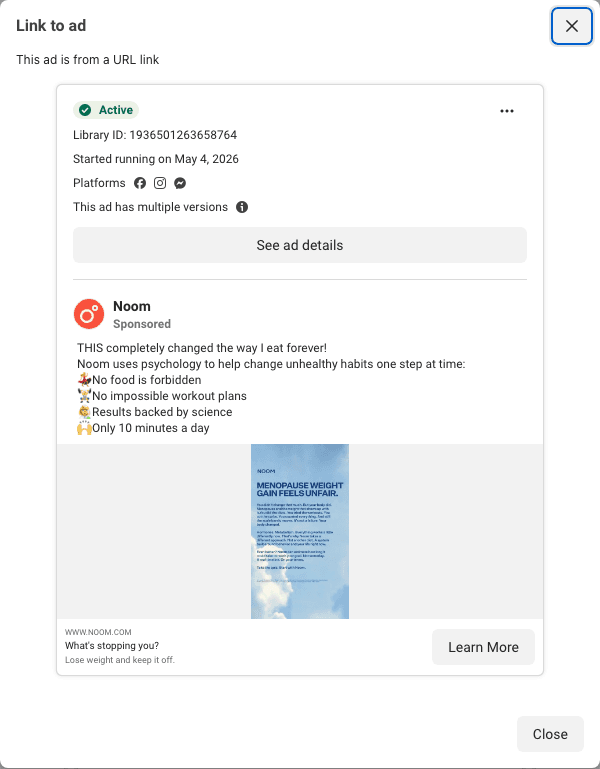
The second creative goes the other way and prints a letter. A flat photograph, a headline in caps that names a feeling rather than a product, then six or seven lines of body type at a size nobody designs an ad at, ending in a sign-off. The primary text above it does the listing the picture refuses to do: no food is forbidden, no impossible workout plans, results backed by science, only 10 minutes a day. Two creatives, one aimed at curiosity and one at recognition.
The landing page
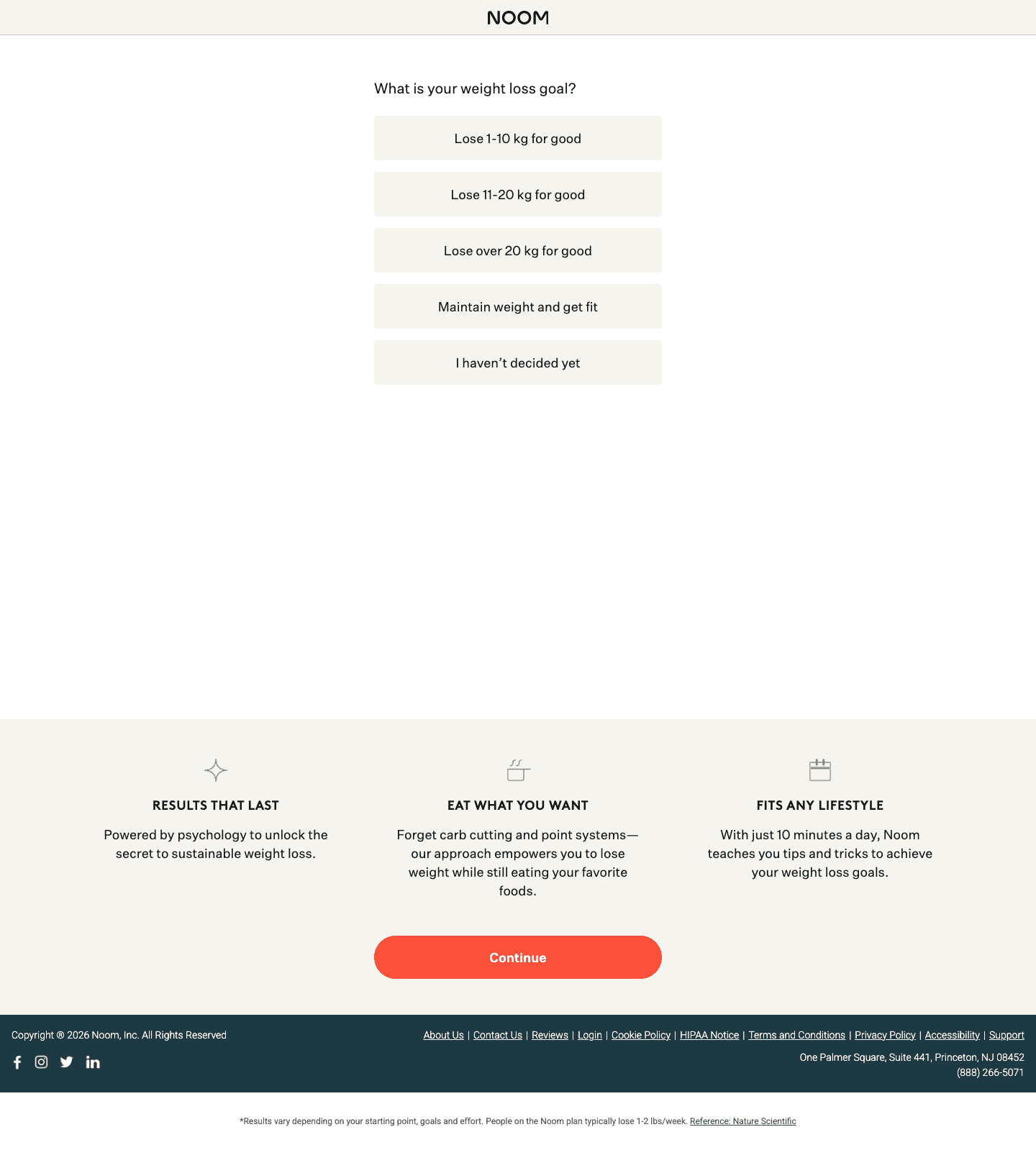
The question. The page is one screen and it is a question: what is your weight loss goal, then five buttons (lose 1 to 10 kg for good, lose 11 to 20 kg, lose over 20 kg, maintain weight and get fit, I haven't decided yet). No hero, no headline about Noom, no image of the app, no navigation. The ad promised a five-minute quiz and the page opens the quiz on the first screen, with no step in between.
The fifth button. "I haven't decided yet" is the one to steal. Every other option asks the visitor to commit to a number they may not have; this one keeps them answering instead of sending them back to the feed.
The three reasons. Under the buttons sit exactly three: results that last (powered by psychology), eat what you want (forget carb cutting and point systems), fits any lifestyle (with just 10 minutes a day). They are the ad's own bullets, compressed. Nothing new is introduced on the page, which is why the page can be this short.
The footnote. Under the footer, in grey: results vary depending on your starting point, goals and effort, people on the Noom plan typically lose 1 to 2 lbs per week, with a citation, and a HIPAA notice in the footer links. For a health product bought from a social ad, that is the trust layer, and the only thing on the page that is not the quiz.
Message match
| The ad says | The page proves it with |
|---|---|
| Take this FREE 5min quiz | Question one, on the first screen, no landing copy first |
| Calculate how long it will take to reach your goal weight | Five goal buttons in kilograms, the same unit as the card |
| No food is forbidden, only 10 minutes a day | The three reasons under the buttons, word for word |
| Award-winning, psychology based weight loss | "Results that last, powered by psychology", the first reason |
The gaps
Two, and both are fixable in a week. The specific promise does not survive the click: the 209-day card sells the Aging and Metabolism course pack by name and offers to calculate a date, and the page asks a general weight loss question and never mentions the course pack or a date. And the page carries no proof at all. The account's best asset is a customer saying they lost nearly 90 pounds in 15 months, and none of it is on the screen where the person decides whether to answer. One line under the buttons would cost nothing.
Finding gaps like these on a page this disciplined is the job of the competitive audit; it is the same reading, applied to your own paid pages.
Teardown 2: Lemonade
The campaign. One dynamic creative unit, live since 4 August 2025, 386 days old at the sweep and still running across Facebook, Instagram, Messenger and Threads. It is the oldest live creative in the set. 14 ads point at lemonade.com/car and 29 more at the pet page, all in one voice.
The ads
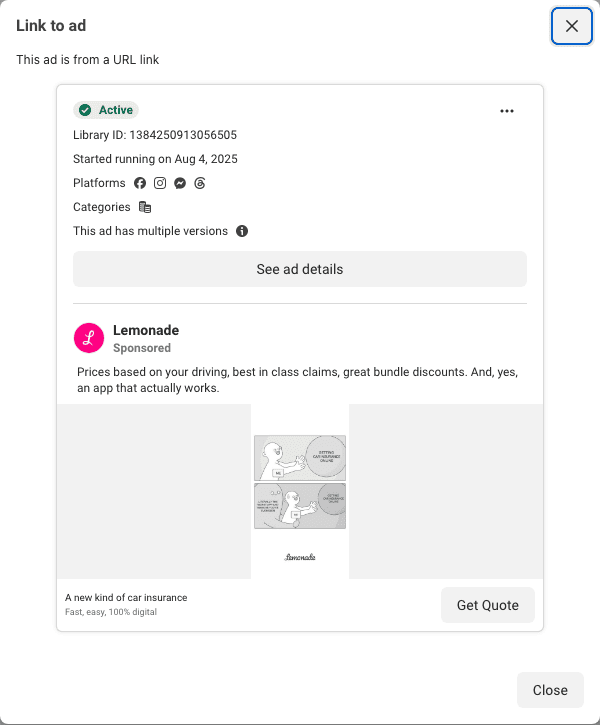
Read the card top to bottom. The primary text is three claims and a wink: prices based on your driving, best in class claims, great bundle discounts, and, yes, an app that actually works. The picture is a hand-drawn four-panel strip, grey line art, no product, no phone, no price, signed with the Lemonade script. The link headline is "A new kind of car insurance" and the line under it is "Fast, easy, 100% digital". The button says Get Quote, not Install, which is the whole strategy in one word: Lemonade is buying a quote, not a download.
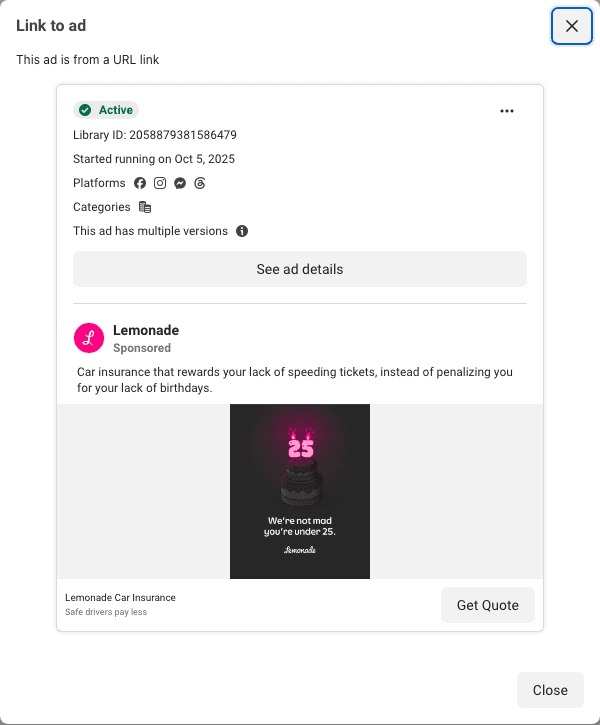
The second creative names a segment instead of a feature. A birthday cake, two glowing candles making 25, one sentence: we're not mad you're under 25. The primary text does the arguing (car insurance that rewards your lack of speeding tickets, instead of penalizing you for your lack of birthdays) and the link line reads "Safe drivers pay less". 324 days. Same page, same button, a different person on the other end.
The landing page

The hero. "Car insurance that costs less for safe drivers", over a line drawing of a car interior. That is the cake ad's link line, expanded. The band directly under it is headed "A new kind of car insurance", the comic ad's link headline, unchanged. Two creatives, two headlines, both waiting on the page. Our capture was made from outside the US and opened with a country picker over the hero, so read the words here, not the layout.
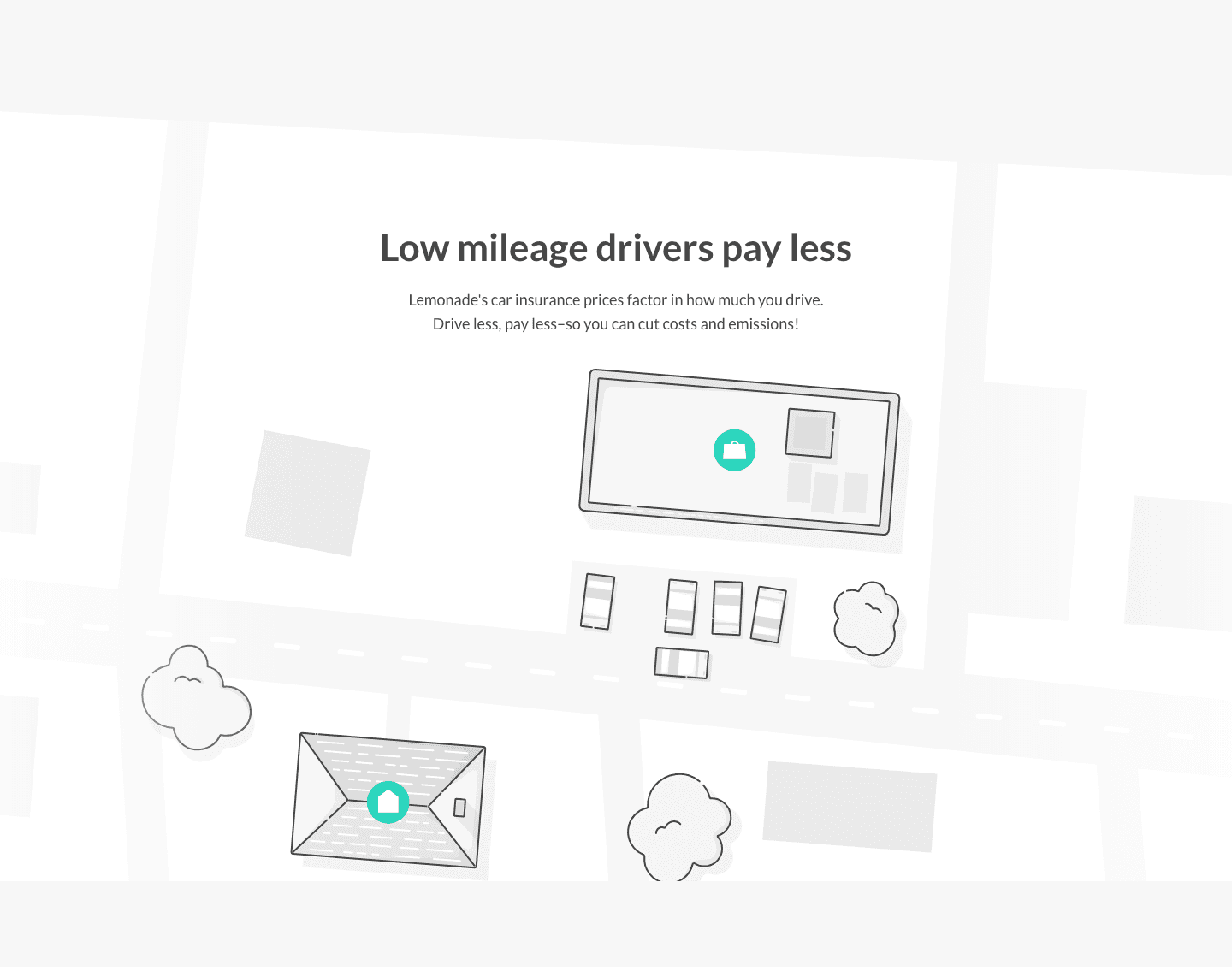
The pricing promise. "Low mileage drivers pay less. Lemonade's car insurance prices factor in how much you drive. Drive less, pay less, so you can cut costs and emissions." Drive less, pay less is also a live ad, running 169 days, in those words.
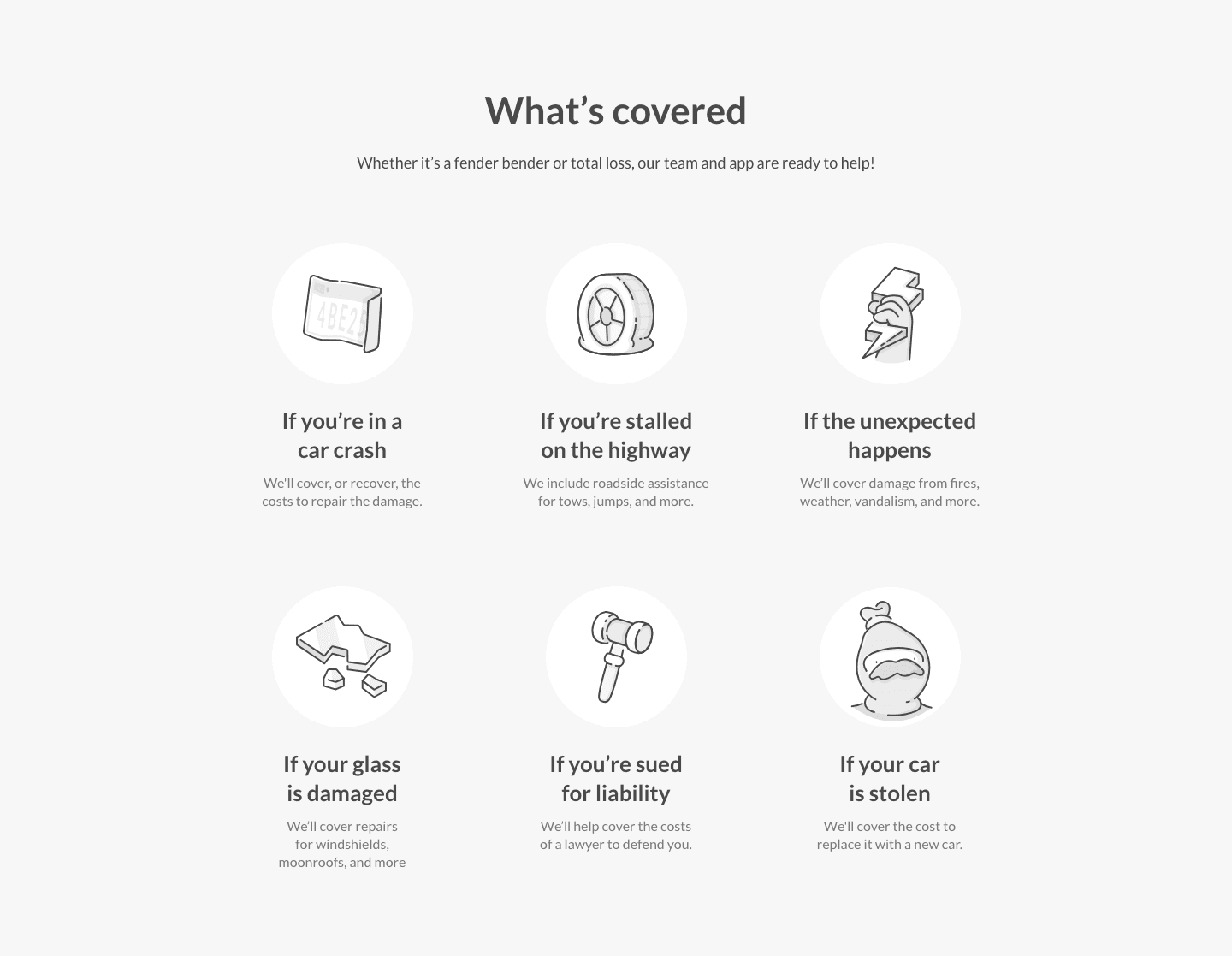
The coverage grid. Six situations, not six features: a crash, a breakdown, broken glass, a liability suit, a theft, the unexpected. One plain sentence under each, so it reads as a list of bad days rather than a policy document.
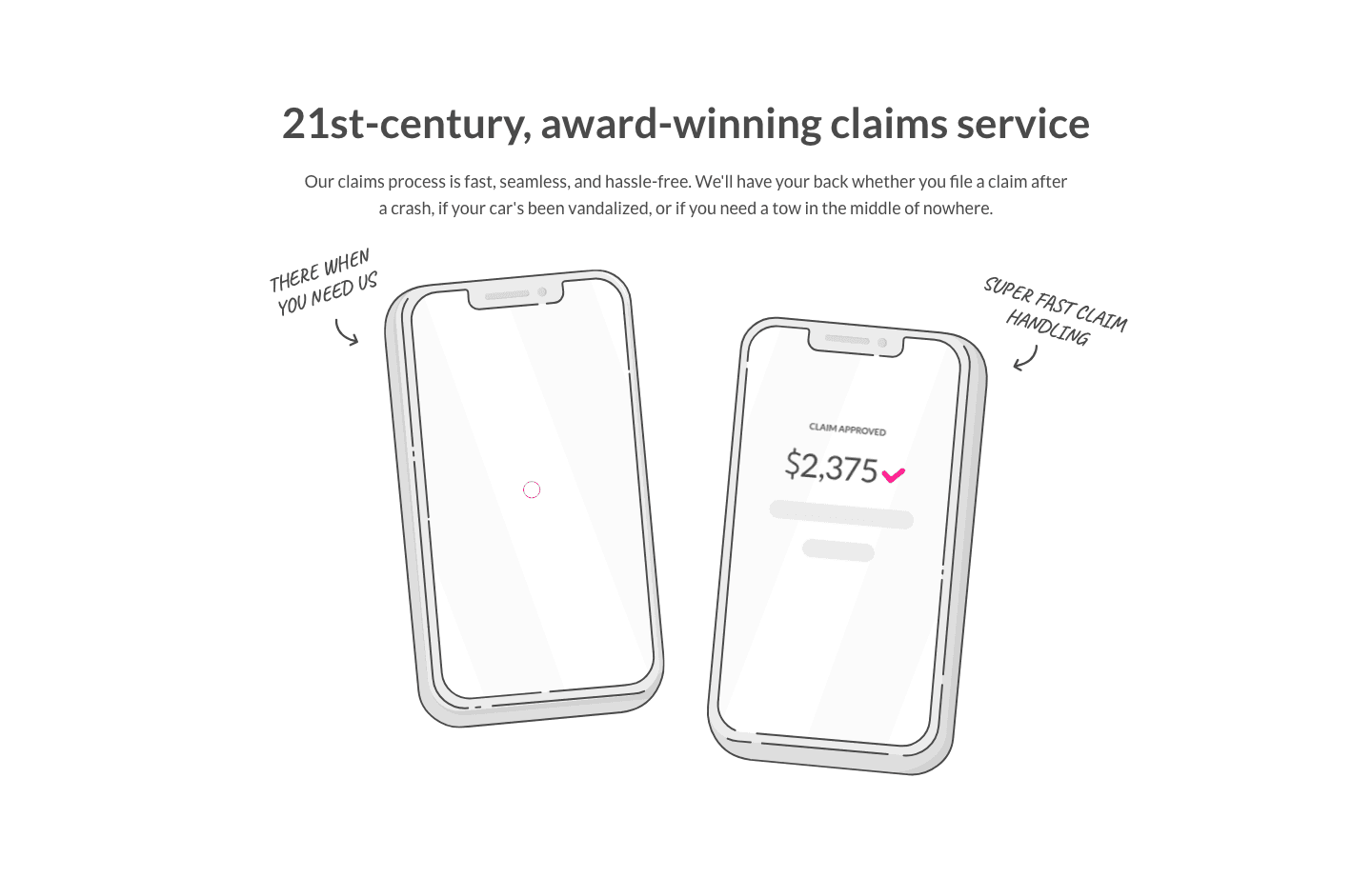
The proof that it is an app. Two phones, hand-lettered arrows reading "there when you need us" and "super fast claim handling", and on the second screen a claim approved for a named amount. This pays off "an app that actually works", the throwaway line at the end of the ad, and it is the only place the product is shown.
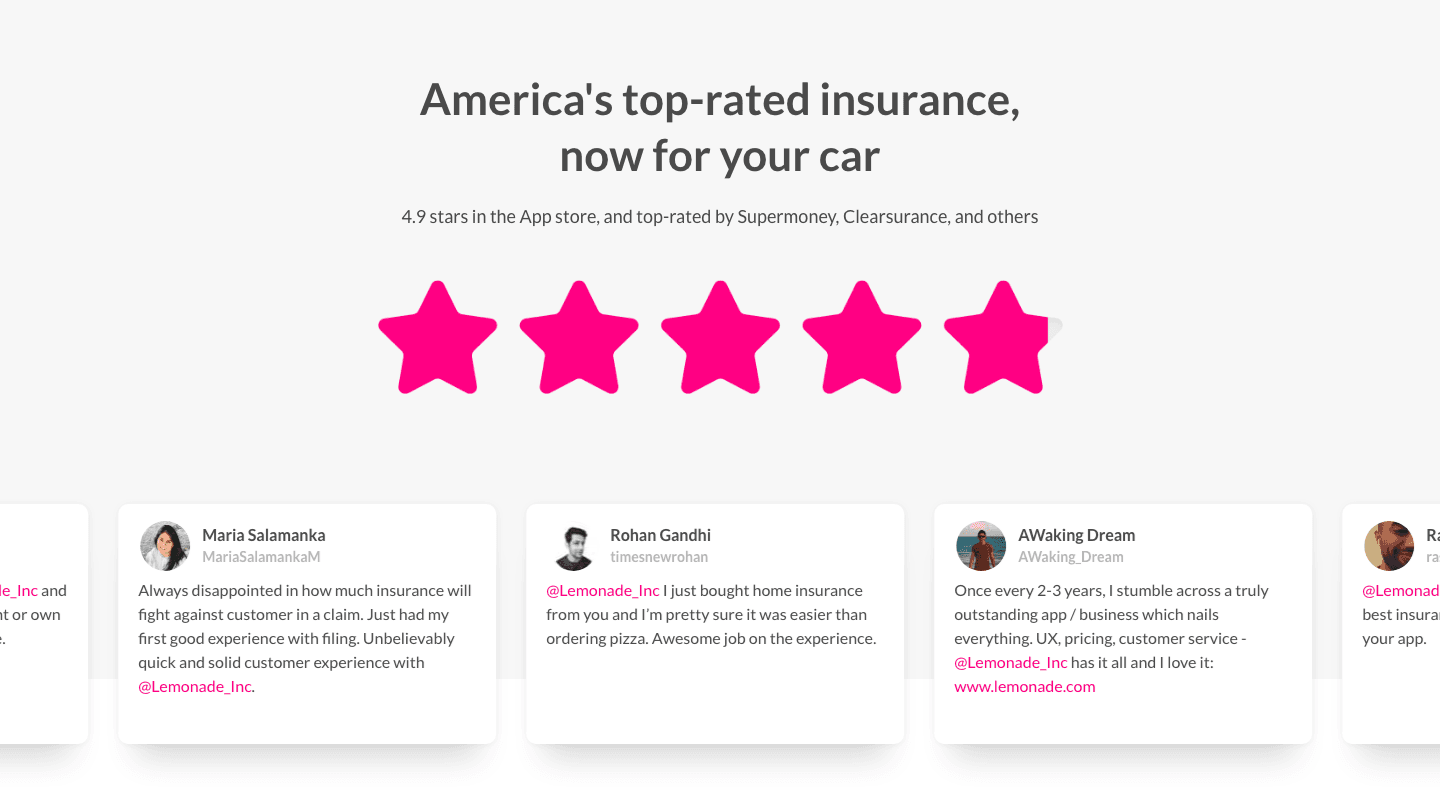
The proof wall. "America's top-rated insurance, now for your car", 4.9 stars in the App Store, then real tweets with faces and handles. One is worth reading twice: a customer says he stumbles across a truly outstanding app once every two or three years, and names UX, pricing and customer service. The page found somebody to say the thing the ads will not say about themselves.
Message match
| The ad says | The page proves it with |
|---|---|
| A new kind of car insurance | The same headline, as the second band of the page |
| Prices based on your driving | The low mileage band, in the ad's own words |
| Best in class claims | Two phone screens and an approved claim, with the amount on it |
| An app that actually works | 4.9 stars in the App Store, then a tweet about the app's UX |
| We're not mad you're under 25 | "Car insurance that costs less for safe drivers", the hero |
The gaps
Two worth flagging. The comic never arrives: the creative that has run 386 days is a hand-drawn strip with a punchline, and the page it opens is grey line art, with the jokes pushed down to a tree-planting band most visitors never reach. The voice that earned the click goes quiet where the decision is made. And the page sells four other products to a visitor one car ad paid for: a car and home bundle button, then cards for renters, pet and term life, each with its own link. Every one is a way out of the quote the campaign is paying for.
Key takeaways: five things to do with this
- Ask before you pitch. The longest-running campaign here, 530 days, is a quiz card that never shows the product. A tap is a cheaper ask than a download, and it is worth something either way.
- Do not send app ads to the app store. 2 of 385 ads do. The other 383 go to a page the advertiser controls and can measure. Buy the quote, the trial or the quiz, not the install.
- Sell one feature, not the app. AllTrails has run offline maps for 109 days across seven versions and never headlined "the best hiking app". Pick the thing somebody would describe to a friend.
- Put the version in the address. Noom's
exsf01and Chime'sintro-offer-v2bare testing programs you can see from outside. If you cannot tell your variants apart from the URL, you are not testing. - Try one of the five open angles. AI, the store rating, the price of the subscription, a named competitor, privacy. Not one ad in 385 mentions AI. In this market that angle is free.
How to run this analysis on your own competitors
The Meta Ad Library and the Google Ads Transparency Center are public and free. Search the brand's page, not a keyword, set the country, filter to active ads, sort by start date. Then:
- Group the ads by angle. Use the eight above. Most brands run three.
- Keep the ones that have run 45 days or more. Those are earning their budget. Click through and read the page each one lands on.
- Write down the angles they are not running. That list is your next campaign.
Or send us the URL and we do it for you.
How we did the analysis
- Sample: the consumer app companies on the benchmark leaderboard, picked by traffic, not by advertiser status. Twelve were selected, eight swept. Mozilla, Revolut, Surfshark and Typeahead 2.0 were not captured in this run and are set aside, not dropped. Streamable was swept and returned no brand-verified ad: every result belonged to a different advertiser using the same word. That leaves seven: AllTrails, Chime, GoodRx, Joinblink, Lemonade, Noom and Robinhood.
- Sources: the Meta Ad Library, searched by brand page, and the Google Ads Transparency Center, both through Apify. Chime and GoodRx were reached by keyword, not by page, so their rows were checked by eye before counting.
- Filter: brand-verified ads only. An ad counts when the page name matches the brand and the landing host is the brand's own domain or an app store. This sweep dropped 335 ads on a mismatched page name and 165 on a mismatched host.
- Ranking: days active. The floor of interest is 45 days, the point at which an ad has survived at least one budget review.
- Reading: every distinct message on Meta was read by hand and put in one angle. Dynamic ads return a template instead of copy, so those were read from the creative image and the landing path, which is how the Calculate button was found. Ads with no readable creative and no real copy are counted in the totals and never quoted.
- Limits: the library returns about 60 ads per brand per market, so the counts per company are a floor and the shares inside the sample are what to read. Robinhood's page is its EU entity, so its ads are European. GoodRx's rows mostly carry no landing link. Lemonade's pages were captured from outside the US and opened with a country picker, so no price from them is quoted here. Chime's and AllTrails' paid pages answered with a bot wall. Meta publishes reach only in the EU and never publishes spend.
Every ad above links to its primary source in the sources list, so the whole analysis is independently checkable.
Sources
Primary sources, all public and checkable today. Open any Meta ad with its Library ID at facebook.com/ads/library/?id=ID.
- Noom's 523-day Calculate card, Library ID 1052553506685819: facebook.com/ads/library/?id=1052553506685819
- Noom's other creatives: the quiz card 1440699726959664, the customer quote 717288391202603, the CALCULATE card 947937008088344, the letter 1936501263658764, plus 1157983408983596, 1362862782193831, 767806852476347, 1319147103166168, 25145762508453549 and the 530-day unit 1174038617682476.
- Lemonade's 386-day comic, Library ID 1384250913056505: facebook.com/ads/library/?id=1384250913056505. Also 611546615011246, 2058879381586479 (the cake), 954521730623278 and 2441959659584476 (pet), 845957667945496 (UK), 849492177816238, 1750920966070066, 1629176888282174, 3375262485980979, 1649464336158608.
- AllTrails: 973941928834576 (offline maps), 1336497118337545 (500,000 trails), 1502255197951532 (30% off), 2062197217721225, 1410748497587532, 986706014179027, 2016445949206000, 1070741285520030, 1492901359153467.
- Chime: 1208971087415789 (the $200 card), 1794369341586077 (the Play Store ad), 947345189012630, 998650779307360.
- Joinblink: 1423362012741547 (SharePoint and Viva), 2215095179288823 (WhatsApp), 870564322318927 (the demo ad), 956039450441354 (the carousel), 1200395255330016, 1318057230127642, 1548701853603219, 1017978707741826, 1691925685228721.
- Robinhood: 1675841069743172 (10 euros), 1427893111835002 (50 euros, France), 855440080511180, 1202766191870877. GoodRx: 374519548377138, 1409132679734536, 1856553309049300, 1475372787371514.
- The landing pages, live: noom.com/programs/health-weight/exsf01, lemonade.com/car, lemonade.com/pet, alltrails.com/plans, joinblink.com/demo, robinhood.com/eu/en/about/crypto
- The sample: the consumer app leaderboard of the Web Anatomy benchmark, selected by traffic. The sibling post is the fintech ads playbook.
- The Google Ads Transparency Center for the search ads: adstransparency.google.com
- Ad sweeps made between 25 August and 1 September 2026, US, Meta by brand page and Google by advertiser; landing pages captured 26 August and 1 September 2026.
Data collected September 2026. Ad statuses and run lengths change; the library links above always show the current state.

Written by
Gabriel Amzallag , Founder, Web Anatomy
5 years CRO + SEO at Qonto (2021–2025). After advising 15+ SaaS on their websites (Payfit, Pigment…), the same patterns kept breaking, so I decided to build the source of truth on what works on the web: the intelligence layer every tool, builder, and team uses to ship sites that perform.
More from the blog
Playbooks
We analyzed the ads the top B2B companies run. Here is what works.
Which B2B ads keep running, the eight angles behind them, and the pages the clicks land on. Two teardowns, HubSpot and Atlassian, with the ads to open.
 Gabriel Amzallag24 min read
Playbooks
We analyzed the ads the top SaaS companies run. Here is what works.
Which SaaS ads keep running in 2026, which angles they use, and the pages behind them. Seven angles that work, five nobody is running.
Gabriel Amzallag25 min readPlaybooks
We analyzed the ads the top healthcare companies run. Here is what works.
Which healthcare ads keep running in 2026, the eight angles behind them, and the pages the clicks land on. Two teardowns, Teladoc Health and Noom, with the ads to look at.
Gabriel Amzallag22 min read