About|
The founder story turns the about section into a reason to trust the company, by naming the person behind the product and explaining why it exists.
Key takeaways
Showing 1–7 of 7 examples


Browse every about pattern by UX best practice.
Every about section is scored across 4 conversion best practices. Copy the best practice stack, not the design. See what converts and why.
Hand-picked from 650+ companies and analyzed by our AI conversion agent. Not a random dump of homepages. Every entry earns its spot.
Found an about section you admire? Run yours through the same scoring engine. See where you stand on the same best practices, and what to fix first.
A founder story is the part of an about section that tells how the company started and why, through a named person instead of a faceless brand. The product pitch answers "what does this do." The founder story answers the question a buyer has right after: "who is behind it, and why should I trust them." When those two answers sit next to each other, the about section stops reading as a corporate blurb and starts reading as a company with a person and a reason behind it.
The best about sections use one of four forms, sometimes more than one together:
By the time a visitor reaches the about section, they usually understand the product. What they are still deciding is whether the people behind it are worth trusting. A section that repeats the feature list adds nothing to that decision. A named founder who explains why the company exists gives the visitor a person to trust, and a person is harder to dismiss than a logo. The story turns an anonymous vendor into someone accountable.
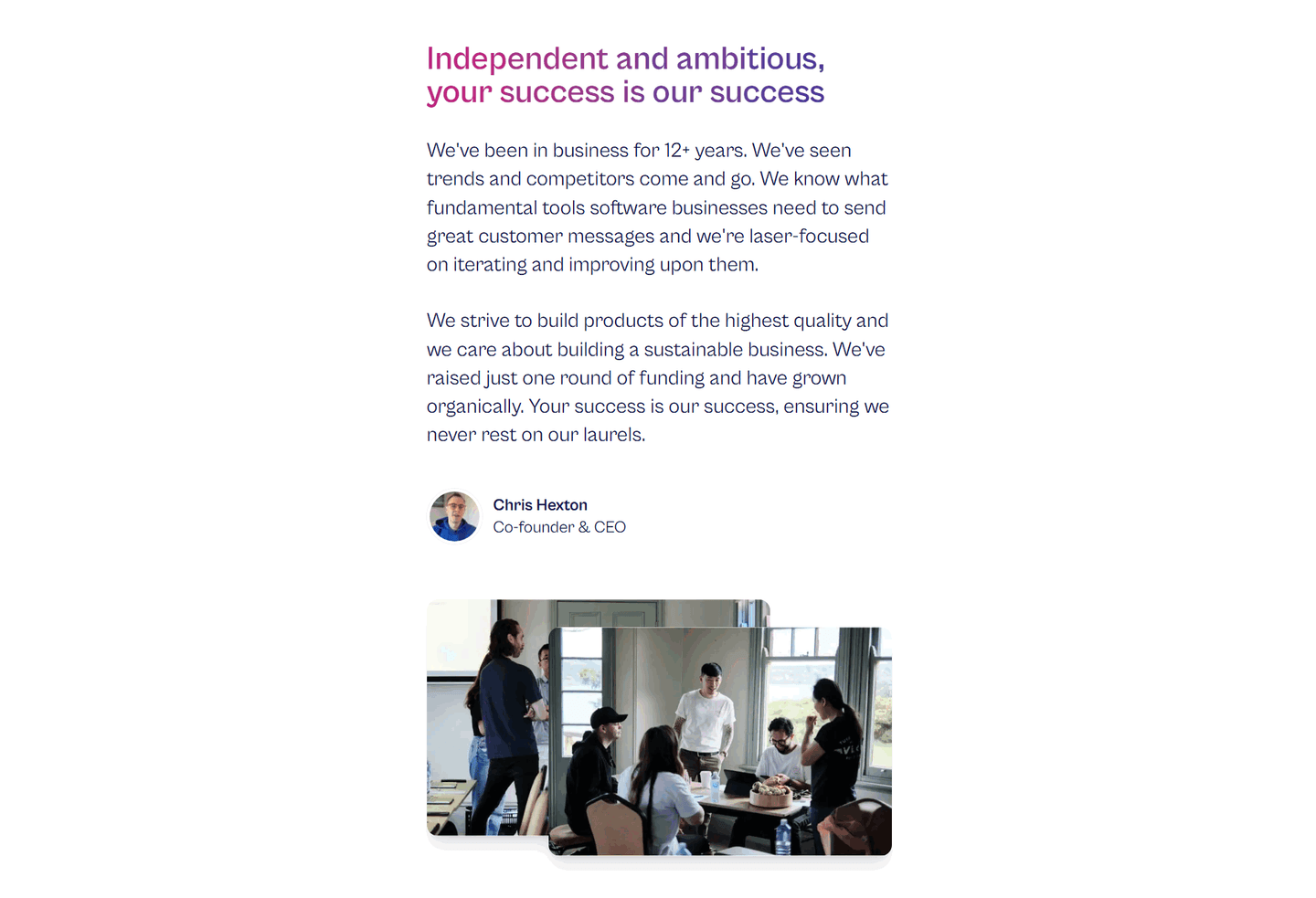
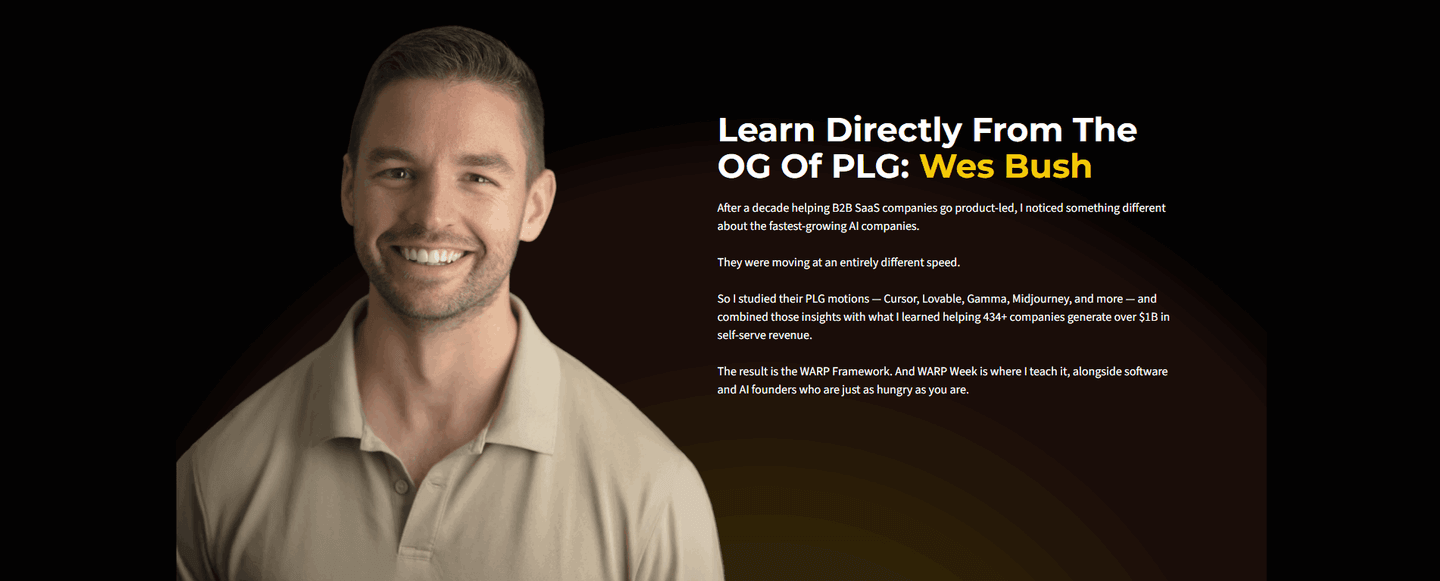
The specificity is what carries the weight. A generic "we started because we cared" reassures no one, because any company could write it. A founder story with proof cannot be faked as easily: ProductLed states that Wes Bush helped 434+ companies generate over 1B in self-serve revenue, Vero notes it raised just one round and grew organically, and Fuzzy AI ends its note on the payoff in bold. A story that could only describe this one company is the one a visitor believes.
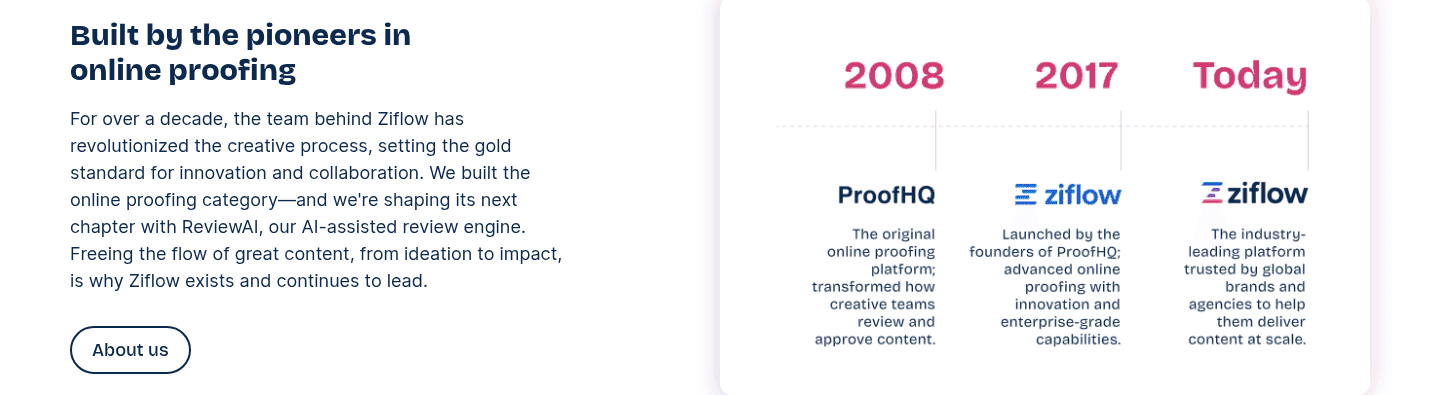
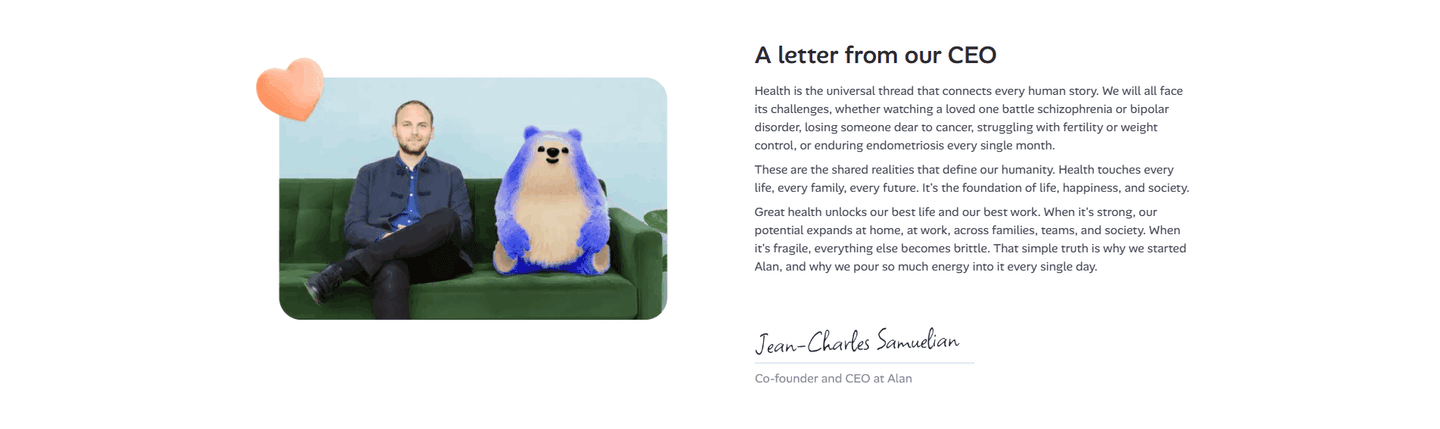
About two in five of the about sections in our library lead with a founder or origin story rather than a pure feature recap. Across the examples below, the pattern that works is a specific person tied to a specific reason. Alan frames a genuine letter from its CEO, signed with a real photo and a handwritten signature, so the mission feels personal and accountable. Vero signs a 12-year origin story with its co-founder and pairs it with an independence claim, raising just one round and growing organically, that says something concrete about how it runs. ProductLed names Wes Bush in the headline as the OG of PLG and backs the story with hard numbers. Ziflow tells a category-creator timeline that positions the team as the people who built online proofing over a decade. The common move is to make the story so specific it could only belong to that company.
A founder story rarely lands on words alone. The strongest pair it with a real founder or team photo so the person has a face, and several, like Ziflow's About us button and Bizzdesign's Read Our Story link, offer a clear path to the full company story for the visitors who want more.
The usual failure is a story with no person in it: a paragraph about the company's "journey" that never names a founder, never explains the reason behind the product, and could describe any vendor in the category. It reassures no one, because there is nobody to trust. The second failure is a story with no proof, a warm origin note that makes a claim the page never backs with a number, a milestone, or a face. Name a real person, tell the specific reason they built the company, and tie it to something concrete a visitor could check.

Curated by
Gabriel Amzallag , Founder, Web Anatomy
5 years CRO + SEO at Qonto (2021–2025). After advising 15+ SaaS on their websites (Payfit, Pigment…), the same patterns kept breaking, so I decided to build the source of truth on what works on the web: the intelligence layer every tool, builder, and team uses to ship sites that perform.
Paste your URL. Get a scored analysis of your about section, including whether the story behind your company comes through. Free, no signup.
The common questions about telling the origin and founder story in the about section, with answers drawn from 7 examples.
It means the about section tells how the company started and why, through a named person rather than a faceless brand. That can be a signed letter from the CEO, an origin timeline showing how the company formed, or a founder note explaining the problem that made them build. Alan runs 'A letter from our CEO' signed by Jean-Charles Samuelian, and Vero signs its story with Chris Hexton, Co-founder and CEO. The point is that a visitor leaves knowing there is an accountable person behind the product, not just a company name.
By the time a visitor reaches the about section, they usually understand the product and are deciding whether to trust the people behind it. A feature recap does nothing for that question. A founder story answers it, because a named person who explains why the company exists is harder to distrust than an anonymous vendor. When Alan signs its mission with a real photo and a handwritten signature, or Fuzzy AI opens its founder note on reps burning 30 hours a week on copy-paste outreach, the company reads as accountable and specific rather than generic.
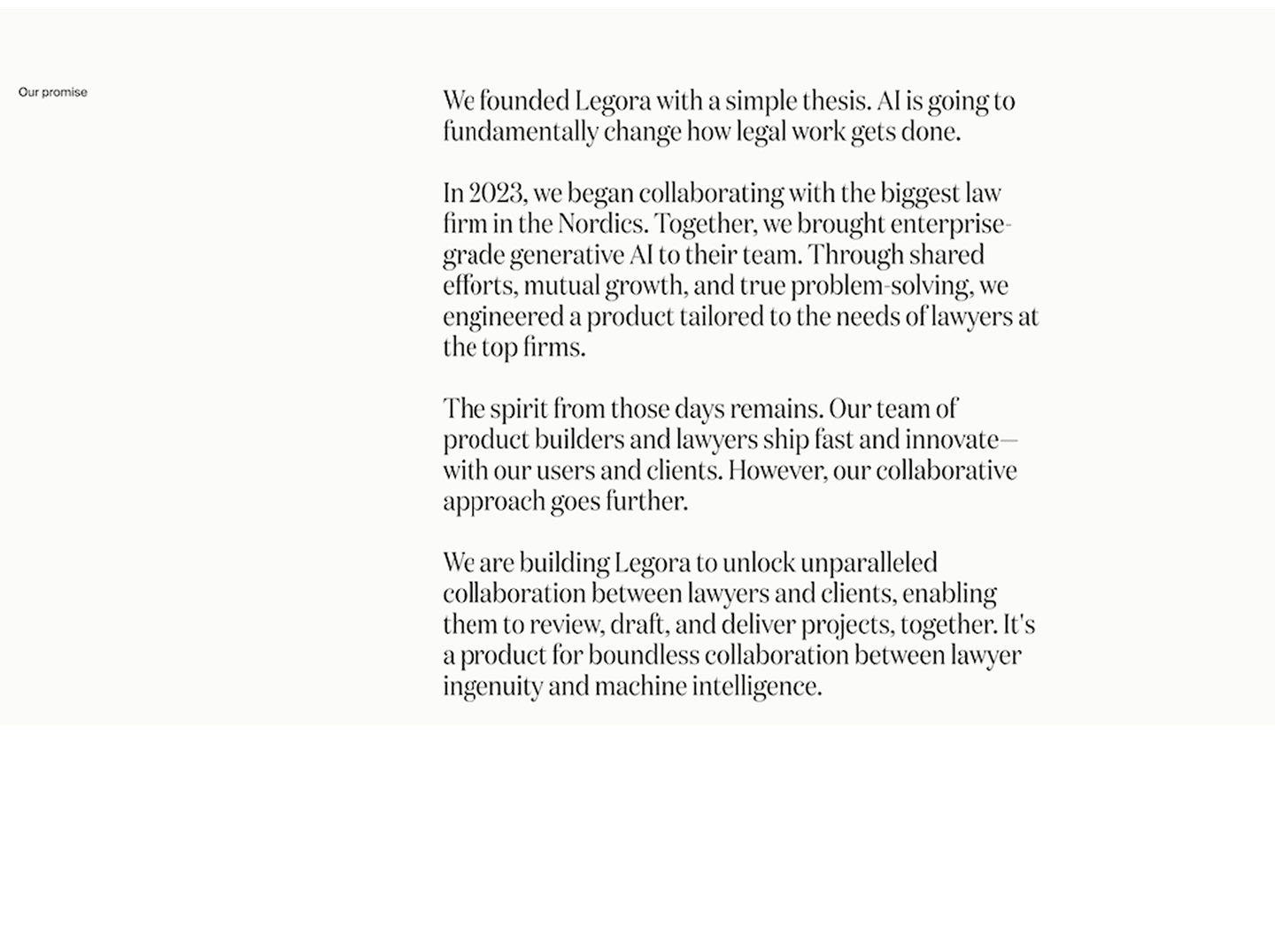
Four show up again and again: a signed founder letter, as with Alan's letter from the CEO and Vero's story signed by Chris Hexton; an origin timeline, as with Ziflow tracing 2008 ProofHQ to 2017 Ziflow to today, and Bizzdesign uniting three market leaders into one platform; a founder note built on a personal insight, as with Wes Bush at ProductLed spotting how the fastest-growing AI companies move differently, and Fuzzy AI's note on wasted outreach hours; and a founding thesis, as with Legora opening on the belief that AI will change how legal work gets done.
Specificity a visitor could check. A vague 'we started because we cared' says nothing, because any company could write it. A strong founder story carries proof: ProductLed states that Wes Bush helped 434+ companies generate over 1B in self-serve revenue, Vero notes it raised just one round and grew organically, and Bizzdesign backs its origin with over 2,000 enterprises relying on it. The difference is that a credible story could only describe this one company.
Usually in the about section, below the value proposition and the product, once a visitor is weighing whether to trust the company rather than just understand what it does. Placed there, the founder story answers the quiet question a buyer has near the end: who is behind this, and why should I believe them. Pairing the story with a real founder photo, a named signature, or a link to read the full story makes it land harder.