Best CMS Website Examples (And Why They Convert)

We scored 9 CMS platform homepages on 60+ conversion criteria. See which sections separate the top performers, and what your page is probably missing.

Updated April 20269 pages analyzed
#CompanyScore

Scored by AI across 60+ conversion criteria

Sanity landing page
#1
59/100
Scroll to explore
Analyze your CMS pageFree. Takes 2 minutes.

What high-performing CMS homepage design gets right

CMS pages have to serve both technical and non-technical buyers, often in the same viewport. The strongest pages in this benchmark do four jobs early:

52.8/100

Avg. page score

What strong CMS pages do before the buyer is ready to click

  • Make the CMS type obvious in the first viewport so the visitor knows whether this is headless, traditional, visual, or publishing-focused.
  • Show the content editing or building experience as a real workflow so the promise feels operational instead of conceptual.
  • Layer trust cues early with integration logos, customer count, or recognizable brands that the buyer's team knows.
  • Give buyers a low-friction next step with a free tier, trial, or interactive product tour.

Top CMS homepage analyzed in detail

Each company below is paired with its strongest section and scored across 60+ conversion criteria. See what they get right, and what you can borrow.

01

StrapiThe leading open-source headless CMS.

Editor's pick59/100
Gabriel AmzallagGabriel AmzallagFounder, LPA

Open-source CMS with developer-first messaging. Strapi pairs strong product visuals with transparent pricing and clear integration documentation that reduces every layer of developer evaluation friction.

What makes this page stand out

  • The self-hosted option provides complete data sovereignty — addressing the growing enterprise concern about content platforms holding their data in third-party clouds
  • Customizable API generation (REST and GraphQL) from a visual content model builder bridges the gap between developer flexibility and content team usability
  • Plugin marketplace and extensible architecture create an ecosystem play: community contributions expand Strapi's capabilities without proportional engineering investment
  • The developer community (60,000+ GitHub stars) serves as both social proof and a distribution channel — developers adopt Strapi, then advocate for it within their organizations

Section we love

·NavbarBest in class
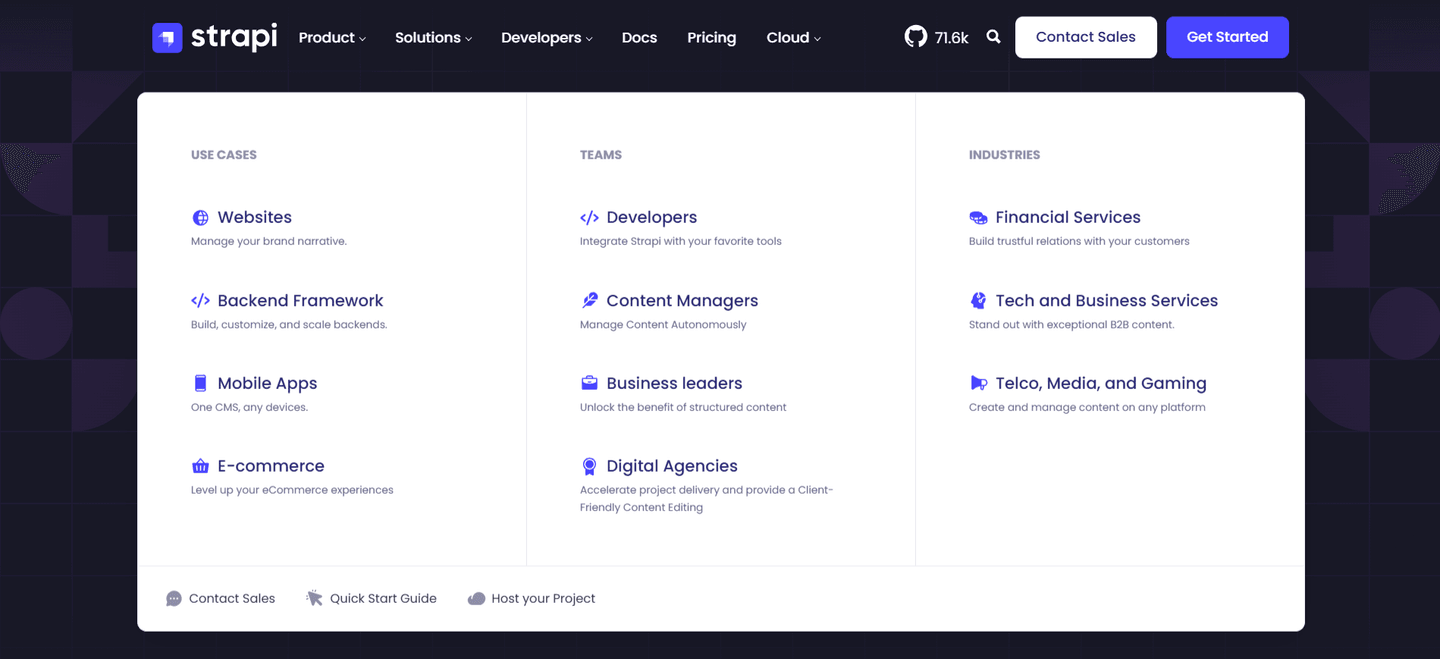
Strapi Navbar section
  1. 1Three-column mega menu (Use Cases, Teams, Industries) provides comprehensive self-selection for all visitor types
  2. 2Each menu item includes an icon and one-line description for quick scanning and context
  3. 3GitHub star count (71.6k) displayed in nav builds social proof for developer-focused audience
  4. 4Footer links in mega menu (Contact Sales, Quick Start Guide, Host your Project) offer immediate next steps

See how your page compares to the 52.8 average page score

Run a diagnostic on your CMS page and get a section-by-section breakdown of what to fix first to improve clarity, trust, and product proof.

Design patterns we see across high-performing CMS pages

Across 9 CMS pages reviewed, the pages that convert tend to make the first screen do one job: name the CMS type and show what the editing or building experience looks like.

The strongest patterns pair clear audience-specific claims with product experience previews, then back those claims with integration logos and customer examples that both developers and content teams recognize. Use website section examples to compare how these building blocks show up across page types.

Value Proposition Strapi

67/100

How Strapi presents their value

Strapi value proposition section
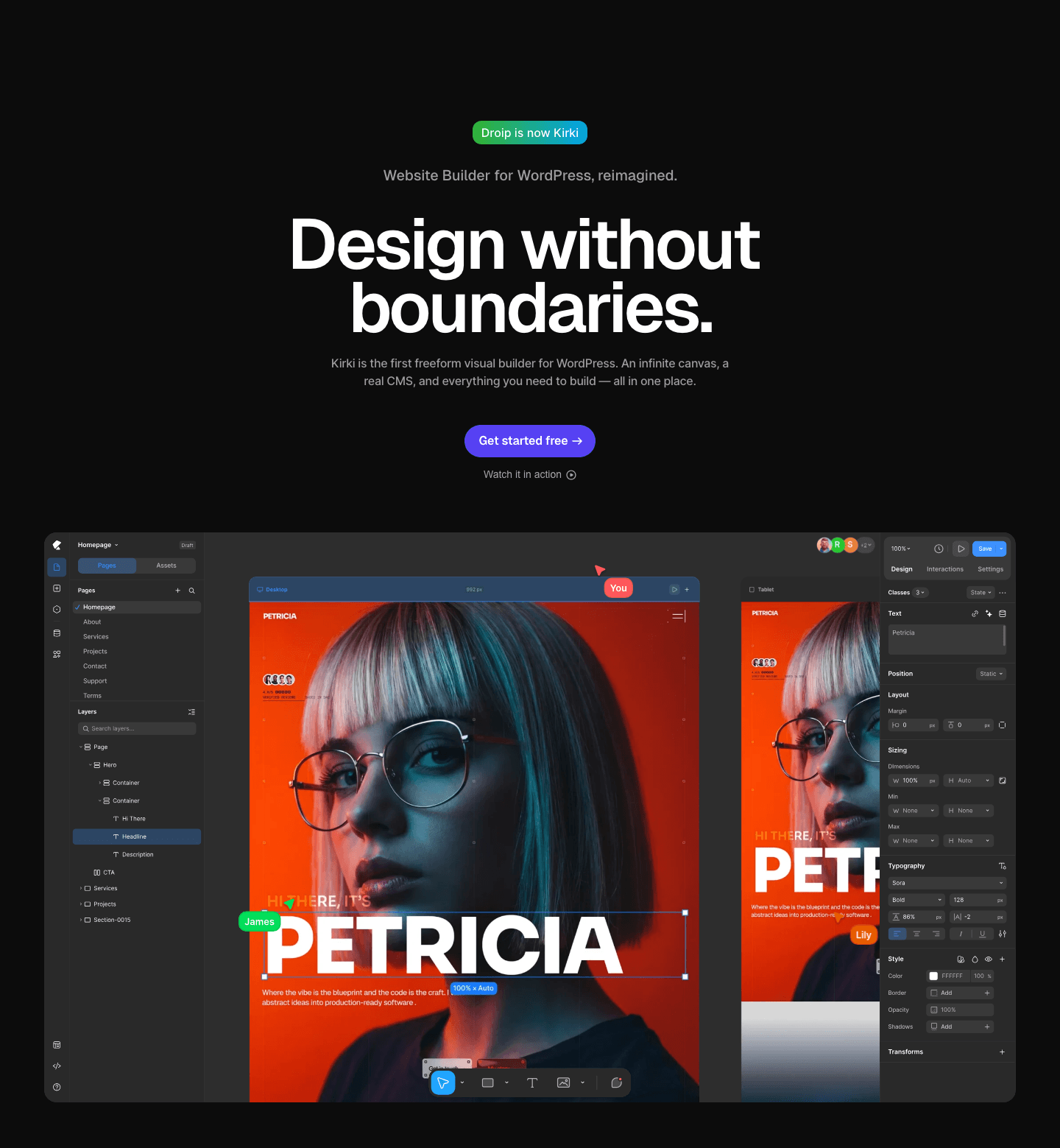
  1. 1Minutes instead of days time comparison in the headline immediately quantifies the developer productivity gain
  2. 2Three strong social proof metrics (70K GitHub stars, 72K active developers, 50M downloads) build massive credibility with the dev audience
  3. 3Product UI screenshot showing collection types and restaurant content entry makes the CMS customizability claim tangible and believable
  4. 4Open source community mention plus the GitHub stars metric together address both the trust and ecosystem concerns of developer buyers

Reviewed design-pattern pick from Strapi’s value proposition section.

What I love about this section

  • Minutes instead of days time comparison in the headline immediately quantifies the developer productivity gain
  • Three strong social proof metrics (70K GitHub stars, 72K active developers, 50M downloads) build massive credibility with the dev audience
  • Product UI screenshot showing collection types and restaurant content entry makes the CMS customizability claim tangible and believable
  • Open source community mention plus the GitHub stars metric together address both the trust and ecosystem concerns of developer buyers

Cta Strapi

57/100

How Strapi drives action without pressure

Strapi cta section
  1. 1Compliance badges (SOC 2, GDPR, MIT) placed prominently near CTAs reduce enterprise buyer risk perception instantly
  2. 2CLI copy-paste command (npx create-strapi-app@latest) lets developers start immediately without navigating away
  3. 3Enterprise logos (Airbus, Adidas, Toyota) serve as strong social proof validating the platform for serious use cases
  4. 4Dual-path CTAs (self-serve deploy vs enterprise exploration) smartly segment developer and buyer personas

Reviewed design-pattern pick from Strapi’s cta section.

What I love about this section

  • Compliance badges (SOC 2, GDPR, MIT) placed prominently near CTAs reduce enterprise buyer risk perception instantly
  • CLI copy-paste command (npx create-strapi-app@latest) lets developers start immediately without navigating away
  • Enterprise logos (Airbus, Adidas, Toyota) serve as strong social proof validating the platform for serious use cases
  • Dual-path CTAs (self-serve deploy vs enterprise exploration) smartly segment developer and buyer personas

Features Strapi

50/100

How Strapi showcases their product

Strapi features section
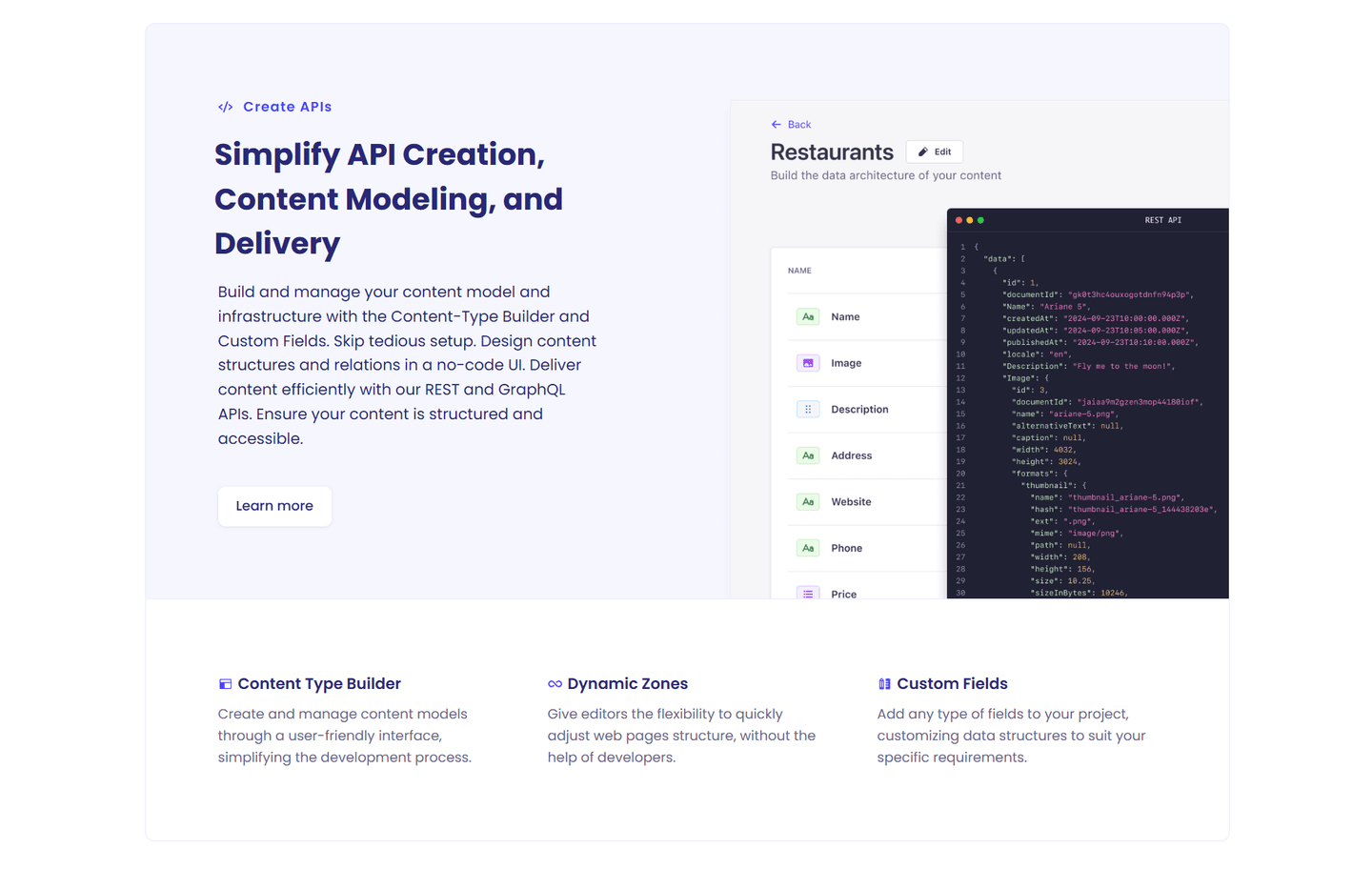
  1. 1Product UI screenshot shows the actual Restaurants content type builder with fields and REST API response
  2. 2Three secondary features (Content Type Builder, Dynamic Zones, Custom Fields) expand the value proposition
  3. 3Learn more link lets prospects explore deeper without leaving the page flow
  4. 4Right-side code snippet shows real API output giving developers a concrete preview of the data structure

Reviewed design-pattern pick from Strapi’s features section.

What I love about this section

  • Product UI screenshot shows the actual Restaurants content type builder with fields and REST API response
  • Three secondary features (Content Type Builder, Dynamic Zones, Custom Fields) expand the value proposition
  • Learn more link lets prospects explore deeper without leaving the page flow
  • Right-side code snippet shows real API output giving developers a concrete preview of the data structure

Overlooked sections that quietly drive clarity and trust

In this set, pricing, integration, and footer sections often do more conversion work than teams expect: they shape evaluation decisions, reduce comparison friction, and keep the buying journey coherent.

The biggest gaps usually appear where the page should explain pricing and integration fit clearly. When those sections are thin, developers and content teams stall because they cannot evaluate total cost and technical fit.

Footer Strapi

80/100

How Strapi closes the page with confidence

Strapi footer section
  1. 1AICPA SOC and GDPR Compliant badges displayed prominently below the brand description
  2. 2Try live demo link provides a low-friction secondary conversion path directly in the footer
  3. 3Six link columns (Product, Solutions, Resources, Integrations, Company) with 40+ deep links
  4. 4Integrations column lists specific CMS frameworks (React, Next.js, Vue.js, Nuxt.js, Astro, Flutter, Svelte)
  5. 5Bottom bar includes License, Terms, and Privacy links for legal transparency

Reviewed overlooked-section pick from Strapi’s footer section.

What I love about this section

  • AICPA SOC and GDPR Compliant badges displayed prominently below the brand description
  • Try live demo link provides a low-friction secondary conversion path directly in the footer
  • Six link columns (Product, Solutions, Resources, Integrations, Company) with 40+ deep links
  • Integrations column lists specific CMS frameworks (React, Next.js, Vue.js, Nuxt.js, Astro, Flutter, Svelte)

Integrations Strapi

50/100

How Strapi signals ecosystem strength

Strapi integrations section
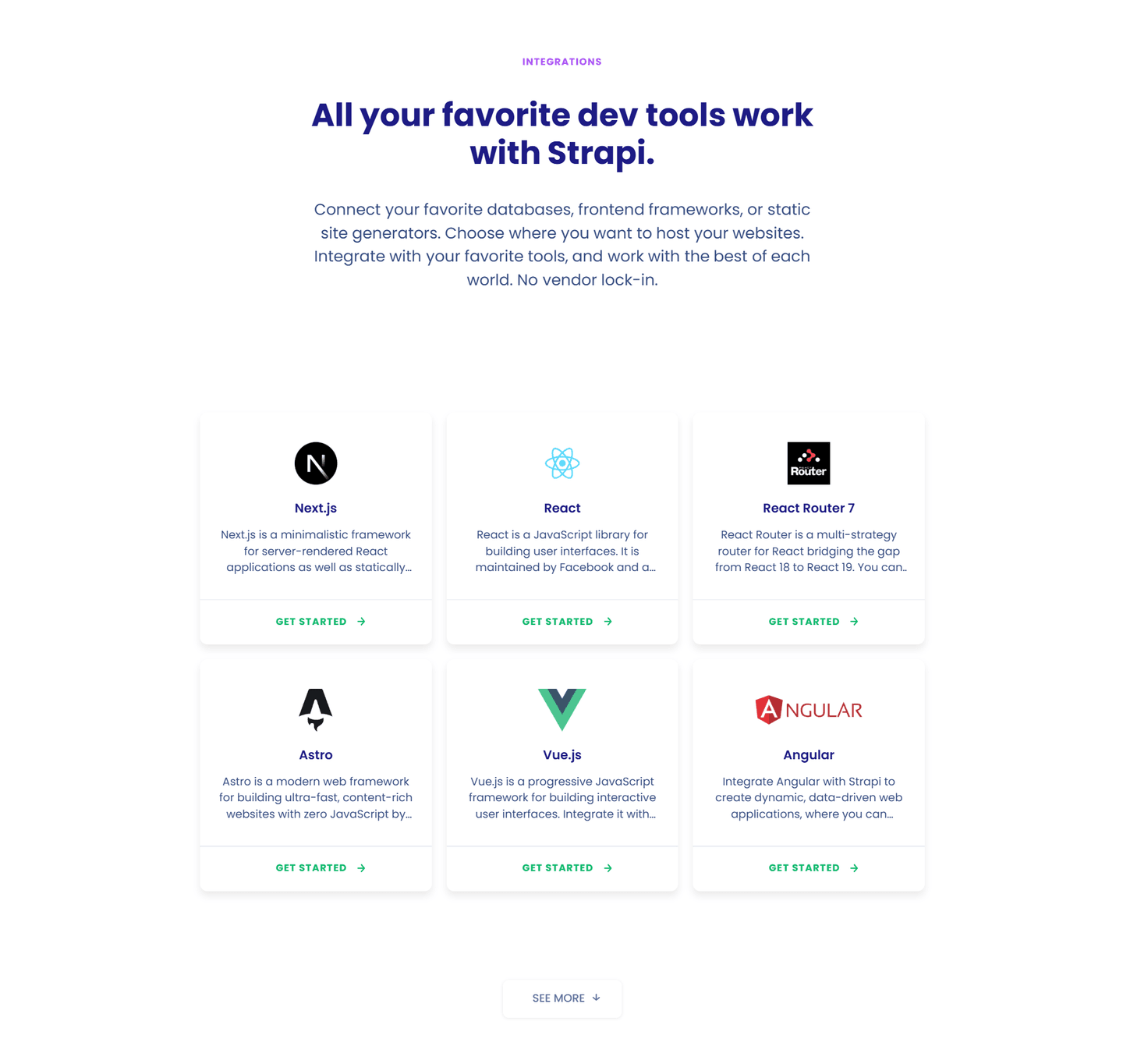
  1. 1Each integration card includes a description and Get Started link providing immediate actionable next steps
  2. 2Features the most popular frontend frameworks like React Next.js Vue.js and Angular
  3. 3See More button at the bottom invites visitors to explore the full integration catalog
  4. 4Descriptive cards go beyond just logos by briefly explaining what each framework does
  5. 5No vendor lock-in messaging reinforces flexibility and reduces buyer hesitation

Reviewed overlooked-section pick from Strapi’s integrations section.

What I love about this section

  • Each integration card includes a description and Get Started link providing immediate actionable next steps
  • Features the most popular frontend frameworks like React Next.js Vue.js and Angular
  • See More button at the bottom invites visitors to explore the full integration catalog
  • Descriptive cards go beyond just logos by briefly explaining what each framework does

Pricing Strapi

43/100

How Strapi creates pricing transparency

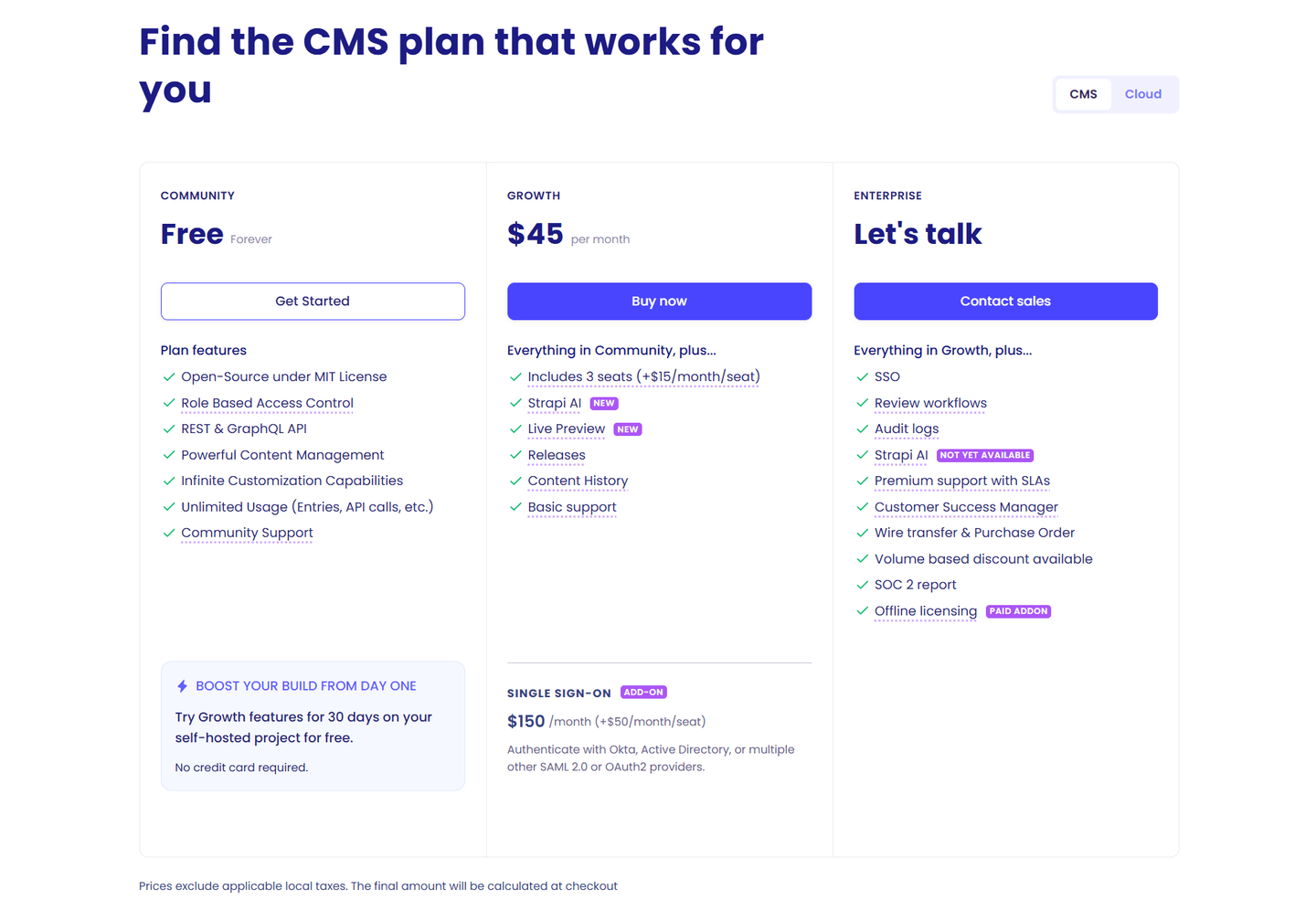
Strapi pricing section
  1. 1Three clear tiers from Free forever to Growth at $45 to Enterprise custom
  2. 2CMS vs Cloud toggle at top lets users pick their deployment model
  3. 3SSO add-on priced separately ($150/month plus $50/seat) shows modular pricing
  4. 4Growth plan highlights new features (Strapi AI Live Preview) with badges
  5. 5Free trial callout for Growth (30 days no credit card) reduces risk

Reviewed overlooked-section pick from Strapi’s pricing section.

What I love about this section

  • Three clear tiers from Free forever to Growth at $45 to Enterprise custom
  • CMS vs Cloud toggle at top lets users pick their deployment model
  • SSO add-on priced separately ($150/month plus $50/seat) shows modular pricing
  • Growth plan highlights new features (Strapi AI Live Preview) with badges

Use the examples below as prompts for what to standardize, not just what to redesign.

Checklist: a practical audit for CMS website design

If you are iterating on a CMS homepage design, this checklist helps you spot missing sections and messaging gaps quickly, especially around Features, Cta, and Faq.

Run it on your current page, then decide what to rewrite, what to reorder, and what proof to add before you touch visual polish. For a faster baseline, you can also try our landing page analysis.

Interactive quiz

What would your CMS homepage score?

Question 1 of 5
0%

Can a developer or content team identify what you do in under 5 seconds?

"Headless CMS for content-driven websites" beats "the future of digital content."

Gabriel Amzallag

Reviewed by

Gabriel Amzallag , Founder, LPA

5 years CRO + SEO at Qonto (2021–2025). After advising 15+ SaaS on their websites (Payfit, Pigment…), the same patterns kept breaking — so I decided to build the source of truth on what works on the web: the intelligence layer every tool, builder, and team uses to ship sites that perform.

See how your page compares to the 52.8 average page score

Run a diagnostic on your CMS page and get a section-by-section breakdown of what to fix first to improve clarity, trust, and product proof.

Analyze your CMS pageFree. Takes 2 minutes.

Explore other industries

See how conversion patterns differ across verticals. Each page scores real homepages on the same framework.

See all industries
Benchmark-backed CMS homepage inspiration

CMS FAQ

Quick answers based on our CMS website benchmark dataset.

What are the best CMS websites?

[01]

The strongest performers in this April 2026 benchmark are Sanity, Strapi, Ghost, and Prismic, with Wix and Squarespace leading on visual-first builder experience. Across 9 CMS homepages scored against 60+ criteria, these pages convert by naming the CMS type in the first viewport (headless, visual, publishing, or marketer-facing) instead of claiming to serve everyone.

What makes CMS websites harder to convert than other SaaS pages?

[02]

CMS pages have to sell to two buyers in the same viewport: the developer evaluating technical architecture and the content team evaluating daily editing. Across 9 homepages reviewed, the pages that convert pick a lane and prove it. Strapi pairs open-source transparency with developer-friendly pricing, Sanity shows both roles the flow they care about, and Ghost commits to publishers instead of hedging.

What is the biggest design mistake on CMS homepages?

[03]

Trying to be everything to everyone with no clear CMS type in the hero. The average page in this April 2026 benchmark scored 52.8. Top performers segment fast: Ghost commits to publishers, Squarespace leads with the visual output, Strapi flags open-source upfront, and Prismic signals marketing-team fit. Buyers should not have to read paragraphs to figure out if a tool is for them.

What sections should a CMS homepage include?

[04]

A hero that names the CMS type and audience, an early trust layer with integration logos or recognizable customer brands, a product experience preview (content editor, page builder, or template gallery), pricing transparency, and a low-friction CTA like a free tier or interactive demo. Strapi and Sanity both stack these blocks well. Across 9 homepages reviewed, pages missing the product preview convert least.

How many CMS examples do I need to review before redesigning?

[05]

Three to five is enough if you pick by CMS type. Only 8% of homepages in this benchmark score in the top tier, so the gap is concentrated in a few blocks. Study Sanity for developer-plus-editor duality, Strapi for open-source positioning, Ghost for focused publishing, Squarespace for visual-first output, and Prismic for marketing-team infrastructure.

Where can I find great inspiration for my CMS website?

[06]

Study pages section by section instead of saving full-page screenshots. Browse best landing page examples for the full gallery, then drill into hero section examples and features section examples to see how Sanity, Strapi, and Ghost differ at each funnel stage.

How do I audit my CMS homepage?

[07]

Use a structured rubric that checks clarity, trust, and friction instead of relying on subjective feedback. Run your page through the landing page analyzer for a section-by-section score against the same 60+ criteria used in this benchmark.